U.S. Senators Release Draft Clarity Act With Crypto Ethics Provisions for Senior Officials
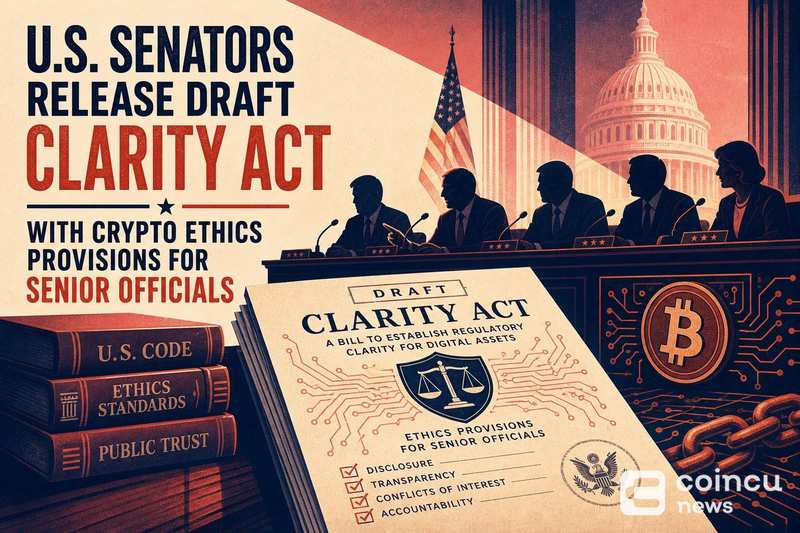
U.S. senators have circulated a draft CLARITY Act that pairs crypto market-structure rules with new ethics provisions for senior officials, adding a temporary ban on issuing or sponsoring digital assets for pay and a set of disclosure and penalty rules aimed squarely at people who hold public office.
What Senators Released in the Draft CLARITY Act
The document is a legislative draft, not an enacted law. An official Senate Banking Committee statement dated July 22, 2026 confirmed that new text of the crypto market-structure legislation was released that day. For related coverage, see U.S. Senate Agriculture Committee to Release Crypto Bill.
The draft’s centerpiece for the ethics debate is a new Division C titled “Ethics Requirements,” running from sections 30101 through 30106, according to the circulated bill text. For related coverage, see Senate Releases Bipartisan Crypto Regulation Bill.
The measure arrives as part of the Senate’s broader digital-asset push, which has already seen lawmakers revive negotiations over crypto market legislation ahead of the summer recess. For related coverage, see U.S. Senate Drafts Crypto Market Structure Bill.
How the Crypto Ethics Provisions Target Senior Officials
The core rule sits in proposed 5 U.S.C. 13152(a), which states that a covered individual may not, in exchange for consideration, issue or sponsor a digital asset. In plain terms, officials cannot get paid to launch or back a token while serving.
The draft defines a covered individual as a public official or employee, or that person’s spouse, and applies the ban during the official’s term of service. The rule reaches beyond the officeholder to a spouse, closing an obvious workaround.
The people captured by the draft’s cross-reference in 5 U.S.C. 13103(f) include the President, the Vice President, senior executive-branch officials above the filing threshold, Members of Congress, judicial officers, and judicial employees, under existing federal disclosure definitions.
The ethics language is not a blanket ban on owning crypto. It targets issuing or sponsoring digital assets for consideration, while still allowing passive investment holdings subject to disclosure and conflict rules.
Section 30102 adds a financial-disclosure requirement for digital assets sold for remuneration when their fair market value exceeds $1,000 at the close of the preceding calendar year.
Enforcement is centralized. The draft makes the U.S. Attorney General the sole enforcer for the ethics section and explicitly bars state attorneys general and private parties from bringing actions under it, concentrating power at the Department of Justice.
Penalties are steep. A covered individual who knowingly and willfully violates the ban must disgorge all profit to the Treasury and pay a civil penalty equal to 10 percent of the consideration received or $500,000, whichever is less.
There is also a market consequence. If a covered individual is found to have issued or sponsored a digital asset in violation of the ban, that asset may not be listed for trading on a digital asset intermediary, a provision aimed at the point of sale rather than only the official.
Why the Draft Matters for U.S. Crypto Policy
Combining market-structure rules with ethics safeguards signals that lawmakers are addressing both how digital-asset markets are regulated and public-trust concerns about officials profiting from token launches. The two goals now sit in one vehicle.
The distinction between draft-stage impact and enacted legal effect remains important. None of these provisions carry legal force yet, and the text can change before any committee vote, as seen when the Senate previously delayed a cryptocurrency draft over policy gaps.
The ethics language carries a political charge given ongoing scrutiny of digital-asset ventures tied to President Donald Trump. The draft’s design, banning paid token issuance while permitting disclosed holdings, tries to thread that debate rather than resolve it.
The measure builds on earlier Senate work, including a market-structure bill senators have been drafting and a separate bipartisan crypto regulation effort that set much of the framing for the current text.
The Sunset Clause Puts an Expiration Date on the Ban
The most distinctive drafting choice is temporary. Section 30105 says the ethics ban has no force and effect on and after noon on January 20, 2029, and no one may be penalized after that date for conduct that occurred on or before the sunset.
That timing aligns with the end of the current presidential term, which reporting has framed as a way to make the ethics rule expire rather than remain permanent, as CoinDesk noted on July 22, 2026.
Market Backdrop as the Draft Circulates
Ether traded at $1,913 with a roughly 2.1% gain over 24 hours as the draft circulated, giving it a market capitalization near $230.9 billion.
Broader sentiment stayed cautious, with the Crypto Fear and Greed Index reading 26, in “Fear” territory, against a total crypto market capitalization of about $2.3 trillion.
What Could Happen Next in Congress and the Crypto Industry
Draft releases are typically followed by feedback, revisions, and committee action. Reporting indicated the text was circulating as senators tried to assemble enough votes before the summer recess.
Crypto firms, compliance observers, and ethics watchdogs are likely to weigh in on the DOJ-only enforcement design and the carve-out that still permits passive holdings. The senior-official focus may draw attention beyond core crypto audiences.
Timeline and final language can still change. This coincides with the Senate Agriculture Committee’s own crypto bill work, and the pieces may yet be reconciled before any floor action.
FAQ About the Draft CLARITY Act and Crypto Ethics Rules
Is the draft CLARITY Act already law?
No. It is a legislative draft circulated among senators, and the Senate Banking Committee confirmed the new text was released on July 22, 2026. It carries no legal force unless passed and enacted.
Who counts as senior officials under the proposal?
The draft covers public officials and employees, and their spouses, referencing federal disclosure definitions that include the President, Vice President, senior executive-branch officials above the filing threshold, Members of Congress, and judicial officers and employees.
What do the crypto ethics provisions aim to prevent?
They bar covered individuals from issuing or sponsoring a digital asset in exchange for consideration during their term, add disclosure duties, and block violating assets from being listed on digital-asset intermediaries.
What happens next before any rules could take effect?
The text may move through review, amendment, and committee debate, and the language can still change. Even if enacted, the ethics ban is written to expire at noon on January 20, 2029.
Disclaimer: This article is for informational purposes only and does not constitute financial or investment advice. Cryptocurrency and digital asset markets carry significant risk. Always do your own research before making decisions.
No tags available.


Other Posts








- China, US Conclude Trade Talks with Focus on Cooperation
- Court Upholds Fed’s Rejection of Custodia Bank’s Request
- Crypto Weekly: NYSE Backs OKX, Kraken Gets Fed Access, BTC Sells
- Former CFO Convicted for $35M Fraudulent Crypto Investment
- DeriW Launches Edge Hour Trading Competition Platform for Derivatives Traders
- Michael Saylor Denies Bitcoin Sell-Off Amid Large BTC Transfer
- Buy Dogecoin on eToro: Step-by-Step Guide for Beginners (2024)
- Kazakhstan Explores Crypto Reserves Backed by National Funds
- JPMorgan Increases Holdings in BlackRock’s Bitcoin ETF
- Nordea Bank Introduces Bitcoin ETP Trading for Nordic Customers
- XRP Spot ETF Launches on Nasdaq Amid Market Fluctuations
- Peter Schiff Challenges Michael Saylor on MSTR’s Business Model
- Thailand Orders Worldcoin to Delete 1.2 Million Biometric Records
- UK Proposes New DeFi Tax Framework to Ease User Burden
- WLFI Under Fire: Analyst Warns Hyperliquid Could Be Next
- Ancient Ethereum Whale Moves $1.19 Billion After Decade
- BlackRock Receives Large Crypto Transfers from Coinbase
- SEC Scrutiny on ALT5 Sigma’s Leadership Disclosure Timing
- Yala Injects $5.5 Million Amid Recovery Efforts
- Radiant Capital Faces $50M Loss in Major Security Breach
- China, US Conclude Trade Talks with Focus on Cooperation
- Court Upholds Fed’s Rejection of Custodia Bank’s Request
- Crypto Weekly: NYSE Backs OKX, Kraken Gets Fed Access, BTC Sells
- Former CFO Convicted for $35M Fraudulent Crypto Investment
- DeriW Launches Edge Hour Trading Competition Platform for Derivatives Traders
- Michael Saylor Denies Bitcoin Sell-Off Amid Large BTC Transfer
- Buy Dogecoin on eToro: Step-by-Step Guide for Beginners (2024)
- Kazakhstan Explores Crypto Reserves Backed by National Funds
- JPMorgan Increases Holdings in BlackRock’s Bitcoin ETF
- Nordea Bank Introduces Bitcoin ETP Trading for Nordic Customers
- XRP Spot ETF Launches on Nasdaq Amid Market Fluctuations
- Peter Schiff Challenges Michael Saylor on MSTR’s Business Model
- Thailand Orders Worldcoin to Delete 1.2 Million Biometric Records
- UK Proposes New DeFi Tax Framework to Ease User Burden
- WLFI Under Fire: Analyst Warns Hyperliquid Could Be Next
- Ancient Ethereum Whale Moves $1.19 Billion After Decade
- BlackRock Receives Large Crypto Transfers from Coinbase
- SEC Scrutiny on ALT5 Sigma’s Leadership Disclosure Timing
- Yala Injects $5.5 Million Amid Recovery Efforts
- Radiant Capital Faces $50M Loss in Major Security Breach
- China, US Conclude Trade Talks with Focus on Cooperation
- Court Upholds Fed’s Rejection of Custodia Bank’s Request
- Crypto Weekly: NYSE Backs OKX, Kraken Gets Fed Access, BTC Sells
- Former CFO Convicted for $35M Fraudulent Crypto Investment
- DeriW Launches Edge Hour Trading Competition Platform for Derivatives Traders
- Michael Saylor Denies Bitcoin Sell-Off Amid Large BTC Transfer
- Buy Dogecoin on eToro: Step-by-Step Guide for Beginners (2024)
- Kazakhstan Explores Crypto Reserves Backed by National Funds
- JPMorgan Increases Holdings in BlackRock’s Bitcoin ETF
- Nordea Bank Introduces Bitcoin ETP Trading for Nordic Customers
- XRP Spot ETF Launches on Nasdaq Amid Market Fluctuations
- Peter Schiff Challenges Michael Saylor on MSTR’s Business Model
- Thailand Orders Worldcoin to Delete 1.2 Million Biometric Records
- UK Proposes New DeFi Tax Framework to Ease User Burden
- WLFI Under Fire: Analyst Warns Hyperliquid Could Be Next
- Ancient Ethereum Whale Moves $1.19 Billion After Decade
- BlackRock Receives Large Crypto Transfers from Coinbase
- SEC Scrutiny on ALT5 Sigma’s Leadership Disclosure Timing
- Yala Injects $5.5 Million Amid Recovery Efforts
- Radiant Capital Faces $50M Loss in Major Security Breach


Sources: Trump Expected to Attend White House Meeting With Crypto CEOs

Bitcoin Mining Rigs Shut Down in Capital of Major Mining Power
Bitmine Immersion Technologies Announces Record and Payment Dates for Cash Dividends on 9.50% Series A Perpetual Preferred Stock

Crypto Player Takes Home $1.749M After a Million PSG Bet on 1win