Standard Chartered has projected that Uniswap’s native token UNI could reach $100 by 2030, marking one of the more ambitious long-term price targets issued by a major financial institution for a DeFi governance token.
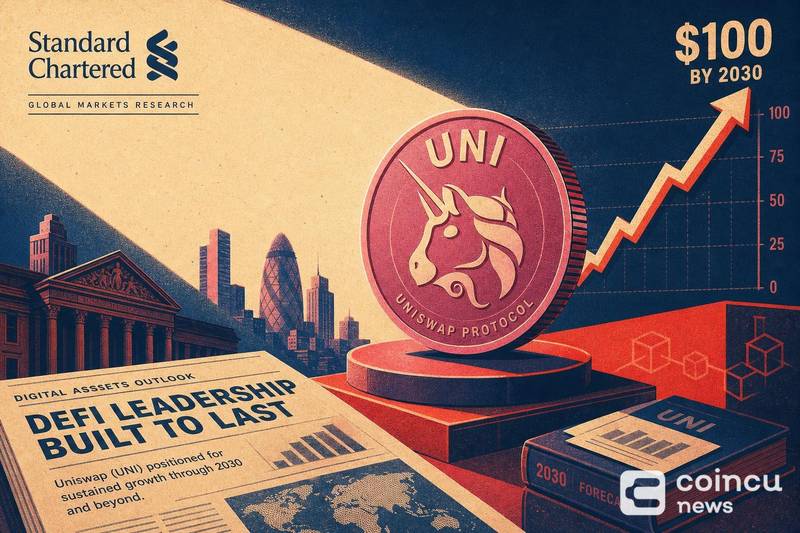
The forecast, reported by The Block, positions UNI among a small group of crypto assets that the bank believes could outperform over the remainder of the decade. Standard Chartered has previously issued bullish calls on Bitcoin and Ether, but a target on a DeFi-native token signals growing institutional attention toward decentralized finance protocols.
The bank has also suggested that certain crypto assets could outperform both Bitcoin and Ether, with UNI appearing to be among those candidates. A $100 price would represent a significant multiple from current levels, making the call notable for its scale as much as its source.
Why Uniswap sits at the center of the DeFi thesis
Uniswap remains the largest decentralized exchange by trading volume across Ethereum and its layer-2 networks. Its automated market maker model pioneered the mechanism that most competing DEXs have since adopted, giving it first-mover network effects in liquidity and user adoption.
The protocol’s relevance extends beyond simple token swaps. Uniswap has expanded across multiple chains and has become core infrastructure within the broader DeFi stack, similar to how rising Ethereum open interest reflects growing derivatives activity built on the same ecosystem.
UNI, as a governance token, gives holders voting power over protocol parameters, fee structures, and treasury allocations. Whether governance tokens can effectively capture protocol revenue remains one of the most debated questions in DeFi valuation, and any $100 path for UNI would likely depend on resolving that question in token holders’ favor.
What needs to happen for UNI to approach $100
A $100 target by 2030 requires several assumptions to hold simultaneously. DeFi trading volume would need to grow substantially over multiple market cycles, and Uniswap would need to maintain or expand its competitive share against rivals.
Fee dynamics represent a critical variable. Uniswap’s governance has debated activating a protocol fee switch that would direct a portion of trading fees to UNI holders. If implemented, this mechanism could create a direct revenue link between protocol activity and token value, strengthening the fundamental case.
Product expansion also matters. Uniswap has been building its own mobile wallet and exploring integrations that could bring DEX access to a broader user base. Growth in users and transaction volume would support the revenue assumptions embedded in a $100 target.
The forecast likely also assumes continued growth in decentralized finance as a category. As institutional interest in crypto deepens, including through developments like Bitcoin ETFs and their implications for self-custody, DEX infrastructure could benefit from users seeking non-custodial alternatives.
Risks that could derail the 2030 forecast
Competitive and structural threats
Uniswap faces competition from other decentralized exchanges, aggregators, and emerging chains with native DEX solutions. If trading activity migrates to alternative platforms or if new AMM designs offer better capital efficiency, Uniswap’s market share could erode.
The broader shift toward intent-based trading and order-flow auctions could also reshape how DEX volume is routed, potentially bypassing traditional AMM pools. Uniswap has been adapting with newer versions of its protocol, but the competitive landscape remains fluid.
Regulatory uncertainty
DeFi governance tokens occupy an uncertain regulatory space. Enforcement actions or new rules classifying governance tokens as securities could significantly affect UNI’s tradability and valuation. Any regulatory framework that restricts token holder revenue sharing would undermine the fee-switch thesis central to bullish UNI projections.
Crypto market cyclicality adds another layer of risk. The 2030 target spans multiple potential market cycles, and DeFi tokens have historically experienced deeper drawdowns than major assets like Bitcoin and Ether during bear markets. The kind of large stablecoin flows seen on exchanges during volatile periods can signal rapid sentiment shifts that hit altcoins hardest.
FAQ
What did Standard Chartered predict for UNI?
Standard Chartered projected that Uniswap’s UNI token could reach $100 by 2030, representing a long-term bullish outlook on the DeFi governance token.
Why is Uniswap important in DeFi?
Uniswap is the largest decentralized exchange by volume and pioneered the automated market maker model. It serves as core trading infrastructure across Ethereum and multiple layer-2 networks.
What risks should investors watch before 2030?
Key risks include regulatory action against DeFi governance tokens, competition from rival DEXs and new trading mechanisms, crypto market cyclicality, and uncertainty around whether UNI can capture protocol revenue through its fee switch.
Disclaimer: This article is for informational purposes only and does not constitute financial or investment advice. Cryptocurrency and digital asset markets carry significant risk. Always do your own research before making decisions.
No tags available.


Other Posts








- China, US Conclude Trade Talks with Focus on Cooperation
- Crypto Weekly: NYSE Backs OKX, Kraken Gets Fed Access, BTC Sells
- DeriW Launches Edge Hour Trading Competition Platform for Derivatives Traders
- Court Upholds Fed’s Rejection of Custodia Bank’s Request
- Former CFO Convicted for $35M Fraudulent Crypto Investment
- Michael Saylor Denies Bitcoin Sell-Off Amid Large BTC Transfer
- Kazakhstan Explores Crypto Reserves Backed by National Funds
- JPMorgan Increases Holdings in BlackRock’s Bitcoin ETF
- Nordea Bank Introduces Bitcoin ETP Trading for Nordic Customers
- Buy Dogecoin on eToro: Step-by-Step Guide for Beginners (2024)
- XRP Spot ETF Launches on Nasdaq Amid Market Fluctuations
- Crypto Leaders Address Macro Volatility Amid Market Shifts
- Peter Schiff Challenges Michael Saylor on MSTR’s Business Model
- Thailand Orders Worldcoin to Delete 1.2 Million Biometric Records
- UK Proposes New DeFi Tax Framework to Ease User Burden
- WLFI Under Fire: Analyst Warns Hyperliquid Could Be Next
- Ancient Ethereum Whale Moves $1.19 Billion After Decade
- BlackRock Receives Large Crypto Transfers from Coinbase
- SEC Scrutiny on ALT5 Sigma’s Leadership Disclosure Timing
- MoonPay Gains Trust License for Crypto Operations in New York
- China, US Conclude Trade Talks with Focus on Cooperation
- Crypto Weekly: NYSE Backs OKX, Kraken Gets Fed Access, BTC Sells
- DeriW Launches Edge Hour Trading Competition Platform for Derivatives Traders
- Court Upholds Fed’s Rejection of Custodia Bank’s Request
- Former CFO Convicted for $35M Fraudulent Crypto Investment
- Michael Saylor Denies Bitcoin Sell-Off Amid Large BTC Transfer
- Kazakhstan Explores Crypto Reserves Backed by National Funds
- JPMorgan Increases Holdings in BlackRock’s Bitcoin ETF
- Nordea Bank Introduces Bitcoin ETP Trading for Nordic Customers
- Buy Dogecoin on eToro: Step-by-Step Guide for Beginners (2024)
- XRP Spot ETF Launches on Nasdaq Amid Market Fluctuations
- Crypto Leaders Address Macro Volatility Amid Market Shifts
- Peter Schiff Challenges Michael Saylor on MSTR’s Business Model
- Thailand Orders Worldcoin to Delete 1.2 Million Biometric Records
- UK Proposes New DeFi Tax Framework to Ease User Burden
- WLFI Under Fire: Analyst Warns Hyperliquid Could Be Next
- Ancient Ethereum Whale Moves $1.19 Billion After Decade
- BlackRock Receives Large Crypto Transfers from Coinbase
- SEC Scrutiny on ALT5 Sigma’s Leadership Disclosure Timing
- MoonPay Gains Trust License for Crypto Operations in New York
- China, US Conclude Trade Talks with Focus on Cooperation
- Crypto Weekly: NYSE Backs OKX, Kraken Gets Fed Access, BTC Sells
- DeriW Launches Edge Hour Trading Competition Platform for Derivatives Traders
- Court Upholds Fed’s Rejection of Custodia Bank’s Request
- Former CFO Convicted for $35M Fraudulent Crypto Investment
- Michael Saylor Denies Bitcoin Sell-Off Amid Large BTC Transfer
- Kazakhstan Explores Crypto Reserves Backed by National Funds
- JPMorgan Increases Holdings in BlackRock’s Bitcoin ETF
- Nordea Bank Introduces Bitcoin ETP Trading for Nordic Customers
- Buy Dogecoin on eToro: Step-by-Step Guide for Beginners (2024)
- XRP Spot ETF Launches on Nasdaq Amid Market Fluctuations
- Crypto Leaders Address Macro Volatility Amid Market Shifts
- Peter Schiff Challenges Michael Saylor on MSTR’s Business Model
- Thailand Orders Worldcoin to Delete 1.2 Million Biometric Records
- UK Proposes New DeFi Tax Framework to Ease User Burden
- WLFI Under Fire: Analyst Warns Hyperliquid Could Be Next
- Ancient Ethereum Whale Moves $1.19 Billion After Decade
- BlackRock Receives Large Crypto Transfers from Coinbase
- SEC Scrutiny on ALT5 Sigma’s Leadership Disclosure Timing
- MoonPay Gains Trust License for Crypto Operations in New York


Trezor Executive Warns Bitcoin ETFs Could Undermine Self-Custody

ETH Open Interest Rises 15.4% in 24 Hours: What It Signals for Ethereum

Wallet V Launches Public Performance Benchmark for AI Trading Agents on Hyperliquid and Aster

NyesteCasino.com Reports: iGaming Industry Navigates Dual Pressures of Regulation and Growth