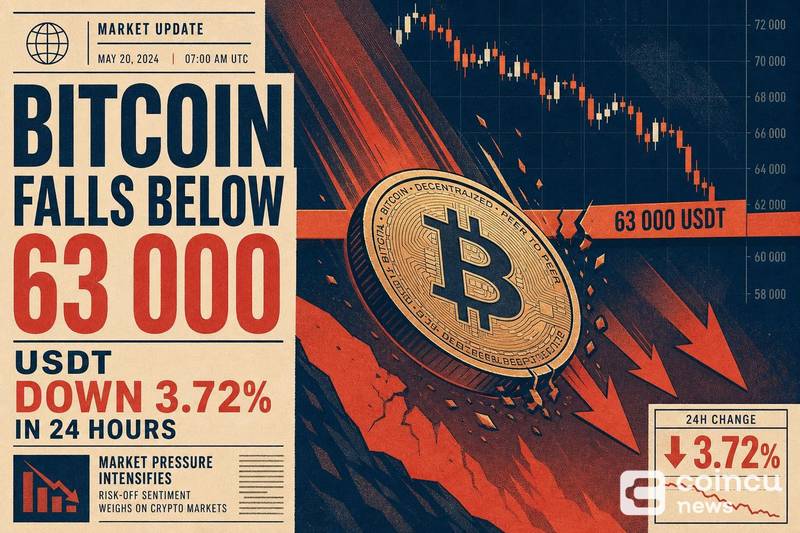
Bitcoin fell below 63,000 USDT, recording a 3.72% decline over 24 hours in a move that pushed the largest cryptocurrency beneath a closely watched round-number threshold.
The drop brought renewed attention to short-term price dynamics as traders assessed whether the break below 63,000 USDT would hold or reverse. The decline also coincided with broader weakness across major digital assets, with Ether similarly falling below 1,700 USDT with a 3.84% daily loss.
Bitcoin Drops Below 63,000 USDT in a Sharp 24-Hour Move
Bitcoin’s slide below the 63,000 USDT mark represented a 3.72% decline within a single 24-hour window. The move was notable for its speed, compressing a meaningful percentage loss into a short timeframe.
Readers should treat this as a time-sensitive market snapshot. Prices in the cryptocurrency market can shift rapidly, and the figures cited here reflect conditions at the time of reporting rather than a settled trend.
Why the 63,000 USDT Level Draws Trader Attention
Round-number price levels like 63,000 USDT tend to concentrate trading activity. Traders frequently place buy and sell orders at or near these thresholds, turning them into zones of heightened volume and potential support or resistance.
When Bitcoin breaks below such a level, it can trigger stop-loss orders clustered just beneath the threshold. This mechanical selling pressure can temporarily accelerate the move downward, independent of any fundamental catalyst.
A single break below a round number does not confirm a trend reversal. Bitcoin has historically pierced key levels only to reclaim them within hours or days. The distinction between a brief wick below 63,000 USDT and a sustained close beneath it matters for any directional assessment.
What a 3.72% Daily Decline Signals About Short-Term Sentiment
A 3.72% drop in 24 hours falls within the normal range of Bitcoin volatility but sits at the more aggressive end of daily moves. For context, single-digit percentage swings are routine in crypto markets, though they would be exceptional in traditional equity indices.
The size of this move suggests a temporary shift in short-term sentiment toward caution. Funding rates across major exchanges offer one lens into this shift, and Bitcoin’s 8-hour average funding rate recently registered at 0.0004%, a data point worth monitoring alongside price action.
Short-term sentiment in crypto can reverse quickly. A sharp daily decline sometimes precedes a rebound as buyers step in at lower prices, while in other cases it marks the start of a deeper correction. The percentage figure alone does not distinguish between these outcomes.
Traders watching ETH funding rate trends alongside Bitcoin’s may find cross-asset signals useful in gauging whether the sell-off reflects broad risk-off behavior or Bitcoin-specific pressure.
What to Watch After Bitcoin Falls Below 63,000 USDT
The first question is whether Bitcoin reclaims 63,000 USDT or continues to trade beneath it. A swift recovery back above the level would suggest the break was a temporary liquidity sweep rather than a meaningful shift in market structure.
Follow-through to the downside, particularly on elevated volume, would carry more weight than the initial drop alone. Confirmation requires additional price action beyond a single 24-hour snapshot.
Traders may also look to upcoming Federal Reserve communications for macro context. The FOMC calendar provides scheduled dates for policy decisions that historically influence risk-asset positioning, including Bitcoin.
FAQ: Bitcoin Below 63,000 USDT
Why does the 63,000 USDT level matter for Bitcoin?
Round-number thresholds like 63,000 USDT attract concentrated trading activity because many market participants set orders at or near these levels. A break below can trigger clustered stop-loss orders, amplifying short-term selling pressure.
Is a 3.72% daily drop significant for Bitcoin?
A 3.72% decline in 24 hours is within the normal volatility range for Bitcoin but represents a sharper-than-average daily move. It signals a short-term sentiment shift without, on its own, confirming a longer-term directional change.
What should traders watch after this decline?
Whether Bitcoin reclaims or remains below 63,000 USDT in the sessions that follow is the primary signal. Sustained trading below this level on higher volume would carry more significance than a brief dip followed by a recovery.
Disclaimer: This article is for informational purposes only and does not constitute financial or investment advice. Cryptocurrency and digital asset markets carry significant risk. Always do your own research before making decisions.
No tags available.


Other Posts








- China, US Conclude Trade Talks with Focus on Cooperation
- Crypto Weekly: NYSE Backs OKX, Kraken Gets Fed Access, BTC Sells
- Court Upholds Fed’s Rejection of Custodia Bank’s Request
- Former CFO Convicted for $35M Fraudulent Crypto Investment
- DeriW Launches Edge Hour Trading Competition Platform for Derivatives Traders
- Michael Saylor Denies Bitcoin Sell-Off Amid Large BTC Transfer
- Buy Dogecoin on eToro: Step-by-Step Guide for Beginners (2024)
- Kazakhstan Explores Crypto Reserves Backed by National Funds
- JPMorgan Increases Holdings in BlackRock’s Bitcoin ETF
- Nordea Bank Introduces Bitcoin ETP Trading for Nordic Customers
- XRP Spot ETF Launches on Nasdaq Amid Market Fluctuations
- Peter Schiff Challenges Michael Saylor on MSTR’s Business Model
- Thailand Orders Worldcoin to Delete 1.2 Million Biometric Records
- UK Proposes New DeFi Tax Framework to Ease User Burden
- WLFI Under Fire: Analyst Warns Hyperliquid Could Be Next
- Ancient Ethereum Whale Moves $1.19 Billion After Decade
- BlackRock Receives Large Crypto Transfers from Coinbase
- SEC Scrutiny on ALT5 Sigma’s Leadership Disclosure Timing
- Yala Injects $5.5 Million Amid Recovery Efforts
- Radiant Capital Faces $50M Loss in Major Security Breach
- China, US Conclude Trade Talks with Focus on Cooperation
- Crypto Weekly: NYSE Backs OKX, Kraken Gets Fed Access, BTC Sells
- Court Upholds Fed’s Rejection of Custodia Bank’s Request
- Former CFO Convicted for $35M Fraudulent Crypto Investment
- DeriW Launches Edge Hour Trading Competition Platform for Derivatives Traders
- Michael Saylor Denies Bitcoin Sell-Off Amid Large BTC Transfer
- Buy Dogecoin on eToro: Step-by-Step Guide for Beginners (2024)
- Kazakhstan Explores Crypto Reserves Backed by National Funds
- JPMorgan Increases Holdings in BlackRock’s Bitcoin ETF
- Nordea Bank Introduces Bitcoin ETP Trading for Nordic Customers
- XRP Spot ETF Launches on Nasdaq Amid Market Fluctuations
- Peter Schiff Challenges Michael Saylor on MSTR’s Business Model
- Thailand Orders Worldcoin to Delete 1.2 Million Biometric Records
- UK Proposes New DeFi Tax Framework to Ease User Burden
- WLFI Under Fire: Analyst Warns Hyperliquid Could Be Next
- Ancient Ethereum Whale Moves $1.19 Billion After Decade
- BlackRock Receives Large Crypto Transfers from Coinbase
- SEC Scrutiny on ALT5 Sigma’s Leadership Disclosure Timing
- Yala Injects $5.5 Million Amid Recovery Efforts
- Radiant Capital Faces $50M Loss in Major Security Breach
- China, US Conclude Trade Talks with Focus on Cooperation
- Crypto Weekly: NYSE Backs OKX, Kraken Gets Fed Access, BTC Sells
- Court Upholds Fed’s Rejection of Custodia Bank’s Request
- Former CFO Convicted for $35M Fraudulent Crypto Investment
- DeriW Launches Edge Hour Trading Competition Platform for Derivatives Traders
- Michael Saylor Denies Bitcoin Sell-Off Amid Large BTC Transfer
- Buy Dogecoin on eToro: Step-by-Step Guide for Beginners (2024)
- Kazakhstan Explores Crypto Reserves Backed by National Funds
- JPMorgan Increases Holdings in BlackRock’s Bitcoin ETF
- Nordea Bank Introduces Bitcoin ETP Trading for Nordic Customers
- XRP Spot ETF Launches on Nasdaq Amid Market Fluctuations
- Peter Schiff Challenges Michael Saylor on MSTR’s Business Model
- Thailand Orders Worldcoin to Delete 1.2 Million Biometric Records
- UK Proposes New DeFi Tax Framework to Ease User Burden
- WLFI Under Fire: Analyst Warns Hyperliquid Could Be Next
- Ancient Ethereum Whale Moves $1.19 Billion After Decade
- BlackRock Receives Large Crypto Transfers from Coinbase
- SEC Scrutiny on ALT5 Sigma’s Leadership Disclosure Timing
- Yala Injects $5.5 Million Amid Recovery Efforts
- Radiant Capital Faces $50M Loss in Major Security Breach



Wintermute Registers as SEC Broker-Dealer for Stocks, Options and Crypto ETFs

Zoomex Enhances Its Strategy Center With Advanced Strategy Trading Tools