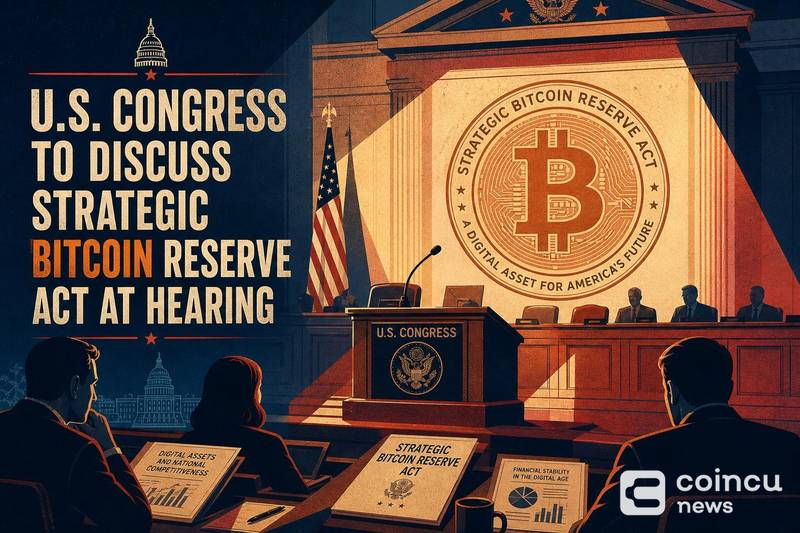
U.S. Congress To Discuss Strategic Bitcoin Reserve Act At Hearing
U.S. Congress is preparing to discuss the Strategic Bitcoin Reserve Act at a scheduled hearing, placing a government-level Bitcoin reserve proposal in front of federal lawmakers rather than treating the idea as market commentary.
The hearing is documented on the House committee calendar, which lists the event materials under a July 17, 2026 filing, on the official House docs portal. The associated bill text is published as HR 8957, available in the introduced-bill PDF.
This is a hearing about proposed legislation, not a law that has been passed. A strategic Bitcoin reserve refers to a government-level reserve framework built specifically around BTC, distinct from broader crypto regulation debates. For related coverage, see U.S. Government Bitcoin Liquidation Sparks Concerns Among Officials.
Why a Bitcoin reserve hearing carries policy weight
A congressional hearing signals formal policy attention to the reserve concept, moving it from informal discussion into the legislative record. The proposal is tied specifically to Bitcoin rather than the wider digital-asset market. For related coverage, see Cantor Fitzgerald Finalizes $4 Billion Bitcoin Acquisition Deal.
The reserve idea already has an executive-branch precedent. In March 2025, the White House issued an action establishing a Strategic Bitcoin Reserve and a U.S. Digital Asset Stockpile, which frames the government’s approach to holding BTC. For related coverage, see Bitcoin Steady as Trump Extends Tariff Deadline to August 1.
The legislative push has been championed by Congressman Nick Begich, who announced legislation to establish a strategic Bitcoin reserve. That effort sits against a backdrop of debate over how the government manages its BTC, including earlier concerns tied to U.S. government Bitcoin liquidation.
Key questions lawmakers and the market will watch
The hearing record confirms the event but does not, in the materials available, spell out the substance of testimony or debate. Readers should treat the following as open questions, not confirmed agenda items.
- Rationale: Why the U.S. should hold a dedicated Bitcoin reserve rather than a broader asset stockpile.
- Acquisition: How any reserve would be funded or sourced, including whether it relies on seized assets.
- Custody: Who would hold the keys and how the BTC would be secured.
- Oversight: What reporting and accountability structures would apply.
These questions echo the wider policy environment, where the crypto lobby has urged Congress to act on digital-asset measures. Congressional committees have also recently taken up related digital-asset frameworks, such as a hearing on the CLARITY Act.
Sentiment and narrative impact before any vote
Bitcoin-specific policy headlines can shape market attention and narrative framing even before a bill advances. A hearing matters as a signal event regardless of whether it produces immediate legal change.
The story carries high interest for Bitcoin holders because the act centers on BTC reserves, a theme that has drawn corporate treasuries such as SpaceX’s Bitcoin holdings into the wider accumulation conversation. This piece makes no price prediction and no call on the bill’s odds of passing.
FAQ about the Strategic Bitcoin Reserve Act hearing
What is the Strategic Bitcoin Reserve Act? It is proposed legislation, published as HR 8957, aimed at establishing a government-level reserve framework centered on Bitcoin.
Does the hearing mean the act is now law? No. A hearing is a step in the legislative process for discussing a bill; it does not mean the act has been approved.
Why does the hearing matter for Bitcoin? It brings a Bitcoin-specific reserve proposal into formal congressional discussion, signaling policy attention to how the U.S. might hold BTC.
Disclaimer: This article is for informational purposes only and does not constitute financial or investment advice. Cryptocurrency and digital asset markets carry significant risk. Always do your own research before making decisions.
No tags available.


Other Posts








- China, US Conclude Trade Talks with Focus on Cooperation
- Crypto Weekly: NYSE Backs OKX, Kraken Gets Fed Access, BTC Sells
- Court Upholds Fed’s Rejection of Custodia Bank’s Request
- Former CFO Convicted for $35M Fraudulent Crypto Investment
- DeriW Launches Edge Hour Trading Competition Platform for Derivatives Traders
- Michael Saylor Denies Bitcoin Sell-Off Amid Large BTC Transfer
- Buy Dogecoin on eToro: Step-by-Step Guide for Beginners (2024)
- Kazakhstan Explores Crypto Reserves Backed by National Funds
- JPMorgan Increases Holdings in BlackRock’s Bitcoin ETF
- Nordea Bank Introduces Bitcoin ETP Trading for Nordic Customers
- XRP Spot ETF Launches on Nasdaq Amid Market Fluctuations
- Peter Schiff Challenges Michael Saylor on MSTR’s Business Model
- Thailand Orders Worldcoin to Delete 1.2 Million Biometric Records
- UK Proposes New DeFi Tax Framework to Ease User Burden
- WLFI Under Fire: Analyst Warns Hyperliquid Could Be Next
- Ancient Ethereum Whale Moves $1.19 Billion After Decade
- BlackRock Receives Large Crypto Transfers from Coinbase
- SEC Scrutiny on ALT5 Sigma’s Leadership Disclosure Timing
- Yala Injects $5.5 Million Amid Recovery Efforts
- Radiant Capital Faces $50M Loss in Major Security Breach
- China, US Conclude Trade Talks with Focus on Cooperation
- Crypto Weekly: NYSE Backs OKX, Kraken Gets Fed Access, BTC Sells
- Court Upholds Fed’s Rejection of Custodia Bank’s Request
- Former CFO Convicted for $35M Fraudulent Crypto Investment
- DeriW Launches Edge Hour Trading Competition Platform for Derivatives Traders
- Michael Saylor Denies Bitcoin Sell-Off Amid Large BTC Transfer
- Buy Dogecoin on eToro: Step-by-Step Guide for Beginners (2024)
- Kazakhstan Explores Crypto Reserves Backed by National Funds
- JPMorgan Increases Holdings in BlackRock’s Bitcoin ETF
- Nordea Bank Introduces Bitcoin ETP Trading for Nordic Customers
- XRP Spot ETF Launches on Nasdaq Amid Market Fluctuations
- Peter Schiff Challenges Michael Saylor on MSTR’s Business Model
- Thailand Orders Worldcoin to Delete 1.2 Million Biometric Records
- UK Proposes New DeFi Tax Framework to Ease User Burden
- WLFI Under Fire: Analyst Warns Hyperliquid Could Be Next
- Ancient Ethereum Whale Moves $1.19 Billion After Decade
- BlackRock Receives Large Crypto Transfers from Coinbase
- SEC Scrutiny on ALT5 Sigma’s Leadership Disclosure Timing
- Yala Injects $5.5 Million Amid Recovery Efforts
- Radiant Capital Faces $50M Loss in Major Security Breach
- China, US Conclude Trade Talks with Focus on Cooperation
- Crypto Weekly: NYSE Backs OKX, Kraken Gets Fed Access, BTC Sells
- Court Upholds Fed’s Rejection of Custodia Bank’s Request
- Former CFO Convicted for $35M Fraudulent Crypto Investment
- DeriW Launches Edge Hour Trading Competition Platform for Derivatives Traders
- Michael Saylor Denies Bitcoin Sell-Off Amid Large BTC Transfer
- Buy Dogecoin on eToro: Step-by-Step Guide for Beginners (2024)
- Kazakhstan Explores Crypto Reserves Backed by National Funds
- JPMorgan Increases Holdings in BlackRock’s Bitcoin ETF
- Nordea Bank Introduces Bitcoin ETP Trading for Nordic Customers
- XRP Spot ETF Launches on Nasdaq Amid Market Fluctuations
- Peter Schiff Challenges Michael Saylor on MSTR’s Business Model
- Thailand Orders Worldcoin to Delete 1.2 Million Biometric Records
- UK Proposes New DeFi Tax Framework to Ease User Burden
- WLFI Under Fire: Analyst Warns Hyperliquid Could Be Next
- Ancient Ethereum Whale Moves $1.19 Billion After Decade
- BlackRock Receives Large Crypto Transfers from Coinbase
- SEC Scrutiny on ALT5 Sigma’s Leadership Disclosure Timing
- Yala Injects $5.5 Million Amid Recovery Efforts
- Radiant Capital Faces $50M Loss in Major Security Breach

Wintermute Registers as SEC Broker-Dealer for Stocks, Options and Crypto ETFs


Russia Signs Law Legalizing Crypto Trading While Crypto Payments Stay Banned

Zoomex Enhances Its Strategy Center With Advanced Strategy Trading Tools