Sygnum has connected its regulated crypto trading rails to BancaStato’s online banking stack, letting the Swiss cantonal bank’s clients buy, hold, and sell four digital assets, including Bitcoin and Ethereum, directly inside the apps they already use for everyday banking. The rollout, announced on July 23, 2026, covers BTC, ETH, LTC, and SOL through BancaStato’s web and mobile channels.
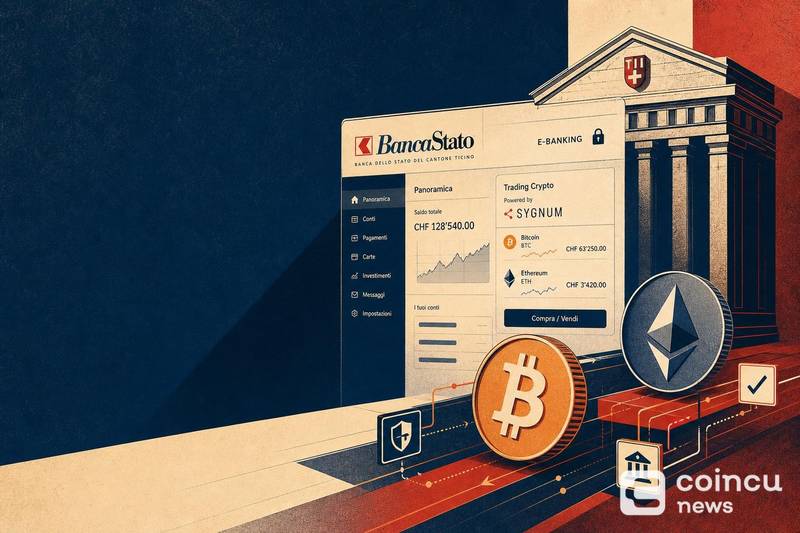
The launch pushes Sygnum BancaStato crypto trading out of a standalone product and into the bank’s core client interface. BancaStato clients no longer need a separate exchange account to gain regulated exposure to the four supported tokens. For related coverage, see Analyst Says Binance Stablecoin Net Outflows Hit $7 Billion This Year.
Four crypto assets now sit inside BancaStato’s existing banking flows
Sygnum said BancaStato joined its B2B banking platform, connecting Sygnum’s API with the bank’s Avaloq-based core infrastructure and digital channels. The integration means trades execute inside BancaStato’s own web and mobile banking apps rather than a third-party venue, according to trade reporting on the deployment. For related coverage, see Binance Clarifies TST Token Deployment Incident.
At rollout, BancaStato clients can buy, hold, and sell Bitcoin, Ethereum, Litecoin, and Solana. The service is aimed at the bank’s Swiss client base, which can access all four assets from the same login used for accounts and payments. For related coverage, see DeFi Kingdoms' DFK Chain to Shut Down on August 28: What It Means.
Sygnum operates as a regulated digital-asset banking group, while BancaStato is a Swiss cantonal bank in Ticino. The tie-up follows a broader pattern of established Swiss institutions embedding digital assets, seen when six Swiss banks including Sygnum launched a CHF stablecoin sandbox.
Why the Avaloq integration matters more than a standard crypto launch
Sygnum described the deployment as the first direct integration of regulated crypto trading in Avaloq’s SaaS environment. That framing matters because Avaloq’s software underpins core banking for a long list of institutions, making the integration a template other banks can reuse rather than a one-off feature.
Secondary Swiss financial coverage confirms BancaStato clients access the service through online banking while the underlying digital assets are held in institutional-grade custody, as reported by finews. The custody layer keeps the risk profile inside a regulated banking perimeter rather than a retail exchange.
Embedded distribution is the strategic point here. Banks that plug crypto trading into their own interfaces retain the client relationship and the custody mandate, an approach that mirrors how Binance built secure banking-style asset storage for large traders to keep balances inside its own environment.
The rollout lands while crypto sentiment stays defensive
The banking integration arrived against a cautious market backdrop rather than a speculative surge. As of the research baseline, Bitcoin traded near $63,039, down roughly 0.94% over 24 hours.
Sentiment was similarly muted. The Fear & Greed Index sat at 27, in “Fear” territory, while Bitcoin’s share of the total market held at about 56.3%.
That context sharpens the significance of the launch. Regulated bank distribution expanding while readings point to caution suggests the move is driven by long-term infrastructure planning, not by chasing a rally. Price action here is context, not the core claim of the story.
What stays limited at launch and what to watch next
The verified scope is narrow: four assets only, BTC, ETH, LTC, and SOL, through BancaStato’s channels. Nothing in the announcement confirms additional tokens, published fee schedules, or a timeline for expansion beyond the stated rollout.
The forward-looking lens is regulatory. Sygnum said on June 30, 2026 that Sygnum Europe received MiCA/CASP authorization, a signal of wider regulated distribution ambitions beyond Switzerland. That approval is a watch item for whether the Avaloq template travels across borders.
No notable expert commentary or a concrete product-expansion schedule was verified, so further bank integrations remain a potential catalyst rather than a confirmed plan. Readers should treat any broader rollout as unconfirmed until Sygnum or its bank partners announce it.
FAQ
Which cryptocurrencies can BancaStato clients trade?
At launch, clients can buy, hold, and sell four assets: Bitcoin, Ethereum, Litecoin, and Solana. No additional tokens have been confirmed.
Is the service available directly inside BancaStato online banking?
Yes. Trades run inside BancaStato’s existing web and mobile banking apps via Sygnum’s API, with digital assets held in institutional-grade custody.
Why is the Avaloq integration important for Swiss crypto banking?
Sygnum called it the first direct integration of regulated crypto trading in Avaloq’s SaaS environment, making it a reusable model for other banks running on the same core software.
Disclaimer: This article is for informational purposes only and does not constitute financial or investment advice. Cryptocurrency and digital asset markets carry significant risk. Always do your own research before making decisions.
No tags available.


Other Posts








- China, US Conclude Trade Talks with Focus on Cooperation
- Crypto Weekly: NYSE Backs OKX, Kraken Gets Fed Access, BTC Sells
- Court Upholds Fed’s Rejection of Custodia Bank’s Request
- Former CFO Convicted for $35M Fraudulent Crypto Investment
- DeriW Launches Edge Hour Trading Competition Platform for Derivatives Traders
- Michael Saylor Denies Bitcoin Sell-Off Amid Large BTC Transfer
- Buy Dogecoin on eToro: Step-by-Step Guide for Beginners (2024)
- Kazakhstan Explores Crypto Reserves Backed by National Funds
- JPMorgan Increases Holdings in BlackRock’s Bitcoin ETF
- Nordea Bank Introduces Bitcoin ETP Trading for Nordic Customers
- XRP Spot ETF Launches on Nasdaq Amid Market Fluctuations
- Peter Schiff Challenges Michael Saylor on MSTR’s Business Model
- Thailand Orders Worldcoin to Delete 1.2 Million Biometric Records
- UK Proposes New DeFi Tax Framework to Ease User Burden
- WLFI Under Fire: Analyst Warns Hyperliquid Could Be Next
- Ancient Ethereum Whale Moves $1.19 Billion After Decade
- BlackRock Receives Large Crypto Transfers from Coinbase
- SEC Scrutiny on ALT5 Sigma’s Leadership Disclosure Timing
- Yala Injects $5.5 Million Amid Recovery Efforts
- Radiant Capital Faces $50M Loss in Major Security Breach
- China, US Conclude Trade Talks with Focus on Cooperation
- Crypto Weekly: NYSE Backs OKX, Kraken Gets Fed Access, BTC Sells
- Court Upholds Fed’s Rejection of Custodia Bank’s Request
- Former CFO Convicted for $35M Fraudulent Crypto Investment
- DeriW Launches Edge Hour Trading Competition Platform for Derivatives Traders
- Michael Saylor Denies Bitcoin Sell-Off Amid Large BTC Transfer
- Buy Dogecoin on eToro: Step-by-Step Guide for Beginners (2024)
- Kazakhstan Explores Crypto Reserves Backed by National Funds
- JPMorgan Increases Holdings in BlackRock’s Bitcoin ETF
- Nordea Bank Introduces Bitcoin ETP Trading for Nordic Customers
- XRP Spot ETF Launches on Nasdaq Amid Market Fluctuations
- Peter Schiff Challenges Michael Saylor on MSTR’s Business Model
- Thailand Orders Worldcoin to Delete 1.2 Million Biometric Records
- UK Proposes New DeFi Tax Framework to Ease User Burden
- WLFI Under Fire: Analyst Warns Hyperliquid Could Be Next
- Ancient Ethereum Whale Moves $1.19 Billion After Decade
- BlackRock Receives Large Crypto Transfers from Coinbase
- SEC Scrutiny on ALT5 Sigma’s Leadership Disclosure Timing
- Yala Injects $5.5 Million Amid Recovery Efforts
- Radiant Capital Faces $50M Loss in Major Security Breach
- China, US Conclude Trade Talks with Focus on Cooperation
- Crypto Weekly: NYSE Backs OKX, Kraken Gets Fed Access, BTC Sells
- Court Upholds Fed’s Rejection of Custodia Bank’s Request
- Former CFO Convicted for $35M Fraudulent Crypto Investment
- DeriW Launches Edge Hour Trading Competition Platform for Derivatives Traders
- Michael Saylor Denies Bitcoin Sell-Off Amid Large BTC Transfer
- Buy Dogecoin on eToro: Step-by-Step Guide for Beginners (2024)
- Kazakhstan Explores Crypto Reserves Backed by National Funds
- JPMorgan Increases Holdings in BlackRock’s Bitcoin ETF
- Nordea Bank Introduces Bitcoin ETP Trading for Nordic Customers
- XRP Spot ETF Launches on Nasdaq Amid Market Fluctuations
- Peter Schiff Challenges Michael Saylor on MSTR’s Business Model
- Thailand Orders Worldcoin to Delete 1.2 Million Biometric Records
- UK Proposes New DeFi Tax Framework to Ease User Burden
- WLFI Under Fire: Analyst Warns Hyperliquid Could Be Next
- Ancient Ethereum Whale Moves $1.19 Billion After Decade
- BlackRock Receives Large Crypto Transfers from Coinbase
- SEC Scrutiny on ALT5 Sigma’s Leadership Disclosure Timing
- Yala Injects $5.5 Million Amid Recovery Efforts
- Radiant Capital Faces $50M Loss in Major Security Breach


Analyst Says Binance Stablecoin Net Outflows Hit $7 Billion This Year


Performa Marks One Year Live with Major Upgrade for Digital-Native SMBs

Zoomex to Attend Coinfest Asia 2026 as Gold Sponsor and Host Summer Bay Party in Bali