
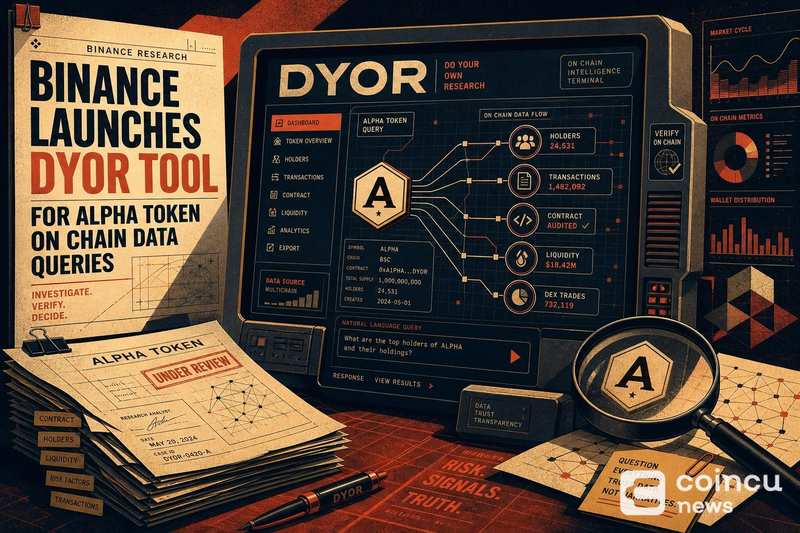

Binance has launched a DYOR research tool designed to let users query on-chain data for Alpha tokens, expanding the exchange’s suite of self-service research features for traders evaluating early-stage digital assets.
What the DYOR Research Tool Does
The new tool, accessible through Binance’s platform, is built around on-chain data queries for tokens listed under the exchange’s Alpha category. Alpha tokens typically represent newer or discovery-stage assets that have not yet graduated to full spot listing, and the DYOR tool gives users a way to inspect blockchain-level activity around these tokens before committing capital.
Binance positioned the feature as part of its broader research infrastructure, according to a report from TradersUnion covering the launch. The tool’s name references the widely used crypto shorthand for “do your own research,” signaling that Binance intends the feature as a data access layer, not an advisory service.

Binance’s announcement on X confirmed the launch and directed users toward the new research hub. The tool appears to sit alongside other Binance Web3 products, including the exchange’s agentic hub for BNB Chain interactions.
How On-Chain Data Queries Fit DYOR Workflows
On-chain data queries allow users to examine blockchain-native metrics such as token holder distribution, transaction volume, liquidity pool activity, and smart contract interactions. For Alpha tokens, which often lack the analyst coverage and historical data available for established assets, direct on-chain access can be the only reliable source of fundamental information.
The tool is designed to surface this data within Binance’s interface rather than requiring users to navigate external block explorers or analytics platforms independently. This reduces friction for users who want to evaluate Alpha tokens but may not be familiar with tools like BscScan or Etherscan.
On-chain data access is not investment analysis. The DYOR tool provides raw or structured blockchain data, not buy or sell recommendations. Users still need to interpret the data and cross-reference it with other sources before making any trading decisions.

Why Binance Is Building Research Features for Alpha Tokens
The launch reflects growing user demand for better token discovery and evaluation tools directly within exchange platforms. As the number of tokens available across decentralized and centralized venues continues to expand, traders increasingly need efficient ways to filter signal from noise, particularly for early-stage assets where information asymmetry is highest.
Binance’s Web3 ecosystem has been expanding in parallel. The exchange’s agentic hub for BNB Chain and its broader Web3 wallet infrastructure suggest a strategy of keeping users within the Binance environment for both trading and research. The DYOR tool fits this pattern by internalizing a workflow that previously required third-party analytics platforms.
This approach also aligns with how other parts of the Web3 ecosystem are evolving. Events like the recent CoinUp Growth Hub Bangkok have highlighted growing demand across Southeast Asia for accessible Web3 tooling, and exchange-native research features address that same user need.
Security remains a parallel concern as Web3 tooling expands. The recent detection of supply chain attacks targeting crypto packages underscores why platform-native research tools, which operate within a controlled environment, may appeal to users wary of interacting with unfamiliar third-party services.
What Traders Should Watch After the Launch
New research tools typically raise questions about data coverage, update frequency, and accuracy. Users should verify whether the DYOR tool covers all Alpha tokens or only a subset, and whether the on-chain data refreshes in real time or on a delayed basis.
Cross-referencing remains essential. Even with a platform-native tool, relying on a single data source for token evaluation introduces risk. Traders and researchers should compare the DYOR tool’s outputs against independent block explorers and analytics platforms to confirm accuracy.
The tool’s long-term impact will depend on adoption and iteration. If Binance expands the feature to cover more token categories or integrates deeper analytics, such as wallet clustering or whale movement alerts, it could shift how users approach token research on centralized exchanges. As on-chain activity grows, with networks like Ethereum recently processing over 70 million monthly transactions, the volume of data available for research tools continues to increase.
FAQ
What is Binance’s DYOR research tool?
It is a feature launched by Binance that allows users to query on-chain blockchain data for tokens in the exchange’s Alpha category. The tool is designed for self-service research, not investment advice.
What does Alpha token on-chain data mean?
Alpha tokens are early-stage or discovery-phase assets available on Binance. On-chain data refers to information recorded directly on the blockchain, such as transaction counts, holder distributions, and smart contract activity for these tokens.
Does the tool provide analysis or raw data?
Based on available information, the DYOR tool provides structured access to on-chain data rather than automated analysis or trading signals. Users are expected to interpret the data independently and cross-check with other sources, consistent with the “do your own research” principle the tool is named after.
Disclaimer: This article is for informational purposes only and does not constitute financial or investment advice. Cryptocurrency and digital asset markets carry significant risk. Always do your own research before making decisions.