Ethereum faces up to $114 million in potential liquidations if its price drops to the $1,472 level, a concentration of leveraged long positions that could amplify selling pressure and accelerate a downside move.
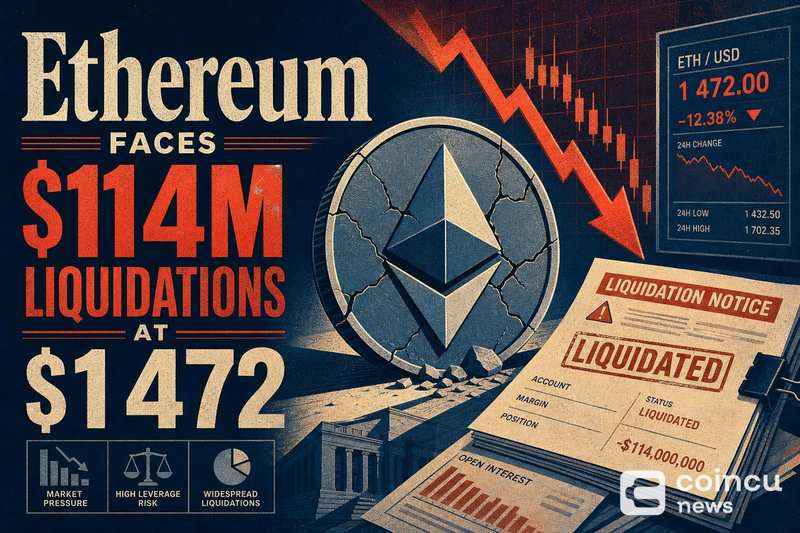
The $114 million figure represents the estimated value of leveraged long positions that would be forcibly closed if ETH reaches the $1,472 price point, based on Coinglass liquidation data. These are potential, not realized, liquidations, meaning they will only trigger if Ethereum’s spot price actually falls to that threshold. For related coverage, see Vitalik Buterin Launches AI De-Anonymization Experiment, Reveals Anonymous Ethereum Writing.
Why the $1,472 liquidation cluster matters
A liquidation cluster of this size signals concentrated leveraged exposure at a specific price level. When a large number of traders open long positions with similar margin requirements, their collective liquidation prices converge around the same zone. For related coverage, see Sweet Sweeps Casino Guide 2026: Bonuses, Withdrawals, and What to Check First.
If ETH approaches $1,472, forced selling from these positions would add to organic sell pressure. The resulting increase in sell-side volume can push the price further down, potentially triggering additional liquidations below that level in what traders call a liquidation cascade. For related coverage, see 5 Online Casino Platforms Readers Commonly Compare in 2026.
The distinction between potential and realized liquidations is critical. The ETH liquidation heatmap shows where clusters of leveraged positions sit, but these only become realized liquidations when price reaches those levels. Market conditions, order book depth, and trading volume all influence whether a liquidation level is actually tested. For related coverage, see Top 5 Online Casino Platforms to Compare in 2026.
Scenarios to watch if Ethereum approaches $1,472
If ETH tests the $1,472 level, the primary risk is a cascade effect. Forced closures of $114 million in long positions would generate significant sell-side pressure, potentially pushing price below the trigger level and into the next cluster of liquidations beneath it.
A stabilization scenario is also possible. If buyers defend the $1,472 zone with sufficient bid-side liquidity, the level could act as support rather than a breakdown point. In that case, the liquidation cluster becomes a magnet that attracts price but does not break it.
Volume and momentum will determine the outcome. A slow drift toward $1,472 on low volume gives buyers time to absorb selling pressure. A sharp move driven by broader market selling or a specific catalyst, such as large whale liquidation events, would make a cascade more likely.
How leverage turns a decline into a cascade
Leveraged trading allows traders to control positions larger than their deposited collateral. When the market moves against a leveraged long position and the trader’s margin falls below the maintenance threshold, the exchange automatically closes the position by selling the underlying asset.
This forced selling adds supply to the market at a time when organic demand may already be weak. If enough positions are liquidated simultaneously, the resulting sell pressure can move the price further down, triggering the next layer of liquidations. This feedback loop is what makes concentrated liquidation levels significant for short-term price action.
The dynamic applies specifically to short-term volatility. Liquidation cascades do not change Ethereum’s fundamentals, and price often recovers once the leveraged overhang is cleared. Institutional interest in Ethereum continues to develop, as demonstrated by initiatives like Ethlabs launching to accelerate Ethereum’s institutional adoption.
Ethereum liquidation FAQ
What does $114 million in potential liquidations mean?
It means that approximately $114 million worth of leveraged long positions on Ethereum futures and perpetual contracts have liquidation prices near the $1,472 level. If ETH’s spot price reaches that point, exchanges would automatically close these positions by selling, converting them from potential to realized liquidations.
Why is $1,472 important for Ethereum?
The $1,472 level is significant not because of any technical indicator or support/resistance line, but because of the volume of leveraged positions concentrated at that price. The density of the liquidation cluster makes it a level where forced selling could meaningfully impact short-term price action.
Does a liquidation level guarantee ETH will fall further?
No. A liquidation level identifies where forced selling would occur if price reaches that point, but it does not guarantee price will get there. Market participants, including market makers and opportunistic buyers, may step in to absorb selling pressure before or at the liquidation level, preventing a cascade.
Disclaimer: This article is for informational purposes only and does not constitute financial or investment advice. Cryptocurrency and digital asset markets carry significant risk. Always do your own research before making decisions.
No tags available.


Other Posts








- China, US Conclude Trade Talks with Focus on Cooperation
- Crypto Weekly: NYSE Backs OKX, Kraken Gets Fed Access, BTC Sells
- Court Upholds Fed’s Rejection of Custodia Bank’s Request
- Former CFO Convicted for $35M Fraudulent Crypto Investment
- DeriW Launches Edge Hour Trading Competition Platform for Derivatives Traders
- Michael Saylor Denies Bitcoin Sell-Off Amid Large BTC Transfer
- Buy Dogecoin on eToro: Step-by-Step Guide for Beginners (2024)
- Kazakhstan Explores Crypto Reserves Backed by National Funds
- JPMorgan Increases Holdings in BlackRock’s Bitcoin ETF
- Nordea Bank Introduces Bitcoin ETP Trading for Nordic Customers
- XRP Spot ETF Launches on Nasdaq Amid Market Fluctuations
- Peter Schiff Challenges Michael Saylor on MSTR’s Business Model
- Thailand Orders Worldcoin to Delete 1.2 Million Biometric Records
- UK Proposes New DeFi Tax Framework to Ease User Burden
- WLFI Under Fire: Analyst Warns Hyperliquid Could Be Next
- Ancient Ethereum Whale Moves $1.19 Billion After Decade
- BlackRock Receives Large Crypto Transfers from Coinbase
- SEC Scrutiny on ALT5 Sigma’s Leadership Disclosure Timing
- Yala Injects $5.5 Million Amid Recovery Efforts
- Radiant Capital Faces $50M Loss in Major Security Breach
- China, US Conclude Trade Talks with Focus on Cooperation
- Crypto Weekly: NYSE Backs OKX, Kraken Gets Fed Access, BTC Sells
- Court Upholds Fed’s Rejection of Custodia Bank’s Request
- Former CFO Convicted for $35M Fraudulent Crypto Investment
- DeriW Launches Edge Hour Trading Competition Platform for Derivatives Traders
- Michael Saylor Denies Bitcoin Sell-Off Amid Large BTC Transfer
- Buy Dogecoin on eToro: Step-by-Step Guide for Beginners (2024)
- Kazakhstan Explores Crypto Reserves Backed by National Funds
- JPMorgan Increases Holdings in BlackRock’s Bitcoin ETF
- Nordea Bank Introduces Bitcoin ETP Trading for Nordic Customers
- XRP Spot ETF Launches on Nasdaq Amid Market Fluctuations
- Peter Schiff Challenges Michael Saylor on MSTR’s Business Model
- Thailand Orders Worldcoin to Delete 1.2 Million Biometric Records
- UK Proposes New DeFi Tax Framework to Ease User Burden
- WLFI Under Fire: Analyst Warns Hyperliquid Could Be Next
- Ancient Ethereum Whale Moves $1.19 Billion After Decade
- BlackRock Receives Large Crypto Transfers from Coinbase
- SEC Scrutiny on ALT5 Sigma’s Leadership Disclosure Timing
- Yala Injects $5.5 Million Amid Recovery Efforts
- Radiant Capital Faces $50M Loss in Major Security Breach
- China, US Conclude Trade Talks with Focus on Cooperation
- Crypto Weekly: NYSE Backs OKX, Kraken Gets Fed Access, BTC Sells
- Court Upholds Fed’s Rejection of Custodia Bank’s Request
- Former CFO Convicted for $35M Fraudulent Crypto Investment
- DeriW Launches Edge Hour Trading Competition Platform for Derivatives Traders
- Michael Saylor Denies Bitcoin Sell-Off Amid Large BTC Transfer
- Buy Dogecoin on eToro: Step-by-Step Guide for Beginners (2024)
- Kazakhstan Explores Crypto Reserves Backed by National Funds
- JPMorgan Increases Holdings in BlackRock’s Bitcoin ETF
- Nordea Bank Introduces Bitcoin ETP Trading for Nordic Customers
- XRP Spot ETF Launches on Nasdaq Amid Market Fluctuations
- Peter Schiff Challenges Michael Saylor on MSTR’s Business Model
- Thailand Orders Worldcoin to Delete 1.2 Million Biometric Records
- UK Proposes New DeFi Tax Framework to Ease User Burden
- WLFI Under Fire: Analyst Warns Hyperliquid Could Be Next
- Ancient Ethereum Whale Moves $1.19 Billion After Decade
- BlackRock Receives Large Crypto Transfers from Coinbase
- SEC Scrutiny on ALT5 Sigma’s Leadership Disclosure Timing
- Yala Injects $5.5 Million Amid Recovery Efforts
- Radiant Capital Faces $50M Loss in Major Security Breach


Former FBI Agent Charged With Stealing Nearly $1 Million in Crypto

Coldcard Exploit Raises Questions About Air-Gapped Bitcoin Wallet Security

Bybit.eu Expands European Offering as Bybit Payments GmbH Secures Electronic Money Institution Licence

1win Introduces Seamless Web3 Login and Crypto Deposits via Trust Wallet, MetaMask, and WalletConnect