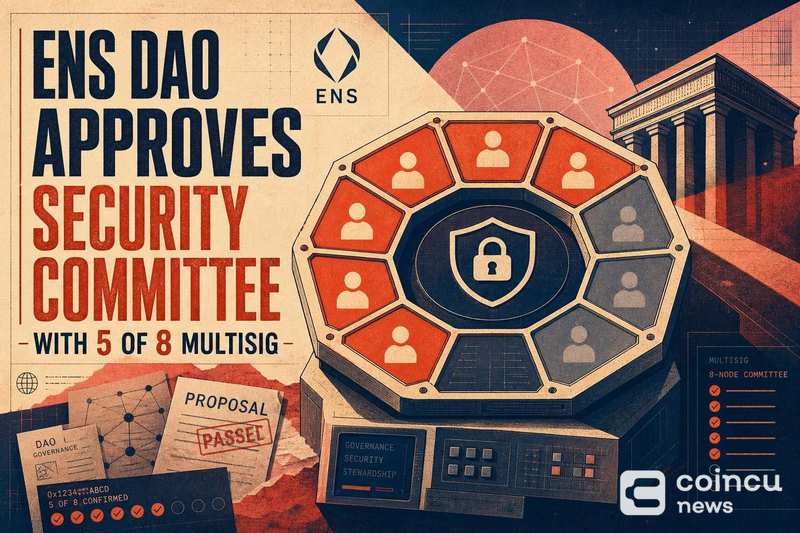
ENS DAO has approved a new security committee that will operate under a 5-of-8 multisig threshold with the power to cancel malicious proposals, tightening the network’s governance defenses as the token’s holders vote to replace an outgoing council whose term expires later this month.
The onchain executable proposal titled “[Executable] Establishing a new Security Council” passed with 4.23M votes in favor, 94.53K against, and 242.24K abstaining, according to the Tally proposal page. Turnout cleared quorum comfortably, reaching 4.47M against a 1M requirement. For related coverage, see Aave v3.1 Upgrade Was Launched To Enhance Security And Different Optimisations.
When the proposal was checked on July 21, 2026, Tally still listed its status as “Pending execution.” That means the vote had passed, but the transaction granting the new council its onchain authority had not yet been shown as executed. For related coverage, see Dubai VARA Approves Tokenization Platform Tribe Tokenisation.
What ENS DAO Approved and How the New Committee Is Structured
The successor ENS DAO Security Council will act on a 5-of-8 basis, meaning any protective action requires at least five of its eight signers to agree, per ENS proposal EP 6.50. It preserves the same cancel-only mandate defined in the earlier EP 5.13. For related coverage, see American Bitcoin Corp Board Approves 1-for-15 Reverse Stock Split.
The council receives a narrow grant of authority through the DAO’s TimelockController: it can cancel proposals it deems malicious, but it cannot initiate governance actions of its own. That framing is what makes the body a security measure rather than a decision-making executive.
The existing council was designed as a 4-of-8 multisig with a limited mandate to cancel harmful proposals and no power to start governance actions, the ENS Security Council policy page states. The new framework raises that bar by one signature while keeping the restricted scope intact.
The new council’s term runs until July 16, 2028, a two-year mandate set out on the Tally proposal. The transition is timed against the outgoing council, whose two-year term ends on July 24, 2026, the executable proposal discussion notes.
Why the 5-of-8 Multisig Model Matters for ENS Governance
Moving from four to five required signatures turns a simple majority of the eight-member council into a supermajority. No coalition of four signers can act alone, which raises the cost of any single faction or compromised set of keys pushing through a veto.
The tradeoff is deliberate. A higher threshold reduces the risk of unilateral control but also demands broader agreement before the council can move, a design choice ENS mirrors in other DAO safeguards such as Aave DAO’s approach to hardening network security.
Setting the bar at five rather than fewer signers reflects the council’s dual job: it must be able to respond quickly to a governance threat, yet not be so easy to trigger that the veto power itself becomes an attack vector. Five of eight keeps emergency response viable while spreading trust across a majority of members.
How Proposal Cancellation Could Protect ENS DAO From Malicious Actions
The council’s single function is to cancel proposals before they execute. In practice, that targets scenarios such as a proposal drafted to drain the treasury, reassign control of core contracts, or slip a hostile parameter change past inattentive voters.
Speed is the point of the mechanism. Onchain governance runs on timelocks, and a cancellation power lets a trusted majority intervene inside that window before a harmful transaction can be executed, reducing damage rather than reversing it after the fact.
“The Security Council is a vital protection for the DAO against governance attacks,” ENS lead developer Nick Johnson wrote in the council renewal discussion.
The Security Council is a vital protection for the DAO against governance attacks.
— Nick Johnson (nick.eth)
The safeguard has clear limits. The council can only stop proposals, not write or amend them, and its cancel-only scope means it cannot fix a flawed process or substitute its own policy. It is a backstop against malicious execution, not a replacement for the DAO’s normal voting.
What the Decision Signals for ENS DAO and the Ethereum Ecosystem
ENS is one of the more closely watched Ethereum-native DAOs, and security-focused governance changes at that level tend to set reference points that other protocols study. A cancel-only committee with a supermajority threshold is the kind of structure smaller protocols can copy, much as security-driven updates like the Aave v3.1 upgrade have shaped wider expectations.
Governance-security incidents have already pushed several DAOs toward stronger controls, from council-style backstops to compensation frameworks like the one CoW DAO adopted after a domain hijacking. ENS raising its own veto threshold fits that broader tightening across Ethereum governance.
For ENS holders, the token traded at $4.56 at press time, up 0.67% over 24 hours, with a market capitalization near $187 million on roughly $15.6 million of daily volume. The governance vote landed against a cautious market backdrop, with the Crypto Fear & Greed Index reading 25, or “Extreme Fear.”
FAQ: ENS DAO Security Committee and 5-of-8 Multisig
What is a 5-of-8 multisig? It is a shared wallet or authority controlled by eight signers where any action needs at least five of them to approve it. For the ENS council, that means five signatures are required to cancel a proposal.
Can the committee cancel any ENS DAO proposal? Its authority is cancel-only and aimed at malicious proposals; it cannot create or modify proposals, and it has no power to initiate governance actions under the mandate carried over from EP 5.13.
Does this reduce ENS decentralization? The council concentrates a narrow veto power in eight members, but raising the threshold from 4-of-8 to 5-of-8 requires broader agreement to act, which is intended to limit unilateral control rather than expand it. As of July 21, 2026, the role-granting transaction was still pending execution on Tally.
Disclaimer: This article is for informational purposes only and does not constitute financial or investment advice. Cryptocurrency and digital asset markets carry significant risk. Always do your own research before making decisions.
No tags available.


Other Posts








- China, US Conclude Trade Talks with Focus on Cooperation
- Crypto Weekly: NYSE Backs OKX, Kraken Gets Fed Access, BTC Sells
- Court Upholds Fed’s Rejection of Custodia Bank’s Request
- Former CFO Convicted for $35M Fraudulent Crypto Investment
- DeriW Launches Edge Hour Trading Competition Platform for Derivatives Traders
- Michael Saylor Denies Bitcoin Sell-Off Amid Large BTC Transfer
- Buy Dogecoin on eToro: Step-by-Step Guide for Beginners (2024)
- Kazakhstan Explores Crypto Reserves Backed by National Funds
- JPMorgan Increases Holdings in BlackRock’s Bitcoin ETF
- Nordea Bank Introduces Bitcoin ETP Trading for Nordic Customers
- XRP Spot ETF Launches on Nasdaq Amid Market Fluctuations
- Peter Schiff Challenges Michael Saylor on MSTR’s Business Model
- Thailand Orders Worldcoin to Delete 1.2 Million Biometric Records
- UK Proposes New DeFi Tax Framework to Ease User Burden
- WLFI Under Fire: Analyst Warns Hyperliquid Could Be Next
- Ancient Ethereum Whale Moves $1.19 Billion After Decade
- BlackRock Receives Large Crypto Transfers from Coinbase
- SEC Scrutiny on ALT5 Sigma’s Leadership Disclosure Timing
- Yala Injects $5.5 Million Amid Recovery Efforts
- Radiant Capital Faces $50M Loss in Major Security Breach
- China, US Conclude Trade Talks with Focus on Cooperation
- Crypto Weekly: NYSE Backs OKX, Kraken Gets Fed Access, BTC Sells
- Court Upholds Fed’s Rejection of Custodia Bank’s Request
- Former CFO Convicted for $35M Fraudulent Crypto Investment
- DeriW Launches Edge Hour Trading Competition Platform for Derivatives Traders
- Michael Saylor Denies Bitcoin Sell-Off Amid Large BTC Transfer
- Buy Dogecoin on eToro: Step-by-Step Guide for Beginners (2024)
- Kazakhstan Explores Crypto Reserves Backed by National Funds
- JPMorgan Increases Holdings in BlackRock’s Bitcoin ETF
- Nordea Bank Introduces Bitcoin ETP Trading for Nordic Customers
- XRP Spot ETF Launches on Nasdaq Amid Market Fluctuations
- Peter Schiff Challenges Michael Saylor on MSTR’s Business Model
- Thailand Orders Worldcoin to Delete 1.2 Million Biometric Records
- UK Proposes New DeFi Tax Framework to Ease User Burden
- WLFI Under Fire: Analyst Warns Hyperliquid Could Be Next
- Ancient Ethereum Whale Moves $1.19 Billion After Decade
- BlackRock Receives Large Crypto Transfers from Coinbase
- SEC Scrutiny on ALT5 Sigma’s Leadership Disclosure Timing
- Yala Injects $5.5 Million Amid Recovery Efforts
- Radiant Capital Faces $50M Loss in Major Security Breach
- China, US Conclude Trade Talks with Focus on Cooperation
- Crypto Weekly: NYSE Backs OKX, Kraken Gets Fed Access, BTC Sells
- Court Upholds Fed’s Rejection of Custodia Bank’s Request
- Former CFO Convicted for $35M Fraudulent Crypto Investment
- DeriW Launches Edge Hour Trading Competition Platform for Derivatives Traders
- Michael Saylor Denies Bitcoin Sell-Off Amid Large BTC Transfer
- Buy Dogecoin on eToro: Step-by-Step Guide for Beginners (2024)
- Kazakhstan Explores Crypto Reserves Backed by National Funds
- JPMorgan Increases Holdings in BlackRock’s Bitcoin ETF
- Nordea Bank Introduces Bitcoin ETP Trading for Nordic Customers
- XRP Spot ETF Launches on Nasdaq Amid Market Fluctuations
- Peter Schiff Challenges Michael Saylor on MSTR’s Business Model
- Thailand Orders Worldcoin to Delete 1.2 Million Biometric Records
- UK Proposes New DeFi Tax Framework to Ease User Burden
- WLFI Under Fire: Analyst Warns Hyperliquid Could Be Next
- Ancient Ethereum Whale Moves $1.19 Billion After Decade
- BlackRock Receives Large Crypto Transfers from Coinbase
- SEC Scrutiny on ALT5 Sigma’s Leadership Disclosure Timing
- Yala Injects $5.5 Million Amid Recovery Efforts
- Radiant Capital Faces $50M Loss in Major Security Breach


Mastercard to Acquire Stablecoin Firm BVNK in $1.8 Billion Deal

Cashelix Launches CASX Token Presale to Fuel the Future of Blockchain P2P Transactions
Bybit Sues North Korea and Lazarus Group, Secures Preliminary Injunction Freezing Stolen Assets in Landmark Crypto Asset Recovery Effort