
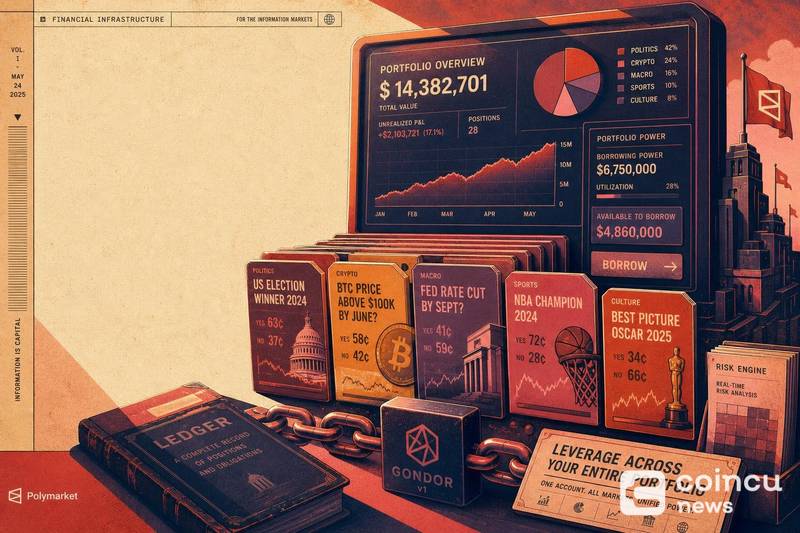

Gondor v1 will support borrowing and leverage using entire Polymarket portfolios, introducing a DeFi lending layer on top of prediction market positions that allows users to collateralize their full portfolio rather than individual positions.
The protocol announced the feature as cross-margin borrowing for Polymarket portfolios, enabling traders to unlock liquidity from positions they already hold without closing them.
According to a KuCoin flash report, Gondor has launched cross-margin borrowing specifically designed for Polymarket portfolios, positioning itself as infrastructure that bridges prediction markets and DeFi lending.
Portfolio-Wide Collateral Changes the Equation
The distinction between isolated and portfolio-wide collateral is significant. In isolated collateral systems, each position stands alone. If a user holds ten Polymarket positions, each one’s borrowing power is evaluated independently.
Portfolio-level collateral aggregates the value of all positions into a single borrowing base. This means a diversified Polymarket portfolio, with positions spread across uncorrelated events, could offer more stable collateral value than any single position alone.
The exact mechanics of how Gondor values and risk-weights different Polymarket positions have not been fully detailed in available documentation. Users should expect that collateral factors will vary based on market liquidity, time to resolution, and position concentration.
Leverage Amplifies Both Conviction and Risk
Adding leverage to prediction market portfolios introduces capital efficiency that Polymarket traders have not previously had access to. A trader confident in a set of outcomes could borrow against existing positions to take new ones, increasing exposure without adding fresh capital.
This also introduces liquidation risk. Prediction markets can experience sharp price swings as new information emerges, and leveraged positions amplify losses in the same way they amplify gains. A portfolio used as collateral could face liquidation if multiple positions move adversely at once.
The risk profile differs from traditional DeFi lending. Prediction market positions have binary or bounded outcomes and fixed expiration dates, which creates a collateral type that behaves differently from volatile tokens like ETH or SOL. Borrowers and the protocol must account for the possibility that positions resolve to zero.
DeFi Infrastructure Meets Prediction Markets
Gondor v1 represents a convergence between DeFi borrowing tools and prediction market assets. Polymarket portfolios are onchain financial instruments with quantifiable value, making them natural candidates for collateralization, similar to how Sui’s Hashi Global is exploring native BTC collateral for its own ecosystem.
The development fits a broader pattern of DeFi protocols treating non-traditional onchain assets as productive collateral. As prediction markets have grown in volume, the capital locked in positions has become an increasingly large pool of idle value that lending infrastructure could unlock.
Whether this model gains traction depends on execution. Collateral valuation for prediction market positions is a novel problem, and the risk models that Gondor deploys will determine whether the system can handle the unique dynamics of binary outcome markets without cascading liquidations.
For now, the launch signals that DeFi builders see prediction market portfolios as a legitimate asset class worth building financial infrastructure around. The actual impact will become clearer as users test the system and real borrowing volume materializes. Developments in crypto-friendly regulatory frameworks could also influence how quickly such DeFi products gain mainstream adoption.
FAQ About Gondor v1 and Polymarket Portfolio Borrowing
What is Gondor v1?
Gondor v1 is a DeFi protocol that enables borrowing and leverage against Polymarket prediction market portfolios. It provides cross-margin borrowing, meaning users can collateralize their entire portfolio of positions rather than individual ones.
What does borrowing against an entire Polymarket portfolio mean?
Instead of pledging a single prediction market position as collateral, users can use their full set of Polymarket holdings. The combined value of all positions determines borrowing capacity, potentially offering better capital efficiency than isolated position lending.
How is leverage different from simple borrowing?
Borrowing lets users access liquidity while keeping their positions open. Leverage specifically refers to using borrowed funds to take additional positions, which multiplies both potential gains and potential losses relative to the original capital deployed.
What are the main risks users should consider?
Liquidation is the primary risk. If the combined value of a user’s Polymarket portfolio drops below the required collateral threshold, the protocol may liquidate positions to cover the loan. Prediction market positions can move sharply on news events, and leveraged exposure amplifies that volatility.
Disclaimer: This article is for informational purposes only and does not constitute financial or investment advice. Cryptocurrency and digital asset markets carry significant risk. Always do your own research before making decisions.