
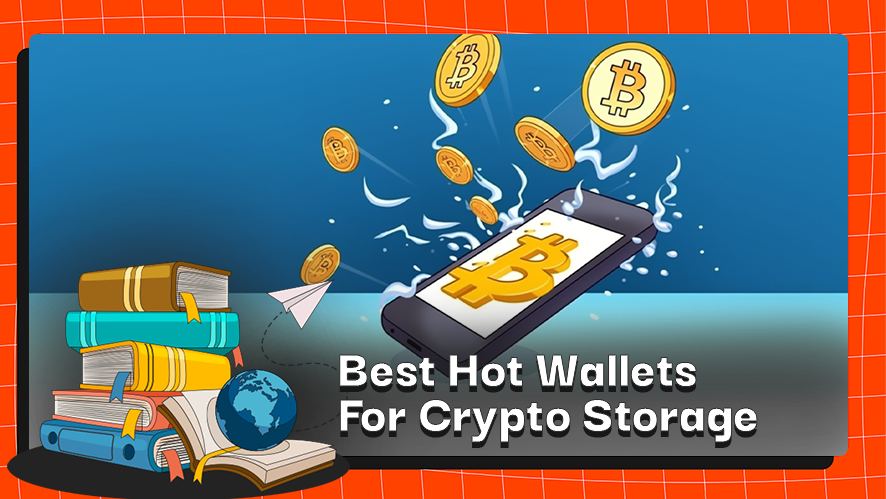

Best Hot Wallets for Crypto Storage in 2026: 5 Wallets Compared
Updated July 6, 2026
Quick Answer
If you want the short version, the best hot wallets for crypto storage in 2026 are MetaMask, Trust Wallet, Phantom, Rabby, and Exodus.
They are not interchangeable. MetaMask remains a strong default for users living inside Ethereum and other EVM-heavy workflows. Trust Wallet is still one of the broadest mainstream multichain options. Phantom is now much more than a Solana-only wallet and works well for users who want a cleaner app experience. Rabby is a focused pick for readers who spend most of their time on Ethereum and EVM chains. Exodus stands out for readers who want a more portfolio-oriented self-custody experience across devices.
The real choice is not only which wallet looks best. It is which wallet matches your chain usage, security habits, and day-to-day transaction style.

What Makes a Hot Wallet Different?
A hot wallet is a wallet connected to the internet, usually through a browser extension, mobile app, or desktop application. That connectivity makes it useful for daily activity like swaps, NFT management, staking, and dApp access. It also means it carries more operational risk than a hardware wallet if the user handles permissions, phishing attempts, or seed-phrase backups poorly.
That is why the right way to use a hot wallet is usually:
- active balances in a hot wallet
- long-term or larger balances in colder storage
Coincu already has a background explainer on understanding hot wallets and cold wallets. This refresh focuses on the more practical decision: which hot wallet actually fits different kinds of crypto users in 2026.

How We Chose These Wallets
This list is not trying to rank the “most bullish” wallet or the wallet with the loudest marketing.
Instead, these five were chosen based on:
- self-custody model
- current official support for mobile, browser, or desktop usage
- multichain or ecosystem-specific strengths
- clear documentation around wallet behavior and supported networks
- practical usefulness for real onchain activity
All product details below were checked against official wallet documentation in July 2026. Where a wallet’s documentation is broad or fast-moving, the wording here stays conservative on purpose.
One more point matters here. A self-custody wallet is not the same thing as a custodial exchange account. Coinbase explains the distinction clearly in its guide to exchanges and self-custody wallets: an exchange manages your assets for you, while a self-custody wallet gives you direct control of private keys or recovery credentials. Coincu’s explainer on what crypto custody is is also useful if you want the broader concept before comparing wallet products.
Quick Comparison
| Wallet | Best for | Supported form factors | Network stance | Strongest point | Main trade-off |
|---|---|---|---|---|---|
| MetaMask | EVM users and frequent dApp users | Browser extension and mobile app | Broad default networks, custom network support, and a more multichain direction than older MetaMask versions | flexible dApp access | can feel busy for newer users |
| Trust Wallet | Mainstream multichain users | Mobile app and browser extension | 100+ blockchain networks according to Trust Wallet | broad chain coverage in one wallet | less specialized than chain-specific wallets |
| Phantom | Solana-first users who also want multichain support | Browser extension and mobile app | Supports Solana plus several additional networks including Ethereum, Base, Polygon, Sui, Monad, Bitcoin, and HyperEVM | clean everyday UX | not as open-ended for custom networks |
| Rabby | Ethereum and EVM-heavy users | Browser extension, desktop, mobile | Purpose-built for Ethereum and EVM chains | focused EVM workflow | weak fit for non-EVM-first users |
| Exodus | Users who want multi-device self-custody | Mobile, desktop, Web3 wallet | 50+ crypto networks according to Exodus support docs | polished portfolio-style experience | some advanced users will want more specialized tooling |
1. MetaMask
MetaMask still deserves a place in almost every serious hot-wallet comparison because it remains one of the most important default gateways into onchain activity.
MetaMask’s help center says the wallet is available as both a browser extension and mobile app. Its current network documentation also shows broad default-network coverage, support for adding custom networks, and a more explicit multichain-account structure than older MetaMask users may remember.
Why it made the list:
- still one of the most widely recognized self-custody wallets
- strong for EVM users and still increasingly relevant for multichain usage
- custom network support remains a real advantage for active users
What looks strongest in 2026:
- mature extension and mobile workflow
- deep dApp compatibility
- multichain account direction makes it less limited than older MetaMask versions
What remains weaker:
- it can feel crowded to beginners
- custom-network flexibility is a strength for advanced users, but also adds room for setup mistakes
Who it may suit:
- EVM users
- DeFi traders
- readers who interact with many different apps and chains
For supporting context, Coincu already has a long-standing MetaMask review and a separate explainer on WalletConnect, both of which fit naturally into this cluster.

2. Trust Wallet
Trust Wallet remains one of the broadest mainstream hot-wallet options for users who want a self-custody wallet without narrowing themselves to one ecosystem.
Trust Wallet’s browser-extension page says users can explore dApps across more than 100 blockchain networks, and it highlights support across multiple browsers and operating systems. It also emphasizes self-custody, built-in private key encryption, multi-wallet management, and hardware-wallet connection support. Trust Wallet’s support articles also reinforce that funds live on their respective chains rather than “inside” the wallet itself.
Why it made the list:
- very broad chain coverage
- strong brand recognition among mainstream self-custody users
- mobile-plus-extension model works well for users who switch devices often
What looks strongest in 2026:
- true multichain breadth
- good bridge wallet for users who hold many assets across different ecosystems
- familiar enough for mainstream adoption without being purely exchange-custodial
What remains weaker:
- very broad wallet coverage does not automatically make it the best specialist choice for every chain
- extension security and update discipline still matter, as shown by past security notices tied to specific versions
Who it may suit:
- multichain users
- mobile-first users
- readers who want one wallet for a wider set of assets and chains
Coincu also has an existing Trust Wallet review that can support internal linking from this refreshed page.
3. Phantom
Phantom used to be easy to summarize as a Solana wallet. That is no longer enough.
Phantom’s help center now documents support for Solana, Ethereum, Base, Polygon, Sui, Monad, Bitcoin, and HyperEVM. That matters because Phantom is no longer just a Solana wallet in practice, even if Solana remains the clearest entry point for many users.
Why it made the list:
- one of the cleanest wallet experiences for users who want both usability and real ecosystem coverage
- strong fit for Solana-native users without being trapped in Solana only
- clearer and friendlier UX than many wallets that grew up inside older extension-first workflows
What looks strongest in 2026:
- multichain support is now much more mature
- strong mobile and extension presence
- still one of the easiest wallets for active Solana users to recommend
What remains weaker:
- Phantom does not let users manually add just any network
- that makes it cleaner, but also less flexible than wallets built around custom-network sprawl
Who it may suit:
- Solana users
- NFT and consumer-Web3 users
- readers who want a cleaner multi-chain daily wallet
4. Rabby
Rabby makes the list because it solves a slightly different problem from the other wallets here. It is not trying to be the broadest multichain wallet for everyone. It is a more focused wallet for users who spend most of their time on Ethereum and other EVM chains.
Rabby’s homepage explicitly positions it as a wallet for Ethereum and EVM chains. That narrower scope is exactly why it remains relevant in a comparison like this: some users do not want a general-purpose wallet first, they want an EVM-first workflow.
Why it made the list:
- strong fit for active EVM users
- focused product scope
- useful alternative for users who feel standard wallet UX has become too noisy
What looks strongest in 2026:
- strong fit for DeFi-native or power users
- focused product identity instead of trying to be everything for everyone
What remains weaker:
- not the best fit if your main goal is broad non-EVM consumer usage
- more useful once the user already understands wallet permissions and transaction flow
Who it may suit:
- EVM power users
- DeFi traders
- users who want a more EVM-specific wallet environment
5. Exodus
Exodus remains relevant because it appeals to a type of user that many wallet roundups ignore: the person who wants self-custody but also wants a cleaner, more portfolio-oriented experience across desktop, mobile, and browser environments.
Exodus support documentation says the wallet supports 50+ crypto networks and broad token coverage on major Web3 networks. That keeps it in the conversation for readers who care as much about cross-device usability as they do about raw DeFi depth.
Why it made the list:
- strong multi-device experience
- broad network support
- easier fit for users who want to manage assets without living entirely inside DeFi-native browser-extension culture
What looks strongest in 2026:
- desktop, mobile, and Web3 wallet workflow is still a real differentiator
- asset support documentation is relatively clear
- good fit for users who care about organization and visibility
What remains weaker:
- power users who prioritize the most aggressive dApp-native tooling may still prefer something more specialized
- some Web3 usage patterns still feel lighter than what a dedicated EVM-first wallet can offer
Who it may suit:
- multi-device users
- portfolio-oriented self-custody users
- readers who want a polished wallet without jumping straight into the deepest power-user tooling
Which Hot Wallet Is Best for Different Types of Users?
If you only want a simple decision framework:
- choose MetaMask if you mainly live on Ethereum, EVM chains, and DeFi apps
- choose Trust Wallet if you want broad multichain coverage in a mainstream self-custody product
- choose Phantom if you are Solana-first but still want a modern multichain wallet
- choose Rabby if you spend most of your time on Ethereum and EVM chains and want a more focused wallet
- choose Exodus if you want a cleaner self-custody experience across desktop, mobile, and browser workflows
What Hot Wallets Still Get Wrong
Most “best hot wallet” pages oversell convenience and undersell operational risk.
The actual weak points are usually:
- phishing
- malicious signing requests
- poor recovery-phrase storage
- confusion between exchange accounts and self-custody wallets
- users storing too much long-term value in always-online wallets
That is why the best hot wallet is not the one with the most chains or the loudest app-store marketing. It is the one whose workflow you can manage safely.
FAQ
What is the best hot wallet for crypto storage in 2026?
There is no one answer for every user. MetaMask, Trust Wallet, Phantom, Rabby, and Exodus all make sense for different reasons. The right choice depends on your chains, your device habits, and whether you need broad multichain access or more specialized transaction tooling.
Is a hot wallet safe enough for storing crypto?
A hot wallet can be safe for active balances if you use it carefully, secure the recovery phrase properly, and avoid signing malicious transactions. It is usually not the best place for larger long-term holdings that could be kept in colder storage.
Which hot wallet is best for beginners?
Trust Wallet and Exodus are often easier starting points for beginners who want a more guided or cleaner interface. MetaMask is still common, but many new users find it more comfortable after they already understand networks and dApp permissions.
Is Phantom only for Solana?
No. Phantom now supports several networks beyond Solana, including Ethereum, Base, Polygon, Sui, Monad, Bitcoin, and HyperEVM according to its current support documentation.
Why is a self-custody wallet different from an exchange account?
A self-custody wallet gives you direct control of recovery credentials or private keys. An exchange account is custodial, which means the platform manages those controls on your behalf.
Final Takeaway
The best hot wallets for crypto storage in 2026 are not competing on one dimension.
MetaMask is still a core option for EVM-heavy users. Trust Wallet remains one of the broadest mainstream self-custody choices. Phantom has evolved into a much stronger multichain wallet than many users still assume. Rabby stays relevant by staying focused on Ethereum and EVM usage. Exodus remains a strong option for users who want self-custody with a more polished multi-device experience.
That is the cleaner way to evaluate hot wallets now. Not by hype, and not by app-store slogans, but by custody model, network fit, and the actual workflow you can manage safely.
References
- MetaMask getting started: https://support.metamask.io/start/getting-started-with-metamask
- MetaMask networks: https://support.metamask.io/configure/networks/
- MetaMask custom networks: https://support.metamask.io/configure/networks/how-to-add-a-custom-network-rpc
- MetaMask multichain accounts: https://support.metamask.io/configure/accounts/multichain-accounts
- Trust Wallet browser extension: https://trustwallet.com/browser-extension
- Trust Wallet support guide on wallet behavior: https://support.trustwallet.com/support/solutions/articles/67000659181-how-to-locate-missing-funds
- Phantom supported chains: https://help.phantom.com/hc/en-us/articles/41372840389651-Supported-networks-chains-in-Phantom
- Phantom supported platforms: https://help.phantom.com/hc/en-us/articles/48456789393811-Supported-platforms-and-browsers
- Rabby homepage: https://rabby.io/
- Rabby integration docs: https://rabby.io/docs/integrating-rabby-wallet
- Exodus supported assets: https://www.exodus.com/support/en/articles/8598611-which-assets-does-exodus-support
- Exodus Web3 wallet guide: https://www.exodus.com/support/en/articles/8598807-getting-started-with-exodus-web3-wallet
- Coinbase self-custody explainer: https://help.coinbase.com/en/coinbase/getting-started/crypto-education/exchanges-self-custody-wallets
Internal Link Opportunities
- MetaMask review: https://coincu.com/metamask-review/
- Trust Wallet review: https://coincu.com/trust-wallet-review-secure-crypto-wallet/
- Ultimate Guide To Choosing The Best Crypto Wallet In 2024: https://coincu.com/best-crypto-wallet/
- Understanding Hot Wallets And Cold Wallets To Secure Your Digital Assets In 2024: https://coincu.com/understanding-hot-wallets-and-cold-wallets/
- What Is WalletConnect? The QR Code That Grew Into Web3’s Backbone: https://coincu.com/what-is-walletconnect-the-qr-code-web3-backbone/
- What Is Crypto Custody?: https://coincu.com/what-is-crypto-custody/
Media Plan
Featured image:
- a collage with MetaMask, Trust Wallet, Phantom, Rabby, and Exodus
- style should look like a wallet-comparison editorial, not a price or trading hero
Suggested inline media:
- MetaMask setup or networks documentation capture
- Phantom supported chains visual
- Trust Wallet browser-extension visual
Caption direction:
- reinforce wallet type, supported environment, and trade-off
Disclosure
This article is for informational purposes only and does not constitute investment advice or security advice. Wallet features, supported networks, browser support, and app behavior can change over time, so readers should verify the latest official wallet documentation before moving funds or connecting to dApps.