
Walrus Protocol is a decentralized data storage and availability network built with the Sui blockchain. Its current positioning is broader than simple file storage: Walrus describes itself as a verifiable data platform for systems that need provable, programmable, and highly available data.
That shift matters. In 2025, many reviews framed Walrus mainly around blockchain storage and WAL exchange listings. By May 2026, the more relevant story is infrastructure: Walrus is targeting AI agents, financial systems, data markets, onchain applications, and developers who need stored data to be verifiable rather than merely hosted.
Walrus stores data as blobs. A blob is content-addressed, meaning that changes to the underlying data produce a different identifier. Blobs are tied to Sui objects, which allows smart contracts to reason about data ownership, lifetime, availability, and access.

| Key Takeaways: – Walrus is no longer only a “decentralized storage protocol” thesis. As of 2026, the project positions itself as a verifiable data platform for high-stakes systems, especially AI agents, data markets, and onchain finance. – Walrus Mainnet is live. It launched in March 2025 and operates on Sui Mainnet with 1,000 shards, two-week Mainnet epochs, and storage purchases up to 53 epochs ahead. – The biggest 2026 update is predictable pricing. On May 13, 2026, Walrus announced fixed USD-denominated storage pricing of $0.023 per GB per month, paid in WAL, with SUI still required for gas. – WAL is used for storage payments, staking, network security, and governance. The max supply is 5,000,000,000 WAL. The official WAL page lists 1,250,000,000 WAL as initial circulating supply. – Walrus has strong technical differentiation through erasure coding, Sui smart-contract integration, onchain object representation, programmable access, and verifiable data availability. – The main risks are adoption, Sui ecosystem dependency, token unlock pressure, developer complexity for advanced use cases, and the fact that Walrus storage is not permanent by default. |
What is Walrus Protocol?
Walrus Protocol is a decentralized data storage and availability network built on the Sui ecosystem. It is designed for applications that need verifiable, programmable, and highly available data, including AI agents, data markets, DeFi systems, decentralized applications, and onchain audit workflows.
Unlike traditional cloud storage, Walrus ties stored data to blockchain-based coordination. Blobs are content-addressed and represented through Sui objects, allowing applications to manage storage ownership, access, payments, and availability through smart contracts.
Walrus is not permanent storage by default. Data is stored for a defined storage period and can be extended over time. This makes it different from permanent-storage networks such as Arweave and more suitable for applications that need programmable data availability rather than indefinite archival storage.
Walrus Mainnet launched in March 2025 and is active on Sui Mainnet. As of May 2026, the network is production-facing and supports publishing and retrieving blobs, Walrus Sites, staking, and storage payments through WAL.

| Parameter | Mainnet | Testnet |
|---|---|---|
| Sui network | Mainnet | Testnet |
| Number of shards | 1,000 | 1,000 |
| Epoch duration | 2 weeks | 1 day |
| Max epochs storage can be bought ahead | 53 | 53 |
| Did you know? Walrus is not only useful for digital assets like NFTs but also helps businesses in their strategy to recover important data at low cost. |
Walrus Protocol Highlights
Cost-Efficient Storage
Walrus optimizes storage costs by ensuring data is uploaded only once, while storage nodes require significantly fewer resources relative to the data size. As the number of storage nodes increases, individual nodes handle smaller data portions, further minimizing overall storage expenses.
High Availability and Reliability
The protocol maintains strong data availability through erasure coding and distributed storage. Data can remain retrievable even when a significant portion of storage nodes are unavailable, depending on read and write threshold conditions. Walrus also supports efficient verification without requiring users to download entire data blocks.
Seamless Integration with Sui Blockchain
Walrus leverages the Sui Blockchain to manage storage resources as Sui objects, coordinate node activities, and facilitate payment processing, ensuring smooth and automated operations.
Robust Tokenomics
The WAL token underpins the protocol’s staking mechanism, incentivizing both storage node operators and users who engage with the system.
Developer-Friendly Tools and API Support
Walrus is compatible with a range of developer tools, including CLI, SDK, and Web2 HTTP technologies. This broad support enables seamless integration into various applications.
Privacy Protection
While data stored on Walrus remains publicly accessible, users can enhance privacy by encrypting sensitive content off-chain before uploading.
How Walrus Protocol Works
Walrus operates on a streamlined, six-component system designed to facilitate efficient decentralized data storage on the Sui blockchain. At the forefront are End Users, individuals who upload various forms of data—known as blobs, such as images or audio files—onto the network. These blobs are accessible and retrievable as needed.
Serving as the intermediary, the Client connects End Users to the network’s infrastructure by receiving the data and transmitting it to the Publisher, which is tasked with recording the blobs into the system.
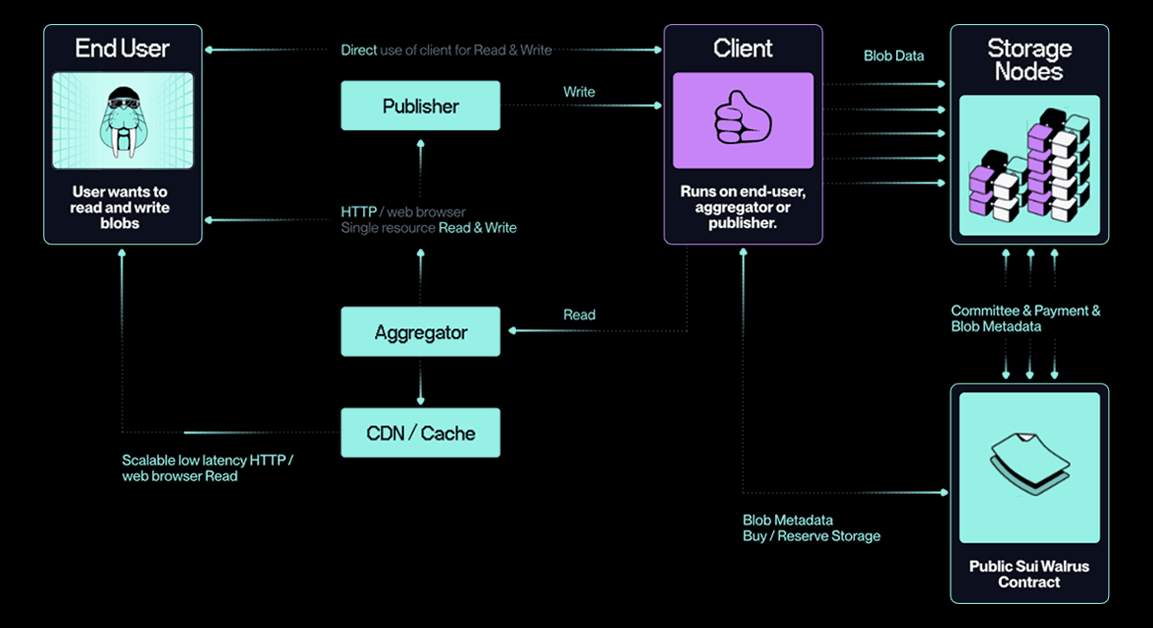
The backbone of Walrus lies in its Storage Nodes. These nodes store the data and handle user access requests. Participation as a node requires users to stake WAL, the platform’s native token, ensuring commitment to the network’s integrity. Supporting the system’s scalability, the Aggregator collects data from various storage nodes and facilitates delivery to other systems or users, enhancing retrieval efficiency.
To ensure low-latency access, Walrus also employs a CDN/Cache, which temporarily stores frequently accessed data, minimizing delays for end users.
Walrus’s data handling follows a multi-step mechanism:
Blobs are broken into smaller segments called slivers using an erasure coding algorithm. These slivers are distributed across the storage nodes to maintain data redundancy and reliability.
Storage nodes receive and store slivers, then submit cryptographic proofs to the Sui blockchain confirming they are actively storing the data.
Users can access stored blobs through various interfaces, including CLI, SDK, or HTTP API. Even if some slivers are lost, the system can reconstruct the original data using the remaining fragments.
At the close of each epoch, the network allocates rewards to active storage nodes and WAL token stakers based on their contributions.
Node performance is regularly evaluated through smart contracts, which can add or remove nodes depending on their reliability and activity during each epoch.
Applications of Walrus Protocol
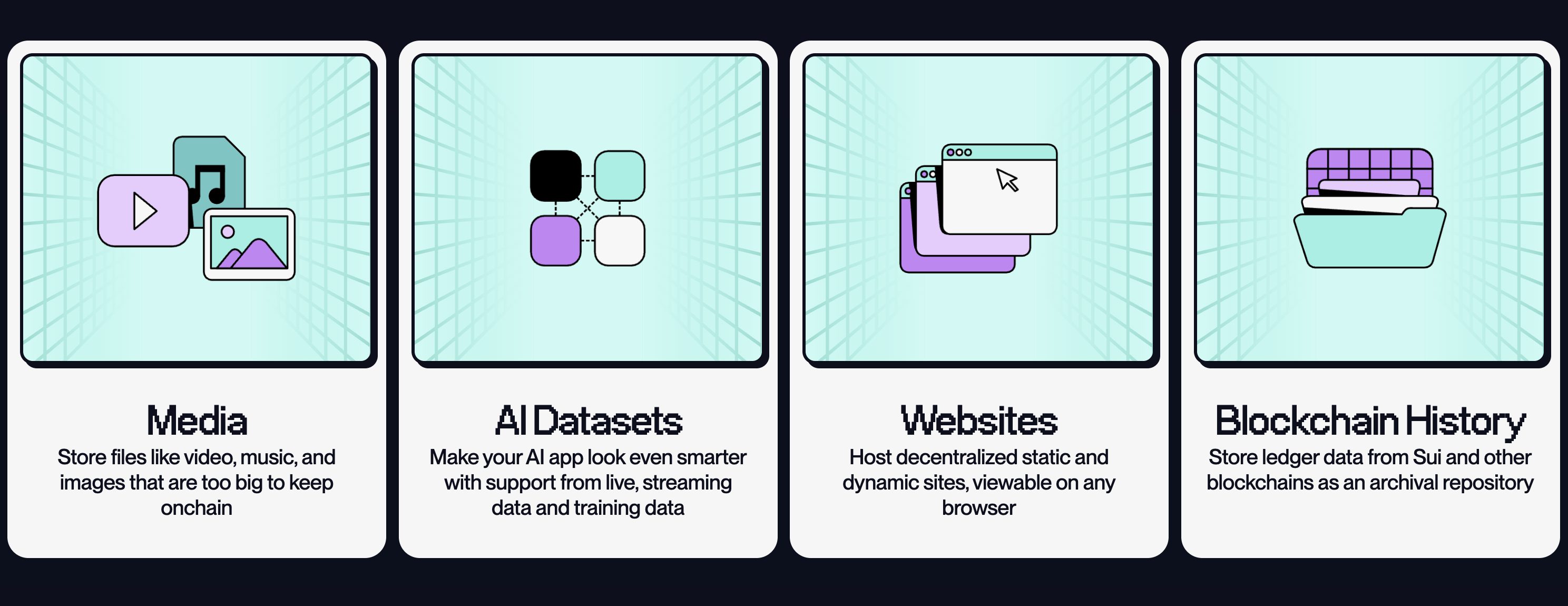
| Media Storage | Supports the storage of large files such as videos and images, surpassing traditional blockchain limits. |
| Blockchain History | Enables long-term storage of historical ledger data from various blockchains. |
| AI Dataset Management | Handles live-streamed and training data for AI applications, ensuring scalable and reliable access. |
| Decentralized Web Hosting | Allows users to host websites without centralized servers, accessible through any standard web browser. |
What Makes Walrus Different?
1. Verifiable storage, not just hosted storage
Walrus is designed so data can be independently verified. Data is content-addressed, cryptographically verifiable, and bound to Sui objects. For users, this means the system can prove whether data has changed and whether it remains available.
This is especially relevant for AI and finance. AI agents, data marketplaces, trading systems, and audit workflows often need to know not only that data can be downloaded, but that it is the correct data and that it has not been silently modified.
2. Erasure coding and high availability
Walrus uses erasure coding instead of full replication. According to official documentation, Walrus maintains roughly 4.5x to 5x storage overhead while providing strong fault tolerance. Reads can remain available with up to two-thirds of nodes responsive, while writes tolerate up to one-third of nodes being unavailable.
The practical benefit is cost-efficient redundancy. Instead of requiring every node to store a full copy of every file, Walrus splits and encodes data into pieces distributed across storage nodes.
3. Sui smart-contract integration
Walrus uses Sui for coordination, availability attestation, ownership, payments, and storage-resource management. Storage is not treated as an offchain afterthought. Blobs are represented through Sui objects, which means smart contracts can interact with data lifetimes, access logic, and verification workflows.
This gives Walrus a different profile from storage systems that focus mainly on archival persistence or peer-to-peer file routing.
4. Predictable pricing in 2026
The most important recent update is Walrus’ move to fixed USD-denominated pricing. On May 13, 2026, Walrus announced storage pricing of $0.023 per GB per month. Users still pay in WAL, but the amount of WAL required adjusts as WAL’s market price changes. SUI remains necessary for gas fees.
This is a meaningful improvement for developers. Token-denominated storage costs can be difficult to forecast when token prices move sharply. A USD-denominated pricing model makes budgeting simpler for teams that want to use Walrus in production.
WAL Token
WAL serves as the native token of the network and is central to the Walrus Protocol’s decentralized storage model.
| Token item | Current information |
|---|---|
| Token symbol | WAL |
| Max supply | 5,000,000,000 WAL |
| Official initial circulating supply | 1,250,000,000 WAL |
| Estimated circulating supply in May 2026 | Around 2,349,583,333 WAL based on public market and circulation-schedule data |
| Main uses | Storage payments, staking, network security, governance |
| Smallest subdivision | FROST, where 1 WAL equals 1 billion FROST |
Tokenomics
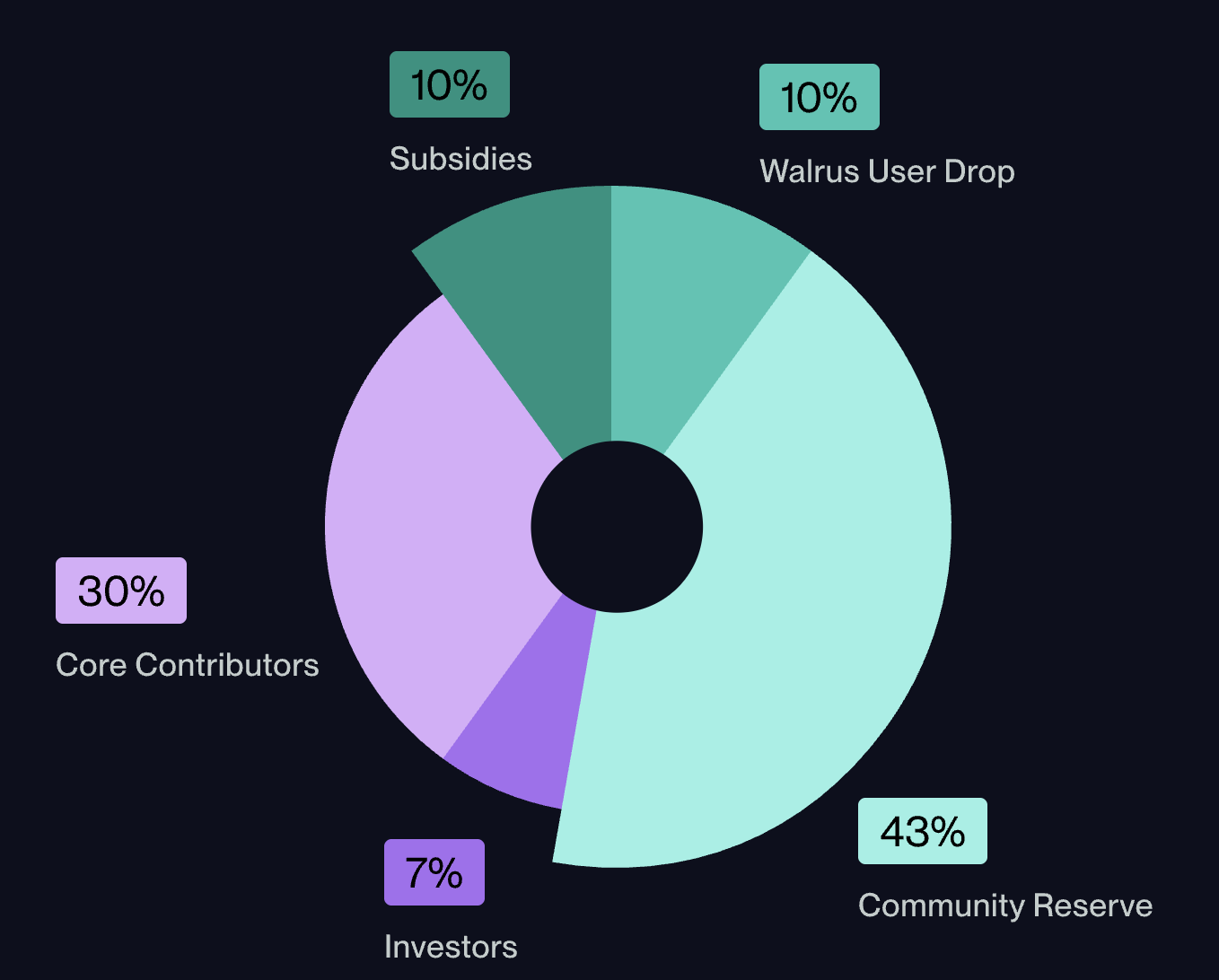
| Walrus User Drop | 10% | Fully unlocked | Distributed to community members from Sui and Walrus ecosystems. Includes initial airdrop and future direct distributions for active participants. |
| Pre-Mainnet | 4% | Fully unlocked | Part of the Walrus User Drop allocation. |
| Post-Mainnet | 6% | Fully unlocked | Part of the Walrus User Drop allocation. |
| Community Reserve | 43% | 690M WAL available at launch; linear unlock until March 2033 | Supports long-term development: grants, dev support, core research, events, and other initiatives. Managed by the Walrus Foundation. |
| Investors | 7% | Unlocks 12 months from Mainnet launch | Reserved for Walrus investors. |
| Core Contributors | 30% | – 20% Early contributors: 4-year unlock with 1-year cliff – 10% Mysten Labs: 50M WAL at launch, linear unlock until March 2030 | For early engineering, infrastructure, growth, and operations contributors. Vesting ensures alignment with long-term goals. |
| Subsidies | 10% | Linearly unlocks over 50 months | Used to subsidize payments to storage nodes as the network grows. |
Release Schedule
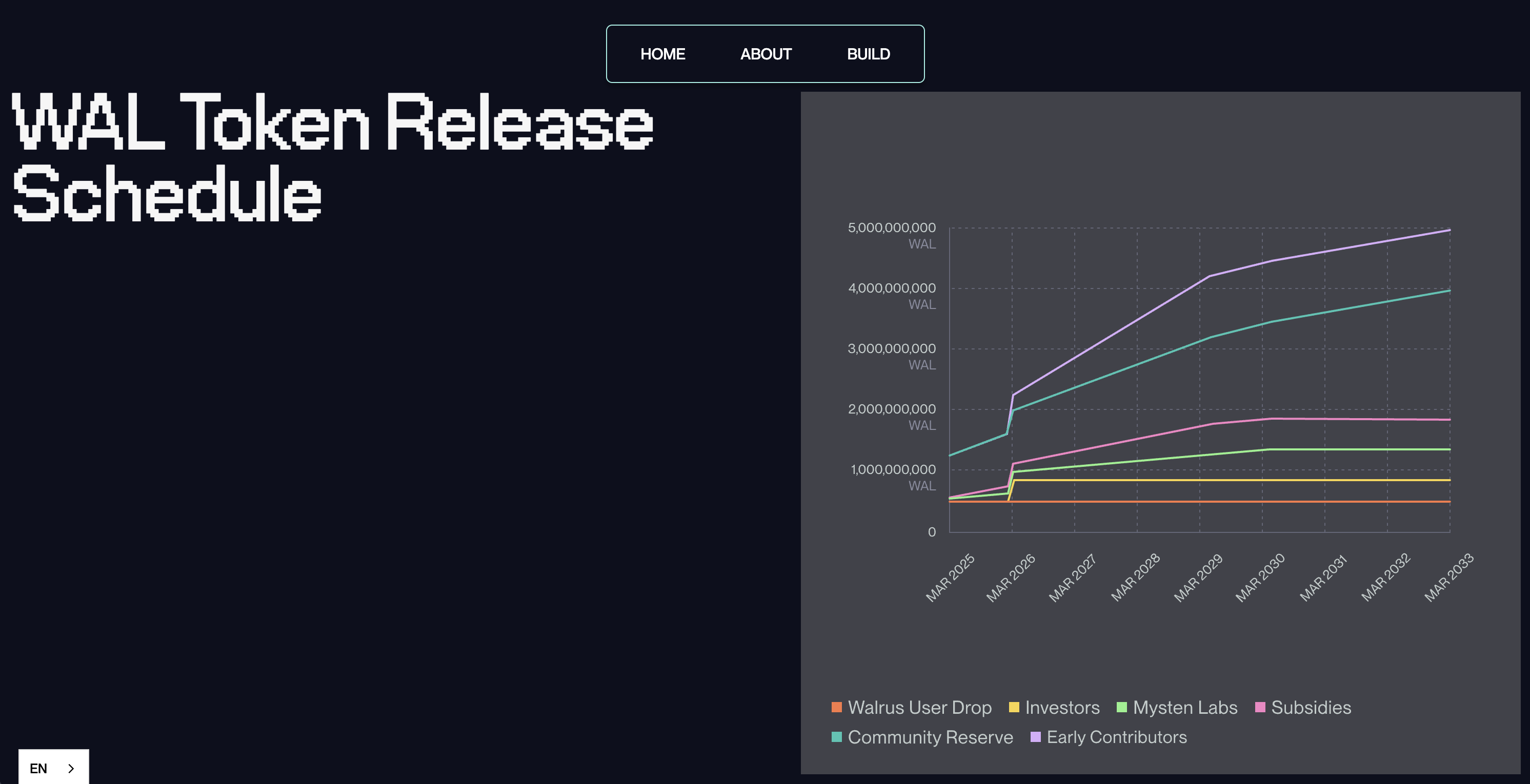
WAL still has unlock risk. Public circulation schedules show that supply increased from the initial 1.25 billion WAL and was estimated around 2.35 billion WAL in May 2026. More unlocks are scheduled in future months. This can create selling pressure if demand for storage, staking, and ecosystem usage does not keep pace with new liquid supply.
For readers, the key point is simple: WAL has real protocol utility, but token price performance depends on adoption, storage demand, broader market conditions, and unlock absorption.
WAL Token Use Cases
WAL has three core functions:
- Payment: Users pay storage fees in WAL.
- Security: WAL can be staked to storage nodes to help secure the network and influence committee selection.
- Governance: WAL stake is used in governance and system-parameter decisions.
The token is now available across a broad set of exchanges and wallets. The official Walrus site says WAL is available on more than 18 exchanges worldwide.
Team
Walrus was originally developed by Mysten Labs, the core contributor behind the Sui network. Mysten Labs’ founding team includes:
- Evan Cheng: Co-Founder and CEO.
- Sam Blackshear: Co-Founder and CTO.
- Adeniyi Abiodun: Co-Founder and CPO.
- Kostas Chalkias: Co-Founder and Chief Cryptographer.
- George Danezis: Co-Founder and Chief Scientist.
Walrus Pricing
Walrus storage pricing changed materially in May 2026. Walrus states that storage nodes track WAL prices from multiple sources and periodically update onchain price votes to keep storage costs aligned with USD.
| Cost item | Detail |
|---|---|
| Storage price | $0.023 per GB per month |
| Payment token | WAL |
| Gas token | SUI |
| Pricing model | USD-denominated, paid in WAL |
| Encoding overhead | Approximately 4.5x to 5x, already accounted for by Walrus tooling |
This makes Walrus easier to compare with centralized cloud storage. However, users should still account for SUI gas fees, upload operations, and the overhead of smaller files. For small files, Walrus recommends optimization strategies such as Quilt because fixed metadata overhead can dominate cost.
Walrus vs Filecoin, Arweave, and IPFS
| Platform | Best fit | Main strength | Main limitation |
|---|---|---|---|
| Walrus | Programmable, verifiable data for AI, DeFi, and Sui applications | Smart-contract integration, availability, access control, predictable pricing | Requires Sui and Move knowledge for advanced use cases; not permanent by default |
| Filecoin | Large-scale storage marketplaces and archival deals | Storage-provider marketplace and proof systems | Slower writes, variable retrieval performance, more complex tooling |
| Arweave | Permanent public archival storage | One-time payment model and strong immutability | Expensive upfront, public by default, no deletion |
| IPFS | Content-addressed file sharing and distribution | Lightweight, widely used, fast content addressing | No built-in persistence guarantee without pinning |
Walrus is strongest when applications need data to be programmable and verifiable inside an onchain workflow. It is less suitable for simple small application state, ultra-low-latency databases, or pure permanent archival storage.
Who Should Use Walrus?
Walrus is a strong fit for:
- AI agent platforms that need persistent, verifiable memory.
- DeFi protocols that need auditable and always-available datasets.
- Data markets that want programmable access and monetization.
- Sui ecosystem developers building apps that need large offchain data tied to onchain logic.
- Teams that need verifiable storage but do not want full-replication costs.
Walrus is not the best fit for:
- Tiny, short-lived app state that can live directly onchain or in a conventional database.
- Low-latency in-memory applications.
- Projects that need permanent storage by default.
- Teams that do not want any dependency on Sui tooling.
Conclusion
Walrus Protocol has matured into one of the more technically interesting decentralized storage projects in 2026. The strongest part of the project is not simply that it stores files. Its real edge is verifiable, programmable data storage that plugs into Sui smart contracts and can support AI agents, financial systems, and data markets.
The May 2026 move to fixed USD pricing at $0.023/GB/month is a major improvement because it reduces cost uncertainty for builders. The ecosystem also looks more active than it did at launch, with Walrus pushing AI memory, data-market partnerships, Walrus Sites, and developer SDKs.
The investment case for WAL is more nuanced. WAL has meaningful utility, but token unlocks, market volatility, and adoption risk remain important. For builders, Walrus is worth testing if verifiability, availability, and programmability are core requirements. For investors, the key question is whether real storage demand and ecosystem usage can grow fast enough to absorb future token supply.
Frequently Asked Questions
Is Walrus Protocol live?
Yes. Walrus Mainnet launched in March 2025 and is active on Sui Mainnet.
What is WAL used for?
WAL is used to pay for storage, stake with storage nodes, secure the network, and participate in governance.
How much does Walrus storage cost?
As of the May 13, 2026 update, Walrus storage is priced at $0.023 per GB per month, paid in WAL. SUI is still needed for gas fees.
Is Walrus permanent storage?
No. Walrus storage is time-bound by epochs and can be extended. It is not permanent by default like Arweave.
How is Walrus different from IPFS?
IPFS is a content-addressed peer-to-peer file sharing protocol, but it does not guarantee persistence unless files are pinned. Walrus is designed to provide verifiable storage availability, onchain object representation, and programmable access through Sui.
What are the biggest risks of Walrus?
The main risks are adoption, dependency on the Sui ecosystem, token unlock pressure, developer complexity, competition from older storage networks, and the need for careful encryption when storing sensitive data.
Methodology
This review uses publicly available information reviewed on May 17, 2026. The main references include Walrus official documentation, Walrus network and storage-cost pages, the WAL token information page, Walrus Foundation/project blog updates, CoinMarketCap market data, and public WAL circulating-supply schedule materials. Figures such as WAL circulating supply, storage pricing, network parameters, exchange availability, and ecosystem activity reflect the sources visible at the time of review. Because crypto market data and protocol settings can change quickly, readers should treat these numbers as dated reference points rather than permanent values.
References
Walrus official documentation: https://docs.wal.app/
Walrus available networks: https://docs.wal.app/docs/system-overview/available-networks
Walrus storage costs: https://docs.wal.app/docs/system-overview/storage-costs
Walrus predictable pricing announcement: https://blog.walrus.xyz/announcing-predictable-pricing-in-usd-on-walrus/
WAL token utility and distribution: https://www.walrus.xyz/wal-token
CoinMarketCap WAL market data: https://coinmarketcap.com/currencies/walrus-xyz/
| DISCLAIMER: The information on this website is provided as general market commentary and does not constitute investment advice. We encourage you to do your own research before investing. |