Raydium Review 2026: Solana DEX Fees, Liquidity, CPMM, CLMM, LaunchLab, and Risks
Raydium remains one of Solana’s most important decentralized exchanges in 2026, but it is no longer accurate to describe it mainly as a Serum-based AMM. The current Raydium stack is broader: it includes CPMM pools, CLMM concentrated liquidity, legacy AMM v4 liquidity, AMM routing, staking/farms, LaunchLab token launches, and beta perpetuals via Orderly Network.
For traders, Raydium is best when you want direct access to deep Raydium liquidity, newly launched Solana tokens, or pools that route well through Solana aggregators. For liquidity providers, Raydium is most attractive if you understand the difference between full-range CPMM liquidity and active CLMM range management. For beginners, Jupiter may still be simpler for finding the best route across Solana, while Orca and Meteora may be better fits for specific LP strategies.
Raydium is not risk-free. Liquidity providers face impermanent loss, CLMM positions can move out of range, new-token pools can be extremely volatile, and Raydium programs remain upgradeable under a multisig rather than a public timelock. That does not make the protocol unusable, but it does mean users should treat Raydium as active DeFi infrastructure, not as a passive savings product.

Raydium 2026 Snapshot
| Metric | Current reading |
|---|---|
| Network | Solana |
| RAY contract | 4k3Dyjzvzp8eMZWUXbBCjEvwSkkk59S5iCNLY3QrkX6R |
| RAY price | $0.71478 |
| RAY market cap | $192.26 million |
| Raydium TVL on Solana | $1.02 billion |
| Raydium DEX 24h volume | $117.21 million |
| Raydium DEX 30d volume | $4.49 billion |
| Raydium 30d fees | $7.24 million |
What Is Raydium?
Raydium is a Solana-based decentralized exchange and liquidity protocol. It allows users to swap tokens, provide liquidity, create pools, participate in farms, use LaunchLab-related token infrastructure, and access additional products built around Solana trading activity.
For broader Solana DEX context, Coincu’s Top 10 Best Solana DEX Ranking explains how Raydium fits beside other trading venues. In its early years, Raydium was best known for a hybrid AMM model that shared liquidity with Serum’s central limit order book. That description is now incomplete.
Raydium’s CPMM documentation says CPMM is the recommended standard constant-product AMM for new pools because it has no OpenBook dependency, supports Token-2022, and uses a cleaner account layout. AMM v4 still exists as legacy infrastructure, while CLMM gives active LPs more precise control over capital allocation.
The most important change from older Raydium reviews is this: Raydium should now be evaluated as a multi-product Solana liquidity layer, not just as an AMM attached to an order book.
What Changed Since Older Raydium Reviews?
Older articles often focus on Serum, AcceleRaytor, “Fusion Pools,” and generic yield farming. Those references are not enough for a 2026 Raydium review.
The current Raydium stack is centered on:
- CPMM, Raydium’s standard constant-product AMM and the recommended program for new constant-product pools.
- CLMM, Raydium’s concentrated liquidity product for LPs who want to deploy liquidity inside chosen price ranges.
- AMM v4, the older hybrid AMM architecture historically tied to Serum/OpenBook liquidity.
- LaunchLab, Raydium’s token launch and bonding-curve infrastructure.
- Burn & Earn, Raydium’s liquidity-locker model for creator and platform fee rights.
- AMM Routing, which helps route trades across Raydium liquidity.
- Perps beta, delivered through Orderly Network integration according to Raydium’s current documentation.
This evolution matters because a user choosing Raydium in 2026 is not just choosing “a Solana AMM.” They are choosing between different liquidity models with different fees, risk profiles, and operational demands.
Core Raydium Products
Raydium Swap
Raydium Swap lets users trade Solana tokens directly through Raydium liquidity. The strongest use case is swapping assets where Raydium pools are deep or where the token launched through Raydium-linked infrastructure.
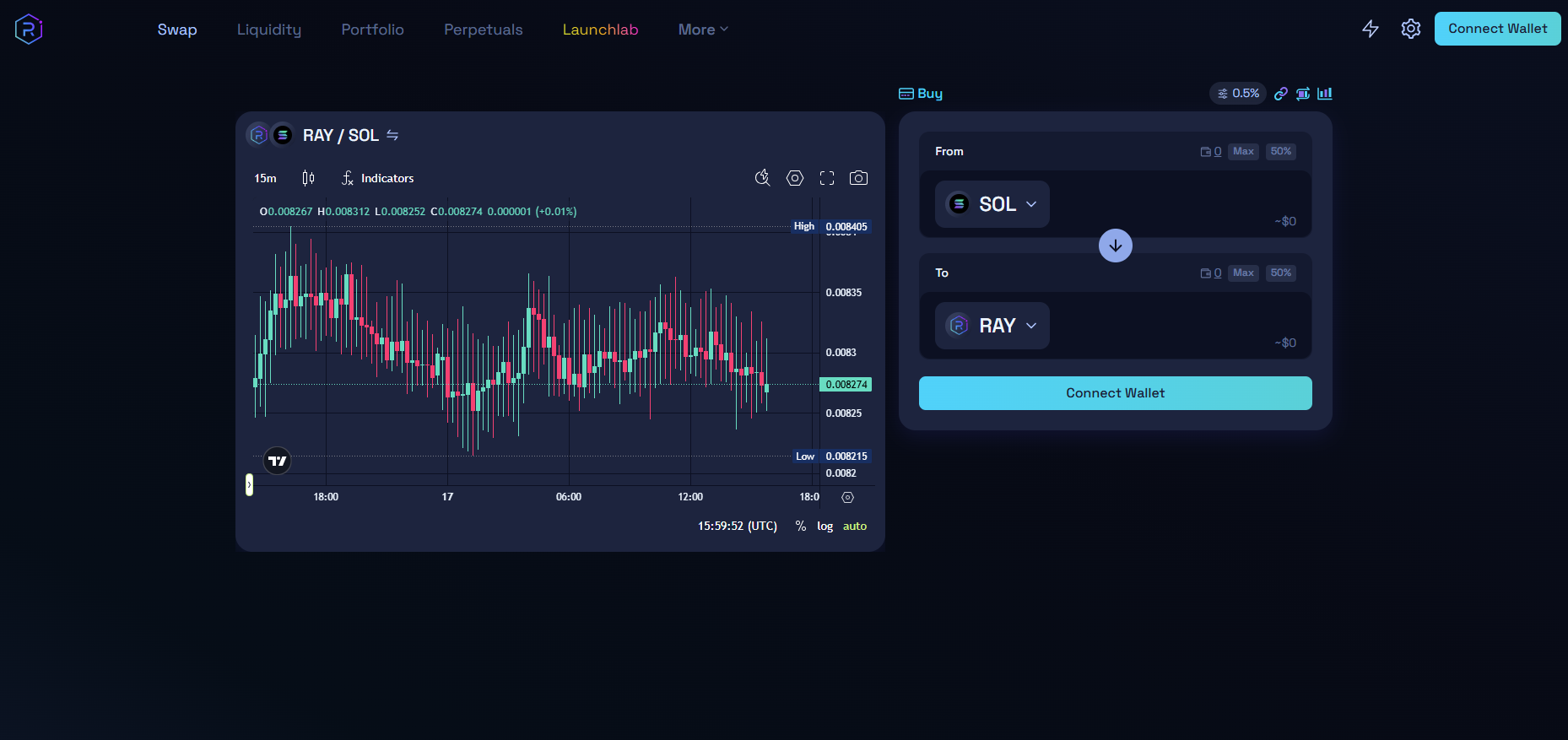
The weakness is that a direct Raydium swap may not always be the best execution route across all Solana liquidity. For large trades, users should compare the final received amount against aggregator quotes. Coincu’s Jupiter Review is useful background for understanding why aggregators matter.
CPMM Pools
CPMM is Raydium’s current standard constant-product AMM. It uses the classic x * y = k invariant and is designed for broad, full-range liquidity. According to Raydium’s documentation, CPMM is the successor to AMM v4, has no OpenBook dependency, supports Token-2022, and is recommended for new constant-product pools.
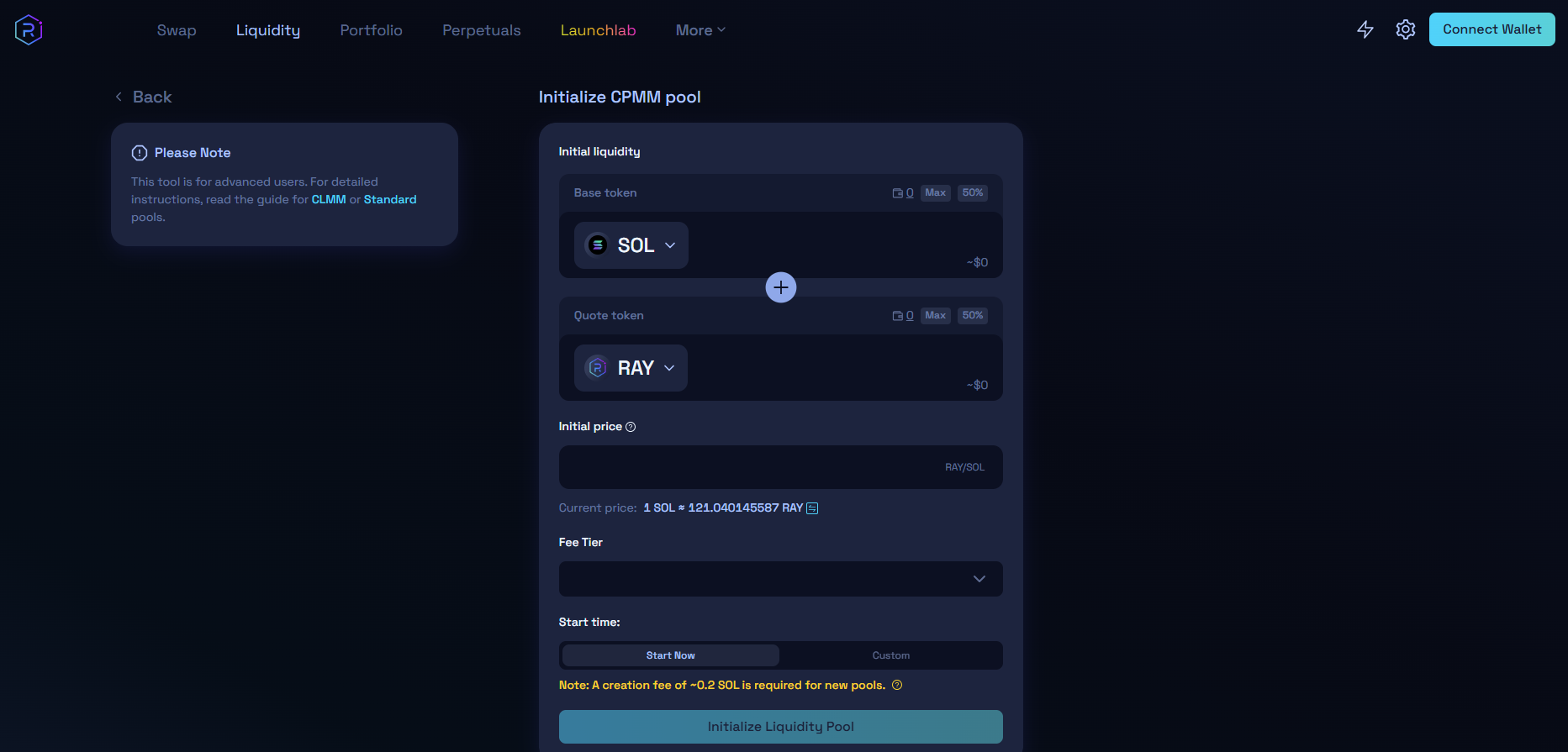
CPMM is usually easier for passive LPs to understand than CLMM because liquidity is spread across the full price curve. The tradeoff is lower capital efficiency compared with concentrated liquidity when price stays inside a narrow range.
CLMM Pools
CLMM stands for concentrated liquidity market maker. Instead of spreading liquidity across all possible prices, LPs choose a price range. If the market trades inside that range, the position can earn fees more efficiently. If the market moves outside the range, the position stops earning swap fees until price returns or the LP rebalances.
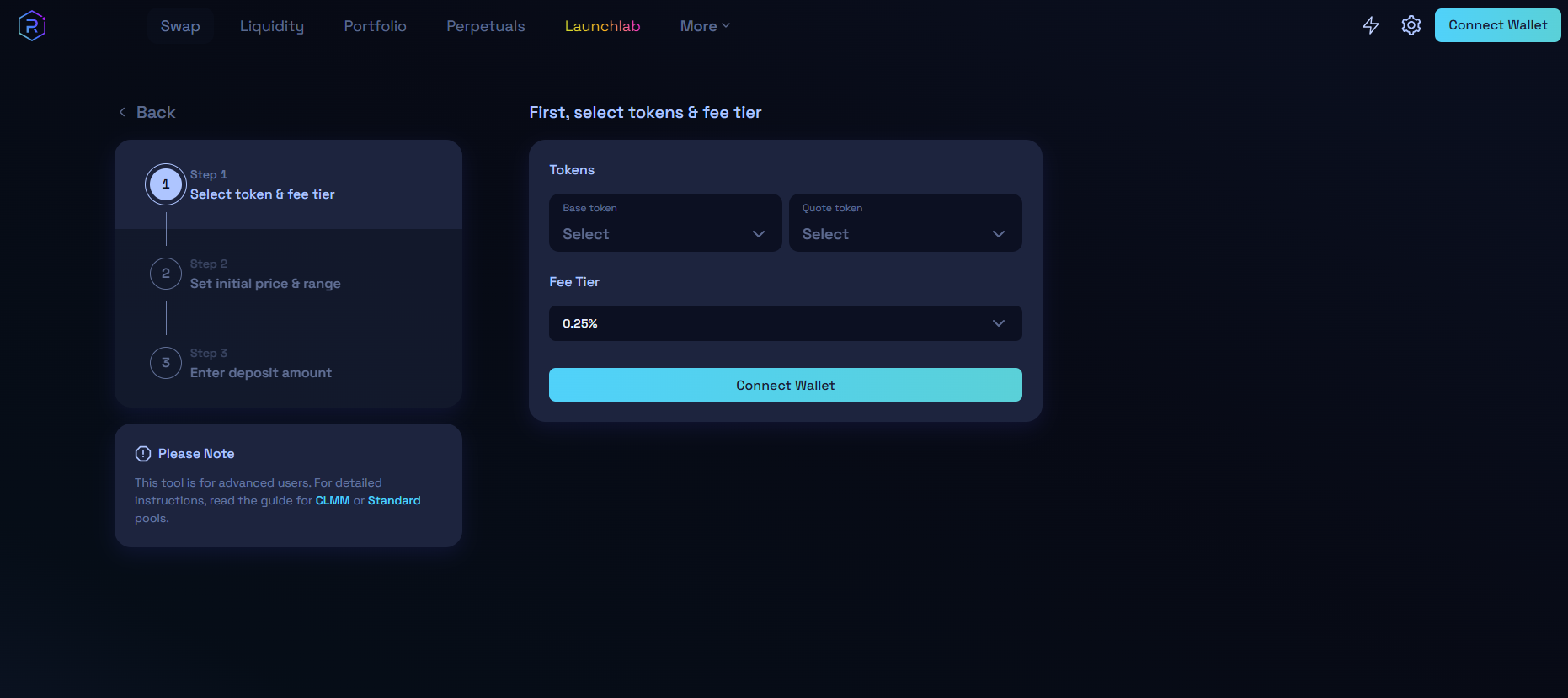
CLMM is better for experienced LPs than for beginners. It can improve capital efficiency, but it also requires monitoring, position management, and a clear view of impermanent loss.
AMM v4
AMM v4 is Raydium’s older hybrid AMM model. It is still relevant because legacy liquidity exists there, but it should not be treated as the main design pattern for new Raydium pools in 2026. Raydium’s own CPMM documentation positions CPMM as the newer standard constant-product design.
LaunchLab
LaunchLab is Raydium’s token launch infrastructure. It supports bonding-curve trading and migration into CPMM pools after a token reaches its graduation target. This makes Raydium especially relevant to Solana’s new-token market, but it also increases user risk because new launches can have shallow liquidity, high volatility, concentrated ownership, or unclear fundamentals.
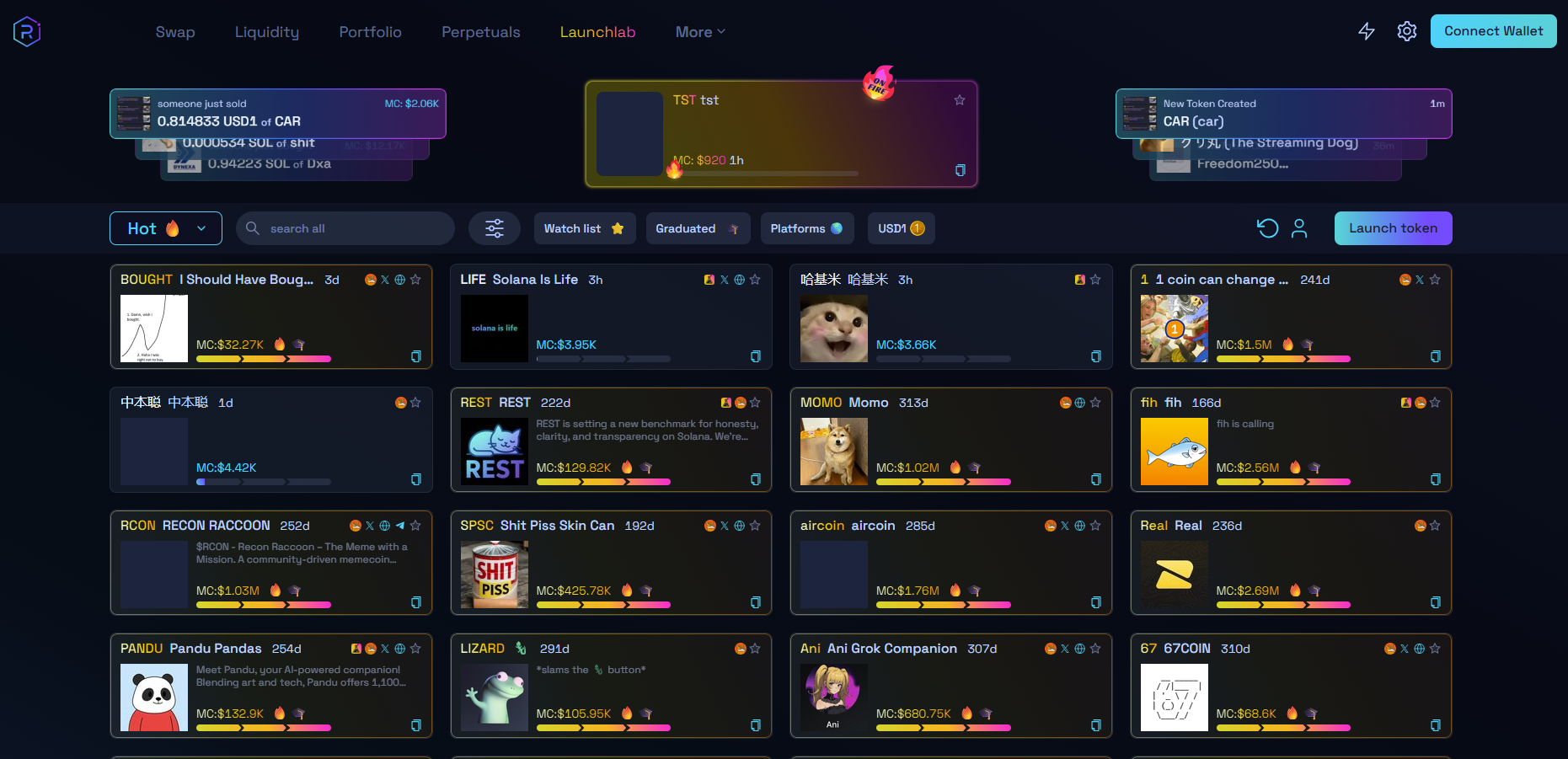
Coincu’s Pump.fun guide and coverage of Pump.fun AMM development show why launchpad liquidity can directly affect Raydium’s market position. For creators and platforms, LaunchLab introduces multiple fee streams, including protocol fees, platform fees, creator fees, referral fees, and post-migration CPMM fees depending on configuration.
Staking and Farms
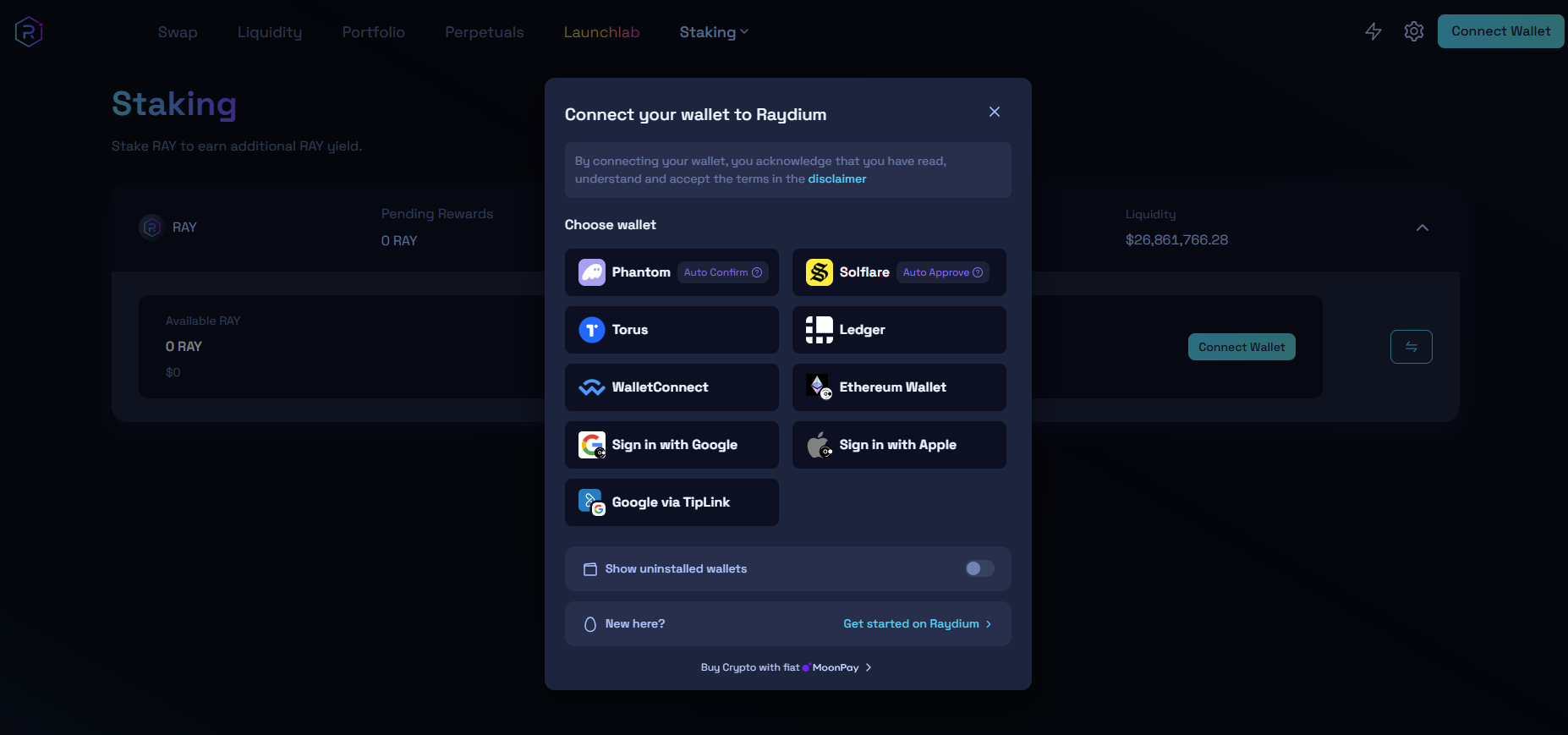
Raydium still supports staking and farming products, but users should separate trading-fee yield from token-incentive yield. A high APR can disappear quickly if emissions change, token prices fall, or pool activity drops. LPs should always calculate returns after impermanent loss, fees, and opportunity cost. For related Solana yield products, see Coincu’s Kamino Finance Review and Jito Review.
Raydium Fees in 2026
Raydium’s fee model depends on the product and pool type. For trading fees, Raydium says every swap incurs a trading fee split between liquidity providers, RAY buybacks, and the treasury:
| Pool type | LP share | RAY buyback | Treasury |
|---|---|---|---|
| CLMM | 84% | 12% | 4% |
| CPMM | 84% | 12% | 4% |
| Standard AMM v4 | 88% | 12% | 0% |
Raydium also charges pool creation fees. Creating a Standard AMM v4 or CPMM pool costs 0.15 SOL, according to Raydium’s protocol fee page. Raydium’s pool-fee page lists the total CPMM pool creation cost at about 0.19 SOL when rent and the protocol fee are included. CLMM pool creation has rent-exemption costs but no Raydium protocol fee for CLMM pool creation or position management.
LaunchLab has a separate fee lifecycle. During bonding-curve trading, a token can include protocol, platform, creator, and referral fees. After graduation, liquidity migrates into a CPMM pool, where trade fees and any configured creator fees follow the post-migration CPMM model. Raydium’s LaunchLab fee reference explains how these fees stack.
Hands-On Review: What Raydium Does Well
- Deep Solana Liquidity: Raydium still has a large liquidity base. DeFiLlama showed about $1.02 billion in Solana TVL for Raydium at the time of this review. That makes Raydium one of the core liquidity venues on Solana and a frequent part of aggregator routes. Coincu has also covered periods when Solana DEX trading volume hit major highs, with Raydium playing an important role.
- Multiple Liquidity Models: Raydium gives LPs more than one way to participate. CPMM is simpler and full-range. CLMM is more efficient but more active. Legacy AMM v4 remains relevant where older liquidity is still active. This range of products makes Raydium more flexible than a one-model DEX.
- Strong New-Token Relevance: LaunchLab gives Raydium direct exposure to Solana token-launch activity. That can create high trading volume and fee opportunities, especially during active market cycles. It also makes Raydium useful for users who want to discover or trade newly launched Solana assets. Coincu’s report on PumpSwap’s volume surge adds useful context for how quickly Solana liquidity flows can shift.
- Clearer 2026 Documentation: Raydium’s documentation is much more explicit than older public descriptions. It separates CPMM, CLMM, AMM v4, fees, pool creation costs, program addresses, security, and LaunchLab mechanics. This helps developers and advanced users verify what they are interacting with.
Where Raydium Falls Short
1. Not Always the Best Swap Route
Raydium has deep pools, but direct Raydium swaps may not always beat an aggregator. Jupiter’s official fee documentation explains that manual market swaps do not charge a Jupiter commission, while underlying DEX and network fees still matter. Jupiter can route across Raydium, Orca, Meteora, Phoenix, Lifinity, and other venues. For small trades this difference may be minor. For larger trades, execution price and slippage matter more than brand preference.
2. CLMM Is Not Passive
CLMM can be attractive because it concentrates liquidity, but it is not a set-and-forget product. If the market exits your chosen range, your position stops earning fees and may become heavily weighted to one token. Users who do not want to monitor ranges should be cautious.
3. New-Token Pools Are High Risk
Raydium’s strength in new Solana launches is also a risk. New pools can have unstable liquidity, changing fees, extreme volatility, and poor token disclosure. A pool being on Raydium does not mean the token is safe. Coincu’s coverage of Pump.fun fee revenue and PUMP buybacks shows how speculative launch activity can move quickly across the Solana ecosystem.
4. Upgradeability and Governance Risk
Raydium’s security page says programs are owned by the BPF Upgradeable Loader and that upgrade/admin authority is held under a Squads multisig. It also says Raydium does not currently employ a timelock for upgrades, with timelocks planned as code moves toward open-sourcing and community governance. Users should understand this before treating Raydium as immutable infrastructure.
Security and Audits
Raydium has a longer audit history than many Solana DeFi projects. Its current security page lists reviews for:
- Order-book AMM by Kudelski Security in Q2 2021.
- CLMM by OtterSec in Q3 2022.
- Updated order-book AMM by OtterSec in Q3 2022.
- Staking by OtterSec in Q3 2022.
- Order-book AMM and OpenBook migration by MadShield in Q2 2023.
- CPMM by MadShield in Q1 2024.
- Burn & Earn by Halborn in Q4 2024.
- LaunchLab by Halborn in Q2 2025.
- CPMM update by Sec3 in Q3 2025.
Raydium also says it runs an active bug bounty program through Immunefi and that Neodyme team members have performed reviews through bug bounty agreements.
That is a positive sign, but audits do not eliminate smart-contract risk, admin-key risk, oracle/routing risk, token risk, wallet risk, or market risk. Users should still test with small transactions and verify they are using official Raydium links.
Raydium vs Orca vs Jupiter vs Meteora
| Platform | Best for | 24h volume snapshot | TVL snapshot | Key tradeoff |
|---|---|---|---|---|
| Raydium | Direct Solana liquidity, CPMM/CLMM pools, LaunchLab tokens | $117.21 million | $1.02 billion | Powerful, but users must understand pool type and token risk |
| Orca | Simple Solana swaps and concentrated liquidity through Whirlpools | $262.60 million | $251.72 million | Cleaner UX, but less tied to Raydium-style launch infrastructure |
| Jupiter | Aggregated swap routing across Solana venues | $22.10 million in DeFiLlama DEX view | $2.02 billion | Best as a router, not the same thing as a single liquidity venue |
| Meteora | DLMM, dynamic fees, LP strategy tooling | $91.68 million | $317.65 million | More specialized LP mechanics and strategy complexity |
The practical takeaway is simple. Use Raydium when Raydium’s pools give the best price, when you want exposure to its LP products, or when interacting with Raydium-native launches.
Use Jupiter when you want broad route discovery. Consider Orca for a simpler Solana DEX experience; Coincu’s Orca Review is a useful comparison. Consider Meteora if you specifically want DLMM-style liquidity and dynamic-fee strategies; Meteora’s DLMM fee documentation explains how its base and variable fees work.
Who Should Use Raydium?
Raydium is a good fit for:
- Solana traders who want direct access to Raydium liquidity.
- Users trading tokens that launched or migrated through Raydium-linked infrastructure.
- LPs who understand the difference between CPMM and CLMM.
- Builders who need Solana liquidity, Token-2022 support, or Raydium SDK/API integrations.
- Experienced DeFi users who can compare routes, read pool settings, and manage wallet risk.
Raydium is not ideal for:
- Users who want the simplest possible swap experience.
- LPs who do not understand impermanent loss.
- Beginners chasing high APR without checking pool depth and token risk.
- Users who assume all Raydium-listed tokens are vetted investments.
- Anyone unwilling to verify URLs, wallet prompts, and token contract addresses.
Key Risks Before Using Raydium
Smart Contract Risk
Raydium has audits and a bug bounty, but smart contracts can still fail. The risk is lower than for unaudited new protocols, but it is not zero.
Impermanent Loss
LPs can lose value relative to simply holding tokens, especially in volatile pairs. CLMM can amplify this operationally because positions may need active rebalancing.
Token Risk
Many Solana tokens are short-lived or highly speculative. Raydium gives access to liquidity; it does not guarantee token quality.
Execution Risk
Low-liquidity pools can produce poor execution, failed transactions, or unexpected slippage. Always inspect the final received amount before confirming a swap.
Admin and Upgrade Risk
Raydium programs are upgradeable under multisig authority. This can help teams patch issues, but it is different from immutable code.
Phishing Risk
Fake Raydium links, fake support accounts, and malicious token pages are common DeFi risks. Use the official Raydium domain and never share seed phrases.
RAY Token Overview
RAY is Raydium’s ecosystem token. It is tied to staking, ecosystem incentives, and protocol economics through buybacks funded by part of trading fees. As of the May 17, 2026 snapshot, CoinGecko showed RAY trading around $0.71478 with a market cap of about $192.26 million and a max supply of 555 million tokens.
RAY is still far below its 2021 all-time high, which means token buyers should not confuse protocol usage with guaranteed token appreciation. The token’s value depends on market conditions, Solana activity, Raydium fee generation, emissions, buybacks, and broader demand for DEX tokens.
Is Raydium Safe?
Raydium is safer than many unaudited Solana protocols, but it should not be described as risk-free. The protocol has multiple audits, an Immunefi bounty, and significant operating history. At the same time, its programs are upgradeable, DeFi composability introduces dependencies, and new-token trading can be risky even when the underlying DEX works correctly.
A safer Raydium workflow is:
- Use only the official Raydium app.
- Start with a small test swap.
- Check token contract addresses.
- Compare received amounts with aggregator quotes.
- Avoid pools where you do not understand the token or fee setup.
- For CLMM, define a rebalance plan before depositing.
- Track realized returns after impermanent loss, not just displayed APR.
Final Verdict: Is Raydium Still Worth Using in 2026?
Yes, Raydium is still worth using in 2026, especially for Solana-native traders, liquidity providers, and builders. It remains a major liquidity venue with over $1 billion in Solana TVL at the time of review, meaningful trading activity, clear protocol documentation, and a product stack that has moved beyond the old Serum-era narrative.
The best reason to use Raydium is not that it is always “the best liquidity” in every situation. The better claim is that Raydium is one of Solana’s core liquidity layers, with strong direct liquidity, CPMM and CLMM options, and deep relevance to Solana token launches.
For SEO and reader trust, this review should be updated regularly. At minimum, refresh the TVL, RAY price, volume, fee data, audit status, and product list every quarter. For DeFi reviews, stale data is not a minor issue; it directly affects whether the article helps readers make informed decisions.
FAQs
Is Raydium still connected to Serum in 2026?
Raydium should not be described mainly as a Serum-based DEX anymore. Older AMM v4 infrastructure was historically tied to Serum/OpenBook-style liquidity, but Raydium’s current standard constant-product pool model is CPMM, which Raydium says has no OpenBook dependency.
What is the difference between Raydium CPMM and CLMM?
CPMM is a full-range constant-product AMM that is easier for passive LPs to understand. CLMM lets LPs concentrate liquidity inside a chosen price range, which can improve capital efficiency but requires more active management.
Does Raydium charge trading fees?
Yes. Raydium trading fees depend on the pool type. For CLMM and CPMM, Raydium’s documentation says 84% of trading fees go to LPs, 12% to RAY buybacks, and 4% to treasury. Standard AMM v4 sends 88% to LPs and 12% to buybacks.
Is Raydium safer than other Solana DEXs?
Raydium has a substantial audit history and an Immunefi bug bounty, which are positive signals. However, it still carries smart-contract risk, admin/upgrade risk, token risk, wallet risk, and LP market risk.
Methodology
The review focuses on decision-making factors that matter to real users: swap execution, liquidity depth, pool design, LP risk, fee distribution, security history, admin/upgrade risk, token data, and competition from Solana DEXes. This article is not financial advice. DeFi data changes quickly, so TVL, volume, token price, APR, pool fees, and risk conditions should be rechecked before making a trade or depositing liquidity.
| DISCLAIMER: The information on this website is provided as general market commentary and does not constitute investment advice. We encourage you to do your own research before investing. |

- China, US Conclude Trade Talks with Focus on Cooperation
- Crypto Weekly: NYSE Backs OKX, Kraken Gets Fed Access, BTC Sells
- Court Upholds Fed’s Rejection of Custodia Bank’s Request
- Former CFO Convicted for $35M Fraudulent Crypto Investment
- DeriW Launches Edge Hour Trading Competition Platform for Derivatives Traders
- Michael Saylor Denies Bitcoin Sell-Off Amid Large BTC Transfer
- Buy Dogecoin on eToro: Step-by-Step Guide for Beginners (2024)
- Kazakhstan Explores Crypto Reserves Backed by National Funds
- JPMorgan Increases Holdings in BlackRock’s Bitcoin ETF
- Nordea Bank Introduces Bitcoin ETP Trading for Nordic Customers
- XRP Spot ETF Launches on Nasdaq Amid Market Fluctuations
- Peter Schiff Challenges Michael Saylor on MSTR’s Business Model
- Thailand Orders Worldcoin to Delete 1.2 Million Biometric Records
- UK Proposes New DeFi Tax Framework to Ease User Burden
- WLFI Under Fire: Analyst Warns Hyperliquid Could Be Next
- Ancient Ethereum Whale Moves $1.19 Billion After Decade
- BlackRock Receives Large Crypto Transfers from Coinbase
- SEC Scrutiny on ALT5 Sigma’s Leadership Disclosure Timing
- Yala Injects $5.5 Million Amid Recovery Efforts
- Radiant Capital Faces $50M Loss in Major Security Breach
- China, US Conclude Trade Talks with Focus on Cooperation
- Crypto Weekly: NYSE Backs OKX, Kraken Gets Fed Access, BTC Sells
- Court Upholds Fed’s Rejection of Custodia Bank’s Request
- Former CFO Convicted for $35M Fraudulent Crypto Investment
- DeriW Launches Edge Hour Trading Competition Platform for Derivatives Traders
- Michael Saylor Denies Bitcoin Sell-Off Amid Large BTC Transfer
- Buy Dogecoin on eToro: Step-by-Step Guide for Beginners (2024)
- Kazakhstan Explores Crypto Reserves Backed by National Funds
- JPMorgan Increases Holdings in BlackRock’s Bitcoin ETF
- Nordea Bank Introduces Bitcoin ETP Trading for Nordic Customers
- XRP Spot ETF Launches on Nasdaq Amid Market Fluctuations
- Peter Schiff Challenges Michael Saylor on MSTR’s Business Model
- Thailand Orders Worldcoin to Delete 1.2 Million Biometric Records
- UK Proposes New DeFi Tax Framework to Ease User Burden
- WLFI Under Fire: Analyst Warns Hyperliquid Could Be Next
- Ancient Ethereum Whale Moves $1.19 Billion After Decade
- BlackRock Receives Large Crypto Transfers from Coinbase
- SEC Scrutiny on ALT5 Sigma’s Leadership Disclosure Timing
- Yala Injects $5.5 Million Amid Recovery Efforts
- Radiant Capital Faces $50M Loss in Major Security Breach
- China, US Conclude Trade Talks with Focus on Cooperation
- Crypto Weekly: NYSE Backs OKX, Kraken Gets Fed Access, BTC Sells
- Court Upholds Fed’s Rejection of Custodia Bank’s Request
- Former CFO Convicted for $35M Fraudulent Crypto Investment
- DeriW Launches Edge Hour Trading Competition Platform for Derivatives Traders
- Michael Saylor Denies Bitcoin Sell-Off Amid Large BTC Transfer
- Buy Dogecoin on eToro: Step-by-Step Guide for Beginners (2024)
- Kazakhstan Explores Crypto Reserves Backed by National Funds
- JPMorgan Increases Holdings in BlackRock’s Bitcoin ETF
- Nordea Bank Introduces Bitcoin ETP Trading for Nordic Customers
- XRP Spot ETF Launches on Nasdaq Amid Market Fluctuations
- Peter Schiff Challenges Michael Saylor on MSTR’s Business Model
- Thailand Orders Worldcoin to Delete 1.2 Million Biometric Records
- UK Proposes New DeFi Tax Framework to Ease User Burden
- WLFI Under Fire: Analyst Warns Hyperliquid Could Be Next
- Ancient Ethereum Whale Moves $1.19 Billion After Decade
- BlackRock Receives Large Crypto Transfers from Coinbase
- SEC Scrutiny on ALT5 Sigma’s Leadership Disclosure Timing
- Yala Injects $5.5 Million Amid Recovery Efforts
- Radiant Capital Faces $50M Loss in Major Security Breach

Bybit Launches US Stock Perpetual Contracts for UNH, GE, JPM, GILD, AMGN, REGN


Performa Marks One Year Live with Major Upgrade for Digital-Native SMBs

Zoomex to Attend Coinfest Asia 2026 as Gold Sponsor and Host Summer Bay Party in Bali