Morph Stablecoin Report: $33T Annual Volume, 10% Cross-Border Payments by 2030
Stablecoins processed $33 trillion in annual transaction volume during 2025, surpassing the combined throughput of Visa and Mastercard, according to a new report from Morph. The layer-2 protocol projects that stablecoins will facilitate 5-10% of global cross-border payments by 2030, with total stablecoin market capitalization exceeding $1.9 trillion.
Morph Reports $33 Trillion Annual Stablecoin Transaction Scale
The $33 trillion figure represents the total value of all stablecoin transfers settled on-chain throughout 2025, a 72% increase from the previous year. That volume eclipsed Visa’s $15.7 trillion and Mastercard’s $9.8 trillion in combined annual card payment throughput.
USDC led by transaction flow, processing $18.3 trillion over the year, while USDT recorded $13.3 trillion. That split reveals an interesting divergence: USDT still dominates by market capitalization at $187 billion, but USDC moves significantly more value through the network.
How Transaction Volume Is Typically Interpreted in Crypto Reporting
Annual transaction scale in crypto measures the total value of settled on-chain transfers, not unique economic activity. A single dollar cycling through multiple transactions within a year gets counted each time it moves, which inflates headline figures relative to traditional payment metrics that track point-of-sale throughput.
Q4 2025 alone accounted for $11 trillion in stablecoin volume, up from $8.8 trillion in Q3. Monthly volume peaked at $1.25 trillion in August 2025, while active stablecoin wallets grew 53% to surpass 30 million participants.
Morph projects that annual settlement volume could exceed $50 trillion by the end of 2026, driven by accelerating institutional adoption and expanding payment corridors.
Why Stablecoins Could Reach 10% of Global Cross-Border Payments by 2030
The Morph report’s central forward-looking claim is that stablecoins will capture 5-10% of global cross-border payments by 2030, with total market capitalization exceeding $1.9 trillion. The projection hinges on several adoption levers that are already showing traction.
B2B stablecoin payments surged from under $100 million monthly in early 2023 to more than $6 billion monthly by mid-2025. That segment now represents roughly 60% of real-economy stablecoin volume, with 77% of corporate users citing supplier payments as their primary use case.
Stablecoins settle 24/7, bypass correspondent banking chains, and reduce friction in corridors where traditional wire transfers take 2-5 business days. For emerging-market remittance corridors and trade finance routes, these speed and cost advantages compound quickly. Companies exploring seamless crypto-to-fiat payment infrastructure are expanding the on-ramp and off-ramp network that makes cross-border stablecoin use practical.
Key Assumptions Required for Forecast Realization
Reaching the 10% threshold depends on continued regulatory clarity, particularly outside the United States. The passing of the GENIUS Act (Guiding and Establishing National Innovation for U.S. Stablecoins) in July 2025 provided the first comprehensive U.S. regulatory framework for payment stablecoins, catalyzing institutional adoption domestically.
Corporate adoption data supports the trend: 41% of Fortune 500 companies assessing or piloting stablecoin payments reported achieving 10% or greater cost savings. But scaling from domestic pilots to global cross-border settlement requires parallel regulatory frameworks in the EU, Asia-Pacific, and Latin America.
The forecast also assumes that fiat on/off-ramp infrastructure continues expanding. Without reliable local-currency conversion in both sender and receiver jurisdictions, stablecoin cross-border payments remain limited to crypto-native corridors.
Barriers and Risks That Could Slow Stablecoin Payment Adoption
Regulatory fragmentation is the most significant obstacle. While the GENIUS Act addressed U.S. stablecoin oversight, jurisdictions like the EU (under MiCA), Singapore, and Hong Kong each maintain distinct compliance requirements. A company operating cross-border stablecoin payments must navigate AML, sanctions screening, and licensing requirements in every jurisdiction it touches.
Compliance costs can erode the settlement-speed advantages that make stablecoins attractive. Enterprise users need robust transaction monitoring, counterparty screening, and audit trails that match or exceed traditional banking standards.
Operational Risk for Businesses Using Stablecoins
Depeg risk, while historically rare for major stablecoins, remains a structural concern. USDC’s brief deviation from its dollar peg during the Silicon Valley Bank crisis in March 2023 demonstrated how banking-sector stress can transmit to stablecoin markets.
Liquidity fragmentation across chains presents another challenge. Stablecoins are issued on dozens of networks, and bridging between them introduces smart contract risk and settlement delays. For institutional users processing large volumes, deep liquidity on a single chain matters more than marginal fee savings on alternative networks.
Retail adoption faces different hurdles than institutional. Consumer-facing stablecoin payments require intuitive wallet interfaces, merchant acceptance, and consumer protections that crypto infrastructure has not yet matched. Recent developments in blockchain infrastructure funding suggest capital is flowing toward solving these gaps, but the timeline remains uncertain.
Market Impact: Which Crypto Segments Benefit If the Trend Holds
If stablecoin transaction volumes continue their trajectory toward the projected $50 trillion in 2026, demand for efficient settlement layers will intensify. Layer-1 and layer-2 networks that can offer low-cost, high-throughput stablecoin transfers stand to capture significant fee revenue.
The USDC-USDT transaction flow divergence signals a shift in issuer competition. Circle’s USDC processing $18.3 trillion versus Tether’s $13.3 trillion suggests that institutional and compliant-focused users are gravitating toward USDC, even as USDT maintains its $187 billion market cap lead.
Implications for DeFi, Exchanges, and Payment Gateways
DeFi protocols that facilitate stablecoin lending, liquidity provision, and yield generation benefit directly from higher stablecoin volumes. More stablecoins in circulation means deeper liquidity pools and more efficient markets. The broader implications mirror dynamics seen in on-chain signal monitoring, where transaction flow data increasingly drives market positioning.
Payment gateways and fintech companies integrating stablecoin rails are positioned to capture B2B payment flows. The jump from $100 million to $6 billion in monthly B2B volume over roughly two years represents one of the fastest-growing segments in digital payments.
Exchange infrastructure also benefits. Platforms that offer stablecoin-to-fiat conversion with low slippage and fast settlement become critical chokepoints in the cross-border payment chain, commanding fees on both conversion and custody.
However, increased regulatory scrutiny could compress margins. As stablecoin payment providers face banking-equivalent compliance requirements, operational costs may rise, particularly for smaller players without the scale to absorb compliance overhead.
FAQ: Stablecoin Transaction Scale and Cross-Border Payment Outlook
What does $33 trillion in annual transaction scale actually mean?
It measures the total USD value of all stablecoin transfers settled on-chain during 2025. This includes repeated movements of the same funds, so it is not equivalent to $33 trillion in unique economic activity. It is comparable to how Visa reports gross payment volume across its network.
Can stablecoins realistically capture 10% of cross-border payments by 2030?
The Morph projection is scenario-based, not a guarantee. Achieving the high end of the 5-10% range requires coordinated regulatory frameworks across major jurisdictions, continued improvement in fiat on/off-ramp coverage, and institutional adoption scaling beyond current pilot programs. The B2B payment growth from $100 million to $6 billion monthly suggests momentum, but cross-border regulatory alignment remains the binding constraint.
Which factors matter most for adoption: regulation, UX, or liquidity?
For institutional adoption, regulation is the primary gating factor, as compliance clarity determines whether corporate treasuries can use stablecoins at all. For retail adoption, UX dominates, since consumer wallets and merchant acceptance must match traditional payment convenience. Liquidity depth matters most at the infrastructure level, determining whether large transfers can settle without significant slippage.
Disclaimer: This article is for informational purposes only and does not constitute financial or investment advice. Cryptocurrency and digital asset markets carry significant risk. Always do your own research before making decisions.
No tags available.


Other Posts








- China, US Conclude Trade Talks with Focus on Cooperation
- Crypto Weekly: NYSE Backs OKX, Kraken Gets Fed Access, BTC Sells
- Court Upholds Fed’s Rejection of Custodia Bank’s Request
- Former CFO Convicted for $35M Fraudulent Crypto Investment
- DeriW Launches Edge Hour Trading Competition Platform for Derivatives Traders
- Michael Saylor Denies Bitcoin Sell-Off Amid Large BTC Transfer
- Buy Dogecoin on eToro: Step-by-Step Guide for Beginners (2024)
- Kazakhstan Explores Crypto Reserves Backed by National Funds
- JPMorgan Increases Holdings in BlackRock’s Bitcoin ETF
- Nordea Bank Introduces Bitcoin ETP Trading for Nordic Customers
- XRP Spot ETF Launches on Nasdaq Amid Market Fluctuations
- Peter Schiff Challenges Michael Saylor on MSTR’s Business Model
- Thailand Orders Worldcoin to Delete 1.2 Million Biometric Records
- UK Proposes New DeFi Tax Framework to Ease User Burden
- WLFI Under Fire: Analyst Warns Hyperliquid Could Be Next
- Ancient Ethereum Whale Moves $1.19 Billion After Decade
- BlackRock Receives Large Crypto Transfers from Coinbase
- SEC Scrutiny on ALT5 Sigma’s Leadership Disclosure Timing
- Yala Injects $5.5 Million Amid Recovery Efforts
- Radiant Capital Faces $50M Loss in Major Security Breach
- China, US Conclude Trade Talks with Focus on Cooperation
- Crypto Weekly: NYSE Backs OKX, Kraken Gets Fed Access, BTC Sells
- Court Upholds Fed’s Rejection of Custodia Bank’s Request
- Former CFO Convicted for $35M Fraudulent Crypto Investment
- DeriW Launches Edge Hour Trading Competition Platform for Derivatives Traders
- Michael Saylor Denies Bitcoin Sell-Off Amid Large BTC Transfer
- Buy Dogecoin on eToro: Step-by-Step Guide for Beginners (2024)
- Kazakhstan Explores Crypto Reserves Backed by National Funds
- JPMorgan Increases Holdings in BlackRock’s Bitcoin ETF
- Nordea Bank Introduces Bitcoin ETP Trading for Nordic Customers
- XRP Spot ETF Launches on Nasdaq Amid Market Fluctuations
- Peter Schiff Challenges Michael Saylor on MSTR’s Business Model
- Thailand Orders Worldcoin to Delete 1.2 Million Biometric Records
- UK Proposes New DeFi Tax Framework to Ease User Burden
- WLFI Under Fire: Analyst Warns Hyperliquid Could Be Next
- Ancient Ethereum Whale Moves $1.19 Billion After Decade
- BlackRock Receives Large Crypto Transfers from Coinbase
- SEC Scrutiny on ALT5 Sigma’s Leadership Disclosure Timing
- Yala Injects $5.5 Million Amid Recovery Efforts
- Radiant Capital Faces $50M Loss in Major Security Breach
- China, US Conclude Trade Talks with Focus on Cooperation
- Crypto Weekly: NYSE Backs OKX, Kraken Gets Fed Access, BTC Sells
- Court Upholds Fed’s Rejection of Custodia Bank’s Request
- Former CFO Convicted for $35M Fraudulent Crypto Investment
- DeriW Launches Edge Hour Trading Competition Platform for Derivatives Traders
- Michael Saylor Denies Bitcoin Sell-Off Amid Large BTC Transfer
- Buy Dogecoin on eToro: Step-by-Step Guide for Beginners (2024)
- Kazakhstan Explores Crypto Reserves Backed by National Funds
- JPMorgan Increases Holdings in BlackRock’s Bitcoin ETF
- Nordea Bank Introduces Bitcoin ETP Trading for Nordic Customers
- XRP Spot ETF Launches on Nasdaq Amid Market Fluctuations
- Peter Schiff Challenges Michael Saylor on MSTR’s Business Model
- Thailand Orders Worldcoin to Delete 1.2 Million Biometric Records
- UK Proposes New DeFi Tax Framework to Ease User Burden
- WLFI Under Fire: Analyst Warns Hyperliquid Could Be Next
- Ancient Ethereum Whale Moves $1.19 Billion After Decade
- BlackRock Receives Large Crypto Transfers from Coinbase
- SEC Scrutiny on ALT5 Sigma’s Leadership Disclosure Timing
- Yala Injects $5.5 Million Amid Recovery Efforts
- Radiant Capital Faces $50M Loss in Major Security Breach

Maharashtra DELTA Act Targets Real Estate Blockchain Tokenization

HashKey Middle East Launches BTC and ETH Perpetual Derivatives After Dubai VARA Approval

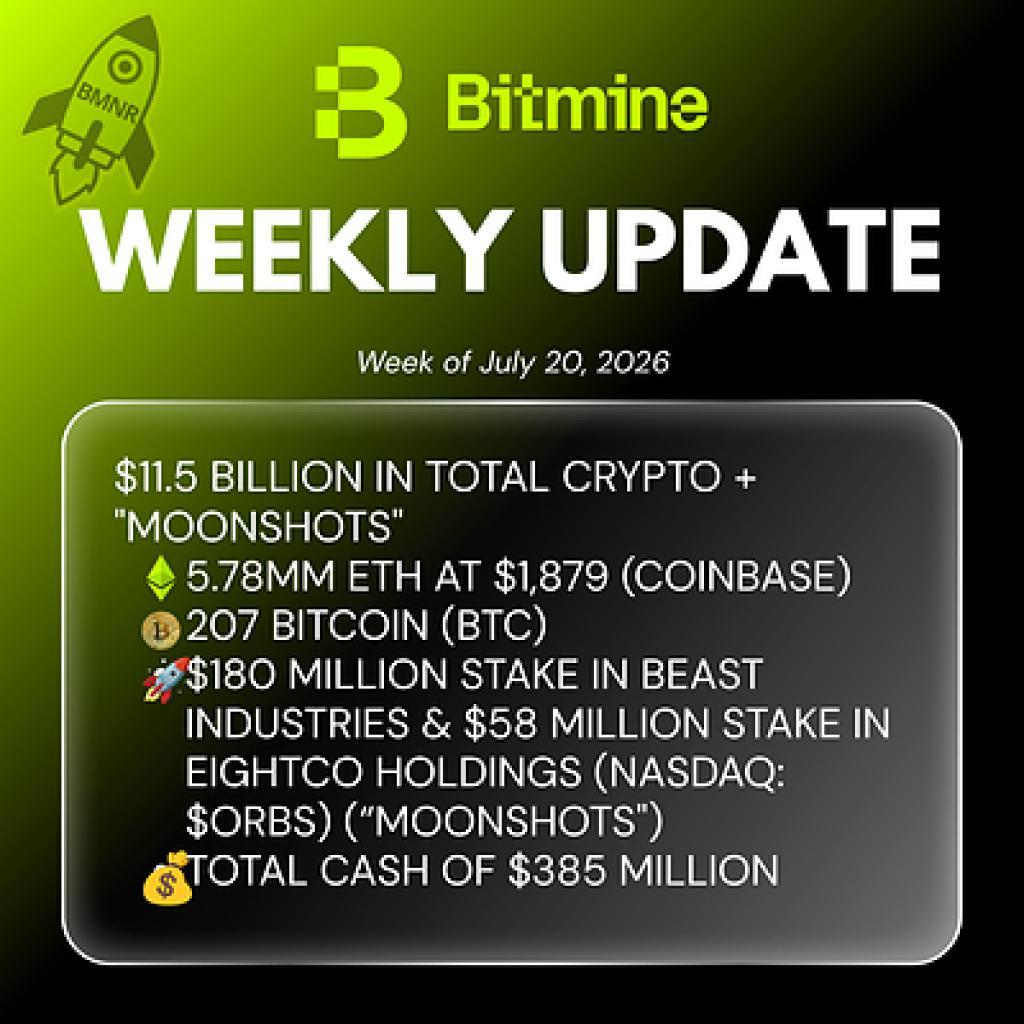
Bitmine Immersion Technologies (BMNR) Announces ETH Holdings Reach 5.78 Million Tokens, and Total Crypto and Total Cash Holdings of $11.5 Billion

GLOBAL MEDIA PROCUREMENT: THE 500-YEAR YIXING ZISHA TEAPOTS PARADIGM