Morgan Stanley Bitcoin ETF Draws $34M on Day One as Fee Pressure Builds
Morgan Stanley’s newly launched Bitcoin ETF, trading under the ticker MSBT, pulled in approximately $34 million on its first day of trading on April 8, 2026, making the bank the first major U.S. financial institution to issue and list its own spot Bitcoin ETF. The fund’s 0.14% expense ratio, the lowest among spot Bitcoin ETFs, immediately sharpened the fee war that has defined the sector since January 2024.
MSBT’s first-day demand: $34 million and 1.6 million shares
The Morgan Stanley Bitcoin Trust debuted on NYSE Arca with $34 million in first-day inflows and 1.6 million shares traded. The launch came during a period of broad market unease, with Bitcoin trading at $71,147, down 1.41% over the prior 24 hours.
For context, the crypto Fear & Greed Index sat at 17, deep in “Extreme Fear” territory. Launching a new product into that sentiment backdrop makes the $34 million figure a notable demand signal, though it remains far too early to extrapolate longer-term appetite.
Morgan Stanley is not merely distributing a third-party Bitcoin product. MSBT is issued by the bank’s own investment management arm, a structural shift from the distribution-only role banks have played since the first wave of spot Bitcoin ETF approvals in early 2024. The bank filed its own S-1 registration statement with the SEC, which went effective on the day of launch.
0.14% expense ratio undercuts BlackRock IBIT by 44%
MSBT’s 0.14% expense ratio is 11 basis points, or roughly 44%, cheaper than BlackRock’s IBIT at 0.25%. That gap drew immediate attention from ETF analysts who track fee dynamics across the sector.
Bloomberg ETF analyst Eric Balchunas called the pricing a “semi-shock” and noted the strategic implications for Morgan Stanley’s advisor network:
SEMI-SHOCK: Morgan Stanley’s bitcoin ETF will charge 14bps, making it the cheapest spot bitcoin ETF on the market and 11bps cheaper than $IBIT. This means none of their advisors will feel conflicted using it and they have shot at getting outside assets. Smart. Launch prob in next… https://t.co/hxg3O1y6tR pic.twitter.com/BEiguHtXzo
— Eric Balchunas (@EricBalchunas) March 27, 2026
Source: @EricBalchunas on X
Fellow Bloomberg analyst James Seyffart echoed the reaction, writing that Morgan Stanley is “not messing around” with a 0.14% fee. The pricing removes a key friction point: Morgan Stanley advisors previously faced a potential conflict of interest when recommending higher-fee competitor products to clients.
Distribution advantage: $6 trillion in client assets and 4% allocation guidance
The fee story alone misses what may be MSBT’s most significant competitive edge. Morgan Stanley’s wealth management division oversees more than $6 trillion in client assets, with thousands of financial advisors who can allocate capital through internal platforms.
Internal guidance allows those advisors to recommend up to a 4% Bitcoin allocation in client portfolios. That built-in distribution pipeline, reaching clients through existing advisory relationships rather than waiting for organic retail discovery, gives MSBT a structural advantage that pure fee comparisons do not capture.
BlackRock’s IBIT remains the dominant force in spot Bitcoin ETFs, with approximately $55 billion in assets under management and leading positions in both trading volume and options activity. But IBIT relies primarily on self-directed investors and third-party platforms for distribution, a fundamentally different model than Morgan Stanley’s advisor-driven approach. The ongoing evolution of BlackRock’s IBIT and ETHA ETF structure shows that even the market leader continues to adapt its product offering.
Near-term market share implications
A $34 million first day is respectable but modest compared to the flows that early spot Bitcoin ETF entrants captured in January 2024. The more meaningful signal will come from whether Morgan Stanley’s advisor network begins systematically routing client allocations into MSBT over the coming weeks.
If even a small fraction of the bank’s $6 trillion client base shifts toward the 4% Bitcoin allocation ceiling, the resulting inflows could meaningfully alter market share dynamics among spot Bitcoin ETFs. The fee savings compound over time: on a $100,000 allocation, MSBT’s 0.14% costs $140 annually versus $250 for IBIT, a difference that grows with portfolio size.
Bitcoin’s broader market context adds uncertainty. With the risk of significant long liquidations at lower price levels and the Fear & Greed Index signaling extreme caution, institutional appetite for new Bitcoin exposure may be muted in the short term regardless of fee advantages.
Who benefits and who faces pressure
For investors, MSBT’s launch is unambiguously positive. Lower fees reduce the cost of holding Bitcoin exposure through regulated vehicles, and fee competition across issuers benefits all ETF holders as incumbents may be forced to respond with their own cuts.
For issuers, the calculus is more complex. BlackRock’s IBIT generates substantial revenue at its current fee level and $55 billion AUM base, and a fee cut to match MSBT would immediately reduce that income stream. Smaller ETF issuers with less scale face an even sharper squeeze, as margin compression hits harder when the asset base is limited.
Morgan Stanley itself is willing to accept thinner ETF margins because MSBT fits into a broader crypto strategy. The bank has been expanding into direct crypto trading through its E*Trade platform and has filed for a Solana ETF, positioning MSBT as one component of a multi-product ecosystem rather than a standalone revenue line. The growing activity across Ethereum derivatives markets underscores how institutional engagement with crypto is deepening across multiple asset classes simultaneously.
What to watch after day one
Second- and third-day flow data will indicate whether the opening intake reflected genuine sustained demand or a one-time allocation by early adopters. A sharp drop-off would suggest the latter; steady inflows in the $10-30 million daily range would point to organic advisor-driven adoption.
Competitor fee responses are the next major variable. If BlackRock or other issuers announce fee reductions or extend promotional waivers, it would confirm that MSBT’s pricing is being taken seriously as a competitive threat, not merely a loss-leader from a late entrant.
Institutional allocation trends beyond Morgan Stanley’s own network will also matter. Balchunas noted that MSBT’s low fee gives it “a shot at getting outside assets,” meaning advisors at other firms could choose MSBT purely on cost. Whether that cross-platform demand materializes will determine if MSBT becomes a niche in-house product or a genuine market-share contender in the spot Bitcoin ETF space.
Disclaimer: This article is for informational purposes only and does not constitute financial or investment advice. Cryptocurrency and digital asset markets carry significant risk. Always do your own research before making decisions.
No tags available.


Other Posts








- China, US Conclude Trade Talks with Focus on Cooperation
- Crypto Weekly: NYSE Backs OKX, Kraken Gets Fed Access, BTC Sells
- Court Upholds Fed’s Rejection of Custodia Bank’s Request
- Former CFO Convicted for $35M Fraudulent Crypto Investment
- DeriW Launches Edge Hour Trading Competition Platform for Derivatives Traders
- Michael Saylor Denies Bitcoin Sell-Off Amid Large BTC Transfer
- Buy Dogecoin on eToro: Step-by-Step Guide for Beginners (2024)
- Kazakhstan Explores Crypto Reserves Backed by National Funds
- JPMorgan Increases Holdings in BlackRock’s Bitcoin ETF
- Nordea Bank Introduces Bitcoin ETP Trading for Nordic Customers
- XRP Spot ETF Launches on Nasdaq Amid Market Fluctuations
- Peter Schiff Challenges Michael Saylor on MSTR’s Business Model
- Thailand Orders Worldcoin to Delete 1.2 Million Biometric Records
- UK Proposes New DeFi Tax Framework to Ease User Burden
- WLFI Under Fire: Analyst Warns Hyperliquid Could Be Next
- Ancient Ethereum Whale Moves $1.19 Billion After Decade
- BlackRock Receives Large Crypto Transfers from Coinbase
- SEC Scrutiny on ALT5 Sigma’s Leadership Disclosure Timing
- Yala Injects $5.5 Million Amid Recovery Efforts
- Radiant Capital Faces $50M Loss in Major Security Breach
- China, US Conclude Trade Talks with Focus on Cooperation
- Crypto Weekly: NYSE Backs OKX, Kraken Gets Fed Access, BTC Sells
- Court Upholds Fed’s Rejection of Custodia Bank’s Request
- Former CFO Convicted for $35M Fraudulent Crypto Investment
- DeriW Launches Edge Hour Trading Competition Platform for Derivatives Traders
- Michael Saylor Denies Bitcoin Sell-Off Amid Large BTC Transfer
- Buy Dogecoin on eToro: Step-by-Step Guide for Beginners (2024)
- Kazakhstan Explores Crypto Reserves Backed by National Funds
- JPMorgan Increases Holdings in BlackRock’s Bitcoin ETF
- Nordea Bank Introduces Bitcoin ETP Trading for Nordic Customers
- XRP Spot ETF Launches on Nasdaq Amid Market Fluctuations
- Peter Schiff Challenges Michael Saylor on MSTR’s Business Model
- Thailand Orders Worldcoin to Delete 1.2 Million Biometric Records
- UK Proposes New DeFi Tax Framework to Ease User Burden
- WLFI Under Fire: Analyst Warns Hyperliquid Could Be Next
- Ancient Ethereum Whale Moves $1.19 Billion After Decade
- BlackRock Receives Large Crypto Transfers from Coinbase
- SEC Scrutiny on ALT5 Sigma’s Leadership Disclosure Timing
- Yala Injects $5.5 Million Amid Recovery Efforts
- Radiant Capital Faces $50M Loss in Major Security Breach
- China, US Conclude Trade Talks with Focus on Cooperation
- Crypto Weekly: NYSE Backs OKX, Kraken Gets Fed Access, BTC Sells
- Court Upholds Fed’s Rejection of Custodia Bank’s Request
- Former CFO Convicted for $35M Fraudulent Crypto Investment
- DeriW Launches Edge Hour Trading Competition Platform for Derivatives Traders
- Michael Saylor Denies Bitcoin Sell-Off Amid Large BTC Transfer
- Buy Dogecoin on eToro: Step-by-Step Guide for Beginners (2024)
- Kazakhstan Explores Crypto Reserves Backed by National Funds
- JPMorgan Increases Holdings in BlackRock’s Bitcoin ETF
- Nordea Bank Introduces Bitcoin ETP Trading for Nordic Customers
- XRP Spot ETF Launches on Nasdaq Amid Market Fluctuations
- Peter Schiff Challenges Michael Saylor on MSTR’s Business Model
- Thailand Orders Worldcoin to Delete 1.2 Million Biometric Records
- UK Proposes New DeFi Tax Framework to Ease User Burden
- WLFI Under Fire: Analyst Warns Hyperliquid Could Be Next
- Ancient Ethereum Whale Moves $1.19 Billion After Decade
- BlackRock Receives Large Crypto Transfers from Coinbase
- SEC Scrutiny on ALT5 Sigma’s Leadership Disclosure Timing
- Yala Injects $5.5 Million Amid Recovery Efforts
- Radiant Capital Faces $50M Loss in Major Security Breach


U.S. Congress Debates Crypto Ethics as DeFi Provisions Stay Under Negotiation

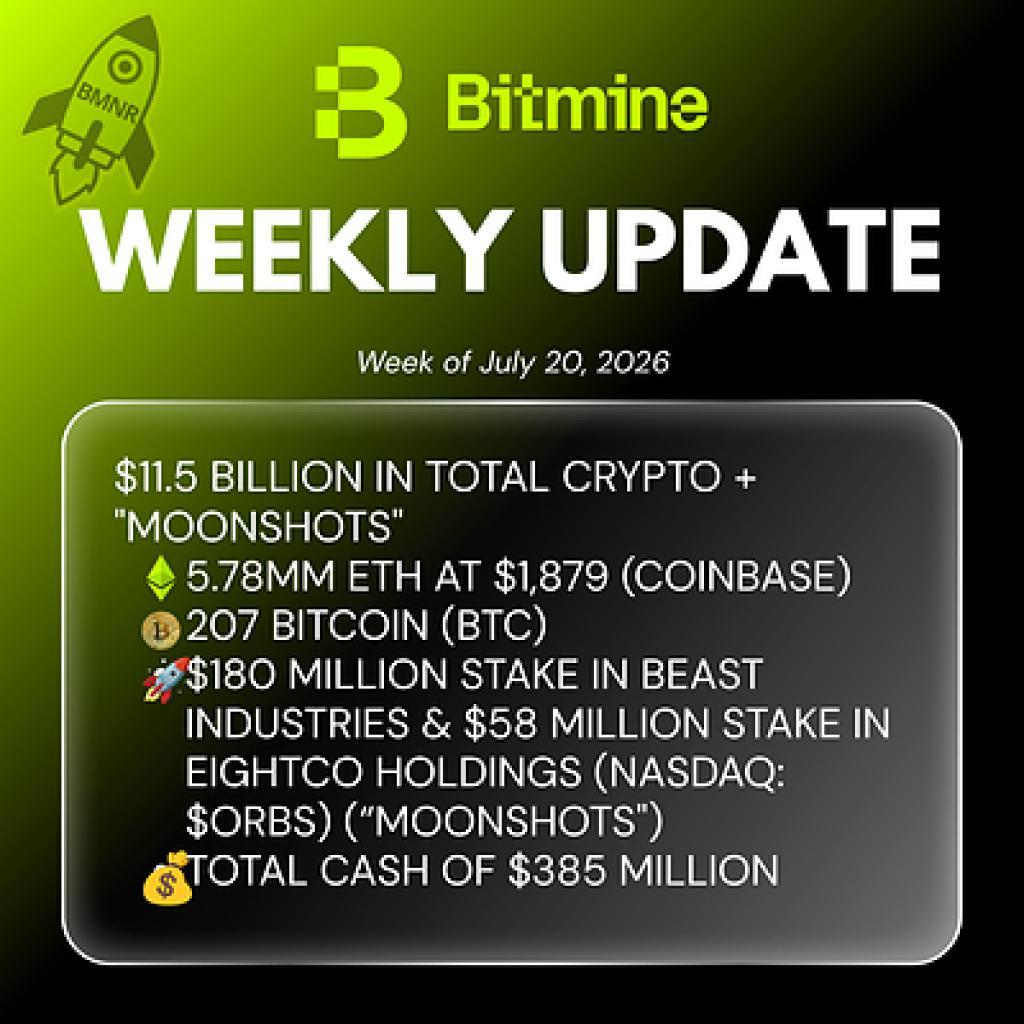
Bitmine Immersion Technologies (BMNR) Announces ETH Holdings Reach 5.78 Million Tokens, and Total Crypto and Total Cash Holdings of $11.5 Billion

GLOBAL MEDIA PROCUREMENT: THE 500-YEAR YIXING ZISHA TEAPOTS PARADIGM