The pump currently looks more consistent with a supply-structure repricing than with a broad fundamental usage comeback. The cleanest onchain evidence is that Terra Classic still has a very large token base, but a meaningful part of the non-circulating supply is visibly tied up in staking rather than freely moving through the market.
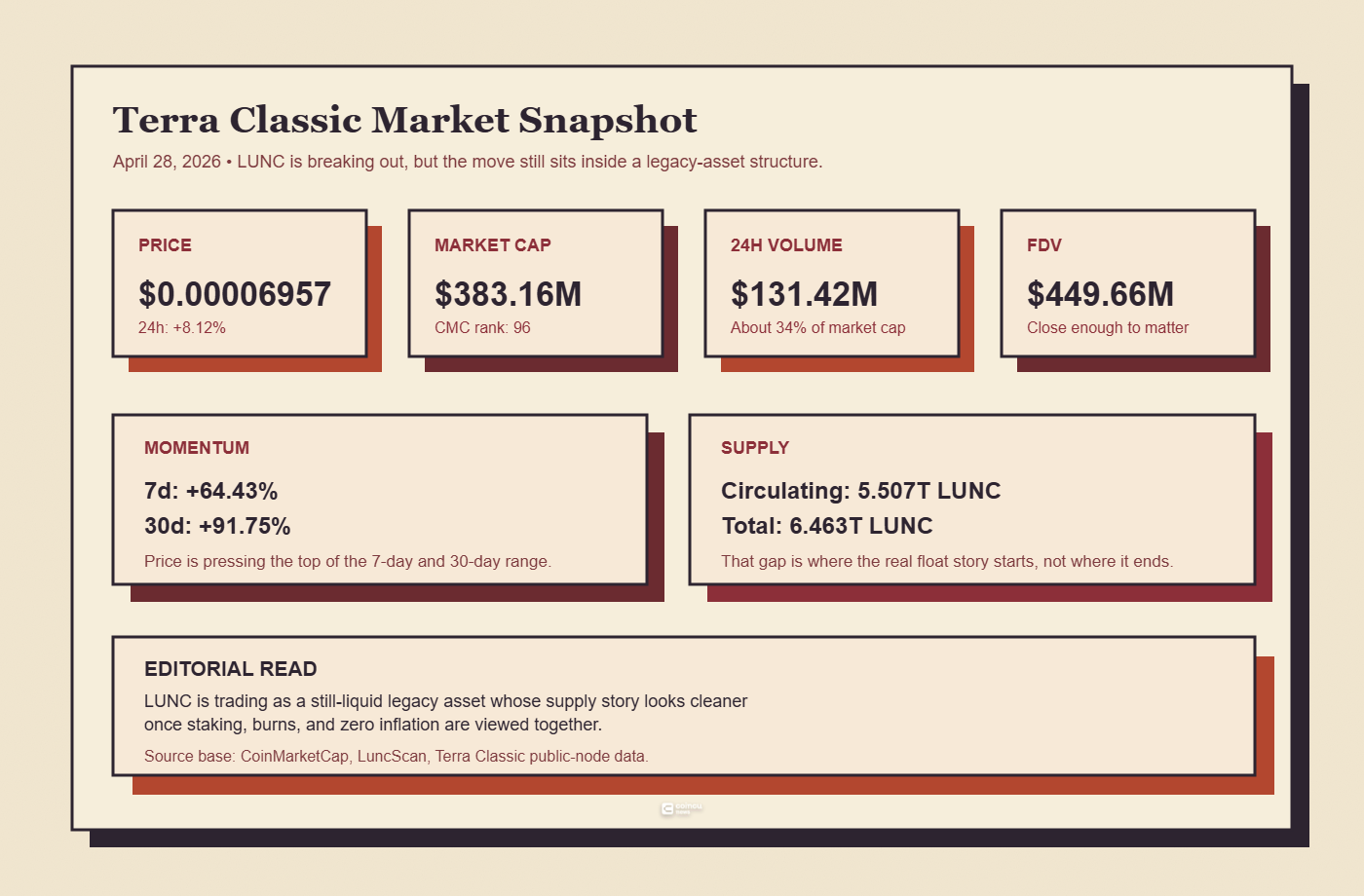
As of April 28, 2026, CoinMarketCap showed LUNC near $0.00006957, up 8.12% in 24 hours, 64.43% in seven days, and 91.75% in 30 days, with roughly $131.42 million in 24-hour volume against a market cap near $383.16 million.
CoinMarketCap currently shows about 5.507 trillion LUNC circulating against about 6.463 trillion total supply, leaving a gap of roughly 955.9 billion LUNC. A direct check of the Terra Classic PublicNode LCD staking endpoint, /cosmos/staking/v1beta1/pool, showed about 932.30 billion LUNC bonded at 08:41 UTC on April 28, 2026, which explains about 97.5% of that gap.
Burns matter too, but they do not explain the whole move by themselves. LuncScan’s burn tracker shows 444.18 billion LUNC burned to date, equal to 6.43% of total supply, while the same tracker shows an average daily burn of about 306.97 million LUNC.
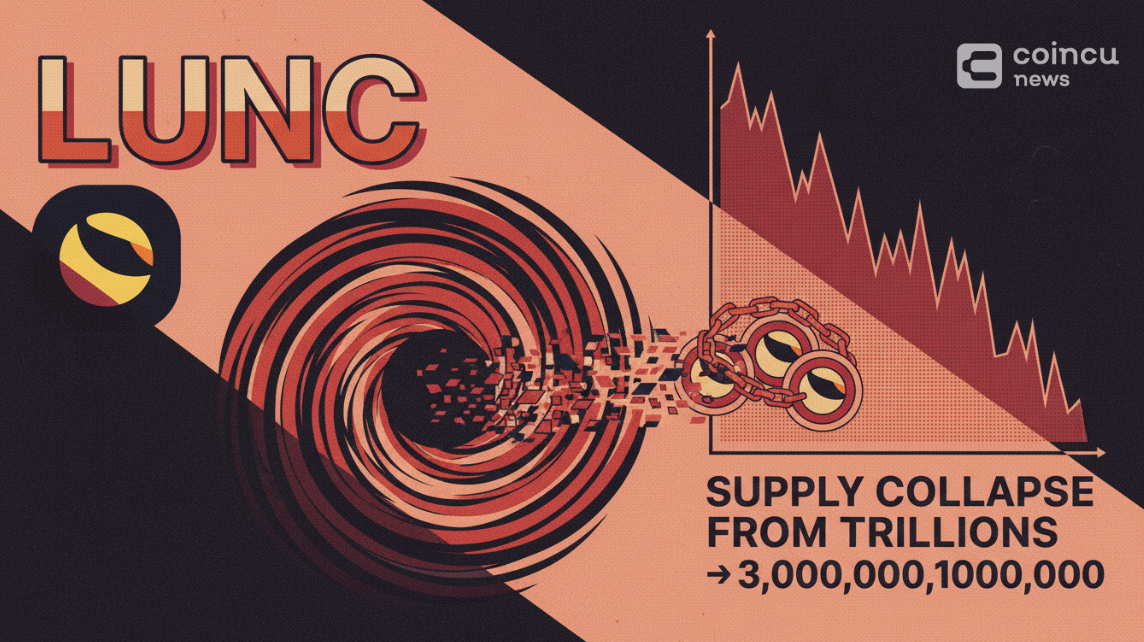
That is real deflationary pressure, but still too slow to justify a near-doubling in 30 days on burn math alone. The more defensible reading is that LUNC is being repriced in a way that is consistent with a post-burn, zero-inflation, heavily staked supply structure becoming easier for the market to notice again.
Table of Contents
Key Takeaways
- LUNC is rising in a way that is consistent with the market repricing a legacy token whose visible float looks tighter than the headline supply first suggests.
- The strongest onchain point is staking, not just burning. Terra Classic’s bonded supply currently explains about 97.5% of the gap between total and circulating supply.
- Burns are real and cumulative. LuncScan shows 444.18 billion LUNC burned to date, but the current average burn rate is still slow relative to a 6.463 trillion supply base.
- The Terra Classic mint module currently reports zero inflation and zero annual provisions, which means burns are not being offset by visible fresh protocol issuance.
Quick Snapshot
Using CoinMarketCap, LuncScan, and direct Terra Classic PublicNode LCD endpoint checks completed at 08:41 UTC on April 28, 2026:
| Metric | Value |
|---|---|
| Price | $0.00006957 |
| 24h change | +8.12% |
| 7d change | +64.43% |
| 30d change | +91.75% |
| 24h volume | $131.42M |
| Market cap | $383.16M |
| FDV | $449.66M |
| Circulating supply | 5.507T LUNC |
| Total supply | 6.463T LUNC |
| 24h low / high | $0.00005738 / $0.00007180 |
| 7d low / high | $0.00004220 / $0.00007180 |
| 30d low / high | $0.00003535 / $0.00007180 |
| Rank on CoinMarketCap | 96 |
Those numbers point to a market that is still structurally small relative to its narrative. LUNC is trading nearly 0.34 times market cap in daily turnover, and its seven-day high is also its 30-day high. That usually means the market is not simply drifting higher. It is repricing aggressively into a breakout.
What Terra Classic Actually Is
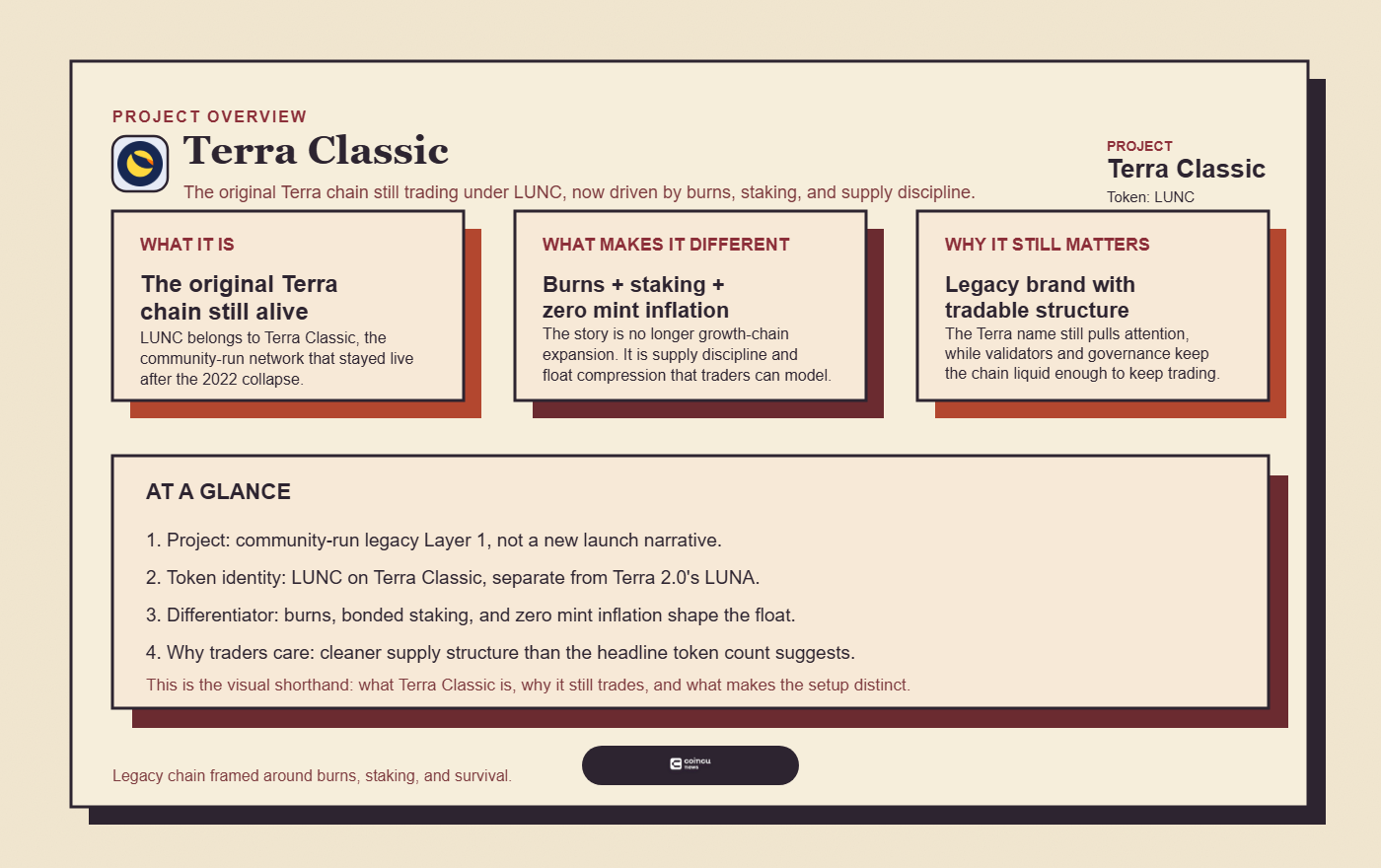
Terra Classic is the community-run chain that remained after the original Terra collapse and the later launch of Terra 2.0. The linked CoinMarketCap page is for that classic chain and its native token LUNC, not for the newer LUNA asset.
That distinction matters because LUNC is no longer trading on a simple growth-chain story. It trades on a recovery-and-supply story. The chain still supports staking, validators, governance, and an ongoing community-maintained ecosystem around the legacy Terra network. The community-run terra-classic.io homepage explicitly frames itself as a resource hub for Terra Classic applications, tooling, and infrastructure, while the official Terra Classic protocol documentation and staking specification show that validator, governance, and delegation mechanics remain live.
That legacy context is also why LUNC still carries unusual reputational baggage. Readers who want a quick refresher on how Terra-related headlines still affect narrative risk can see Coincu’s Do Kwon Faces Possible Second Trial in South Korea and the earlier Coincu market note Terra Classic and Terra Tokens Surge Amid Market Speculation.
The current bull case is therefore not “Terra is back” in the old sense. It is narrower and more technical:
| Current narrative | Why traders care |
|---|---|
| Burned supply keeps accumulating | Supports a deflationary recovery story |
| Staking still removes a large amount of LUNC from liquid circulation | Gives the market a visible supply sink |
| The mint module currently shows zero inflation | Strengthens the idea that supply pressure is not being reintroduced from protocol issuance |
| The chain still has enough community and validator structure to stay tradable | Keeps LUNC from being treated as a completely abandoned relic |
Why LUNC Is Moving Higher
The market is repricing a tighter visible float
This is the clearest structural clue behind the move.
CoinMarketCap currently shows about 6.463 trillion total LUNC and about 5.507 trillion circulating. On its own, that still looks like a huge supply base. But the Terra Classic PublicNode LCD staking endpoint, /cosmos/staking/v1beta1/pool, showed about 932.30 billion LUNC bonded in staking when checked at 08:41 UTC on April 28, 2026. That means most of the gap between total and circulating supply is not abstract. It is visible in the staking layer.
Once that becomes the lens, the recent move makes more sense. Traders are not only looking at a very large total supply. They are looking at a token where a meaningful amount of supply is already burned, another meaningful amount is staked, and the tradable portion can tighten quickly when sentiment improves.
Burns help the story, but staking is doing more of the heavy lifting right now
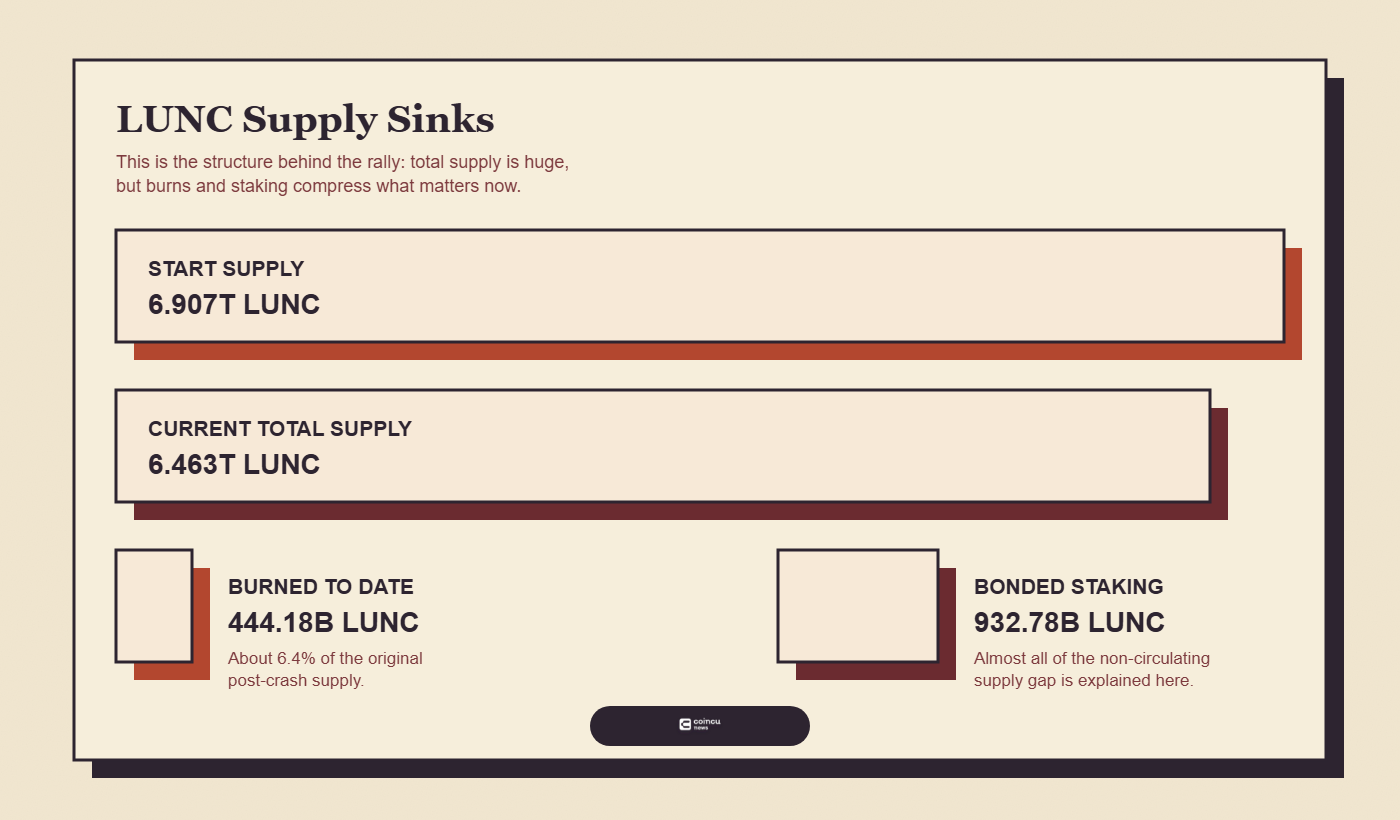
LuncScan’s burn tracker currently shows 444.18 billion LUNC burned to date, reducing supply from about 6.907 trillion at the start of the post-crash journey to about 6.463 trillion now. That is a real reduction and one of the main reasons LUNC still has a live scarcity narrative.
At the same time, the same tracker shows an average daily burn near 306.97 million LUNC. That is meaningful, but still slow relative to a 6.463 trillion supply base. On burn pace alone, the market does not suddenly justify a 64.43% seven-day move.
The more complete explanation is that burned supply improved the base, while bonded supply appears to be doing more of the live-float tightening that traders actually care about today.
Zero inflation makes the supply narrative cleaner
This is a subtle but important point.
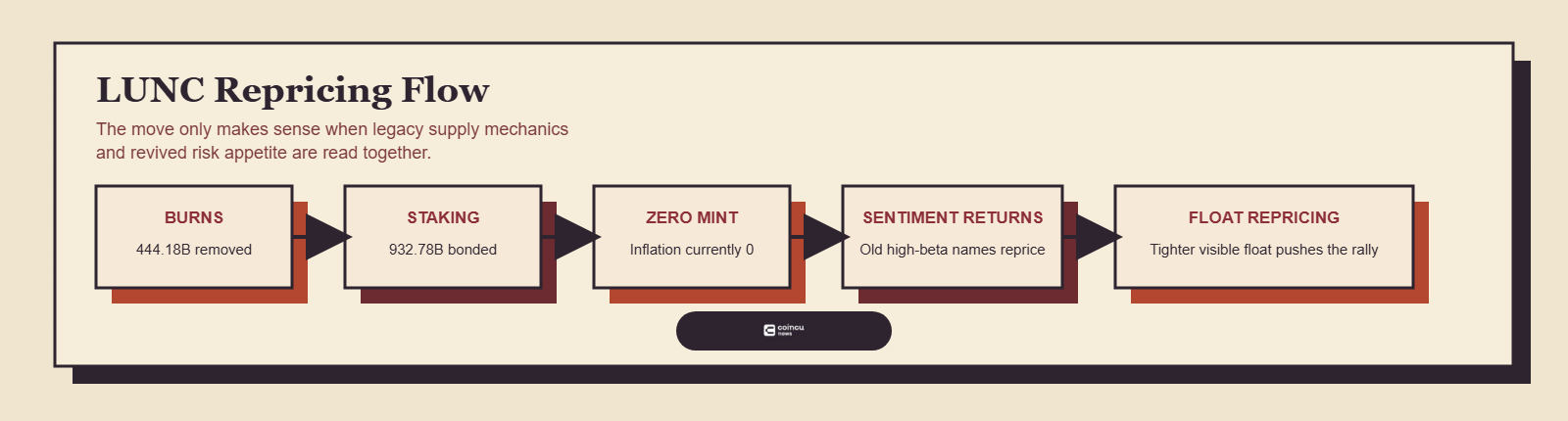
The Terra Classic PublicNode LCD mint endpoints, /cosmos/mint/v1beta1/inflation and /cosmos/mint/v1beta1/annual_provisions, both returned zero at 08:41 UTC on April 28, 2026. That means the protocol is not visibly printing fresh LUNC through the mint module to offset the supply reduction story.
For a market like LUNC, where perception of supply discipline matters more than almost anything else, that is a supportive signal.
Broader risk appetite can amplify the structure
Supply structure only matters when traders are willing to look at it.
Part of the recent backdrop is simply that crypto sentiment has improved enough for old high-beta names to start moving again. That does not prove broader mood caused the rally, but it does help explain why a cleaner supply story can suddenly matter more.
The deeper point is that LUNC did not need a perfect fundamental rebirth to rally. It only needed the market to re-engage with a token that already had a post-burn, post-collapse scarcity narrative sitting under the surface.
Deep Onchain Read
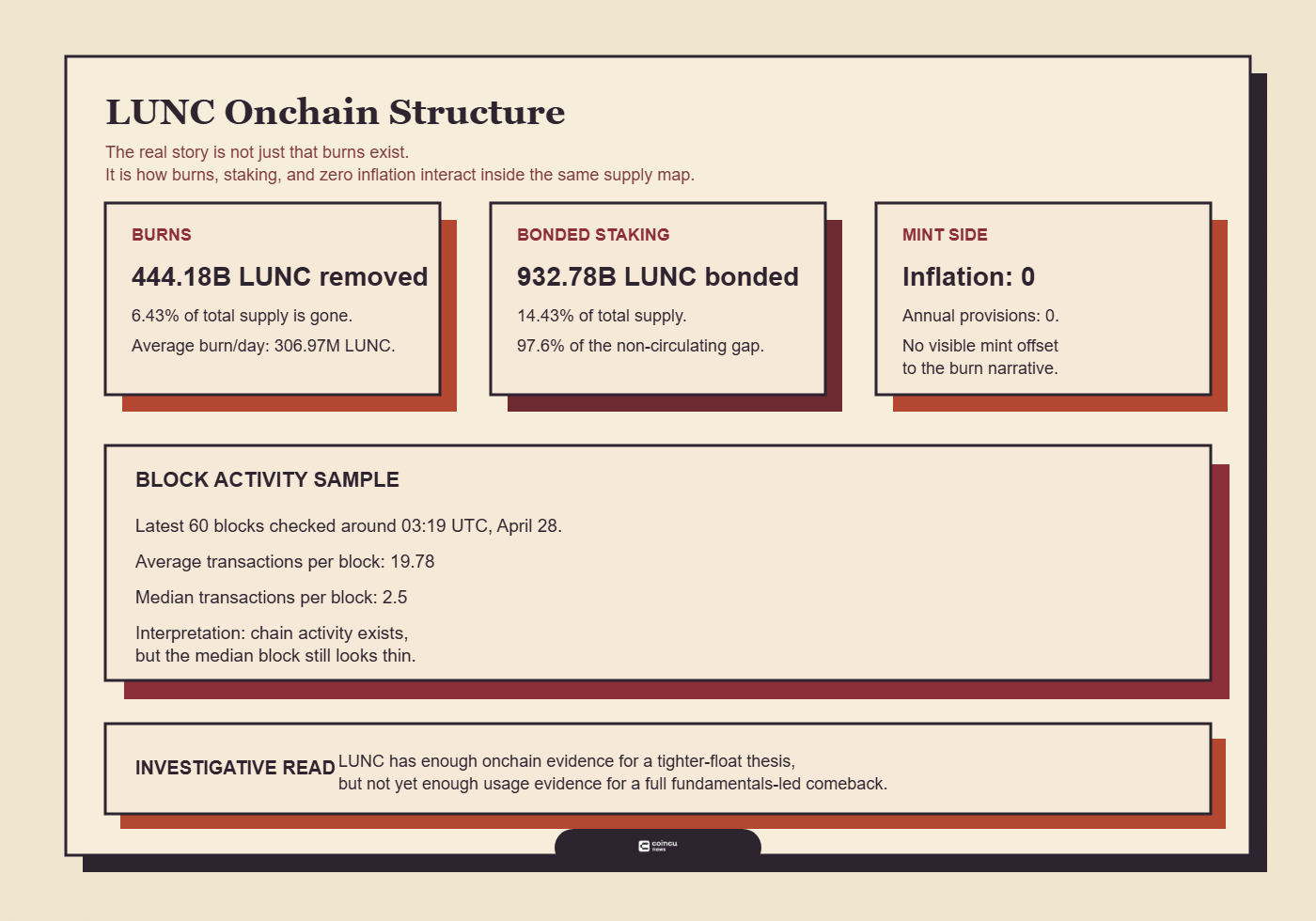
The onchain picture is what turns the LUNC move from a vague meme about burns into a cleaner supply-structure story.
Burned supply is large, but not large enough to explain the whole move alone
Using the LuncScan burn tracker checked at 01:59 UTC on April 28, 2026:
| Burn metric | Value |
|---|---|
| LUNC burned to date | 444.18B |
| Share of total supply removed | 6.43% |
| Average burn per day | 306.97M |
| Burned today at time of check | 42.25M |
| Start-of-journey supply | 6.907T |
| Current total supply on tracker | 6.463T |
That is enough to prove the deflation story is not imaginary. But it is also enough to show its limits. A 306.97 million daily burn sounds large until it is compared with a supply base still measured in trillions.
Bonded staking explains most of the non-circulating gap
This is the most important onchain clue in the whole case.
CoinMarketCap currently shows about 5.507 trillion LUNC circulating and about 6.463 trillion total supply, leaving roughly 955.9 billion LUNC outside circulating supply. The Terra Classic PublicNode LCD staking endpoint, /cosmos/staking/v1beta1/pool, showed about 932.30 billion LUNC bonded at 08:41 UTC on April 28, 2026.
That means bonded staking alone explains about 97.5% of the total-minus-circulating gap.
| Supply-structure metric | Value |
|---|---|
| Total supply | 6.463T LUNC |
| Circulating supply | 5.507T LUNC |
| Total-minus-circulating gap | 955.9B LUNC |
| Bonded supply | 932.30B LUNC |
| Bonded share of total supply | 14.43% |
| Bonded share of circulating supply | 16.93% |
| Bonded share of non-circulating gap | 97.5% |
That does not make staked LUNC permanently illiquid. Terra Classic’s staking specification still shows a 21-day unbonding time, so bonded supply can eventually come back. But for current market structure, it is a real friction layer between total supply and immediate float.
Mint-side inflation is currently zero
This point is easy to miss, but it matters.
The Terra Classic PublicNode LCD mint endpoints currently show:
| Mint metric | Value |
|---|---|
| Inflation | 0 |
| Annual provisions | 0 |
That means the chain is not currently offsetting burn and staking narratives with visible protocol-side issuance from the mint module.
This review is strongest on supply structure, not on usage acceleration
This is where the article shifts from narrative to evidence discipline.
A point-in-time spot check of 60 recent Terra Classic blocks can be useful for editorial color, but it is too small to stand in for a broad demand study. This review therefore does not treat short-window block flow as decisive evidence either for or against the rally.
The disciplined reading is that the onchain evidence in this article directly verifies burns, staking, and zero mint issuance. It does not directly verify a broad usage breakout across a longer time window.
What onchain supports, and what remains open
| Onchain-supported point | Why it matters |
|---|---|
| Burns have materially reduced supply since May 2022 | Confirms the long-running deflation narrative is real |
| Bonded staking explains most of the non-circulating gap | Supports the tighter-float interpretation |
| Mint-side inflation currently reads zero | Strengthens the supply-discipline case |
| The most reproducible onchain evidence here is supply-side rather than activity-side | Keeps the thesis grounded in directly verifiable data |
| Open question | Why it matters |
|---|---|
| Whether the recent rally can attract sustained real usage rather than only speculation | That determines whether repricing can mature into a stronger trend |
| How much bonded supply may eventually unbond if price keeps rising | That affects future sell pressure |
| Whether burn pace can stay meaningful without another large external driver | That determines whether the scarcity narrative can stay fresh |
What Could Reverse The Move
The current setup explains why LUNC can move quickly, but it also explains why the rally could cool sharply if the structure changes.
| Reversal risk | Why it matters |
|---|---|
| Staked supply starts coming back to market | The current float story depends in part on bonded supply staying bonded despite the 21-day unbonding path |
| Burn pace remains too slow relative to price expansion | Burns are supportive, but they do not mathematically justify every leg of the rally |
| Price outruns the supply evidence for too long | If a longer-window demand recovery does not follow, the market may eventually treat the move as mostly narrative-driven |
| Broader high-beta crypto appetite cools | Assets like LUNC usually lose momentum quickly in a risk-off turn |
That same release-pressure logic is familiar across crypto. Coincu recently highlighted a different version of it in Arkham Reports Ethereum Foundation Unstaked $48.9M in ETH, where the key question was not whether staking existed, but when supply might come back to market.
Final Read
LUNC is moving higher in a way that is consistent with the market revisiting a token whose supply story is cleaner than many people assume at first glance.
Burns are real, inflation is currently zero, and bonded staking is doing most of the real work in tightening the visible float. That combination is enough to support a sharp repricing when sentiment improves. The strongest single onchain fact is that bonded supply explains almost all of the gap between total and circulating LUNC.
At the same time, the move still looks more like a supply-and-sentiment rally than a fully evidenced onchain fundamentals revival. This review directly proves the supply structure. It does not claim to prove that network usage has already expanded enough to match the speed of the price move.
That does not make the rally fake. It makes it conditional. LUNC is moving because the market sees a tighter live supply structure, not because Terra Classic has suddenly become a high-growth chain again.
Readers who want another Coincu example of a structure-led why-pumping framework can compare this setup with Katana Network (KAT) Jumped 55% in 24 Hours, These 5 On-Chain Signals Explain Why.
Methodology
This review is based on public materials checked on April 28, 2026, including the linked CoinMarketCap Terra Classic page, the LuncScan burn tracker, the Terra Classic community ecosystem hub, the Terra Classic protocol and staking docs, and direct PublicNode LCD queries for Terra Classic. The key supply-side endpoint checks were:
- Staking pool: https://terra-classic-lcd.publicnode.com/cosmos/staking/v1beta1/pool
- Mint inflation: https://terra-classic-lcd.publicnode.com/cosmos/mint/v1beta1/inflation
- Annual provisions: https://terra-classic-lcd.publicnode.com/cosmos/mint/v1beta1/annual_provisions
Those three LCD endpoints were checked at 08:41 UTC on April 28, 2026. This article does not rely on a long-window activity dataset, and any short-window block checks should be treated only as spot observations rather than as a full demand study. Market and onchain figures change quickly, so all values in this article should be read as point-in-time observations.
Disclaimer
This article is for research and informational purposes only and should not be treated as financial advice. Terra Classic remains a highly volatile legacy asset, and narrative-driven rallies can reverse quickly when liquidity or sentiment changes.
Sources
CoinMarketCap, Terra Classic page: https://coinmarketcap.com/currencies/terra-luna/
LuncScan, LUNC burn tracker: https://luncscan.com/burn/lunc
Terra Classic ecosystem hub: https://terra-classic.io/
Terra Classic docs, protocol overview: https://classic-docs.terra.money/docs/learn/protocol.html
Terra Classic docs, staking specification: https://classic-docs.terra.money/docs/develop/module-specifications/spec-staking.html
Terra Classic PublicNode LCD, staking pool: https://terra-classic-lcd.publicnode.com/cosmos/staking/v1beta1/pool
Terra Classic PublicNode LCD, mint inflation: https://terra-classic-lcd.publicnode.com/cosmos/mint/v1beta1/inflation
Terra Classic PublicNode LCD, annual provisions: https://terra-classic-lcd.publicnode.com/cosmos/mint/v1beta1/annual_provisions

No tags available.


Other Posts









- Amplify 2024: Ohio’s Premier Blockchain Summit
- Polymarket Announces U.S. Beta Relaunch Amid Market Buzz
- China, US Conclude Trade Talks with Focus on Cooperation
- Crypto Weekly: NYSE Backs OKX, Kraken Gets Fed Access, BTC Sells
- CELO holds as Celo reviews Opera 160M token claim
- DeriW Launches Edge Hour Trading Competition Platform for Derivatives Traders
- Michael Saylor Denies Bitcoin Sell-Off Amid Large BTC Transfer
- Court Upholds Fed’s Rejection of Custodia Bank’s Request
- EU Opens Antitrust Probe Into Deutsche Boerse and Nasdaq Derivatives Dealings
- Kazakhstan Explores Crypto Reserves Backed by National Funds
- JPMorgan Increases Holdings in BlackRock’s Bitcoin ETF
- Nordea Bank Introduces Bitcoin ETP Trading for Nordic Customers
- XRP Spot ETF Launches on Nasdaq Amid Market Fluctuations
- JPMorgan Chase Launches 24/7 Digital Deposit Token for Clients
- Crypto Leaders Address Macro Volatility Amid Market Shifts
- Former CFO Convicted for $35M Fraudulent Crypto Investment
- Peter Schiff Challenges Michael Saylor on MSTR’s Business Model
- Thailand Orders Worldcoin to Delete 1.2 Million Biometric Records
- UK Proposes New DeFi Tax Framework to Ease User Burden
- U.S. Treasury Proposes New Tax Relief Regulations
- Amplify 2024: Ohio’s Premier Blockchain Summit
- Polymarket Announces U.S. Beta Relaunch Amid Market Buzz
- China, US Conclude Trade Talks with Focus on Cooperation
- Crypto Weekly: NYSE Backs OKX, Kraken Gets Fed Access, BTC Sells
- CELO holds as Celo reviews Opera 160M token claim
- DeriW Launches Edge Hour Trading Competition Platform for Derivatives Traders
- Michael Saylor Denies Bitcoin Sell-Off Amid Large BTC Transfer
- Court Upholds Fed’s Rejection of Custodia Bank’s Request
- EU Opens Antitrust Probe Into Deutsche Boerse and Nasdaq Derivatives Dealings
- Kazakhstan Explores Crypto Reserves Backed by National Funds
- JPMorgan Increases Holdings in BlackRock’s Bitcoin ETF
- Nordea Bank Introduces Bitcoin ETP Trading for Nordic Customers
- XRP Spot ETF Launches on Nasdaq Amid Market Fluctuations
- JPMorgan Chase Launches 24/7 Digital Deposit Token for Clients
- Crypto Leaders Address Macro Volatility Amid Market Shifts
- Former CFO Convicted for $35M Fraudulent Crypto Investment
- Peter Schiff Challenges Michael Saylor on MSTR’s Business Model
- Thailand Orders Worldcoin to Delete 1.2 Million Biometric Records
- UK Proposes New DeFi Tax Framework to Ease User Burden
- U.S. Treasury Proposes New Tax Relief Regulations
- Amplify 2024: Ohio’s Premier Blockchain Summit
- Polymarket Announces U.S. Beta Relaunch Amid Market Buzz
- China, US Conclude Trade Talks with Focus on Cooperation
- Crypto Weekly: NYSE Backs OKX, Kraken Gets Fed Access, BTC Sells
- CELO holds as Celo reviews Opera 160M token claim
- DeriW Launches Edge Hour Trading Competition Platform for Derivatives Traders
- Michael Saylor Denies Bitcoin Sell-Off Amid Large BTC Transfer
- Court Upholds Fed’s Rejection of Custodia Bank’s Request
- EU Opens Antitrust Probe Into Deutsche Boerse and Nasdaq Derivatives Dealings
- Kazakhstan Explores Crypto Reserves Backed by National Funds
- JPMorgan Increases Holdings in BlackRock’s Bitcoin ETF
- Nordea Bank Introduces Bitcoin ETP Trading for Nordic Customers
- XRP Spot ETF Launches on Nasdaq Amid Market Fluctuations
- JPMorgan Chase Launches 24/7 Digital Deposit Token for Clients
- Crypto Leaders Address Macro Volatility Amid Market Shifts
- Former CFO Convicted for $35M Fraudulent Crypto Investment
- Peter Schiff Challenges Michael Saylor on MSTR’s Business Model
- Thailand Orders Worldcoin to Delete 1.2 Million Biometric Records
- UK Proposes New DeFi Tax Framework to Ease User Burden
- U.S. Treasury Proposes New Tax Relief Regulations
Latest


Press Release
BitMart x $EAT Trade-to-Feed Competition to Pay Out $4.4M USDT to Traders in May 2026