Sui Foundation disclosed that three separate mainnet interruptions on May 28-29, 2026 were caused by upgrade-related bugs, including flaws in gas charging logic introduced with the v1.72 release and a latent issue with how validators preserved randomness state across restarts. No user funds were at risk and no committed transactions were reverted, the foundation said.
What Sui Said About the Three Mainnet Interruptions
The Sui Foundation published a detailed postmortem confirming that Sui Mainnet experienced three outage incidents across May 28-29, 2026. The interruptions came shortly after a major protocol upgrade, and each had a distinct technical trigger.
The foundation attributed all three incidents to software bugs rather than external attacks or security vulnerabilities. It stated that no user funds were at risk during any of the outages and that the network did not revert any committed transactions.
Sui carries a market capitalization of roughly $3.59 billion, making the reliability of its mainnet a material concern for a broad base of users and developers.
The incidents added to a pattern of mainnet disruptions for Sui, which also experienced a separate network stall on January 14, 2026. That earlier episode had its own distinct root cause, but the clustering of outages within a few months has drawn attention to the chain’s upgrade testing and deployment practices.
How the First Two Outages Were Linked to the v1.72 Upgrade
The first two interruptions stemmed from crash bugs in the gas charging logic introduced around the v1.72 release. That release included changes to how the protocol handled address balances, and the bugs surfaced when specific transaction patterns triggered an underflow in the gas payment settlement path.
When the first outage hit on May 28, validators crashed and the network stalled. The Mysten Labs engineering team deployed an interim fix to restore service, but the foundation acknowledged that this patch carried a known low-probability halt risk that the team accepted in order to bring the network back online quickly.
That calculated risk materialized. The second outage followed shortly after, triggered by the same class of bug that the interim fix had not fully resolved. The sequence illustrated the tension between restoring service rapidly and deploying a complete fix, a tradeoff familiar to operators of any distributed system but particularly consequential for a blockchain where downtime freezes all on-chain activity.
The episode is a reminder that protocol upgrades carry inherent risk. Other major chains have faced similar challenges; even in traditional crypto markets, unexpected disruptions can cascade quickly, as seen when Ether fell below $2,000 during a period of broad market stress earlier this year.
Why the Third Interruption Happened at Epoch Change
The third outage had an entirely separate root cause from the first two. It was triggered by a latent bug in how validators preserved randomness state across restarts, and it surfaced at the next scheduled epoch change after the earlier fixes were deployed.
Sui’s consensus mechanism relies on distributed key generation (DKG) to produce shared randomness at each epoch boundary. When validators restarted with the patched software, the bug prevented them from correctly carrying over the randomness state needed to complete the epoch transition.
This meant the network stalled again even though the gas charging bug had been resolved. The two failure modes were independent, with the randomness state issue having been latent in the codebase before the v1.72 release but only exposed by the unusual restart conditions created by the emergency patching process.
How Mysten Labs Restored the Network
The engineering team at Mysten Labs addressed the outages through two emergency pull requests merged on May 29, 2026. PR #26828 fixed the gas-payment settlement underflow by pruning address-balance gas-payment entries on early aborts caused by insufficient funds, preventing the crash path that had brought down validators.
PR #26846 introduced a deterministic force-close mechanism for the stalled epoch and set the mainnet recovery target to epoch 1142, consensus commit 768980. This allowed validators to converge on a consistent state and resume block production without reverting any previously committed transactions.
The DeFi ecosystem built on Sui, which holds roughly $752.3 million in total value locked, remained intact through the outages. While users could not execute new transactions during the downtime, existing positions and balances were unaffected.
The broader crypto market was already under pressure during the incident window. The Fear and Greed Index sat at 29, firmly in “Fear” territory, and SUI itself was trading at $0.896 with a 1.47% decline over 24 hours. Network reliability concerns layered on top of existing market anxiety, though the token’s price movement was modest relative to the severity of three consecutive outages.
The incident comes at a time when blockchain reliability is under increasing scrutiny across the industry. Projects like HYPE, which recently overtook Dogecoin to enter the top 10 by market cap, demonstrate how quickly market positioning can shift, making sustained uptime a competitive necessity.
What the Sui Interruptions Mean for Users and the Network
Were user funds at risk? No. The Sui Foundation stated that no user funds were at risk during any of the three incidents. The bugs caused validator crashes and network stalls but did not create conditions where assets could be lost or stolen.
Were any transactions reverted? No. The network did not revert any committed transactions during the May 28-29 outages. The recovery process was designed to resume from the last consistent state rather than roll back.
What does this mean for Sui’s reliability? Three outages in roughly 24 hours, following a separate stall in January, raises questions about the chain’s upgrade testing pipeline. The Sui Foundation’s postmortem was detailed and transparent, but the pattern suggests that the current release process may need additional safeguards before major protocol changes reach mainnet.
Exchanges and infrastructure providers that depend on Sui’s liveness, including those planning new product launches like Kraken’s upcoming perpetual contracts expansion, will likely watch future Sui upgrades more closely. The foundation’s willingness to publish a full technical postmortem is a positive signal, but the operational track record now includes four mainnet interruptions in 2026 alone.
Disclaimer: This article is for informational purposes only and does not constitute financial or investment advice. Cryptocurrency and digital asset markets carry significant risk. Always do your own research before making decisions.
No tags available.


Other Posts







- China, US Conclude Trade Talks with Focus on Cooperation
- Crypto Weekly: NYSE Backs OKX, Kraken Gets Fed Access, BTC Sells
- Court Upholds Fed’s Rejection of Custodia Bank’s Request
- Former CFO Convicted for $35M Fraudulent Crypto Investment
- DeriW Launches Edge Hour Trading Competition Platform for Derivatives Traders
- Michael Saylor Denies Bitcoin Sell-Off Amid Large BTC Transfer
- Buy Dogecoin on eToro: Step-by-Step Guide for Beginners (2024)
- Kazakhstan Explores Crypto Reserves Backed by National Funds
- JPMorgan Increases Holdings in BlackRock’s Bitcoin ETF
- Nordea Bank Introduces Bitcoin ETP Trading for Nordic Customers
- XRP Spot ETF Launches on Nasdaq Amid Market Fluctuations
- Peter Schiff Challenges Michael Saylor on MSTR’s Business Model
- Thailand Orders Worldcoin to Delete 1.2 Million Biometric Records
- UK Proposes New DeFi Tax Framework to Ease User Burden
- WLFI Under Fire: Analyst Warns Hyperliquid Could Be Next
- Ancient Ethereum Whale Moves $1.19 Billion After Decade
- BlackRock Receives Large Crypto Transfers from Coinbase
- SEC Scrutiny on ALT5 Sigma’s Leadership Disclosure Timing
- Yala Injects $5.5 Million Amid Recovery Efforts
- Radiant Capital Faces $50M Loss in Major Security Breach
- China, US Conclude Trade Talks with Focus on Cooperation
- Crypto Weekly: NYSE Backs OKX, Kraken Gets Fed Access, BTC Sells
- Court Upholds Fed’s Rejection of Custodia Bank’s Request
- Former CFO Convicted for $35M Fraudulent Crypto Investment
- DeriW Launches Edge Hour Trading Competition Platform for Derivatives Traders
- Michael Saylor Denies Bitcoin Sell-Off Amid Large BTC Transfer
- Buy Dogecoin on eToro: Step-by-Step Guide for Beginners (2024)
- Kazakhstan Explores Crypto Reserves Backed by National Funds
- JPMorgan Increases Holdings in BlackRock’s Bitcoin ETF
- Nordea Bank Introduces Bitcoin ETP Trading for Nordic Customers
- XRP Spot ETF Launches on Nasdaq Amid Market Fluctuations
- Peter Schiff Challenges Michael Saylor on MSTR’s Business Model
- Thailand Orders Worldcoin to Delete 1.2 Million Biometric Records
- UK Proposes New DeFi Tax Framework to Ease User Burden
- WLFI Under Fire: Analyst Warns Hyperliquid Could Be Next
- Ancient Ethereum Whale Moves $1.19 Billion After Decade
- BlackRock Receives Large Crypto Transfers from Coinbase
- SEC Scrutiny on ALT5 Sigma’s Leadership Disclosure Timing
- Yala Injects $5.5 Million Amid Recovery Efforts
- Radiant Capital Faces $50M Loss in Major Security Breach
- China, US Conclude Trade Talks with Focus on Cooperation
- Crypto Weekly: NYSE Backs OKX, Kraken Gets Fed Access, BTC Sells
- Court Upholds Fed’s Rejection of Custodia Bank’s Request
- Former CFO Convicted for $35M Fraudulent Crypto Investment
- DeriW Launches Edge Hour Trading Competition Platform for Derivatives Traders
- Michael Saylor Denies Bitcoin Sell-Off Amid Large BTC Transfer
- Buy Dogecoin on eToro: Step-by-Step Guide for Beginners (2024)
- Kazakhstan Explores Crypto Reserves Backed by National Funds
- JPMorgan Increases Holdings in BlackRock’s Bitcoin ETF
- Nordea Bank Introduces Bitcoin ETP Trading for Nordic Customers
- XRP Spot ETF Launches on Nasdaq Amid Market Fluctuations
- Peter Schiff Challenges Michael Saylor on MSTR’s Business Model
- Thailand Orders Worldcoin to Delete 1.2 Million Biometric Records
- UK Proposes New DeFi Tax Framework to Ease User Burden
- WLFI Under Fire: Analyst Warns Hyperliquid Could Be Next
- Ancient Ethereum Whale Moves $1.19 Billion After Decade
- BlackRock Receives Large Crypto Transfers from Coinbase
- SEC Scrutiny on ALT5 Sigma’s Leadership Disclosure Timing
- Yala Injects $5.5 Million Amid Recovery Efforts
- Radiant Capital Faces $50M Loss in Major Security Breach

HSBC Says Crypto Allocation Fell to 6% as 45% of HNW Investors Plan to Increase Holdings


Binance Wallet Adds Changxin Technology Perpetuals With 20x Leverage
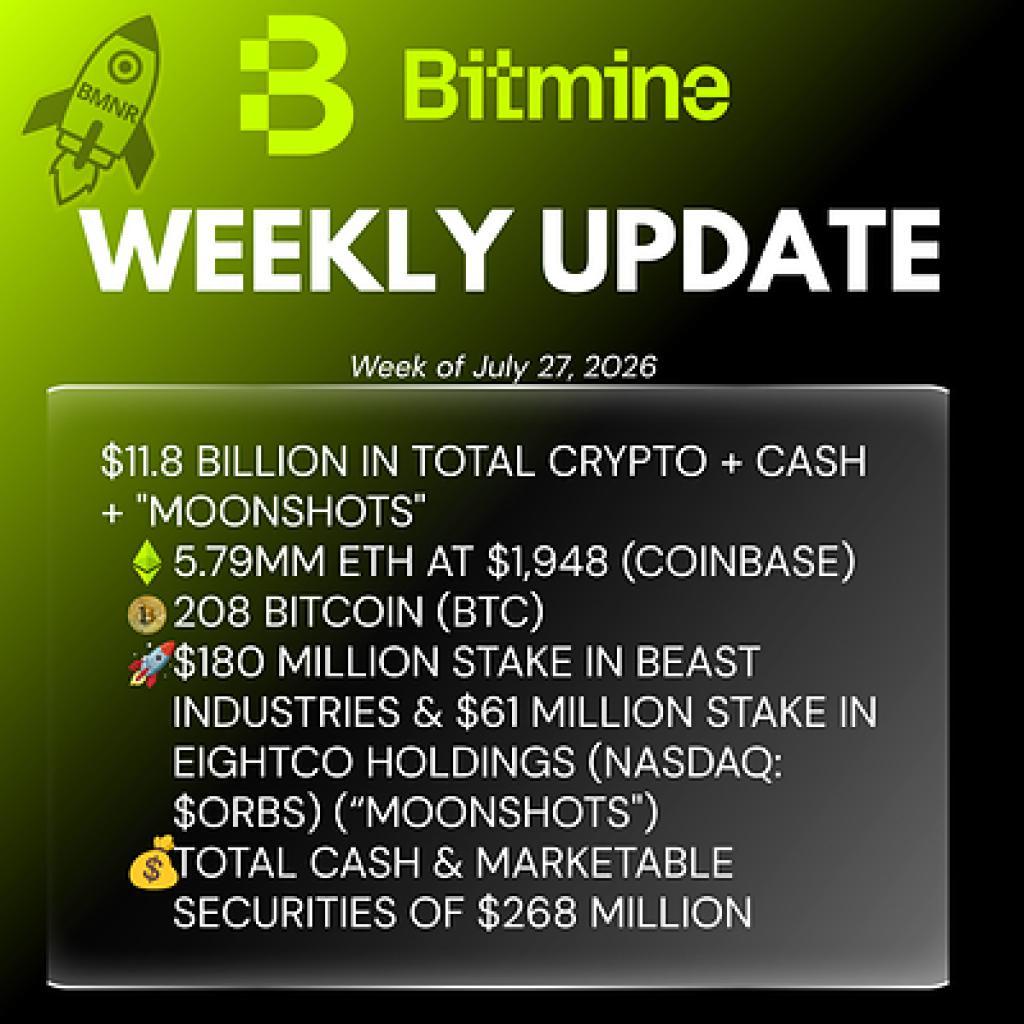
Bitmine Immersion Technologies (BMNR) Announces ETH Holdings Reach 5.79 Million Tokens, and Total Crypto and Total Cash Holdings of $11.8 Billion
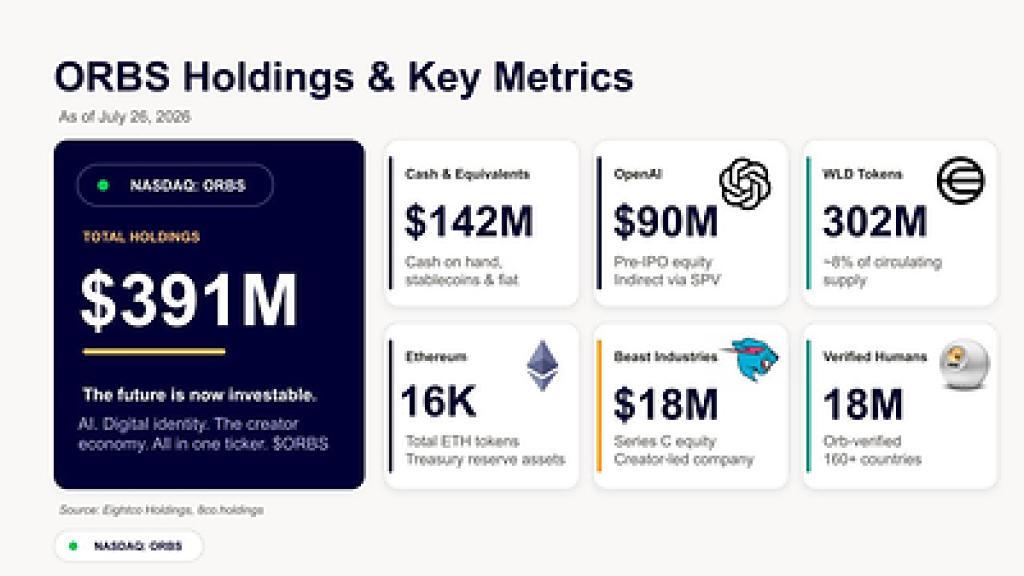
Eightco Holdings (NASDAQ: ORBS) Announces its Participation in World Foundation’s $52.5M funding round as World Shifts From Building the Network to Scaling Utility