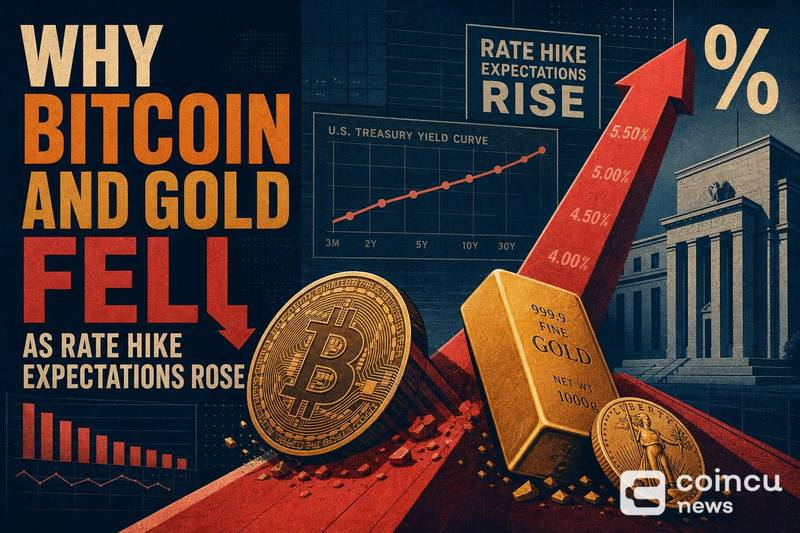
Rising interest rate hike expectations have pressured both Bitcoin and gold lower, undermining the hedging narratives that investors have long attached to both assets. The simultaneous decline highlights how macro repricing can overwhelm traditional and alternative safe havens alike when markets begin pricing in tighter monetary policy.
How Rate Hike Expectations Reset the Market Narrative
Rate hike expectations refer to the probability, priced into futures and bond markets, that a central bank will raise its benchmark interest rate at an upcoming meeting. When those probabilities shift higher, markets do not wait for the actual policy decision. Asset prices adjust immediately as traders reposition portfolios around the new expected path of rates.
Higher expected rates raise the opportunity cost of holding assets that generate no yield. Cash and short-duration bonds become more attractive relative to gold, Bitcoin, and other instruments that rely on capital appreciation rather than income. This dynamic tightens financial conditions before any official rate change takes place.
The repricing also tends to strengthen the U.S. dollar, which compounds pressure on dollar-denominated commodities and risk assets. When rate expectations shift abruptly, correlations between otherwise unrelated assets can spike as the same macro force drives selling across multiple markets simultaneously.
Why Bitcoin Lost Support Even With Its Hedge Narrative
Bitcoin occupies an unusual position in financial markets. Long-term holders frequently describe it as a hedge against inflation and currency debasement, a digital alternative to gold. Short-term traders, however, treat it as a high-beta risk asset that thrives on liquidity and weakens when monetary conditions tighten.
When rate hike expectations rise, the risk-asset side of Bitcoin’s identity tends to dominate. A stronger dollar, higher real yields, and reduced liquidity all work against speculative positioning. Leveraged traders face higher funding costs, and institutional allocators may rotate toward newly attractive yield-bearing instruments.
Bitcoin’s market activity on CoinGecko reflects these dual forces, with price action often tracking broader risk sentiment in the short term even as the long-term supply dynamics remain unchanged. The fixed 21 million supply cap does not protect against a liquidity-driven drawdown when macro conditions shift.
Short-Term Trading Behavior vs. Long-Term Store of Value
The distinction between Bitcoin’s short-term price action and its long-term thesis is critical. A single-day or single-week decline driven by rate expectations does not necessarily invalidate the store-of-value argument, which rests on multi-year adoption trends and monetary debasement cycles.
However, the frequency with which Bitcoin sells off alongside equities during macro stress events has complicated the pure-hedge narrative. Institutional participants, including those entering through products like CME’s Nasdaq Crypto Index Futures, often manage Bitcoin exposure within broader risk frameworks that trigger selling when volatility spikes.
Why Gold Also Fell Instead of Acting as a Safe Haven
Gold’s reputation as the ultimate safe haven obscures a more nuanced reality. While gold tends to perform well during financial crises and periods of negative real interest rates, it can struggle when nominal rates rise faster than inflation expectations, pushing real yields higher.
Higher real yields increase the carrying cost of gold, which produces no income. Investors holding gold must forgo the rising yield available from government bonds, making bullion relatively less attractive. This relationship between gold and real yields is one of the most consistent patterns in commodity markets.
A stronger dollar adds a second headwind. Gold is priced in dollars globally, so dollar appreciation makes it more expensive for international buyers, reducing demand at the margin. When rate hike expectations drive both higher real yields and a stronger dollar simultaneously, gold faces a double squeeze.
When Gold Works as a Hedge and When It Can Fail
Gold typically excels as a hedge during demand-driven crises, financial system stress, or periods when central banks are cutting rates and expanding balance sheets. In those environments, falling real yields and dollar weakness create tailwinds for bullion.
Gold tends to underperform as a hedge during supply-side inflation episodes where central banks respond with aggressive tightening. In those scenarios, the rate response overwhelms the inflation impulse, and gold behaves more like a rate-sensitive asset than a crisis hedge. The current environment, where markets are pricing in additional tightening, fits this pattern.
What Simultaneous Weakness in Bitcoin and Gold Means for Hedging Strategies
When both Bitcoin and gold decline together, it signals that macro repricing is powerful enough to override the distinct demand drivers of each asset. This is not unusual during periods of rapid rate expectation shifts. Correlation between asset classes tends to rise during macro stress, precisely when diversification benefits are most needed.
The simultaneous decline does not mean hedging is broken. It means that tactical hedges, positions designed to protect against short-term drawdowns, can fail when the dominant market force is a broad repricing of the discount rate applied to all future cash flows and asset values.
Strategic diversification operates on a different timeline. Over full market cycles, assets with fundamentally different supply dynamics and demand drivers tend to reassert their independent behavior. The Fear and Greed Index often captures these sentiment extremes, which historically have preceded reversals in correlation patterns.
Judging Whether a Hedge Failed or Was Simply Early
A hedge that declines alongside the asset it is meant to protect has not necessarily failed. The relevant question is whether the hedge’s long-term return profile still provides meaningful diversification over the investor’s full time horizon.
Bitcoin miners continue building infrastructure despite price volatility, as demonstrated by Keel Infrastructure’s recent $458 million notes offering. This type of long-term capital commitment suggests that institutional participants view short-term macro-driven drawdowns as distinct from structural changes in the asset’s value proposition.
For investors evaluating their hedging framework, the key takeaway is that no single asset reliably hedges against every type of market stress. Rate-driven selloffs affect non-yielding assets broadly, while credit crises or currency crises may favor gold or Bitcoin differently. Matching the hedge to the specific risk being managed matters more than holding a generic “safe haven” allocation.
FAQ: Bitcoin, Gold, and Rate Hike Expectations
Why can Bitcoin and gold fall at the same time?
Both assets are non-yielding, meaning they produce no interest or dividends. When expected interest rates rise, the opportunity cost of holding non-yielding assets increases for both, creating a common selling pressure that can override their otherwise different demand drivers.
Is Bitcoin still a hedge against inflation?
Bitcoin’s fixed supply of 21 million coins provides a structural argument against long-term monetary debasement. However, in the short term, Bitcoin often trades as a risk asset sensitive to liquidity conditions. Its effectiveness as an inflation hedge depends heavily on the time horizon and whether central banks are tightening or easing in response to inflation.
Why do higher interest rates hurt non-yielding assets?
Higher rates make risk-free instruments like government bonds more attractive. Investors can earn meaningful returns from bonds with minimal risk, reducing the incentive to hold assets like gold or Bitcoin that rely entirely on price appreciation. This shifts capital flows away from non-yielding assets toward income-generating alternatives.
Does one-day price action invalidate the long-term hedge thesis?
No. Short-term price movements driven by macro repricing reflect changes in positioning and sentiment, not fundamental shifts in an asset’s long-term properties. Bitcoin’s supply schedule and gold’s physical scarcity remain unchanged regardless of daily price action. The hedge thesis should be evaluated over full economic cycles, not individual trading sessions. Recent developments like institutional ETF flow patterns illustrate how short-term positioning can diverge sharply from longer-term structural trends.
Disclaimer: This article is for informational purposes only and does not constitute financial or investment advice. Cryptocurrency and digital asset markets carry significant risk. Always do your own research before making decisions.
No tags available.





- China, US Conclude Trade Talks with Focus on Cooperation
- Crypto Weekly: NYSE Backs OKX, Kraken Gets Fed Access, BTC Sells
- Court Upholds Fed’s Rejection of Custodia Bank’s Request
- Former CFO Convicted for $35M Fraudulent Crypto Investment
- DeriW Launches Edge Hour Trading Competition Platform for Derivatives Traders
- Michael Saylor Denies Bitcoin Sell-Off Amid Large BTC Transfer
- Buy Dogecoin on eToro: Step-by-Step Guide for Beginners (2024)
- Kazakhstan Explores Crypto Reserves Backed by National Funds
- JPMorgan Increases Holdings in BlackRock’s Bitcoin ETF
- Nordea Bank Introduces Bitcoin ETP Trading for Nordic Customers
- XRP Spot ETF Launches on Nasdaq Amid Market Fluctuations
- Peter Schiff Challenges Michael Saylor on MSTR’s Business Model
- Thailand Orders Worldcoin to Delete 1.2 Million Biometric Records
- UK Proposes New DeFi Tax Framework to Ease User Burden
- WLFI Under Fire: Analyst Warns Hyperliquid Could Be Next
- Ancient Ethereum Whale Moves $1.19 Billion After Decade
- BlackRock Receives Large Crypto Transfers from Coinbase
- SEC Scrutiny on ALT5 Sigma’s Leadership Disclosure Timing
- Yala Injects $5.5 Million Amid Recovery Efforts
- Radiant Capital Faces $50M Loss in Major Security Breach
- China, US Conclude Trade Talks with Focus on Cooperation
- Crypto Weekly: NYSE Backs OKX, Kraken Gets Fed Access, BTC Sells
- Court Upholds Fed’s Rejection of Custodia Bank’s Request
- Former CFO Convicted for $35M Fraudulent Crypto Investment
- DeriW Launches Edge Hour Trading Competition Platform for Derivatives Traders
- Michael Saylor Denies Bitcoin Sell-Off Amid Large BTC Transfer
- Buy Dogecoin on eToro: Step-by-Step Guide for Beginners (2024)
- Kazakhstan Explores Crypto Reserves Backed by National Funds
- JPMorgan Increases Holdings in BlackRock’s Bitcoin ETF
- Nordea Bank Introduces Bitcoin ETP Trading for Nordic Customers
- XRP Spot ETF Launches on Nasdaq Amid Market Fluctuations
- Peter Schiff Challenges Michael Saylor on MSTR’s Business Model
- Thailand Orders Worldcoin to Delete 1.2 Million Biometric Records
- UK Proposes New DeFi Tax Framework to Ease User Burden
- WLFI Under Fire: Analyst Warns Hyperliquid Could Be Next
- Ancient Ethereum Whale Moves $1.19 Billion After Decade
- BlackRock Receives Large Crypto Transfers from Coinbase
- SEC Scrutiny on ALT5 Sigma’s Leadership Disclosure Timing
- Yala Injects $5.5 Million Amid Recovery Efforts
- Radiant Capital Faces $50M Loss in Major Security Breach
- China, US Conclude Trade Talks with Focus on Cooperation
- Crypto Weekly: NYSE Backs OKX, Kraken Gets Fed Access, BTC Sells
- Court Upholds Fed’s Rejection of Custodia Bank’s Request
- Former CFO Convicted for $35M Fraudulent Crypto Investment
- DeriW Launches Edge Hour Trading Competition Platform for Derivatives Traders
- Michael Saylor Denies Bitcoin Sell-Off Amid Large BTC Transfer
- Buy Dogecoin on eToro: Step-by-Step Guide for Beginners (2024)
- Kazakhstan Explores Crypto Reserves Backed by National Funds
- JPMorgan Increases Holdings in BlackRock’s Bitcoin ETF
- Nordea Bank Introduces Bitcoin ETP Trading for Nordic Customers
- XRP Spot ETF Launches on Nasdaq Amid Market Fluctuations
- Peter Schiff Challenges Michael Saylor on MSTR’s Business Model
- Thailand Orders Worldcoin to Delete 1.2 Million Biometric Records
- UK Proposes New DeFi Tax Framework to Ease User Burden
- WLFI Under Fire: Analyst Warns Hyperliquid Could Be Next
- Ancient Ethereum Whale Moves $1.19 Billion After Decade
- BlackRock Receives Large Crypto Transfers from Coinbase
- SEC Scrutiny on ALT5 Sigma’s Leadership Disclosure Timing
- Yala Injects $5.5 Million Amid Recovery Efforts
- Radiant Capital Faces $50M Loss in Major Security Breach




RISEx Launches ‘Ignite’ Season 1 Points Program, Following $3B in Volume During the Early Access Phase

Zoomex X Space Recap With Fernando Llorente and the World Cup Final Panel