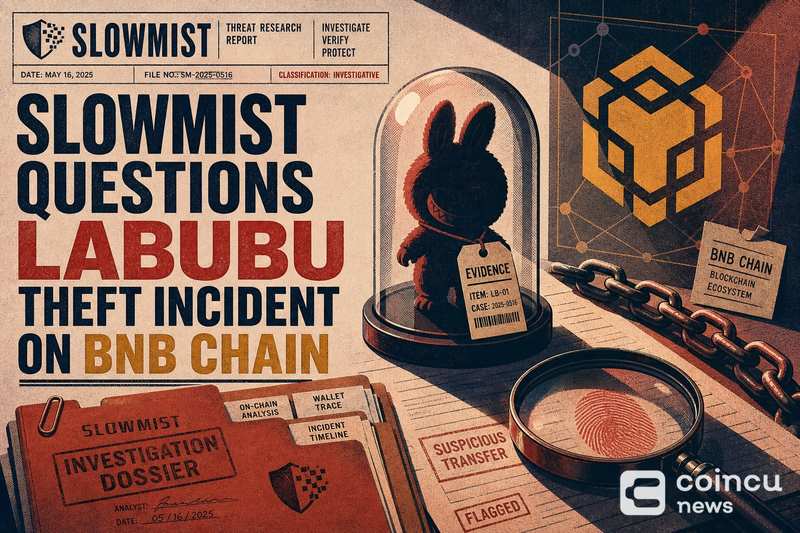
The LABUBU theft incident on BNB Chain remains an unresolved security case based on the limited public record supplied for this article: a SlowMist BSC archive entry and a BscScan address page tied to the review. That narrow record supports a cautious reading in which suspected abnormal parameter changes, not a clearly documented external exploit, are central to why the event is being questioned.
What the current record confirms
The two readable URLs in the brief are SlowMist’s BSC incident archive and the BscScan page for the tracked address. Together, they confirm only that SlowMist logged a BSC-related case and that an on-chain address is part of the incident record.
What the record does not provide is equally important. Neither SlowMist’s archive listing nor the linked BscScan address page supplies a transaction hash, decoded function call, or project postmortem, so the evidence here does not prove that the event was a conventional theft.
Why suspected parameter changes matter
That absence of a decoded exploit path is why suspected parameter changes matter. If the disputed action involved privileged settings rather than an obvious drain transaction on the reviewed BscScan address, the case sits closer to a governance or control failure than to the clearer fund-movement pattern seen in COINCU’s report on hackers moving stolen funds to KuCoin.
The wording attached to SlowMist’s BSC archive page is therefore more important than any missing market reaction data, because no verified loss figure or asset flow accompanies the brief. On the supplied evidence, abnormal parameter changes should be read as a warning that contract settings or administrative permissions may be part of the dispute.
Why the case remains open
Cosine is named in the incident framing supplied for this article, but the directly readable evidence still comes back to SlowMist’s archive and the same BscScan address page. That gap matters because public challenges to an initial theft label require traceable on-chain proof, not just a case title.
Without a cited transfer trail on the linked address record, it is too early to extend the story into laundering, recovery, or attacker attribution. Later-stage enforcement stories, such as COINCU’s report on a Japanese police stablecoin-linked money-laundering case, depend on a much fuller evidence chain than this brief provides.
Readers can verify only two things right now: SlowMist’s BSC archive shows the case exists in its tracking set, and the BscScan address page shows the on-chain address being examined. Neither URL, on its own, identifies who controlled the address or which contract parameter allegedly changed.
That is why the clearest takeaway is about privileged controls and disclosure, not blame. When a BNB Chain incident turns on unclear administrative changes rather than a published exploit trace on the available explorer record, the governance questions begin to resemble other authority debates, including recent discussion around expanding ENS Foundation authority, where who can change key settings becomes the core issue.
FAQ
Was the LABUBU incident confirmed as a theft? No. Based on SlowMist’s archive and the supplied BscScan page, the case remains disputed and lacks the transaction-level proof needed for a definitive theft label.
What are abnormal parameter changes in this context? On the limited record tied to SlowMist’s BSC archive entry, the phrase points to suspected irregular changes in contract settings or admin-controlled values, not a clearly documented exploit path on BscScan.
Why are SlowMist and Cosine questioning the incident? The brief frames both parties as challenging the original narrative, but the readable evidence supplied here, the SlowMist archive listing and the tracked BscScan address, only supports a cautious conclusion that the cause is still unresolved.
Disclaimer: This article is for informational purposes only and does not constitute financial or investment advice. Cryptocurrency and digital asset markets carry significant risk. Always do your own research before making decisions.
No tags available.


Other Posts







- China, US Conclude Trade Talks with Focus on Cooperation
- Crypto Weekly: NYSE Backs OKX, Kraken Gets Fed Access, BTC Sells
- DeriW Launches Edge Hour Trading Competition Platform for Derivatives Traders
- Court Upholds Fed’s Rejection of Custodia Bank’s Request
- Former CFO Convicted for $35M Fraudulent Crypto Investment
- Michael Saylor Denies Bitcoin Sell-Off Amid Large BTC Transfer
- Buy Dogecoin on eToro: Step-by-Step Guide for Beginners (2024)
- Kazakhstan Explores Crypto Reserves Backed by National Funds
- JPMorgan Increases Holdings in BlackRock’s Bitcoin ETF
- Nordea Bank Introduces Bitcoin ETP Trading for Nordic Customers
- XRP Spot ETF Launches on Nasdaq Amid Market Fluctuations
- Crypto Leaders Address Macro Volatility Amid Market Shifts
- Peter Schiff Challenges Michael Saylor on MSTR’s Business Model
- Thailand Orders Worldcoin to Delete 1.2 Million Biometric Records
- UK Proposes New DeFi Tax Framework to Ease User Burden
- WLFI Under Fire: Analyst Warns Hyperliquid Could Be Next
- Ancient Ethereum Whale Moves $1.19 Billion After Decade
- BlackRock Receives Large Crypto Transfers from Coinbase
- SEC Scrutiny on ALT5 Sigma’s Leadership Disclosure Timing
- MoonPay Gains Trust License for Crypto Operations in New York
- China, US Conclude Trade Talks with Focus on Cooperation
- Crypto Weekly: NYSE Backs OKX, Kraken Gets Fed Access, BTC Sells
- DeriW Launches Edge Hour Trading Competition Platform for Derivatives Traders
- Court Upholds Fed’s Rejection of Custodia Bank’s Request
- Former CFO Convicted for $35M Fraudulent Crypto Investment
- Michael Saylor Denies Bitcoin Sell-Off Amid Large BTC Transfer
- Buy Dogecoin on eToro: Step-by-Step Guide for Beginners (2024)
- Kazakhstan Explores Crypto Reserves Backed by National Funds
- JPMorgan Increases Holdings in BlackRock’s Bitcoin ETF
- Nordea Bank Introduces Bitcoin ETP Trading for Nordic Customers
- XRP Spot ETF Launches on Nasdaq Amid Market Fluctuations
- Crypto Leaders Address Macro Volatility Amid Market Shifts
- Peter Schiff Challenges Michael Saylor on MSTR’s Business Model
- Thailand Orders Worldcoin to Delete 1.2 Million Biometric Records
- UK Proposes New DeFi Tax Framework to Ease User Burden
- WLFI Under Fire: Analyst Warns Hyperliquid Could Be Next
- Ancient Ethereum Whale Moves $1.19 Billion After Decade
- BlackRock Receives Large Crypto Transfers from Coinbase
- SEC Scrutiny on ALT5 Sigma’s Leadership Disclosure Timing
- MoonPay Gains Trust License for Crypto Operations in New York
- China, US Conclude Trade Talks with Focus on Cooperation
- Crypto Weekly: NYSE Backs OKX, Kraken Gets Fed Access, BTC Sells
- DeriW Launches Edge Hour Trading Competition Platform for Derivatives Traders
- Court Upholds Fed’s Rejection of Custodia Bank’s Request
- Former CFO Convicted for $35M Fraudulent Crypto Investment
- Michael Saylor Denies Bitcoin Sell-Off Amid Large BTC Transfer
- Buy Dogecoin on eToro: Step-by-Step Guide for Beginners (2024)
- Kazakhstan Explores Crypto Reserves Backed by National Funds
- JPMorgan Increases Holdings in BlackRock’s Bitcoin ETF
- Nordea Bank Introduces Bitcoin ETP Trading for Nordic Customers
- XRP Spot ETF Launches on Nasdaq Amid Market Fluctuations
- Crypto Leaders Address Macro Volatility Amid Market Shifts
- Peter Schiff Challenges Michael Saylor on MSTR’s Business Model
- Thailand Orders Worldcoin to Delete 1.2 Million Biometric Records
- UK Proposes New DeFi Tax Framework to Ease User Burden
- WLFI Under Fire: Analyst Warns Hyperliquid Could Be Next
- Ancient Ethereum Whale Moves $1.19 Billion After Decade
- BlackRock Receives Large Crypto Transfers from Coinbase
- SEC Scrutiny on ALT5 Sigma’s Leadership Disclosure Timing
- MoonPay Gains Trust License for Crypto Operations in New York

Japanese Police Uncover Stablecoin-Linked Money Laundering Case



PremiumBlock Launches Non-Custodial Risk Hub for User-Created Prediction Markets, Perps and Web3 Poker