75 Million USDT Leaves Binance as On-Chain Data Signals Major Outflow
A transfer of 75 million USDT out of Binance has been flagged by on-chain tracking services, drawing attention from traders monitoring large stablecoin movements across centralized exchanges.
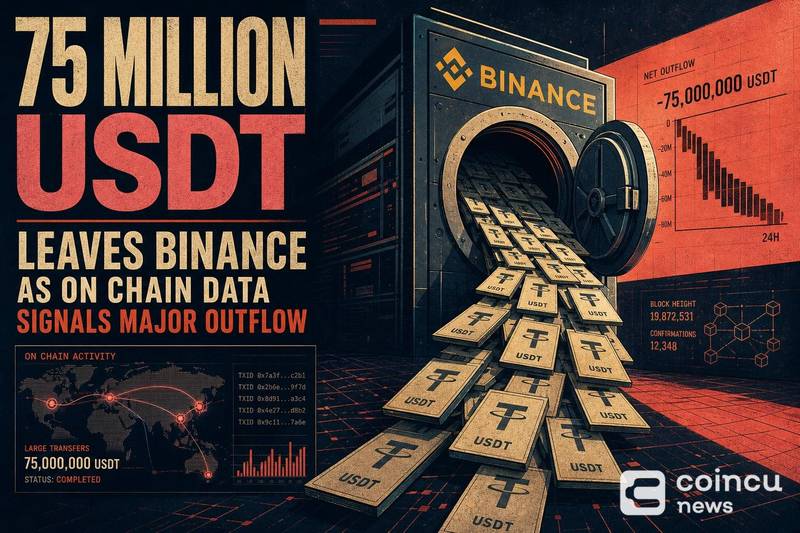
The transaction, recorded on the Ethereum blockchain, was detected by Whale Alert, a widely followed on-chain monitoring service that tracks high-value transfers in real time. The movement involved USDT leaving a Binance-associated wallet to an external address.
ON-CHAIN DATA
- Transaction hash: 0x0b880…8abc7
- Amount: 75,000,000 USDT
- From: Binance-linked wallet
- Network: Ethereum
The transfer is verifiable through multiple block explorers, including Blockscout, confirming the amount and originating wallet. The data shows the movement occurred, but does not reveal the motive behind it.
Why Traders Watch Large USDT Withdrawals From Exchanges
Stablecoin outflows from centralized exchanges are among the most closely tracked signals in crypto markets. When large amounts of USDT leave an exchange like Binance, it can suggest capital is being repositioned, whether to private custody, over-the-counter desks, or competing platforms.
Exchange reserve changes have previously coincided with notable market moves. Binance itself has seen significant USDT flow activity in both directions; the exchange recently recorded $463 million in net USDT inflows over a single 24-hour period, illustrating how volatile these flows can be.
However, a single transfer of this size should not be overinterpreted. Binance processes billions of dollars in daily volume, and the outflow represents a fraction of the exchange’s total stablecoin reserves.
What Blockchain Data Can and Cannot Confirm Here
On-chain data confirms the core elements of this event: the asset moved was USDT, the amount was 75 million, the transfer originated from a wallet associated with Binance, and the transaction settled on Ethereum.
What blockchain data cannot confirm is the identity of the ultimate recipient, the purpose of the transfer, or whether it reflects a client withdrawal or internal treasury operation. Wallet attribution services label addresses based on historical patterns, but labels do not prove current ownership or intent.
Exchange treasury management, including rebalancing between hot and cold wallets, can produce on-chain signatures that look identical to large client withdrawals. Without an official statement from Binance or confirmed wallet attribution for the receiving address, the destination purpose remains unknown.
Possible Explanations for the Outflow
Several scenarios could explain a transfer of this scale. The first and most straightforward is a large client withdrawal, where an institutional or high-net-worth user moved funds to self-custody or an external venue.
A second possibility is internal wallet management. Exchanges routinely shift assets between wallets for security, liquidity, or operational reasons. These movements are visible on-chain but do not represent a net change in exchange holdings.
A third scenario involves institutional settlement. Large OTC trades or settlement processes may require moving stablecoins off-exchange as part of a pre-arranged transaction, a process that would appear as an outflow but reflects standard business activity.
None of these explanations are confirmed by the available data. The transfer is a verified on-chain event, but the reasoning behind it remains speculative without additional context. Large exchange movements often coincide with broader market dynamics, such as ETH price levels capable of triggering hundreds of millions in short liquidations, reflecting how interconnected exchange flows and leveraged positioning have become.
FAQ About the 75 Million USDT Binance Outflow
What does a USDT outflow from Binance mean?
It means USDT was transferred from a Binance-associated wallet to an external address. This could reflect a client withdrawal, internal rebalancing, or an OTC settlement. The movement alone does not indicate buying or selling pressure.
Does this transfer indicate a whale purchase or sell-off?
Not necessarily. USDT is a stablecoin pegged to the US dollar, so moving it off an exchange does not directly represent a market trade. The funds could be used for purchases elsewhere, held in custody, or deployed in DeFi protocols. Without wallet identification, no trading intent can be confirmed. Traders watching for signals across exchanges, including activity on platforms like Bybit and newer listing venues, should apply the same caution to unattributed transfers.
Can on-chain data confirm who received the funds?
Blockchain explorers show the receiving wallet address, but unless that address has been publicly attributed to a known entity, the recipient’s identity remains unknown. The transaction hash is publicly available for anyone to verify the amount and timing.
Disclaimer: This article is for informational purposes only and does not constitute financial or investment advice. Cryptocurrency and digital asset markets carry significant risk. Always do your own research before making decisions.
No tags available.


Other Posts








- China, US Conclude Trade Talks with Focus on Cooperation
- Crypto Weekly: NYSE Backs OKX, Kraken Gets Fed Access, BTC Sells
- Court Upholds Fed’s Rejection of Custodia Bank’s Request
- Former CFO Convicted for $35M Fraudulent Crypto Investment
- DeriW Launches Edge Hour Trading Competition Platform for Derivatives Traders
- Michael Saylor Denies Bitcoin Sell-Off Amid Large BTC Transfer
- Buy Dogecoin on eToro: Step-by-Step Guide for Beginners (2024)
- Kazakhstan Explores Crypto Reserves Backed by National Funds
- JPMorgan Increases Holdings in BlackRock’s Bitcoin ETF
- Nordea Bank Introduces Bitcoin ETP Trading for Nordic Customers
- XRP Spot ETF Launches on Nasdaq Amid Market Fluctuations
- Peter Schiff Challenges Michael Saylor on MSTR’s Business Model
- Thailand Orders Worldcoin to Delete 1.2 Million Biometric Records
- UK Proposes New DeFi Tax Framework to Ease User Burden
- WLFI Under Fire: Analyst Warns Hyperliquid Could Be Next
- Ancient Ethereum Whale Moves $1.19 Billion After Decade
- BlackRock Receives Large Crypto Transfers from Coinbase
- SEC Scrutiny on ALT5 Sigma’s Leadership Disclosure Timing
- Yala Injects $5.5 Million Amid Recovery Efforts
- Radiant Capital Faces $50M Loss in Major Security Breach
- China, US Conclude Trade Talks with Focus on Cooperation
- Crypto Weekly: NYSE Backs OKX, Kraken Gets Fed Access, BTC Sells
- Court Upholds Fed’s Rejection of Custodia Bank’s Request
- Former CFO Convicted for $35M Fraudulent Crypto Investment
- DeriW Launches Edge Hour Trading Competition Platform for Derivatives Traders
- Michael Saylor Denies Bitcoin Sell-Off Amid Large BTC Transfer
- Buy Dogecoin on eToro: Step-by-Step Guide for Beginners (2024)
- Kazakhstan Explores Crypto Reserves Backed by National Funds
- JPMorgan Increases Holdings in BlackRock’s Bitcoin ETF
- Nordea Bank Introduces Bitcoin ETP Trading for Nordic Customers
- XRP Spot ETF Launches on Nasdaq Amid Market Fluctuations
- Peter Schiff Challenges Michael Saylor on MSTR’s Business Model
- Thailand Orders Worldcoin to Delete 1.2 Million Biometric Records
- UK Proposes New DeFi Tax Framework to Ease User Burden
- WLFI Under Fire: Analyst Warns Hyperliquid Could Be Next
- Ancient Ethereum Whale Moves $1.19 Billion After Decade
- BlackRock Receives Large Crypto Transfers from Coinbase
- SEC Scrutiny on ALT5 Sigma’s Leadership Disclosure Timing
- Yala Injects $5.5 Million Amid Recovery Efforts
- Radiant Capital Faces $50M Loss in Major Security Breach
- China, US Conclude Trade Talks with Focus on Cooperation
- Crypto Weekly: NYSE Backs OKX, Kraken Gets Fed Access, BTC Sells
- Court Upholds Fed’s Rejection of Custodia Bank’s Request
- Former CFO Convicted for $35M Fraudulent Crypto Investment
- DeriW Launches Edge Hour Trading Competition Platform for Derivatives Traders
- Michael Saylor Denies Bitcoin Sell-Off Amid Large BTC Transfer
- Buy Dogecoin on eToro: Step-by-Step Guide for Beginners (2024)
- Kazakhstan Explores Crypto Reserves Backed by National Funds
- JPMorgan Increases Holdings in BlackRock’s Bitcoin ETF
- Nordea Bank Introduces Bitcoin ETP Trading for Nordic Customers
- XRP Spot ETF Launches on Nasdaq Amid Market Fluctuations
- Peter Schiff Challenges Michael Saylor on MSTR’s Business Model
- Thailand Orders Worldcoin to Delete 1.2 Million Biometric Records
- UK Proposes New DeFi Tax Framework to Ease User Burden
- WLFI Under Fire: Analyst Warns Hyperliquid Could Be Next
- Ancient Ethereum Whale Moves $1.19 Billion After Decade
- BlackRock Receives Large Crypto Transfers from Coinbase
- SEC Scrutiny on ALT5 Sigma’s Leadership Disclosure Timing
- Yala Injects $5.5 Million Amid Recovery Efforts
- Radiant Capital Faces $50M Loss in Major Security Breach

BitMEX to Shut Down on September 23, 2026: What Users Need to Know


Hyperliquid Trader Banks US$499,100 After Closing US$21.59M BTC Long

CoinRabbit and GoMining Report: Managing Bitcoin Matters More Than Mining Volume