Strategy, the corporate holder formerly known as MicroStrategy, is carrying roughly $55 billion in Bitcoin against about $3 billion in cash, alongside an unrealized loss of close to $9.9 billion, a balance-sheet snapshot that keeps the company at the center of the debate over corporate Bitcoin holdings.
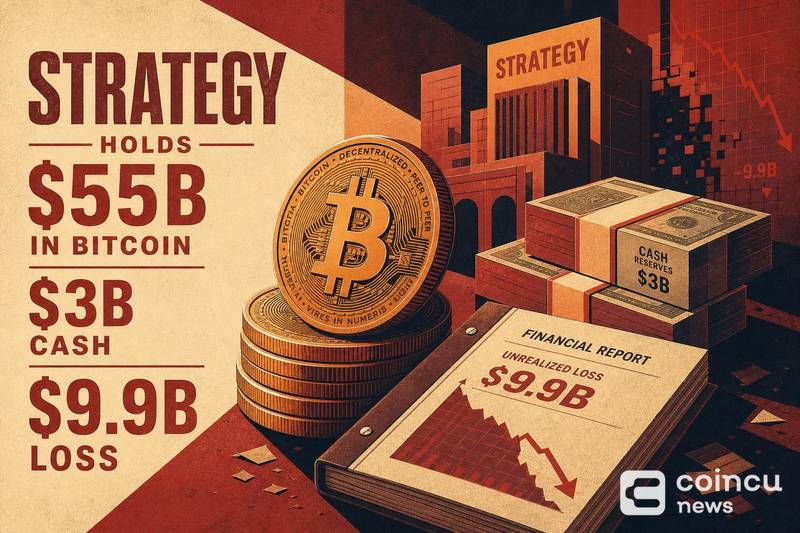
The figures anchor Strategy’s position as the most Bitcoin-heavy public treasury, with its digital-asset exposure dwarfing its liquid reserves. The scale of that mismatch is what makes the company a proxy for how institutional Bitcoin bets are performing, according to its most recent SEC filing. For related coverage, see Strategy Sells $200M+ BTC as Metaplanet Resumes Buying.
A Balance Sheet Dominated by Bitcoin
The roughly $3 billion cash cushion is a fraction of the Bitcoin stack it sits beside. That ratio concentrates treasury risk in a single, volatile asset, leaving liquidity as a secondary line rather than a hedge against price swings. For related coverage, see Bitmine Immersion Technologies (BMNR) Announces ETH Holdings Reach 5.77 Million Tokens, and Total Crypto and Total Cash Holdings of $11.3 Billion.
Strategy’s recent activity has reinforced that concentration. The company added $467 million in cash and made no changes to its Bitcoin holdings in its latest reporting period, per CoinDesk. That pattern signals a strategy of holding the position intact rather than trimming exposure during drawdowns, a contrast with peers like Metaplanet, which has continued accumulating even as some sellers stepped back.
What the $9.9 Billion Unrealized Loss Actually Means
An unrealized loss is a paper figure. It reflects the gap between the price Strategy paid for its Bitcoin and its current market valuation, and it exists only on the balance sheet until coins are actually sold. For related coverage, see Kraken Launches Customizable Crypto Vault for Bitcoin, Ether and Stablecoin Yield.
That distinction matters. A near-$9.9 billion unrealized loss is not the same as $9.9 billion of cash walking out the door; the company has not realized any of it through selling, and the separate cash position remains untouched by the mark-to-market swing.
Still, paper losses shape optics. Reported valuation losses of this size feed investor sentiment and headline risk, even when they do not affect the company’s ability to keep holding, a dynamic familiar to other crypto-heavy treasuries such as Bitmine, which reports its crypto and cash holdings together.
Why This Matters Beyond Strategy
Because Strategy’s holdings are so large, its balance sheet is read as a barometer for the broader corporate Bitcoin thesis. When its paper losses widen, the read-through is that other institutional buyers are underwater too.
The cash reserve is the counterweight investors watch to judge resilience. It offers a small buffer of flexibility, and whether that buffer is seen as adequate depends heavily on where Bitcoin trades next, which has stayed volatile through recent sharp single-day drops.
What to Watch Next
Bitcoin’s price is the single biggest lever on the loss figure. Any move in the spot market flows directly into the mark-to-market total, and forecasts remain split, with Standard Chartered still targeting $100,000 by the end of 2026.
Future filings are the other variable. Subsequent disclosures could change both the holdings and the loss total, and the pace of any cash additions will show whether Strategy keeps building liquidity or leans further into Bitcoin. Its prior-week filing already showed the company adjusting cash while leaving the Bitcoin stack unchanged.
FAQ
How much Bitcoin does Strategy hold? Strategy’s Bitcoin position is valued at about $55 billion, making it the largest corporate Bitcoin treasury.
Does the unrealized loss mean Strategy sold Bitcoin? No. An unrealized loss is a valuation gap on paper; the company has not sold the underlying coins.
Why does the cash reserve matter? The roughly $3 billion in cash provides liquidity and flexibility during volatility, separate from the Bitcoin position’s paper losses.
What could change the paper loss? A rise in Bitcoin’s market price would shrink the unrealized loss, while a further decline would widen it.
Disclaimer: This article is for informational purposes only and does not constitute financial or investment advice. Cryptocurrency and digital asset markets carry significant risk. Always do your own research before making decisions.
No tags available.


Other Posts








- China, US Conclude Trade Talks with Focus on Cooperation
- Crypto Weekly: NYSE Backs OKX, Kraken Gets Fed Access, BTC Sells
- Court Upholds Fed’s Rejection of Custodia Bank’s Request
- Former CFO Convicted for $35M Fraudulent Crypto Investment
- DeriW Launches Edge Hour Trading Competition Platform for Derivatives Traders
- Michael Saylor Denies Bitcoin Sell-Off Amid Large BTC Transfer
- Buy Dogecoin on eToro: Step-by-Step Guide for Beginners (2024)
- Kazakhstan Explores Crypto Reserves Backed by National Funds
- JPMorgan Increases Holdings in BlackRock’s Bitcoin ETF
- Nordea Bank Introduces Bitcoin ETP Trading for Nordic Customers
- XRP Spot ETF Launches on Nasdaq Amid Market Fluctuations
- Peter Schiff Challenges Michael Saylor on MSTR’s Business Model
- Thailand Orders Worldcoin to Delete 1.2 Million Biometric Records
- UK Proposes New DeFi Tax Framework to Ease User Burden
- WLFI Under Fire: Analyst Warns Hyperliquid Could Be Next
- Ancient Ethereum Whale Moves $1.19 Billion After Decade
- BlackRock Receives Large Crypto Transfers from Coinbase
- SEC Scrutiny on ALT5 Sigma’s Leadership Disclosure Timing
- Yala Injects $5.5 Million Amid Recovery Efforts
- Radiant Capital Faces $50M Loss in Major Security Breach
- China, US Conclude Trade Talks with Focus on Cooperation
- Crypto Weekly: NYSE Backs OKX, Kraken Gets Fed Access, BTC Sells
- Court Upholds Fed’s Rejection of Custodia Bank’s Request
- Former CFO Convicted for $35M Fraudulent Crypto Investment
- DeriW Launches Edge Hour Trading Competition Platform for Derivatives Traders
- Michael Saylor Denies Bitcoin Sell-Off Amid Large BTC Transfer
- Buy Dogecoin on eToro: Step-by-Step Guide for Beginners (2024)
- Kazakhstan Explores Crypto Reserves Backed by National Funds
- JPMorgan Increases Holdings in BlackRock’s Bitcoin ETF
- Nordea Bank Introduces Bitcoin ETP Trading for Nordic Customers
- XRP Spot ETF Launches on Nasdaq Amid Market Fluctuations
- Peter Schiff Challenges Michael Saylor on MSTR’s Business Model
- Thailand Orders Worldcoin to Delete 1.2 Million Biometric Records
- UK Proposes New DeFi Tax Framework to Ease User Burden
- WLFI Under Fire: Analyst Warns Hyperliquid Could Be Next
- Ancient Ethereum Whale Moves $1.19 Billion After Decade
- BlackRock Receives Large Crypto Transfers from Coinbase
- SEC Scrutiny on ALT5 Sigma’s Leadership Disclosure Timing
- Yala Injects $5.5 Million Amid Recovery Efforts
- Radiant Capital Faces $50M Loss in Major Security Breach
- China, US Conclude Trade Talks with Focus on Cooperation
- Crypto Weekly: NYSE Backs OKX, Kraken Gets Fed Access, BTC Sells
- Court Upholds Fed’s Rejection of Custodia Bank’s Request
- Former CFO Convicted for $35M Fraudulent Crypto Investment
- DeriW Launches Edge Hour Trading Competition Platform for Derivatives Traders
- Michael Saylor Denies Bitcoin Sell-Off Amid Large BTC Transfer
- Buy Dogecoin on eToro: Step-by-Step Guide for Beginners (2024)
- Kazakhstan Explores Crypto Reserves Backed by National Funds
- JPMorgan Increases Holdings in BlackRock’s Bitcoin ETF
- Nordea Bank Introduces Bitcoin ETP Trading for Nordic Customers
- XRP Spot ETF Launches on Nasdaq Amid Market Fluctuations
- Peter Schiff Challenges Michael Saylor on MSTR’s Business Model
- Thailand Orders Worldcoin to Delete 1.2 Million Biometric Records
- UK Proposes New DeFi Tax Framework to Ease User Burden
- WLFI Under Fire: Analyst Warns Hyperliquid Could Be Next
- Ancient Ethereum Whale Moves $1.19 Billion After Decade
- BlackRock Receives Large Crypto Transfers from Coinbase
- SEC Scrutiny on ALT5 Sigma’s Leadership Disclosure Timing
- Yala Injects $5.5 Million Amid Recovery Efforts
- Radiant Capital Faces $50M Loss in Major Security Breach



Revolut Gets Dubai VARA In-Principle Approval for UAE Crypto Services

CT3 Announces Dedicated Storage Contracts to Expand Decentralized Storage Infrastructure
EthSystems Launches to Build Privacy Solutions for Institutions on Ethereum