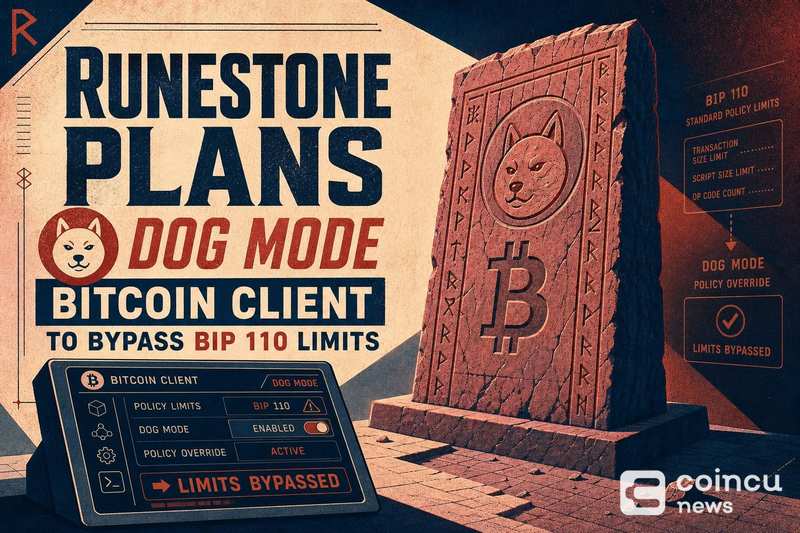
Runestone Plans DOG Mode Bitcoin Client to Bypass BIP 110 Limits
Runestone is reported to be planning a Bitcoin client called DOG Mode, aimed at working around the constraints that BIP 110 would place on non-financial data. The proposal, still at an early and largely unconfirmed stage, would target how a specialized client handles data rather than changing Bitcoin’s base layer itself.
The plan surfaced through crypto commentary on X, where the account behind much of the ordinals and Bitcoin data discussion, Leonidas, referenced Runestone building toward a DOG Mode client. According to that single, unconfirmed report, the objective is to keep carrying non-financial data on Bitcoin despite the limits BIP 110 is designed to impose. For related coverage, see 1win Expands Its Prediction Markets with Crypto Forecasts.
Runestone is a Bitcoin-native project that gained attention through its distribution model, which launched with no pre-sale or team allocation. That history is why a client-level proposal tied to its name draws interest among builders working on the network. For related coverage, see Whale Alert Detects $55M USDT Transfer to Binance.
What BIP 110 Would Limit for Non-Financial Data
BIP 110 is a Bitcoin Improvement Proposal documented in the official BIPs repository. In the context of this story, it is presented as the constraint that would restrict how much non-financial data can move through the network. For related coverage, see Uala Raises $197M Led by Allianz X, Tether Joins.
Non-financial data here refers to information that is not a simple value transfer of BTC, the kind of payload that inscription-style and data-heavy projects attach to transactions. Limits on that data are contested because they touch on what Bitcoin should be used for beyond payments.
Protocol rules versus client behavior
A key distinction runs through the reporting: BIP 110 concerns protocol-level rules, while DOG Mode is described as client behavior. A proposal that lives in a client does not necessarily alter the base layer that all nodes follow, which is why the framing is “circumvent” rather than “remove.”
How a DOG Mode Client Might Approach the Constraint
The available reporting suggests the workaround is client-based, meaning it would sit in how a particular Bitcoin client relays, indexes, or handles transactions rather than in a consensus change. Beyond that framing, specific implementation details are not established in the research at hand.
Any inference about the exact mechanism should be treated as inference, not confirmed design. It is unclear from current information whether DOG Mode would rely on relay policy, indexing, or transaction handling to keep non-financial data flowing.
The open risks
A client that diverges from prevailing node policy faces questions of compatibility and acceptance. If other operators do not adopt or relay the same behavior, the practical reach of such a client could stay narrow, and the tradeoffs would fall on the projects depending on it.
Why Builders, Not Traders, Are the Audience
A client aimed at non-financial data use cases matters more to developers than to short-term price watchers. The market data around Bitcoin is not the story here; the story is infrastructure and what the network can carry.
Bitcoin-native data efforts routinely trigger debate over the network’s purpose and resource use, and token-issuance work such as the Runes protocol for issuing tokens on Bitcoin has sat at the center of those arguments. A DOG Mode client would land in the same contested space.
Even if adoption stays niche at first, the proposal signals continued demand for alternative Bitcoin data rails, alongside criticism from those who favor keeping the network focused and lean.
FAQ
What is Runestone in this context?
Runestone is a Bitcoin-native project associated with an ordinals-era distribution that carried no pre-sale. Here it is named as the party reportedly planning the DOG Mode client.
Would DOG Mode change Bitcoin itself?
Based on the framing available, DOG Mode is described as client behavior, not a base-layer protocol change. That distinction is central to how the proposal is presented.
Why is non-financial data on Bitcoin controversial?
Because it raises the question of whether Bitcoin should carry payloads beyond value transfer, which affects resource use and touches long-running disagreements over the network’s purpose.
Who is most affected if DOG Mode launches?
Builders and node operators working with data-heavy Bitcoin use cases, rather than everyday BTC holders or traders.
The details above rest on a single, unconfirmed report and the referenced proposal document. Specifics of DOG Mode remain to be independently verified.
Additional source references: source document 1.
Disclaimer: This article is for informational purposes only and does not constitute financial or investment advice. Cryptocurrency and digital asset markets carry significant risk. Always do your own research before making decisions.
No tags available.


Other Posts








- China, US Conclude Trade Talks with Focus on Cooperation
- Crypto Weekly: NYSE Backs OKX, Kraken Gets Fed Access, BTC Sells
- Court Upholds Fed’s Rejection of Custodia Bank’s Request
- Former CFO Convicted for $35M Fraudulent Crypto Investment
- DeriW Launches Edge Hour Trading Competition Platform for Derivatives Traders
- Michael Saylor Denies Bitcoin Sell-Off Amid Large BTC Transfer
- Buy Dogecoin on eToro: Step-by-Step Guide for Beginners (2024)
- Kazakhstan Explores Crypto Reserves Backed by National Funds
- JPMorgan Increases Holdings in BlackRock’s Bitcoin ETF
- Nordea Bank Introduces Bitcoin ETP Trading for Nordic Customers
- XRP Spot ETF Launches on Nasdaq Amid Market Fluctuations
- Peter Schiff Challenges Michael Saylor on MSTR’s Business Model
- Thailand Orders Worldcoin to Delete 1.2 Million Biometric Records
- UK Proposes New DeFi Tax Framework to Ease User Burden
- WLFI Under Fire: Analyst Warns Hyperliquid Could Be Next
- Ancient Ethereum Whale Moves $1.19 Billion After Decade
- BlackRock Receives Large Crypto Transfers from Coinbase
- SEC Scrutiny on ALT5 Sigma’s Leadership Disclosure Timing
- Yala Injects $5.5 Million Amid Recovery Efforts
- Radiant Capital Faces $50M Loss in Major Security Breach
- China, US Conclude Trade Talks with Focus on Cooperation
- Crypto Weekly: NYSE Backs OKX, Kraken Gets Fed Access, BTC Sells
- Court Upholds Fed’s Rejection of Custodia Bank’s Request
- Former CFO Convicted for $35M Fraudulent Crypto Investment
- DeriW Launches Edge Hour Trading Competition Platform for Derivatives Traders
- Michael Saylor Denies Bitcoin Sell-Off Amid Large BTC Transfer
- Buy Dogecoin on eToro: Step-by-Step Guide for Beginners (2024)
- Kazakhstan Explores Crypto Reserves Backed by National Funds
- JPMorgan Increases Holdings in BlackRock’s Bitcoin ETF
- Nordea Bank Introduces Bitcoin ETP Trading for Nordic Customers
- XRP Spot ETF Launches on Nasdaq Amid Market Fluctuations
- Peter Schiff Challenges Michael Saylor on MSTR’s Business Model
- Thailand Orders Worldcoin to Delete 1.2 Million Biometric Records
- UK Proposes New DeFi Tax Framework to Ease User Burden
- WLFI Under Fire: Analyst Warns Hyperliquid Could Be Next
- Ancient Ethereum Whale Moves $1.19 Billion After Decade
- BlackRock Receives Large Crypto Transfers from Coinbase
- SEC Scrutiny on ALT5 Sigma’s Leadership Disclosure Timing
- Yala Injects $5.5 Million Amid Recovery Efforts
- Radiant Capital Faces $50M Loss in Major Security Breach
- China, US Conclude Trade Talks with Focus on Cooperation
- Crypto Weekly: NYSE Backs OKX, Kraken Gets Fed Access, BTC Sells
- Court Upholds Fed’s Rejection of Custodia Bank’s Request
- Former CFO Convicted for $35M Fraudulent Crypto Investment
- DeriW Launches Edge Hour Trading Competition Platform for Derivatives Traders
- Michael Saylor Denies Bitcoin Sell-Off Amid Large BTC Transfer
- Buy Dogecoin on eToro: Step-by-Step Guide for Beginners (2024)
- Kazakhstan Explores Crypto Reserves Backed by National Funds
- JPMorgan Increases Holdings in BlackRock’s Bitcoin ETF
- Nordea Bank Introduces Bitcoin ETP Trading for Nordic Customers
- XRP Spot ETF Launches on Nasdaq Amid Market Fluctuations
- Peter Schiff Challenges Michael Saylor on MSTR’s Business Model
- Thailand Orders Worldcoin to Delete 1.2 Million Biometric Records
- UK Proposes New DeFi Tax Framework to Ease User Burden
- WLFI Under Fire: Analyst Warns Hyperliquid Could Be Next
- Ancient Ethereum Whale Moves $1.19 Billion After Decade
- BlackRock Receives Large Crypto Transfers from Coinbase
- SEC Scrutiny on ALT5 Sigma’s Leadership Disclosure Timing
- Yala Injects $5.5 Million Amid Recovery Efforts
- Radiant Capital Faces $50M Loss in Major Security Breach

Runestone Plans DOG Mode Bitcoin Client to Bypass BIP 110 Limits




Bitmine Immersion Technologies (BMNR) Releases July Chairman’s Message: “ETH is the cure for the ‘Uncanny Valley of Wealth'”