U.S. Regulators Miss 1-Year Deadline for GENIUS Act Stablecoin Rules
U.S. regulators have missed the one-year deadline to issue GENIUS Act stablecoin rules, with key federal implementation measures still stuck at the proposed-rule stage after the July 18, 2026 cutoff passed. The delay leaves the statutory framework for U.S. payment stablecoins legally in force but operationally incomplete, and pushes the market toward a fallback effective date of January 18, 2027.
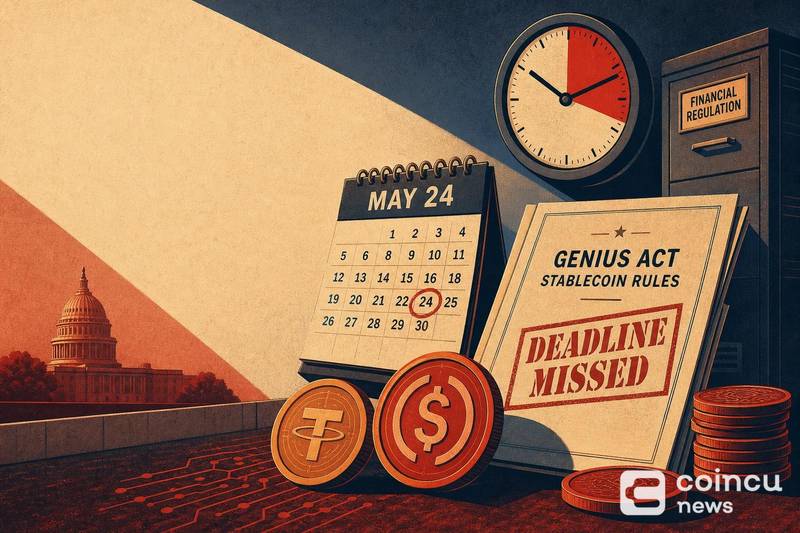
What happened with the GENIUS Act rulemaking deadline?
The GENIUS Act, enacted as Public Law 119-27, was approved on July 18, 2025, starting a one-year clock for implementing regulations. For related coverage, see Visa Hiring Senior Director for Stablecoin Labs Role With Salary Up to $400K.
Section 13(a) of the statute required each primary federal payment stablecoin regulator, the Secretary of the Treasury, and each state payment stablecoin regulator to promulgate implementing regulations not later than one year after enactment. For related coverage, see DOG Mode Relaxes Bitcoin Forwarding Policy Without Changing Consensus Rules.
That deadline expired without final federal rules in place. The agencies most directly implicated are the U.S. Treasury and its Financial Crimes Enforcement Network, the Office of the Comptroller of the Currency, and the Federal Reserve, alongside state-level payment stablecoin regulators.
Which regulators were responsible
A Treasury and FinCEN proposed rule for permitted payment stablecoin issuer customer identification programs was published on June 22, 2026 with a comment period that remains open until August 21, 2026, well past the statutory deadline.
The OCC said in February 2026 that it had issued a proposed rulemaking to implement the GENIUS Act and that public comments would inform a later final rule, signaling its work was still at the proposal stage.
Days before the cutoff, Barron’s reported on July 14 that Federal Reserve figure Kevin Warsh said the central bank was racing to release its stablecoin rules by the Saturday deadline.
What rules were regulators expected to deliver?
The GENIUS Act builds a licensing and supervision regime for payment stablecoin issuers, and Section 13(a) tasked regulators with turning that framework into enforceable rules covering how issuers operate day to day.
Reserve standards
Among the pending areas are reserve backing requirements and the operational standards that govern how issuers hold and disclose the assets supporting each token, guidance that issuers of U.S.-regulated tokens such as USDC would follow.
Compliance and supervision
The still-open FinCEN customer identification program proposal shows that core anti-money-laundering compliance mechanics remain unsettled, an area that overlaps with global efforts as the FATF has urged stronger crypto AML enforcement amid rising stablecoin-linked crime.
Without finalized supervision rules, issuers and exchanges lack the detailed federal playbook for examinations, licensing pathways, and disclosure formats that the Act promised to standardize.
Why the delay matters for the U.S. stablecoin market
The gap between an enacted law and its implementing rules leaves issuers planning against a statute that is legally binding but practically incomplete. By statute, the Act’s outside effective date remains 18 months after enactment, or January 18, 2027, unless final federal rules trigger an earlier 120-day pathway.
That timing matters for compliance planning: firms cannot finalize build-out for reserve reporting or customer identification systems until the FinCEN proposal and parallel OCC rule are settled, and the FinCEN comment window alone runs through August 21, 2026.
USDC, the largest U.S.-oriented stablecoin proxy, traded at $0.9999 with a market capitalization near $73.3 billion, showing no peg stress tied to the missed deadline.
Broader sentiment stayed cautious, with the Crypto Fear & Greed Index reading 28, or “Fear,” at the time of the deadline.
Regulatory uncertainty
A balanced reading is that the delay does not void the law. Supervisory expectations and enforcement authority can still proceed under the statute itself even where final rules lag, so the miss is a timing failure rather than a collapse of the framework.
Industry analysis at Paradigm noted that agencies frequently miss statutory deadlines with limited practical consequences, framing the slippage as common rather than fatal to implementation.
How the crypto industry may react next
With final rules pending, issuers and trade groups are likely to press for interim guidance and clearer timelines so they can align product launches with the January 18, 2027 fallback date rather than an uncertain rulemaking calendar.
Some firms may continue building compliance infrastructure against the proposed rules on the assumption they broadly survive to final form, while holding back on U.S. expansion decisions that hinge on settled reserve and licensing standards.
The dynamic mirrors the appetite for legislative certainty elsewhere in Washington, where Coinbase has argued the CLARITY Act would strengthen U.S. crypto rules, and it contrasts with tightening abroad as European stablecoin issuers face tougher standards under MiCA.
FAQ about the GENIUS Act stablecoin rules delay
What is the GENIUS Act? It is Public Law 119-27, a U.S. law enacted on July 18, 2025 that establishes a federal framework for licensing and supervising payment stablecoin issuers.
Which regulators missed the deadline? Section 13(a) applied to primary federal payment stablecoin regulators, the Treasury Secretary, and state payment stablecoin regulators. As of July 19, 2026, at least the Treasury/FinCEN and OCC measures remained proposed rules rather than final ones.
Does the delay change current stablecoin operations immediately? No. Tokens like USDC continued trading normally, and the missed deadline does not repeal the statute or force an immediate operational change.
What happens next for the rulemaking process? Comment periods such as FinCEN’s, open until August 21, 2026, must close before final rules can issue, and the Act’s fallback effective date of January 18, 2027 applies unless final federal rules trigger the earlier 120-day pathway.
Disclaimer: This article is for informational purposes only and does not constitute financial or investment advice. Cryptocurrency and digital asset markets carry significant risk. Always do your own research before making decisions.
No tags available.


Other Posts








- China, US Conclude Trade Talks with Focus on Cooperation
- Crypto Weekly: NYSE Backs OKX, Kraken Gets Fed Access, BTC Sells
- Court Upholds Fed’s Rejection of Custodia Bank’s Request
- Former CFO Convicted for $35M Fraudulent Crypto Investment
- DeriW Launches Edge Hour Trading Competition Platform for Derivatives Traders
- Michael Saylor Denies Bitcoin Sell-Off Amid Large BTC Transfer
- Buy Dogecoin on eToro: Step-by-Step Guide for Beginners (2024)
- Kazakhstan Explores Crypto Reserves Backed by National Funds
- JPMorgan Increases Holdings in BlackRock’s Bitcoin ETF
- Nordea Bank Introduces Bitcoin ETP Trading for Nordic Customers
- XRP Spot ETF Launches on Nasdaq Amid Market Fluctuations
- Peter Schiff Challenges Michael Saylor on MSTR’s Business Model
- Thailand Orders Worldcoin to Delete 1.2 Million Biometric Records
- UK Proposes New DeFi Tax Framework to Ease User Burden
- WLFI Under Fire: Analyst Warns Hyperliquid Could Be Next
- Ancient Ethereum Whale Moves $1.19 Billion After Decade
- BlackRock Receives Large Crypto Transfers from Coinbase
- SEC Scrutiny on ALT5 Sigma’s Leadership Disclosure Timing
- Yala Injects $5.5 Million Amid Recovery Efforts
- Radiant Capital Faces $50M Loss in Major Security Breach
- China, US Conclude Trade Talks with Focus on Cooperation
- Crypto Weekly: NYSE Backs OKX, Kraken Gets Fed Access, BTC Sells
- Court Upholds Fed’s Rejection of Custodia Bank’s Request
- Former CFO Convicted for $35M Fraudulent Crypto Investment
- DeriW Launches Edge Hour Trading Competition Platform for Derivatives Traders
- Michael Saylor Denies Bitcoin Sell-Off Amid Large BTC Transfer
- Buy Dogecoin on eToro: Step-by-Step Guide for Beginners (2024)
- Kazakhstan Explores Crypto Reserves Backed by National Funds
- JPMorgan Increases Holdings in BlackRock’s Bitcoin ETF
- Nordea Bank Introduces Bitcoin ETP Trading for Nordic Customers
- XRP Spot ETF Launches on Nasdaq Amid Market Fluctuations
- Peter Schiff Challenges Michael Saylor on MSTR’s Business Model
- Thailand Orders Worldcoin to Delete 1.2 Million Biometric Records
- UK Proposes New DeFi Tax Framework to Ease User Burden
- WLFI Under Fire: Analyst Warns Hyperliquid Could Be Next
- Ancient Ethereum Whale Moves $1.19 Billion After Decade
- BlackRock Receives Large Crypto Transfers from Coinbase
- SEC Scrutiny on ALT5 Sigma’s Leadership Disclosure Timing
- Yala Injects $5.5 Million Amid Recovery Efforts
- Radiant Capital Faces $50M Loss in Major Security Breach
- China, US Conclude Trade Talks with Focus on Cooperation
- Crypto Weekly: NYSE Backs OKX, Kraken Gets Fed Access, BTC Sells
- Court Upholds Fed’s Rejection of Custodia Bank’s Request
- Former CFO Convicted for $35M Fraudulent Crypto Investment
- DeriW Launches Edge Hour Trading Competition Platform for Derivatives Traders
- Michael Saylor Denies Bitcoin Sell-Off Amid Large BTC Transfer
- Buy Dogecoin on eToro: Step-by-Step Guide for Beginners (2024)
- Kazakhstan Explores Crypto Reserves Backed by National Funds
- JPMorgan Increases Holdings in BlackRock’s Bitcoin ETF
- Nordea Bank Introduces Bitcoin ETP Trading for Nordic Customers
- XRP Spot ETF Launches on Nasdaq Amid Market Fluctuations
- Peter Schiff Challenges Michael Saylor on MSTR’s Business Model
- Thailand Orders Worldcoin to Delete 1.2 Million Biometric Records
- UK Proposes New DeFi Tax Framework to Ease User Burden
- WLFI Under Fire: Analyst Warns Hyperliquid Could Be Next
- Ancient Ethereum Whale Moves $1.19 Billion After Decade
- BlackRock Receives Large Crypto Transfers from Coinbase
- SEC Scrutiny on ALT5 Sigma’s Leadership Disclosure Timing
- Yala Injects $5.5 Million Amid Recovery Efforts
- Radiant Capital Faces $50M Loss in Major Security Breach

Project Eleven launches Bitcoin quantum-fragile coin recovery tool


Data Shows Four Largest Bitcoin Mining Pools Control Over 70% of Hash Rate

Numerai Completes Third Strategic NMR Buyback, Bringing Total Repurchases to $3.2 Million

ether.fi Partners with Nexus Mutual to Protect Against ETH Slashing at Institutional Scale