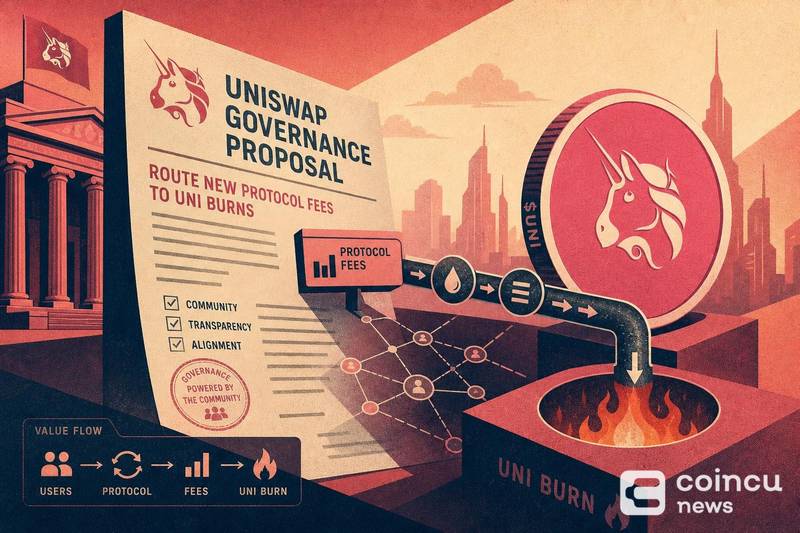
Uniswap Governance Proposals Would Route New Protocol Fees to UNI Burns
Uniswap has submitted two governance proposals that would route new protocol fee revenue into a UNI burn mechanism, tying the exchange’s fee switch directly to token supply rather than to treasury retention or holder payouts. The proposals mark the latest attempt to activate value capture for UNI holders through Uniswap governance.
What the two Uniswap governance proposals aim to change
The core of both proposals is the same idea: turn on protocol fees and direct the resulting revenue toward buying and burning UNI. Uniswap founder Hayden Adams flagged the effort in a post on X. For related coverage, see Numerai Completes Third Strategic NMR Buyback, Bringing Total Repurchases to $3.2 Million.
Splitting the change into two separate proposals lets governance handle the mechanical questions independently. One governs whether protocol fees are switched on at all, while the second governs where that fee revenue is routed once collected.
The move follows an earlier push by Uniswap Labs to activate protocol fees for v4 pools, which put the fee-switch question in front of voters via Snapshot. It also arrives after the Uniswap Foundation proposed changes to the community governance process itself.
How protocol fees could be redirected into the UNI burn mechanism
Under the proposed path, a portion of the fees generated by Uniswap pools would be collected at the protocol level rather than flowing entirely to liquidity providers. Those collected fees would then feed the burn mechanism instead of accumulating in the DAO treasury.
A burn permanently removes tokens from circulation. In theory, routing recurring fee revenue into burns reduces circulating UNI supply over time, though the actual effect depends on how much fee revenue the switch produces and how consistently it is applied.
This design is distinct from two alternatives Uniswap governance has weighed before: distributing fees to stakers or holders directly, and retaining fees in the treasury for the foundation to allocate. The burn model captures value at the supply level rather than through direct cash flows.
What the proposals could mean for UNI holders and governance
Fee activation has long been one of the most contested questions in Uniswap governance, and a burn-linked version reframes the debate around token scarcity rather than yield. How delegates evaluate that trade-off will shape whether the proposals advance.
The proposals still have to clear governance. Approval and implementation risk remains, including the legal and structural questions that stalled earlier fee-switch attempts, so passage is not guaranteed by the filing alone.
Uniswap already generates meaningful fee volume, having recently seen its 24-hour fees reach $5.03 million, trailing only Tether and Circle. That existing revenue base is what makes the fee-routing question consequential for holders.
Why this matters for the DeFi fee-value capture debate
DeFi protocols continue to argue over whether fees should benefit users, treasuries, or token holders, and Uniswap’s size makes its choice a reference point for the sector. A burn-based approach differs from direct-rewards models by favoring supply reduction over distributed income.
Longer-term sentiment around UNI has also drawn outside attention, with Standard Chartered projecting UNI could reach $100 by 2030. Fee-value capture mechanics are part of the case observers cite when weighing that kind of trajectory.
FAQ
What is the UNI burn mechanism? It is the proposed process of using protocol fee revenue to remove UNI from circulation permanently, rather than paying it out or holding it in the treasury.
Do the proposals mean UNI will automatically become deflationary? No. Any supply reduction depends on the proposals passing, the fee switch being turned on, and the amount of fee revenue routed to burns.
When could the proposals be voted on? The proposals were submitted to Uniswap governance, and timing for any vote or implementation would follow the DAO’s standard process, as detailed in the related Uniswap governance forum discussion.
Additional source references: source document 1.
Disclaimer: This article is for informational purposes only and does not constitute financial or investment advice. Cryptocurrency and digital asset markets carry significant risk. Always do your own research before making decisions.
No tags available.


Other Posts








- China, US Conclude Trade Talks with Focus on Cooperation
- Crypto Weekly: NYSE Backs OKX, Kraken Gets Fed Access, BTC Sells
- Court Upholds Fed’s Rejection of Custodia Bank’s Request
- Former CFO Convicted for $35M Fraudulent Crypto Investment
- DeriW Launches Edge Hour Trading Competition Platform for Derivatives Traders
- Michael Saylor Denies Bitcoin Sell-Off Amid Large BTC Transfer
- Buy Dogecoin on eToro: Step-by-Step Guide for Beginners (2024)
- Kazakhstan Explores Crypto Reserves Backed by National Funds
- JPMorgan Increases Holdings in BlackRock’s Bitcoin ETF
- Nordea Bank Introduces Bitcoin ETP Trading for Nordic Customers
- XRP Spot ETF Launches on Nasdaq Amid Market Fluctuations
- Peter Schiff Challenges Michael Saylor on MSTR’s Business Model
- Thailand Orders Worldcoin to Delete 1.2 Million Biometric Records
- UK Proposes New DeFi Tax Framework to Ease User Burden
- WLFI Under Fire: Analyst Warns Hyperliquid Could Be Next
- Ancient Ethereum Whale Moves $1.19 Billion After Decade
- BlackRock Receives Large Crypto Transfers from Coinbase
- SEC Scrutiny on ALT5 Sigma’s Leadership Disclosure Timing
- Yala Injects $5.5 Million Amid Recovery Efforts
- Radiant Capital Faces $50M Loss in Major Security Breach
- China, US Conclude Trade Talks with Focus on Cooperation
- Crypto Weekly: NYSE Backs OKX, Kraken Gets Fed Access, BTC Sells
- Court Upholds Fed’s Rejection of Custodia Bank’s Request
- Former CFO Convicted for $35M Fraudulent Crypto Investment
- DeriW Launches Edge Hour Trading Competition Platform for Derivatives Traders
- Michael Saylor Denies Bitcoin Sell-Off Amid Large BTC Transfer
- Buy Dogecoin on eToro: Step-by-Step Guide for Beginners (2024)
- Kazakhstan Explores Crypto Reserves Backed by National Funds
- JPMorgan Increases Holdings in BlackRock’s Bitcoin ETF
- Nordea Bank Introduces Bitcoin ETP Trading for Nordic Customers
- XRP Spot ETF Launches on Nasdaq Amid Market Fluctuations
- Peter Schiff Challenges Michael Saylor on MSTR’s Business Model
- Thailand Orders Worldcoin to Delete 1.2 Million Biometric Records
- UK Proposes New DeFi Tax Framework to Ease User Burden
- WLFI Under Fire: Analyst Warns Hyperliquid Could Be Next
- Ancient Ethereum Whale Moves $1.19 Billion After Decade
- BlackRock Receives Large Crypto Transfers from Coinbase
- SEC Scrutiny on ALT5 Sigma’s Leadership Disclosure Timing
- Yala Injects $5.5 Million Amid Recovery Efforts
- Radiant Capital Faces $50M Loss in Major Security Breach
- China, US Conclude Trade Talks with Focus on Cooperation
- Crypto Weekly: NYSE Backs OKX, Kraken Gets Fed Access, BTC Sells
- Court Upholds Fed’s Rejection of Custodia Bank’s Request
- Former CFO Convicted for $35M Fraudulent Crypto Investment
- DeriW Launches Edge Hour Trading Competition Platform for Derivatives Traders
- Michael Saylor Denies Bitcoin Sell-Off Amid Large BTC Transfer
- Buy Dogecoin on eToro: Step-by-Step Guide for Beginners (2024)
- Kazakhstan Explores Crypto Reserves Backed by National Funds
- JPMorgan Increases Holdings in BlackRock’s Bitcoin ETF
- Nordea Bank Introduces Bitcoin ETP Trading for Nordic Customers
- XRP Spot ETF Launches on Nasdaq Amid Market Fluctuations
- Peter Schiff Challenges Michael Saylor on MSTR’s Business Model
- Thailand Orders Worldcoin to Delete 1.2 Million Biometric Records
- UK Proposes New DeFi Tax Framework to Ease User Burden
- WLFI Under Fire: Analyst Warns Hyperliquid Could Be Next
- Ancient Ethereum Whale Moves $1.19 Billion After Decade
- BlackRock Receives Large Crypto Transfers from Coinbase
- SEC Scrutiny on ALT5 Sigma’s Leadership Disclosure Timing
- Yala Injects $5.5 Million Amid Recovery Efforts
- Radiant Capital Faces $50M Loss in Major Security Breach


Wintermute Registers as SEC Broker-Dealer for Stocks, Options and Crypto ETFs


Zoomex Enhances Its Strategy Center With Advanced Strategy Trading Tools