Lido, the largest liquid staking protocol on Ethereum, is the subject of an unconfirmed report describing a stETH yield recalculation discrepancy, a reporting-layer issue that would concern how staking rewards are accounted for rather than any confirmed loss of user funds.
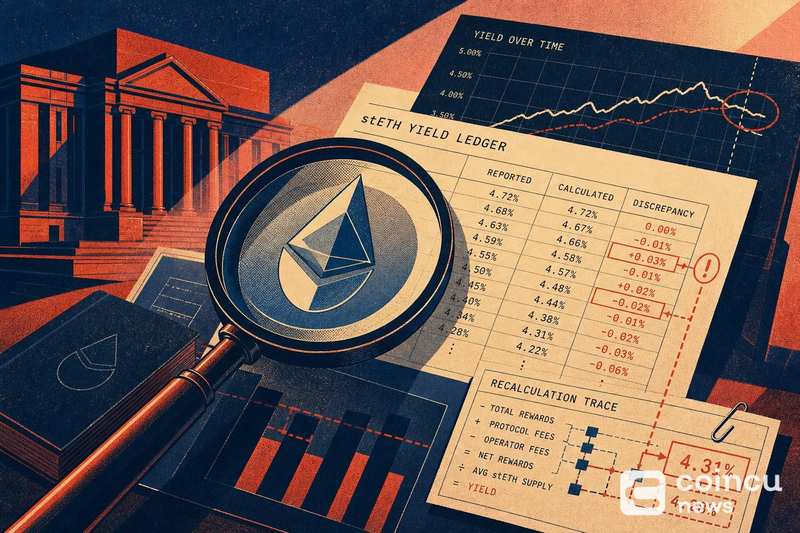
The reported issue centers on Lido’s stETH, the liquid staking token that represents ETH staked through the protocol. As of publication, there is no verified public statement from Lido confirming a final root cause, and the matter surfaces only through open web search results rather than a primary announcement. For related coverage, see South Korea Investigates Polymarket Over Anti-Gambling Allegations.
Because the available evidence is thin, this article deliberately stays narrow. A “recalculation discrepancy” describes a mismatch in how yield is computed or displayed, which is distinct from an on-chain change in a holder’s underlying balance. No confirmed information indicates that funds are at risk. For related coverage, see Stablecoin Inflows to Exchanges Hit 2025 Lows, Signaling Weak Crypto Demand.
What a Yield Recalculation Discrepancy Would Mean
stETH accrues staking rewards, and those rewards are reflected through the protocol’s accounting and reporting layers. A discrepancy in that recalculation would affect reported figures, such as an APR dashboard or an accounting report, not necessarily the tokens held in a wallet.
This distinction matters. Yield calculation is about how rewards are reported over time, while token pricing and on-chain balances are separate records. An accounting mismatch can appear on a front end without any corresponding change to on-chain state.
Accuracy in this reporting is important because stETH is deeply integrated across Ethereum DeFi. The token is used in lending, collateral, and grant contexts, including an Ethereum Foundation stETH grant to Argot, so downstream integrations rely on consistent yield data.
What stETH Holders Should Watch
Until Lido publishes a verified update, ordinary stETH holders have no confirmed action to take. The prudent step is to monitor official Lido channels for any status change rather than acting on unconfirmed search-surfaced reports.
If the issue is confined to reporting, it would primarily affect displayed metrics and integrations that consume those figures, not the ability to hold or transfer stETH. Nothing in the available evidence confirms disruption to withdrawals, transfers, or staking operations.
stETH remains an actively used asset within Lido’s ecosystem, which has seen governance activity such as a proposal of up to $5.8M in stETH for a Kelp funding gap and notable token movements like a large early-investor LDO deposit to Kraken.
What Verification Would Require
A credible resolution would typically involve a root-cause analysis, verification of user-facing metrics against on-chain state, and confirmation that partner integrations reflect corrected figures. None of these steps has been publicly confirmed for this report.
Readers seeking the most current position should rely on Lido’s own status and communication channels. Attempts to trace this issue through syndicated search feeds returned no authoritative primary confirmation at the time of writing.
FAQ
Is stETH affected? There is no confirmed evidence that stETH balances are affected. The report describes a yield recalculation discrepancy, which points to reporting rather than on-chain holdings.
Does this mean funds are at risk? No verified information indicates funds are at risk. A recalculation discrepancy is an accounting or display issue unless official confirmation states otherwise.
Where should users check for official Lido updates? Users should consult Lido’s official website and status channels for any verified statement, rather than relying on unconfirmed search results.
Disclaimer: This article is for informational purposes only and does not constitute financial or investment advice. Cryptocurrency and digital asset markets carry significant risk. Always do your own research before making decisions.
No tags available.


Other Posts








- China, US Conclude Trade Talks with Focus on Cooperation
- Crypto Weekly: NYSE Backs OKX, Kraken Gets Fed Access, BTC Sells
- Court Upholds Fed’s Rejection of Custodia Bank’s Request
- Former CFO Convicted for $35M Fraudulent Crypto Investment
- DeriW Launches Edge Hour Trading Competition Platform for Derivatives Traders
- Michael Saylor Denies Bitcoin Sell-Off Amid Large BTC Transfer
- Buy Dogecoin on eToro: Step-by-Step Guide for Beginners (2024)
- Kazakhstan Explores Crypto Reserves Backed by National Funds
- JPMorgan Increases Holdings in BlackRock’s Bitcoin ETF
- Nordea Bank Introduces Bitcoin ETP Trading for Nordic Customers
- XRP Spot ETF Launches on Nasdaq Amid Market Fluctuations
- Peter Schiff Challenges Michael Saylor on MSTR’s Business Model
- Thailand Orders Worldcoin to Delete 1.2 Million Biometric Records
- UK Proposes New DeFi Tax Framework to Ease User Burden
- WLFI Under Fire: Analyst Warns Hyperliquid Could Be Next
- Ancient Ethereum Whale Moves $1.19 Billion After Decade
- BlackRock Receives Large Crypto Transfers from Coinbase
- SEC Scrutiny on ALT5 Sigma’s Leadership Disclosure Timing
- Yala Injects $5.5 Million Amid Recovery Efforts
- Radiant Capital Faces $50M Loss in Major Security Breach
- China, US Conclude Trade Talks with Focus on Cooperation
- Crypto Weekly: NYSE Backs OKX, Kraken Gets Fed Access, BTC Sells
- Court Upholds Fed’s Rejection of Custodia Bank’s Request
- Former CFO Convicted for $35M Fraudulent Crypto Investment
- DeriW Launches Edge Hour Trading Competition Platform for Derivatives Traders
- Michael Saylor Denies Bitcoin Sell-Off Amid Large BTC Transfer
- Buy Dogecoin on eToro: Step-by-Step Guide for Beginners (2024)
- Kazakhstan Explores Crypto Reserves Backed by National Funds
- JPMorgan Increases Holdings in BlackRock’s Bitcoin ETF
- Nordea Bank Introduces Bitcoin ETP Trading for Nordic Customers
- XRP Spot ETF Launches on Nasdaq Amid Market Fluctuations
- Peter Schiff Challenges Michael Saylor on MSTR’s Business Model
- Thailand Orders Worldcoin to Delete 1.2 Million Biometric Records
- UK Proposes New DeFi Tax Framework to Ease User Burden
- WLFI Under Fire: Analyst Warns Hyperliquid Could Be Next
- Ancient Ethereum Whale Moves $1.19 Billion After Decade
- BlackRock Receives Large Crypto Transfers from Coinbase
- SEC Scrutiny on ALT5 Sigma’s Leadership Disclosure Timing
- Yala Injects $5.5 Million Amid Recovery Efforts
- Radiant Capital Faces $50M Loss in Major Security Breach
- China, US Conclude Trade Talks with Focus on Cooperation
- Crypto Weekly: NYSE Backs OKX, Kraken Gets Fed Access, BTC Sells
- Court Upholds Fed’s Rejection of Custodia Bank’s Request
- Former CFO Convicted for $35M Fraudulent Crypto Investment
- DeriW Launches Edge Hour Trading Competition Platform for Derivatives Traders
- Michael Saylor Denies Bitcoin Sell-Off Amid Large BTC Transfer
- Buy Dogecoin on eToro: Step-by-Step Guide for Beginners (2024)
- Kazakhstan Explores Crypto Reserves Backed by National Funds
- JPMorgan Increases Holdings in BlackRock’s Bitcoin ETF
- Nordea Bank Introduces Bitcoin ETP Trading for Nordic Customers
- XRP Spot ETF Launches on Nasdaq Amid Market Fluctuations
- Peter Schiff Challenges Michael Saylor on MSTR’s Business Model
- Thailand Orders Worldcoin to Delete 1.2 Million Biometric Records
- UK Proposes New DeFi Tax Framework to Ease User Burden
- WLFI Under Fire: Analyst Warns Hyperliquid Could Be Next
- Ancient Ethereum Whale Moves $1.19 Billion After Decade
- BlackRock Receives Large Crypto Transfers from Coinbase
- SEC Scrutiny on ALT5 Sigma’s Leadership Disclosure Timing
- Yala Injects $5.5 Million Amid Recovery Efforts
- Radiant Capital Faces $50M Loss in Major Security Breach


Sberbank Plans Crypto Trading Infrastructure Launch by December 1

RISEx Launches ‘Ignite’ Season 1 Points Program, Following $3B in Volume During the Early Access Phase

Zoomex X Space Recap With Fernando Llorente and the World Cup Final Panel