Bitwise’s Rasmussen Says Circle Is Mispriced on Stablecoin Growth Outlook
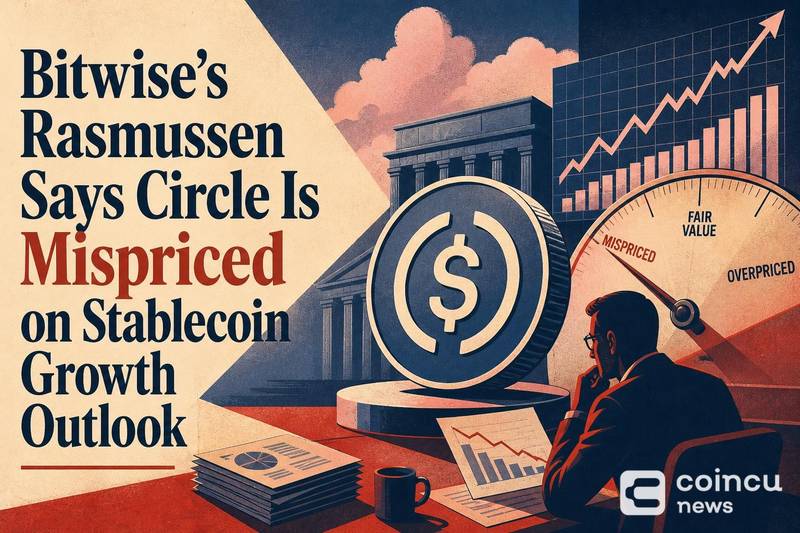
Bitwise Head of Research Ryan Rasmussen says the market is misjudging Circle’s stablecoin growth outlook, arguing that the USDC issuer’s push beyond reserve income into payments infrastructure is “very mispriced by the market” as the stablecoin sector heads toward the multi-trillion-dollar range.
Why Bitwise’s Rasmussen Says Circle May Be Mispriced
Rasmussen told CoinDesk that Circle’s expansion beyond reserve income into payments infrastructure is being very mispriced by the market, according to the outlet’s August 10, 2026 report. For related coverage, see Coinsbuy Hack: $8M Reported Drain Across Two Blockchains.
In market terms, “mispriced” means a company’s share price fails to reflect the value an analyst believes its business will generate. Rasmussen’s framing is bullish relative to consensus: he argues investors are underweighting how much Circle could earn if it becomes both a stablecoin giant and a payments giant.
The call is explicitly tied to Circle’s stablecoin growth outlook rather than short-term trading. Rasmussen expects the stablecoin market to expand from roughly $300 billion to between $3 trillion and $5 trillion, a forecast that underpins his view on where Circle’s addressable market is headed.
What Stablecoin Growth Means for Circle’s Outlook
Circle’s business scales with USDC usage. The token’s circulation and onchain activity translate into reserve income today and payments revenue potential tomorrow, which is why sector growth expectations feed directly into how investors value the company.
USDC currently sits near the center of the market. DefiLlama put the total stablecoin market cap at $301.173 billion on August 10, 2026, with USDC accounting for $72.333 billion of that total.
Live market data placed USDC’s market capitalization at roughly $72.28 billion, with the token trading at $0.9997 at press time, underscoring how large Circle’s core franchise already is even before any multi-trillion expansion.
The distinction between current performance and future expectations matters here. Circle reported USDC circulation of $73.3 billion at Q2 2026 quarter end, but Rasmussen’s thesis rests on adoption that is still years away, not on figures already booked.
Those growth assumptions can shift quickly. A stablecoin market reaching $3 trillion to $5 trillion would represent a roughly tenfold jump from today’s base, and any forecast of that magnitude remains a forward-looking estimate rather than a certainty.
Why the Market May Be Undervaluing or Repricing Circle
Rasmussen appears to be challenging the assumption that Circle is primarily a play on reserve income, which fluctuates with interest rates. His argument is that markets are not pricing in the payments-infrastructure business layered on top of that.
The scale of that payments footprint is already visible. Circle said Q2 2026 USDC onchain transaction volume reached $14.8 trillion, which supports the view that the company is building settlement rails rather than only collecting yield on reserves.
A second pricing gap involves distribution. Circle’s January 2026 product-vision post said USDC was natively available on 30 blockchains as of December 2025, with its Cross-Chain Transfer Protocol having processed $126 billion in cumulative volume, a multichain reach that a pure reserve-income model would not capture.
There is a credible counterpoint. Circle carried a market cap of about $17.02 billion at the August 10 close, with CRCL at $67.05, meaning much of the payments optionality may already be embedded in a valuation that leaves little room for execution missteps.
It is important to separate opinion from confirmed data here. The $14.8 trillion volume and $72.3 billion circulation are reported figures; the claim that Circle is undervalued is Rasmussen’s valuation judgment, not an established fact. Broader sentiment is also cautious, with the Fear & Greed Index at 30, in “Fear” territory.
Catalysts and Risks Investors Should Watch Next
On the upside, continued growth in USDC circulation and onchain volume would validate the payments thesis. Regulatory clarity is another potential tailwind; CoinDesk reported that Rasmussen views Circle as well positioned as U.S. stablecoin rules take shape, echoing the way institutions are increasingly framing tokenized-asset infrastructure as a regulated growth lane.
Circle’s own disclosures point to a widening moat if adoption holds, with its multichain USDC distribution and CCTP settlement layer positioned to capture payments flows beyond the reserve-income base.
On the downside, competition and demand shifts are the clearest risks. USDC’s $72.333 billion share of a $301 billion market leaves room for rivals to erode market position, and a stablecoin backdrop that has drawn scrutiny across jurisdictions, from Brazil’s approaching licensing deadline to evolving U.S. frameworks, could reshape issuer economics.
Macro risk appetite adds another variable. With crypto sentiment soft and the total market cap around $2.28 trillion after a 1.3% daily decline, outlook-driven positions in listed proxies like CRCL remain sensitive to new information. Broader risk signals, from shifting Bitcoin sentiment to treasury-strategy moves such as corporate Bitcoin accumulation, can quickly change how investors price crypto-linked equities.
FAQ About Circle’s Valuation and Stablecoin Growth
What does “mispriced” mean in Rasmussen’s argument?
It means the current share price does not reflect the value Rasmussen believes Circle’s business will generate. He argues the payments-infrastructure side of Circle is undervalued relative to its stablecoin growth outlook.
Why does stablecoin growth matter for Circle?
Circle earns from USDC reserves and increasingly from payments activity, so a larger stablecoin market expands its addressable revenue. Rasmussen expects the sector to grow from roughly $300 billion toward $3 trillion to $5 trillion.
What could change the outlook?
Faster or slower USDC adoption, regulatory decisions, and competitive pressure on market share are the main variables. Rasmussen’s multi-trillion forecast is a forward-looking analyst view, not a confirmed outcome, and remains sensitive to new data.
Disclaimer: This article is for informational purposes only and does not constitute financial or investment advice. Cryptocurrency and digital asset markets carry significant risk. Always do your own research before making decisions.
No tags available.


Other Posts








- China, US Conclude Trade Talks with Focus on Cooperation
- Crypto Weekly: NYSE Backs OKX, Kraken Gets Fed Access, BTC Sells
- Court Upholds Fed’s Rejection of Custodia Bank’s Request
- Former CFO Convicted for $35M Fraudulent Crypto Investment
- DeriW Launches Edge Hour Trading Competition Platform for Derivatives Traders
- Michael Saylor Denies Bitcoin Sell-Off Amid Large BTC Transfer
- Buy Dogecoin on eToro: Step-by-Step Guide for Beginners (2024)
- Kazakhstan Explores Crypto Reserves Backed by National Funds
- JPMorgan Increases Holdings in BlackRock’s Bitcoin ETF
- Nordea Bank Introduces Bitcoin ETP Trading for Nordic Customers
- XRP Spot ETF Launches on Nasdaq Amid Market Fluctuations
- Peter Schiff Challenges Michael Saylor on MSTR’s Business Model
- Thailand Orders Worldcoin to Delete 1.2 Million Biometric Records
- UK Proposes New DeFi Tax Framework to Ease User Burden
- WLFI Under Fire: Analyst Warns Hyperliquid Could Be Next
- Ancient Ethereum Whale Moves $1.19 Billion After Decade
- BlackRock Receives Large Crypto Transfers from Coinbase
- SEC Scrutiny on ALT5 Sigma’s Leadership Disclosure Timing
- Yala Injects $5.5 Million Amid Recovery Efforts
- Radiant Capital Faces $50M Loss in Major Security Breach
- China, US Conclude Trade Talks with Focus on Cooperation
- Crypto Weekly: NYSE Backs OKX, Kraken Gets Fed Access, BTC Sells
- Court Upholds Fed’s Rejection of Custodia Bank’s Request
- Former CFO Convicted for $35M Fraudulent Crypto Investment
- DeriW Launches Edge Hour Trading Competition Platform for Derivatives Traders
- Michael Saylor Denies Bitcoin Sell-Off Amid Large BTC Transfer
- Buy Dogecoin on eToro: Step-by-Step Guide for Beginners (2024)
- Kazakhstan Explores Crypto Reserves Backed by National Funds
- JPMorgan Increases Holdings in BlackRock’s Bitcoin ETF
- Nordea Bank Introduces Bitcoin ETP Trading for Nordic Customers
- XRP Spot ETF Launches on Nasdaq Amid Market Fluctuations
- Peter Schiff Challenges Michael Saylor on MSTR’s Business Model
- Thailand Orders Worldcoin to Delete 1.2 Million Biometric Records
- UK Proposes New DeFi Tax Framework to Ease User Burden
- WLFI Under Fire: Analyst Warns Hyperliquid Could Be Next
- Ancient Ethereum Whale Moves $1.19 Billion After Decade
- BlackRock Receives Large Crypto Transfers from Coinbase
- SEC Scrutiny on ALT5 Sigma’s Leadership Disclosure Timing
- Yala Injects $5.5 Million Amid Recovery Efforts
- Radiant Capital Faces $50M Loss in Major Security Breach
- China, US Conclude Trade Talks with Focus on Cooperation
- Crypto Weekly: NYSE Backs OKX, Kraken Gets Fed Access, BTC Sells
- Court Upholds Fed’s Rejection of Custodia Bank’s Request
- Former CFO Convicted for $35M Fraudulent Crypto Investment
- DeriW Launches Edge Hour Trading Competition Platform for Derivatives Traders
- Michael Saylor Denies Bitcoin Sell-Off Amid Large BTC Transfer
- Buy Dogecoin on eToro: Step-by-Step Guide for Beginners (2024)
- Kazakhstan Explores Crypto Reserves Backed by National Funds
- JPMorgan Increases Holdings in BlackRock’s Bitcoin ETF
- Nordea Bank Introduces Bitcoin ETP Trading for Nordic Customers
- XRP Spot ETF Launches on Nasdaq Amid Market Fluctuations
- Peter Schiff Challenges Michael Saylor on MSTR’s Business Model
- Thailand Orders Worldcoin to Delete 1.2 Million Biometric Records
- UK Proposes New DeFi Tax Framework to Ease User Burden
- WLFI Under Fire: Analyst Warns Hyperliquid Could Be Next
- Ancient Ethereum Whale Moves $1.19 Billion After Decade
- BlackRock Receives Large Crypto Transfers from Coinbase
- SEC Scrutiny on ALT5 Sigma’s Leadership Disclosure Timing
- Yala Injects $5.5 Million Amid Recovery Efforts
- Radiant Capital Faces $50M Loss in Major Security Breach

Bitwise’s Rasmussen Says Circle Is Mispriced on Stablecoin Growth Outlook


Syntetika Launches Tokenization Hub Bringing Regulated Investment Strategies Onchain
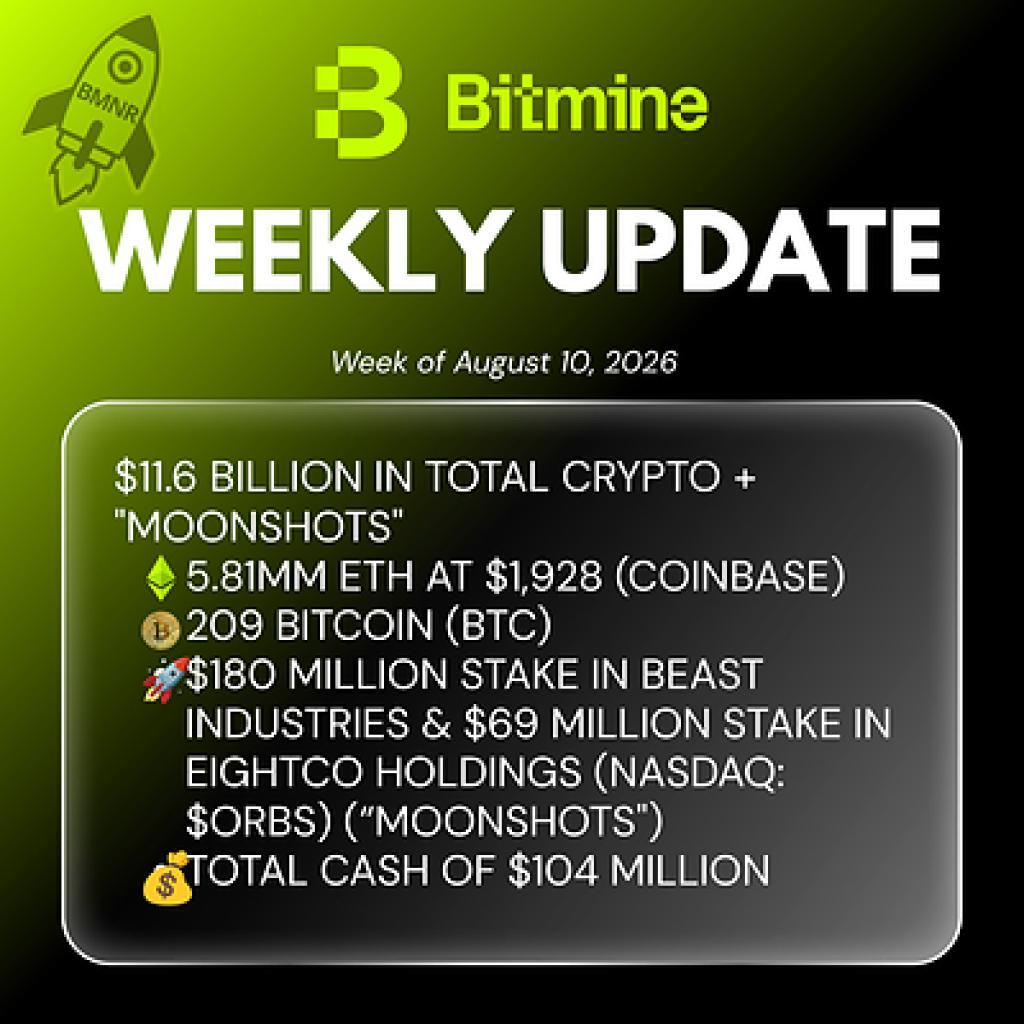
Bitmine Immersion Technologies (BMNR) Announces ETH Holdings Reach 5.81 Million Tokens, and Total Crypto and Total Cash Holdings of $11.6 Billion