Binance recorded a net inflow of $47.3 million in USDT over the past hour, a notable single-hour liquidity event that has drawn attention from traders monitoring stablecoin movements on centralized exchanges.
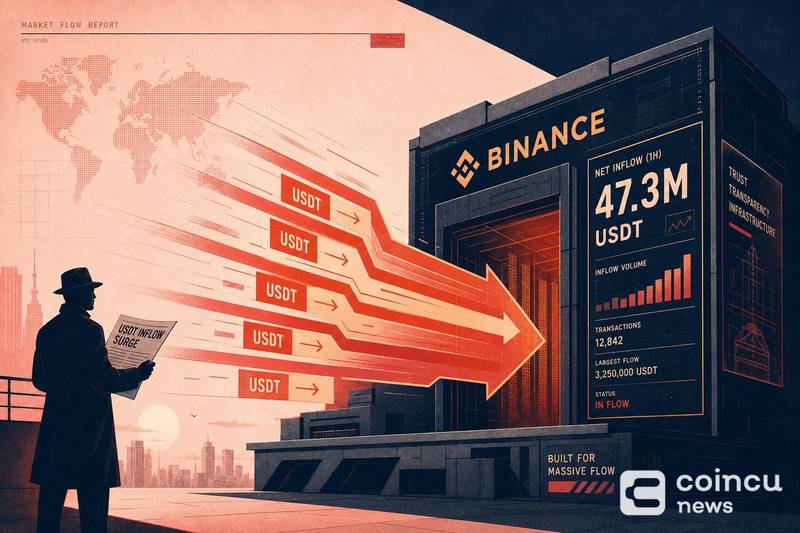
The figure, tracked via CoinGlass exchange flow data, reflects the difference between USDT deposits into Binance and withdrawals from the platform during a one-hour window. A positive net inflow of this size means substantially more USDT entered Binance wallets than left them during that period.
Why Stablecoin Inflows to Exchanges Signal Potential Trading Activity
USDT is the most widely used stablecoin for trading on centralized exchanges. When large amounts of USDT flow into an exchange like Binance, it typically represents capital being positioned for potential purchases of Bitcoin, Ethereum, or other assets.
The logic is straightforward: traders deposit stablecoins to an exchange when they intend to buy. A sudden spike in USDT balances on a single venue can therefore indicate that one or more large participants are preparing to deploy capital.
This is distinct from actual executed orders. The inflow represents buying power that has arrived on the exchange, not trades that have already been placed. The capital could sit idle, be spread across multiple assets, or be deployed over hours or days rather than immediately.
Recent weeks have seen varied capital flows across the crypto market. Separate data showed that Bitcoin ETFs experienced $1.41 billion in seven-day outflows while Ethereum ETFs saw modest additions, illustrating how capital rotates across different vehicles and venues.
What a One-Hour USDT Surge Could Indicate for Near-Term Sentiment
A $47.3 million net inflow compressed into a single hour is large enough to register as an outlier in typical hourly flow data. Short-window capital movements of this magnitude are often monitored by algorithmic traders and on-chain analysts as early signals of sentiment shifts.
One interpretation is that the inflow reflects a bullish positioning move, with one or more participants preparing to accumulate crypto assets. Another possibility is that the capital is being staged for arbitrage opportunities or for market-making purposes that carry no directional bias.
The difference between liquidity arriving on an exchange and that liquidity translating into market-moving orders is critical. Stablecoin deposits create the potential for buying pressure but do not guarantee it. Traders watching this metric typically wait for confirmation from subsequent price action or additional flow data before drawing conclusions.
New infrastructure continues to emerge around crypto trading activity. Platforms like FairGambling have launched analytics tools that reflect the growing demand for transparency across the digital asset ecosystem, and exchange flow tracking has become a standard part of the trader toolkit.
What Context Is Missing Before Drawing Broader Conclusions
The $47.3 million figure represents a single exchange, a single asset, and a single hourly window. Without comparison to prior hours or to average hourly USDT flows on Binance, it is difficult to gauge how unusual this event truly is.
No corresponding price movement data was available alongside the flow figure. A large stablecoin inflow that coincides with rising prices carries a different interpretation than one occurring during a flat or declining market.
Flows on other major exchanges during the same period are also unknown. If Binance’s inflow was offset by outflows on Coinbase, OKX, or other venues, the net effect across the market would be muted. Similarly, flows in other stablecoins such as USDC were not captured in this data point.
Broader market developments, including shifts in real-world asset infrastructure and institutional positioning, can also influence how stablecoin capital moves between exchanges and DeFi protocols.
Isolated hourly data points are best treated as one input among many rather than as standalone trading signals. Confirmation from sustained flow trends, on-chain wallet analysis, and price action over subsequent hours would strengthen or weaken the significance of this particular reading.
FAQ About Binance USDT Net Inflows
What is a net inflow?
A net inflow is the difference between the total amount of an asset deposited into an exchange and the total amount withdrawn during a given period. A positive net inflow means more entered than left.
Why does USDT movement on Binance matter?
Binance is one of the largest cryptocurrency exchanges by trading volume. USDT is the dominant stablecoin used for trading pairs. Large movements of USDT into Binance can signal that traders are preparing to buy crypto assets, making it a widely watched liquidity indicator.
Does a USDT inflow mean crypto prices will rise?
Not necessarily. An inflow represents potential buying power, not executed trades. The deposited USDT may be used for purchases, held idle, or deployed for non-directional strategies like market making. Price impact depends on how and when the capital is actually deployed.
Why is the one-hour time frame important?
Short time windows can capture sudden capital movements that may precede near-term trading activity. However, a single hourly reading is a limited data point. Traders typically look for sustained patterns across multiple hours or days before treating flow data as a reliable signal.
Disclaimer: This article is for informational purposes only and does not constitute financial or investment advice. Cryptocurrency and digital asset markets carry significant risk. Always do your own research before making decisions.
No tags available.


Other Posts








- China, US Conclude Trade Talks with Focus on Cooperation
- Crypto Weekly: NYSE Backs OKX, Kraken Gets Fed Access, BTC Sells
- Court Upholds Fed’s Rejection of Custodia Bank’s Request
- Former CFO Convicted for $35M Fraudulent Crypto Investment
- DeriW Launches Edge Hour Trading Competition Platform for Derivatives Traders
- Michael Saylor Denies Bitcoin Sell-Off Amid Large BTC Transfer
- Buy Dogecoin on eToro: Step-by-Step Guide for Beginners (2024)
- Kazakhstan Explores Crypto Reserves Backed by National Funds
- JPMorgan Increases Holdings in BlackRock’s Bitcoin ETF
- Nordea Bank Introduces Bitcoin ETP Trading for Nordic Customers
- XRP Spot ETF Launches on Nasdaq Amid Market Fluctuations
- Peter Schiff Challenges Michael Saylor on MSTR’s Business Model
- Thailand Orders Worldcoin to Delete 1.2 Million Biometric Records
- UK Proposes New DeFi Tax Framework to Ease User Burden
- WLFI Under Fire: Analyst Warns Hyperliquid Could Be Next
- Ancient Ethereum Whale Moves $1.19 Billion After Decade
- BlackRock Receives Large Crypto Transfers from Coinbase
- SEC Scrutiny on ALT5 Sigma’s Leadership Disclosure Timing
- Yala Injects $5.5 Million Amid Recovery Efforts
- Radiant Capital Faces $50M Loss in Major Security Breach
- China, US Conclude Trade Talks with Focus on Cooperation
- Crypto Weekly: NYSE Backs OKX, Kraken Gets Fed Access, BTC Sells
- Court Upholds Fed’s Rejection of Custodia Bank’s Request
- Former CFO Convicted for $35M Fraudulent Crypto Investment
- DeriW Launches Edge Hour Trading Competition Platform for Derivatives Traders
- Michael Saylor Denies Bitcoin Sell-Off Amid Large BTC Transfer
- Buy Dogecoin on eToro: Step-by-Step Guide for Beginners (2024)
- Kazakhstan Explores Crypto Reserves Backed by National Funds
- JPMorgan Increases Holdings in BlackRock’s Bitcoin ETF
- Nordea Bank Introduces Bitcoin ETP Trading for Nordic Customers
- XRP Spot ETF Launches on Nasdaq Amid Market Fluctuations
- Peter Schiff Challenges Michael Saylor on MSTR’s Business Model
- Thailand Orders Worldcoin to Delete 1.2 Million Biometric Records
- UK Proposes New DeFi Tax Framework to Ease User Burden
- WLFI Under Fire: Analyst Warns Hyperliquid Could Be Next
- Ancient Ethereum Whale Moves $1.19 Billion After Decade
- BlackRock Receives Large Crypto Transfers from Coinbase
- SEC Scrutiny on ALT5 Sigma’s Leadership Disclosure Timing
- Yala Injects $5.5 Million Amid Recovery Efforts
- Radiant Capital Faces $50M Loss in Major Security Breach
- China, US Conclude Trade Talks with Focus on Cooperation
- Crypto Weekly: NYSE Backs OKX, Kraken Gets Fed Access, BTC Sells
- Court Upholds Fed’s Rejection of Custodia Bank’s Request
- Former CFO Convicted for $35M Fraudulent Crypto Investment
- DeriW Launches Edge Hour Trading Competition Platform for Derivatives Traders
- Michael Saylor Denies Bitcoin Sell-Off Amid Large BTC Transfer
- Buy Dogecoin on eToro: Step-by-Step Guide for Beginners (2024)
- Kazakhstan Explores Crypto Reserves Backed by National Funds
- JPMorgan Increases Holdings in BlackRock’s Bitcoin ETF
- Nordea Bank Introduces Bitcoin ETP Trading for Nordic Customers
- XRP Spot ETF Launches on Nasdaq Amid Market Fluctuations
- Peter Schiff Challenges Michael Saylor on MSTR’s Business Model
- Thailand Orders Worldcoin to Delete 1.2 Million Biometric Records
- UK Proposes New DeFi Tax Framework to Ease User Burden
- WLFI Under Fire: Analyst Warns Hyperliquid Could Be Next
- Ancient Ethereum Whale Moves $1.19 Billion After Decade
- BlackRock Receives Large Crypto Transfers from Coinbase
- SEC Scrutiny on ALT5 Sigma’s Leadership Disclosure Timing
- Yala Injects $5.5 Million Amid Recovery Efforts
- Radiant Capital Faces $50M Loss in Major Security Breach


Former FBI Agent Charged With Stealing Nearly $1 Million in Crypto

Coldcard Exploit Raises Questions About Air-Gapped Bitcoin Wallet Security

Bybit.eu Expands European Offering as Bybit Payments GmbH Secures Electronic Money Institution Licence

1win Introduces Seamless Web3 Login and Crypto Deposits via Trust Wallet, MetaMask, and WalletConnect