Syndicate has attributed a $380,000 loss to a private key leak that allowed an attacker to execute a malicious upgrade on the project’s bridge contract. The incident highlights the risks associated with centralized key management in cross-chain bridge infrastructure.
What Syndicate Says Happened in the $380,000 Bridge Incident
According to a report from The Block, Syndicate disclosed that a leaked private key gave an attacker the ability to push a malicious upgrade to the project’s bridge contract. The resulting exploit drained approximately $380,000 in user funds.
The attack vector was not a vulnerability in the bridge’s smart contract logic itself. Instead, the compromise stemmed from unauthorized access to administrative credentials that controlled the contract’s upgrade mechanism.
Syndicate’s account frames the incident as an operational security failure rather than a code-level exploit. The distinction matters because it points to key management practices, not protocol design, as the root cause.
How a Private Key Leak Can Enable a Malicious Contract Upgrade
Many bridge protocols use upgradeable smart contracts, where a privileged key or set of keys can push new code to the live contract. This design allows teams to patch bugs and add features, but it also creates a single point of failure if those keys are compromised.
In this case, Syndicate indicated that the attacker obtained the private key controlling the bridge’s upgrade authority. With that key, the attacker deployed a modified contract that redirected funds, similar in mechanism to incidents the broader DeFi ecosystem has seen, including cases where governance processes were tested after bridge-related attacks.
Why Upgrade Permissions Are the Critical Weakness
The difference between a contract exploit and compromised admin credentials is significant. A code bug can be audited and fixed in future deployments. A compromised upgrade key, however, means the attacker had full authority to rewrite the contract’s behavior at will.
Once the attacker held the upgrade key, no amount of smart contract auditing would have prevented the exploit. The Syndicate bridge documentation describes the bridging mechanism, but the operational controls around key storage became the attack surface.
What Was Affected and Why the $380,000 Loss Matters
Immediate User Impact
The reported $380,000 in losses represents funds drained through the malicious contract upgrade. While the dollar amount is modest compared to some of the largest bridge exploits in crypto history, the attack method carries outsized significance.
Bridge incidents, regardless of scale, erode user confidence in cross-chain infrastructure. Users who trusted the bridge with their funds had no way to anticipate that administrative credentials would be compromised.
Protocol-Level Consequences
The incident raises questions about Syndicate’s key management and access control practices. For any protocol relying on upgradeable contracts, the security of the upgrade key is as critical as the security of the code itself.
The broader DeFi sector has repeatedly seen bridge-related losses, and even relatively small incidents can prompt users to withdraw liquidity. The pattern echoes situations where regulatory bodies have moved to establish clearer frameworks around digital asset infrastructure security.
Security Lessons for Bridge Operators After the Syndicate Report
The most immediate takeaway from Syndicate’s disclosure is the importance of multisig controls for contract upgrade authority. A single private key controlling upgrade permissions creates an unacceptable risk profile.
Multisig wallets require multiple parties to approve any upgrade transaction, meaning a single leaked key cannot unilaterally push malicious code. Many established bridge protocols have adopted this approach as a baseline security measure.
Beyond multisig implementation, the incident underscores the need for operational key storage practices such as hardware security modules, air-gapped signing environments, and regular access reviews. The fact that a key leak, not a code vulnerability, caused the loss suggests that Syndicate’s operational security did not match the sensitivity of the credentials involved.
Bridge operators should also consider timelocks on upgrade transactions, giving the community and monitoring systems a window to detect and respond to unauthorized changes before they take effect. In an ecosystem where large fund movements are closely tracked, real-time monitoring of contract upgrades is equally essential.
FAQ About the Syndicate Bridge Contract Upgrade Incident
What did Syndicate say caused the $380,000 loss?
Syndicate attributed the loss to a private key leak that gave an attacker the ability to execute a malicious upgrade on the project’s bridge contract. The upgraded contract was then used to drain funds.
How can a private key leak enable a contract upgrade?
Upgradeable smart contracts have an admin key that authorizes new code deployments. If that key is leaked or stolen, the holder can replace the contract’s logic with malicious code, effectively taking control of all funds managed by the contract.
Why are bridge upgrade keys considered high risk?
Bridge contracts often hold pooled user funds from multiple chains. The upgrade key for such a contract has the power to redirect all of those funds. This makes bridge upgrade keys among the most sensitive credentials in DeFi, and a primary target for attackers.
Disclaimer: This article is for informational purposes only and does not constitute financial or investment advice. Cryptocurrency and digital asset markets carry significant risk. Always do your own research before making decisions.
No tags available.


Other Posts








- China, US Conclude Trade Talks with Focus on Cooperation
- Crypto Weekly: NYSE Backs OKX, Kraken Gets Fed Access, BTC Sells
- DeriW Launches Edge Hour Trading Competition Platform for Derivatives Traders
- Court Upholds Fed’s Rejection of Custodia Bank’s Request
- Former CFO Convicted for $35M Fraudulent Crypto Investment
- Michael Saylor Denies Bitcoin Sell-Off Amid Large BTC Transfer
- Buy Dogecoin on eToro: Step-by-Step Guide for Beginners (2024)
- Kazakhstan Explores Crypto Reserves Backed by National Funds
- JPMorgan Increases Holdings in BlackRock’s Bitcoin ETF
- Nordea Bank Introduces Bitcoin ETP Trading for Nordic Customers
- XRP Spot ETF Launches on Nasdaq Amid Market Fluctuations
- Crypto Leaders Address Macro Volatility Amid Market Shifts
- Peter Schiff Challenges Michael Saylor on MSTR’s Business Model
- Thailand Orders Worldcoin to Delete 1.2 Million Biometric Records
- UK Proposes New DeFi Tax Framework to Ease User Burden
- WLFI Under Fire: Analyst Warns Hyperliquid Could Be Next
- Ancient Ethereum Whale Moves $1.19 Billion After Decade
- BlackRock Receives Large Crypto Transfers from Coinbase
- SEC Scrutiny on ALT5 Sigma’s Leadership Disclosure Timing
- MoonPay Gains Trust License for Crypto Operations in New York
- China, US Conclude Trade Talks with Focus on Cooperation
- Crypto Weekly: NYSE Backs OKX, Kraken Gets Fed Access, BTC Sells
- DeriW Launches Edge Hour Trading Competition Platform for Derivatives Traders
- Court Upholds Fed’s Rejection of Custodia Bank’s Request
- Former CFO Convicted for $35M Fraudulent Crypto Investment
- Michael Saylor Denies Bitcoin Sell-Off Amid Large BTC Transfer
- Buy Dogecoin on eToro: Step-by-Step Guide for Beginners (2024)
- Kazakhstan Explores Crypto Reserves Backed by National Funds
- JPMorgan Increases Holdings in BlackRock’s Bitcoin ETF
- Nordea Bank Introduces Bitcoin ETP Trading for Nordic Customers
- XRP Spot ETF Launches on Nasdaq Amid Market Fluctuations
- Crypto Leaders Address Macro Volatility Amid Market Shifts
- Peter Schiff Challenges Michael Saylor on MSTR’s Business Model
- Thailand Orders Worldcoin to Delete 1.2 Million Biometric Records
- UK Proposes New DeFi Tax Framework to Ease User Burden
- WLFI Under Fire: Analyst Warns Hyperliquid Could Be Next
- Ancient Ethereum Whale Moves $1.19 Billion After Decade
- BlackRock Receives Large Crypto Transfers from Coinbase
- SEC Scrutiny on ALT5 Sigma’s Leadership Disclosure Timing
- MoonPay Gains Trust License for Crypto Operations in New York
- China, US Conclude Trade Talks with Focus on Cooperation
- Crypto Weekly: NYSE Backs OKX, Kraken Gets Fed Access, BTC Sells
- DeriW Launches Edge Hour Trading Competition Platform for Derivatives Traders
- Court Upholds Fed’s Rejection of Custodia Bank’s Request
- Former CFO Convicted for $35M Fraudulent Crypto Investment
- Michael Saylor Denies Bitcoin Sell-Off Amid Large BTC Transfer
- Buy Dogecoin on eToro: Step-by-Step Guide for Beginners (2024)
- Kazakhstan Explores Crypto Reserves Backed by National Funds
- JPMorgan Increases Holdings in BlackRock’s Bitcoin ETF
- Nordea Bank Introduces Bitcoin ETP Trading for Nordic Customers
- XRP Spot ETF Launches on Nasdaq Amid Market Fluctuations
- Crypto Leaders Address Macro Volatility Amid Market Shifts
- Peter Schiff Challenges Michael Saylor on MSTR’s Business Model
- Thailand Orders Worldcoin to Delete 1.2 Million Biometric Records
- UK Proposes New DeFi Tax Framework to Ease User Burden
- WLFI Under Fire: Analyst Warns Hyperliquid Could Be Next
- Ancient Ethereum Whale Moves $1.19 Billion After Decade
- BlackRock Receives Large Crypto Transfers from Coinbase
- SEC Scrutiny on ALT5 Sigma’s Leadership Disclosure Timing
- MoonPay Gains Trust License for Crypto Operations in New York


U.S. Dollar Index Falls to 101.105 as Major Currency Rates Shift

Chainalysis Plans On-Chain Tracking Standards System With Address Clustering Ontology
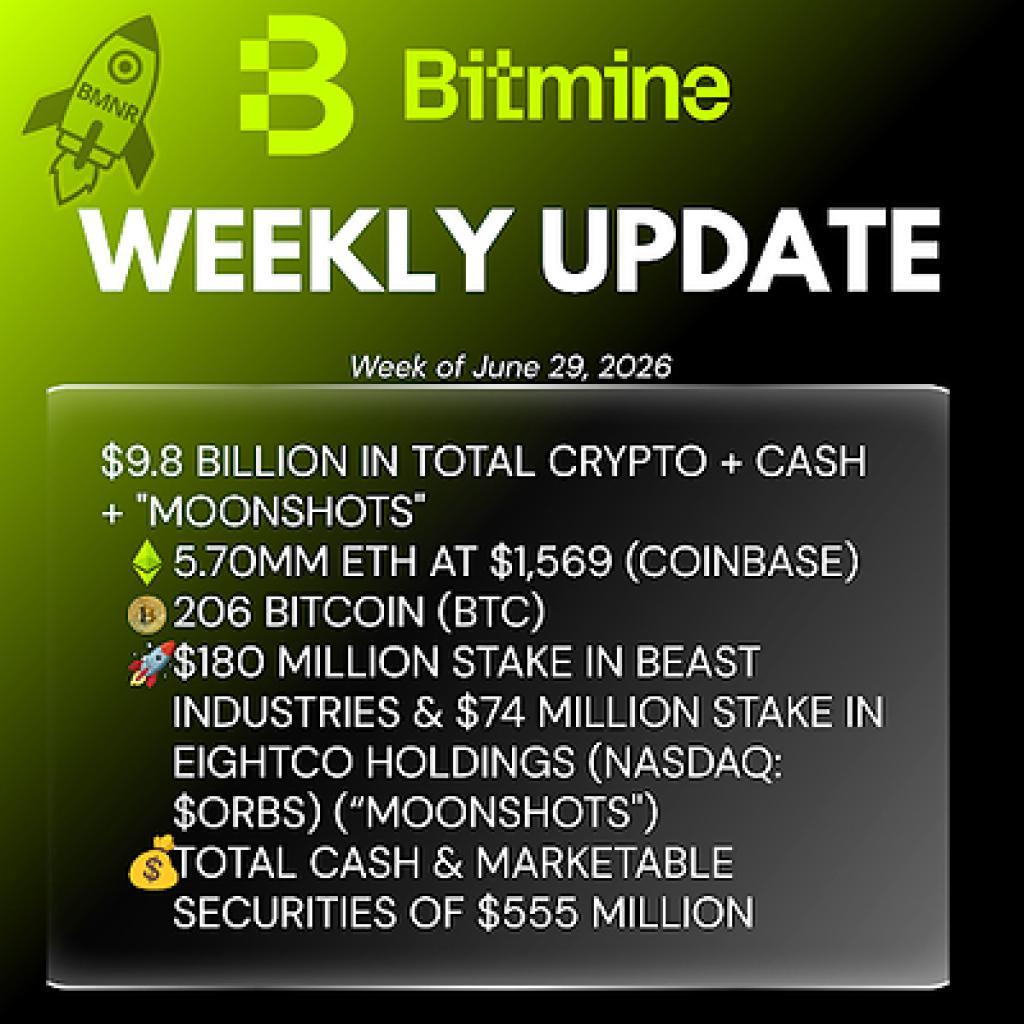
Bitmine Immersion Technologies (BMNR) Announces ETH Holdings Reach 5.70 Million Tokens, and Total Crypto and Total Cash Holdings of $9.8 Billion

Toss Brings 30 Million Users Into the AI Data Economy in Partnership With Poseidon