Senators Press Treasury to Preserve State Stablecoin Authority in GENIUS Bill
A bipartisan group of US senators is pressing the Treasury Department to preserve state-level regulatory authority over stablecoins as the agency moves to implement the GENIUS bill, warning that federal overreach could undermine existing state supervisory frameworks.
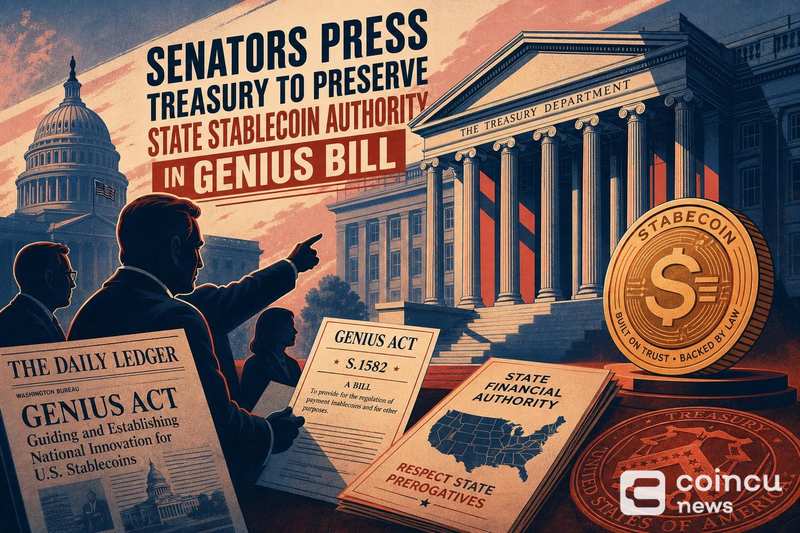
The senators’ appeal, outlined in a letter focused on state implementation, targets Treasury’s approach to recognizing state stablecoin regimes rather than any specific issuer or token. The core request is straightforward: do not use the implementation process to effectively strip states of oversight roles that the bill’s text was designed to preserve.
The push comes as Treasury works through the mechanics of the GENIUS Act (S.1582), which establishes a federal framework for stablecoin regulation while nominally allowing state-chartered issuers to continue operating under state supervision. The debate arrives at a moment when ongoing legislative efforts to define stablecoin oversight have intensified across Washington.
Why state-level oversight is the central implementation fight
The dispute is not about whether stablecoins should be regulated. It is about who gets to regulate them and under what standards.
State regulators have built licensing and examination frameworks for money transmitters and digital asset firms over the past decade. Several states have issued stablecoin-specific guidance or charters. The GENIUS bill acknowledges this existing infrastructure, but the practical question is whether Treasury’s implementation will treat state regimes as genuinely equivalent or impose conditions that effectively force issuers into a federal-only pathway.
The Conference of State Bank Supervisors has raised concerns that Treasury’s approach to judging state regimes as “substantially similar” to federal standards needs recalibration. The CSBS argument is that the current framing risks setting the bar in a way that marginalizes state programs rather than integrating them.
For stablecoin issuers, the outcome determines compliance costs, licensing strategy, and competitive positioning. A framework that genuinely preserves dual federal-state pathways gives issuers optionality. One that funnels everything through Treasury narrows the field, with potential ripple effects on stablecoin flows across major exchanges.
How the GENIUS bill divides authority between Treasury and the states
The bill text establishes federal requirements for payment stablecoin issuers, including reserve composition, redemption rights, and disclosure standards. It also creates a process for state-regulated issuers to continue operating if their state regime meets certain conditions.
Treasury’s role is pivotal because the agency holds significant discretion over how equivalence is assessed. The bill sets the statutory framework, but the implementation details, including what counts as a qualifying state regime, are where the real regulatory power sits.
This is the gap the senators are targeting. The bill’s language may intend to preserve state authority, but if Treasury’s interpretation of “substantially similar” is too narrow, the practical effect could be federal preemption by another name. The distinction between what the bill says and how Treasury implements it is the core tension in the senators’ letter.
What remains unresolved after the senators’ appeal
Several key questions remain open. Treasury has not publicly indicated whether it will revise its approach in response to the bipartisan pressure. The agency’s existing press releases on stablecoin oversight do not fully address the equivalence standards that the GENIUS bill requires.
It is also unclear how many state regimes would qualify under Treasury’s current interpretation. States with robust digital asset frameworks, such as New York’s BitLicense regime, may have an easier path than states with lighter-touch approaches. The criteria Treasury ultimately adopts will shape which states can maintain meaningful supervisory roles.
The bipartisan nature of the appeal suggests the issue cuts across party lines, which could increase pressure on Treasury to accommodate state regulators. Whether that pressure translates into concrete changes in implementation guidance will depend on upcoming Treasury actions and potential congressional oversight hearings. As regulatory clarity for digital assets remains in flux, the resolution of this dispute could shape how projects across the broader crypto ecosystem, including infrastructure-focused blockchain networks, navigate US compliance requirements.
What policy watchers should monitor next
What is the GENIUS bill in this context? The GENIUS Act (S.1582) is federal legislation that creates a regulatory framework for payment stablecoins in the United States. The current dispute is not about the bill’s passage but about how Treasury implements provisions that affect whether states retain meaningful oversight authority.
Why does state-level authority matter for stablecoin issuers? State regulatory frameworks offer issuers alternative compliance pathways, potentially with different cost structures and supervisory approaches than a single federal regime. If Treasury’s implementation effectively eliminates these pathways, issuers lose optionality and smaller or state-focused firms may face higher barriers to entry.
What is the next concrete catalyst? The most immediate signal will be whether Treasury issues revised guidance or a formal response to the senators’ letter. Any rulemaking or interpretive guidance on the “substantially similar” standard for state regimes will be the key document to watch. Congressional oversight hearings on GENIUS bill implementation could also force public commitments from Treasury officials.
Disclaimer: This article is for informational purposes only and does not constitute financial or investment advice. Cryptocurrency and digital asset markets carry significant risk. Always do your own research before making decisions.
No tags available.


Other Posts








- China, US Conclude Trade Talks with Focus on Cooperation
- Court Upholds Fed’s Rejection of Custodia Bank’s Request
- Crypto Weekly: NYSE Backs OKX, Kraken Gets Fed Access, BTC Sells
- Former CFO Convicted for $35M Fraudulent Crypto Investment
- DeriW Launches Edge Hour Trading Competition Platform for Derivatives Traders
- Michael Saylor Denies Bitcoin Sell-Off Amid Large BTC Transfer
- Buy Dogecoin on eToro: Step-by-Step Guide for Beginners (2024)
- Kazakhstan Explores Crypto Reserves Backed by National Funds
- JPMorgan Increases Holdings in BlackRock’s Bitcoin ETF
- Nordea Bank Introduces Bitcoin ETP Trading for Nordic Customers
- XRP Spot ETF Launches on Nasdaq Amid Market Fluctuations
- Peter Schiff Challenges Michael Saylor on MSTR’s Business Model
- Thailand Orders Worldcoin to Delete 1.2 Million Biometric Records
- UK Proposes New DeFi Tax Framework to Ease User Burden
- WLFI Under Fire: Analyst Warns Hyperliquid Could Be Next
- Ancient Ethereum Whale Moves $1.19 Billion After Decade
- BlackRock Receives Large Crypto Transfers from Coinbase
- SEC Scrutiny on ALT5 Sigma’s Leadership Disclosure Timing
- Yala Injects $5.5 Million Amid Recovery Efforts
- Radiant Capital Faces $50M Loss in Major Security Breach
- China, US Conclude Trade Talks with Focus on Cooperation
- Court Upholds Fed’s Rejection of Custodia Bank’s Request
- Crypto Weekly: NYSE Backs OKX, Kraken Gets Fed Access, BTC Sells
- Former CFO Convicted for $35M Fraudulent Crypto Investment
- DeriW Launches Edge Hour Trading Competition Platform for Derivatives Traders
- Michael Saylor Denies Bitcoin Sell-Off Amid Large BTC Transfer
- Buy Dogecoin on eToro: Step-by-Step Guide for Beginners (2024)
- Kazakhstan Explores Crypto Reserves Backed by National Funds
- JPMorgan Increases Holdings in BlackRock’s Bitcoin ETF
- Nordea Bank Introduces Bitcoin ETP Trading for Nordic Customers
- XRP Spot ETF Launches on Nasdaq Amid Market Fluctuations
- Peter Schiff Challenges Michael Saylor on MSTR’s Business Model
- Thailand Orders Worldcoin to Delete 1.2 Million Biometric Records
- UK Proposes New DeFi Tax Framework to Ease User Burden
- WLFI Under Fire: Analyst Warns Hyperliquid Could Be Next
- Ancient Ethereum Whale Moves $1.19 Billion After Decade
- BlackRock Receives Large Crypto Transfers from Coinbase
- SEC Scrutiny on ALT5 Sigma’s Leadership Disclosure Timing
- Yala Injects $5.5 Million Amid Recovery Efforts
- Radiant Capital Faces $50M Loss in Major Security Breach
- China, US Conclude Trade Talks with Focus on Cooperation
- Court Upholds Fed’s Rejection of Custodia Bank’s Request
- Crypto Weekly: NYSE Backs OKX, Kraken Gets Fed Access, BTC Sells
- Former CFO Convicted for $35M Fraudulent Crypto Investment
- DeriW Launches Edge Hour Trading Competition Platform for Derivatives Traders
- Michael Saylor Denies Bitcoin Sell-Off Amid Large BTC Transfer
- Buy Dogecoin on eToro: Step-by-Step Guide for Beginners (2024)
- Kazakhstan Explores Crypto Reserves Backed by National Funds
- JPMorgan Increases Holdings in BlackRock’s Bitcoin ETF
- Nordea Bank Introduces Bitcoin ETP Trading for Nordic Customers
- XRP Spot ETF Launches on Nasdaq Amid Market Fluctuations
- Peter Schiff Challenges Michael Saylor on MSTR’s Business Model
- Thailand Orders Worldcoin to Delete 1.2 Million Biometric Records
- UK Proposes New DeFi Tax Framework to Ease User Burden
- WLFI Under Fire: Analyst Warns Hyperliquid Could Be Next
- Ancient Ethereum Whale Moves $1.19 Billion After Decade
- BlackRock Receives Large Crypto Transfers from Coinbase
- SEC Scrutiny on ALT5 Sigma’s Leadership Disclosure Timing
- Yala Injects $5.5 Million Amid Recovery Efforts
- Radiant Capital Faces $50M Loss in Major Security Breach

Bitcoin’s $116M Self-Custody Wake-Up Call Raises ETF Questions

SafePal Data Breach Exposes Nearly 40,000 Customers’ Order Info


BiggerZ: Building a Fairness-First Crypto Casino, Sportsbook and Prediction Markets Platform
Bitmine Immersion Technologies Announces Record and Payment Dates for Cash Dividends on 9.50% Series A Perpetual Preferred Stock