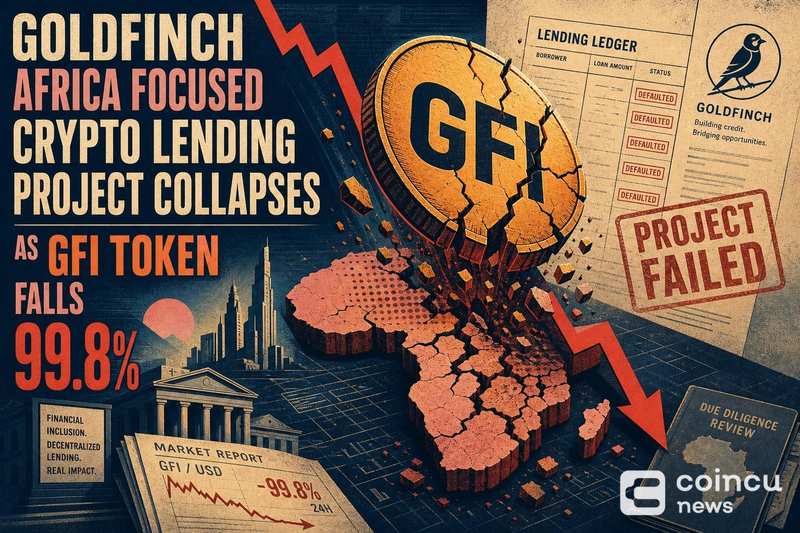
Goldfinch Africa-Focused Crypto Lending Project Collapses as GFI Token Falls 99.8%
Goldfinch, a decentralized lending protocol that positioned itself as a bridge between DeFi capital and real-world credit markets in emerging economies, has seen its GFI governance token lose virtually all of its value, falling roughly 99.8% from its peak as the project’s lending operations unraveled.
The protocol, built on Ethereum, aimed to connect crypto lenders with borrowers in underserved markets, particularly across Africa and other developing regions. Unlike typical DeFi lending platforms that require on-chain collateral, Goldfinch pursued an under-collateralized model where real-world borrowers could access capital through vetted lending pools.
Lending Pool Failures Exposed Structural Risks
Cracks in Goldfinch’s model became visible through its governance forums, where updates on troubled lending pools surfaced. A governance discussion on the Lend East pool highlighted repayment difficulties that signaled deeper problems with the protocol’s credit underwriting approach.
The Lend East pool was one of several borrower pools on the platform that channeled funds to real-world lending operations. When borrowers in these pools struggled to meet repayment obligations, lenders on the protocol faced potential losses with limited recourse, a fundamental vulnerability in any under-collateralized lending system.
Goldfinch’s official website still lists the protocol’s framework, but active development and community engagement have declined sharply. The governance forum shows a pattern of increasingly concerned posts from depositors seeking clarity on the status of their funds.
GFI’s Near-Total Collapse Reflects Lost Confidence
The GFI token’s 99.8% decline from its all-time high represents one of the steepest drawdowns among DeFi governance tokens. A drop of this magnitude typically signals not just bearish sentiment but a fundamental repricing, where the market assigns near-zero value to the protocol’s future cash flows and governance rights.
It is important to distinguish between token price collapse and operational collapse. A token can lose most of its value while the underlying protocol still functions, and conversely, a protocol can fail while its token retains speculative value. In Goldfinch’s case, however, both the token performance and the operational health of lending pools deteriorated in parallel.
For GFI holders, the near-total loss of token value means governance rights are effectively worthless. For liquidity providers who deposited stablecoins into lending pools, the concern is more direct: whether principal can be recovered from borrowers who may have defaulted.
What Went Wrong With Goldfinch’s Model
Goldfinch’s approach carried inherent risks that are well understood in traditional finance but proved especially difficult to manage in a decentralized context. Under-collateralized lending depends heavily on borrower due diligence, legal enforceability of loan agreements, and active monitoring of repayment performance.
In traditional lending, institutions have legal teams, local offices, and regulatory frameworks to pursue delinquent borrowers. Goldfinch attempted to replicate this through a system of “auditors” and “backers” who were supposed to vet borrowers, but enforcement across jurisdictions, particularly in emerging markets, remained a persistent challenge.
The timeline of warning signs included delayed repayments from multiple pools, governance proposals to address defaults, and declining participation from new lenders. As confidence eroded, new capital inflows dried up, leaving existing lenders exposed to a shrinking pool of increasingly distressed loans.
Several specific failure points remain unresolved. The extent of actual defaults across all pools, the recovery rate on distressed loans, and whether any borrower fraud contributed to losses are questions the community continues to debate without definitive answers.
Implications for DeFi Lending and Emerging Market Credit
Goldfinch’s collapse raises pointed questions about the viability of under-collateralized DeFi lending, at least in its current form. The protocol was among several projects, alongside Maple Finance and TrueFi, that attempted to bring real-world credit to DeFi. Each has faced its own challenges with defaults and restructuring.
The failure is particularly significant for Africa-focused crypto credit initiatives. While Goldfinch’s problems stemmed from structural and operational issues rather than anything inherent to African borrowers, the collapse could make it harder for legitimate projects to attract DeFi capital for emerging market lending. As institutions like Franklin Templeton expand into digital assets, the contrast between institutional-grade risk management and early DeFi credit experiments becomes starker.
The core lesson is about transparency and underwriting discipline. DeFi protocols that extend credit to off-chain borrowers must solve the same problems traditional lenders face: credit assessment, collateral enforcement, and loss recovery. Smart contracts alone cannot enforce real-world loan repayments.
It would be a mistake, however, to generalize Goldfinch’s failure to all blockchain-based lending or all Africa-focused crypto projects. The broader ecosystem continues to develop, with stablecoin infrastructure expanding to new chains and institutional builders entering the space. The question is whether future attempts will learn from the structural weaknesses that Goldfinch exposed.
Key Questions for Affected Users
Is Goldfinch still operating?
The protocol’s smart contracts remain deployed on Ethereum, but active development, new lending pool creation, and meaningful governance activity have largely ceased. The project’s governance forum contains updates on legacy pools but no indication of new lending operations.
Why did GFI fall 99.8%?
The token’s collapse reflects a combination of lending pool defaults, loss of depositor confidence, declining protocol activity, and the broader repricing of DeFi governance tokens that lack sustainable revenue. When a protocol’s core business, lending, stops generating returns, its governance token loses its fundamental value proposition.
Who is most exposed to the collapse?
Three groups bear the heaviest impact: GFI token holders who bought at higher prices, senior pool depositors who provided capital across all borrower pools, and junior tranche backers who took first-loss positions in specific pools. Junior backers face the steepest potential losses, as their capital absorbs defaults before senior pool depositors.
Disclaimer: This article is for informational purposes only and does not constitute financial or investment advice. Cryptocurrency and digital asset markets carry significant risk. Always do your own research before making decisions.
No tags available.


Other Posts








- China, US Conclude Trade Talks with Focus on Cooperation
- Crypto Weekly: NYSE Backs OKX, Kraken Gets Fed Access, BTC Sells
- DeriW Launches Edge Hour Trading Competition Platform for Derivatives Traders
- Court Upholds Fed’s Rejection of Custodia Bank’s Request
- Former CFO Convicted for $35M Fraudulent Crypto Investment
- Michael Saylor Denies Bitcoin Sell-Off Amid Large BTC Transfer
- Buy Dogecoin on eToro: Step-by-Step Guide for Beginners (2024)
- Kazakhstan Explores Crypto Reserves Backed by National Funds
- JPMorgan Increases Holdings in BlackRock’s Bitcoin ETF
- Nordea Bank Introduces Bitcoin ETP Trading for Nordic Customers
- XRP Spot ETF Launches on Nasdaq Amid Market Fluctuations
- Crypto Leaders Address Macro Volatility Amid Market Shifts
- Peter Schiff Challenges Michael Saylor on MSTR’s Business Model
- Thailand Orders Worldcoin to Delete 1.2 Million Biometric Records
- UK Proposes New DeFi Tax Framework to Ease User Burden
- WLFI Under Fire: Analyst Warns Hyperliquid Could Be Next
- Ancient Ethereum Whale Moves $1.19 Billion After Decade
- BlackRock Receives Large Crypto Transfers from Coinbase
- SEC Scrutiny on ALT5 Sigma’s Leadership Disclosure Timing
- MoonPay Gains Trust License for Crypto Operations in New York
- China, US Conclude Trade Talks with Focus on Cooperation
- Crypto Weekly: NYSE Backs OKX, Kraken Gets Fed Access, BTC Sells
- DeriW Launches Edge Hour Trading Competition Platform for Derivatives Traders
- Court Upholds Fed’s Rejection of Custodia Bank’s Request
- Former CFO Convicted for $35M Fraudulent Crypto Investment
- Michael Saylor Denies Bitcoin Sell-Off Amid Large BTC Transfer
- Buy Dogecoin on eToro: Step-by-Step Guide for Beginners (2024)
- Kazakhstan Explores Crypto Reserves Backed by National Funds
- JPMorgan Increases Holdings in BlackRock’s Bitcoin ETF
- Nordea Bank Introduces Bitcoin ETP Trading for Nordic Customers
- XRP Spot ETF Launches on Nasdaq Amid Market Fluctuations
- Crypto Leaders Address Macro Volatility Amid Market Shifts
- Peter Schiff Challenges Michael Saylor on MSTR’s Business Model
- Thailand Orders Worldcoin to Delete 1.2 Million Biometric Records
- UK Proposes New DeFi Tax Framework to Ease User Burden
- WLFI Under Fire: Analyst Warns Hyperliquid Could Be Next
- Ancient Ethereum Whale Moves $1.19 Billion After Decade
- BlackRock Receives Large Crypto Transfers from Coinbase
- SEC Scrutiny on ALT5 Sigma’s Leadership Disclosure Timing
- MoonPay Gains Trust License for Crypto Operations in New York
- China, US Conclude Trade Talks with Focus on Cooperation
- Crypto Weekly: NYSE Backs OKX, Kraken Gets Fed Access, BTC Sells
- DeriW Launches Edge Hour Trading Competition Platform for Derivatives Traders
- Court Upholds Fed’s Rejection of Custodia Bank’s Request
- Former CFO Convicted for $35M Fraudulent Crypto Investment
- Michael Saylor Denies Bitcoin Sell-Off Amid Large BTC Transfer
- Buy Dogecoin on eToro: Step-by-Step Guide for Beginners (2024)
- Kazakhstan Explores Crypto Reserves Backed by National Funds
- JPMorgan Increases Holdings in BlackRock’s Bitcoin ETF
- Nordea Bank Introduces Bitcoin ETP Trading for Nordic Customers
- XRP Spot ETF Launches on Nasdaq Amid Market Fluctuations
- Crypto Leaders Address Macro Volatility Amid Market Shifts
- Peter Schiff Challenges Michael Saylor on MSTR’s Business Model
- Thailand Orders Worldcoin to Delete 1.2 Million Biometric Records
- UK Proposes New DeFi Tax Framework to Ease User Burden
- WLFI Under Fire: Analyst Warns Hyperliquid Could Be Next
- Ancient Ethereum Whale Moves $1.19 Billion After Decade
- BlackRock Receives Large Crypto Transfers from Coinbase
- SEC Scrutiny on ALT5 Sigma’s Leadership Disclosure Timing
- MoonPay Gains Trust License for Crypto Operations in New York
Goldfinch Africa-Focused Crypto Lending Project Collapses as GFI Token Falls 99.8%


Franklin Templeton Completes 250 Digital Acquisition, Launches Franklin Crypto