Liquidity Staking TVL Falls to Two-Year Low as Q2 Total Drops to $33.4B
Liquid staking total value locked slid to $33.4 billion in Q2 2026, hitting a two-year low and signaling weakened capital commitment across the largest DeFi yield category.
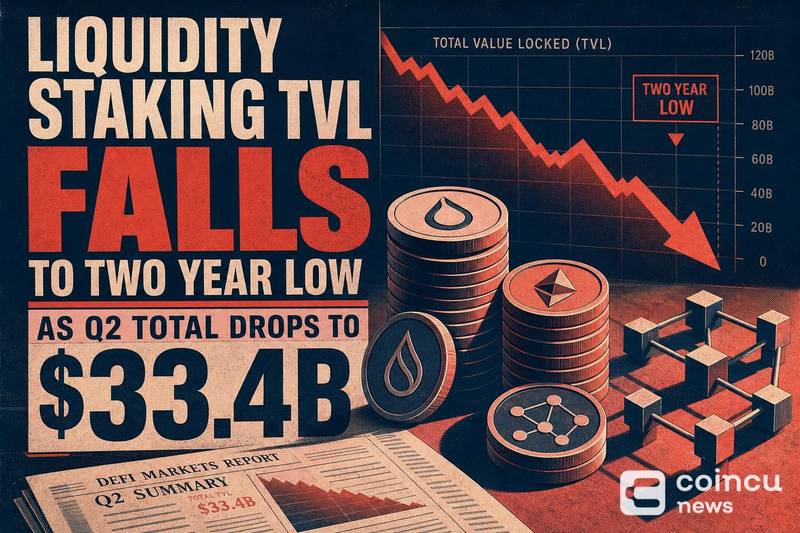
The decline, visible on DeFiLlama’s liquid staking tracker, marks the lowest TVL reading for the sector since mid-2024. The drop represents a significant retracement from highs reached when liquid staking protocols overtook DeFi lending as the second-largest crypto sector in early 2023.
Q2 TVL Contraction Points to Capital Outflows and Price Pressure
TVL declines in liquid staking can stem from two distinct forces: falling prices of the underlying staked assets, or net withdrawals by depositors. A drop to $33.4 billion likely reflects a combination of both. For related coverage, see SOL Price Falls Below $65, Still Up 4.52% in 24 Hours.
When asset prices fall, the dollar-denominated TVL shrinks even if the number of staked tokens remains unchanged. At the same time, reduced confidence in yield opportunities can drive depositors to redeem their liquid staking tokens, pulling actual capital from protocols.
The Q2 period saw softer demand for staking derivatives overall. Without fresh capital inflows or rising token prices to offset redemptions, the sector’s aggregate TVL compressed to levels not seen in two years.
Why a Two-Year Low Matters for DeFi Health
Liquid staking TVL serves as a barometer for capital confidence in DeFi yield strategies. When depositors commit assets to protocols like Lido, Rocket Pool, or Coinbase’s cbETH, they signal willingness to lock value in exchange for staking rewards and DeFi composability.
A sustained decline suggests investors are either rotating capital elsewhere or reducing DeFi exposure entirely. This matters because liquid staking tokens underpin significant activity across lending, borrowing, and liquidity provision, as Solana’s TVL challenges with liquid staking have previously illustrated.
Protocols that depend on staked liquidity as collateral or trading pairs face knock-on effects when that liquidity shrinks. Lower TVL can mean thinner markets, wider spreads, and reduced capital efficiency across DeFi.
For investors monitoring staking-based income strategies, the contraction raises questions about whether current yield rates are sufficient to attract and retain depositors in a less favorable market environment.
Protocols and Metrics to Watch for Stabilization Signals
The next directional move for liquid staking TVL depends on several observable indicators. Net deposit and withdrawal trends at major protocols will reveal whether the outflow is decelerating or accelerating.
Changes to protocol incentive structures, such as boosted rewards or new integrations, often precede TVL recoveries. Conversely, incentive reductions can accelerate withdrawals.
Underlying asset prices remain the most direct lever on dollar-denominated TVL. A sustained recovery in ETH or SOL prices would mechanically lift the sector’s reported TVL even without new deposits. Broader DeFi liquidity conditions across decentralized exchanges will also shape whether capital returns to staking or flows into alternative yield venues.
FAQ About the Liquid Staking TVL Decline
What is liquid staking TVL?
Liquid staking TVL measures the total dollar value of crypto assets deposited into liquid staking protocols. These protocols issue derivative tokens representing staked positions, allowing holders to earn staking rewards while retaining the ability to use their capital in DeFi.
Why can TVL fall even if protocol usage stays active?
TVL is denominated in dollars, so falling token prices reduce the reported figure even when the same number of tokens remains staked. A 20% drop in ETH price, for example, would reduce ETH-based liquid staking TVL by roughly 20% without a single withdrawal.
Does a two-year low signal long-term weakness?
Not necessarily. TVL is cyclical and tracks broader crypto market conditions. Previous liquid staking TVL drawdowns have reversed when market sentiment improved and asset prices recovered. The metric reflects current capital allocation preferences, not a permanent structural shift.
Which protocols dominate the liquid staking sector?
Lido remains the largest liquid staking protocol by TVL, followed by platforms such as Rocket Pool, Coinbase Wrapped Staked ETH, and Solana-focused staking providers. Concentration among a few large protocols means that deposit or withdrawal trends at Lido alone can move sector-wide TVL figures significantly.
Disclaimer: This article is for informational purposes only and does not constitute financial or investment advice. Cryptocurrency and digital asset markets carry significant risk. Always do your own research before making decisions.
No tags available.


Other Posts








- China, US Conclude Trade Talks with Focus on Cooperation
- Crypto Weekly: NYSE Backs OKX, Kraken Gets Fed Access, BTC Sells
- DeriW Launches Edge Hour Trading Competition Platform for Derivatives Traders
- Court Upholds Fed’s Rejection of Custodia Bank’s Request
- Former CFO Convicted for $35M Fraudulent Crypto Investment
- Michael Saylor Denies Bitcoin Sell-Off Amid Large BTC Transfer
- Buy Dogecoin on eToro: Step-by-Step Guide for Beginners (2024)
- Kazakhstan Explores Crypto Reserves Backed by National Funds
- JPMorgan Increases Holdings in BlackRock’s Bitcoin ETF
- Nordea Bank Introduces Bitcoin ETP Trading for Nordic Customers
- XRP Spot ETF Launches on Nasdaq Amid Market Fluctuations
- Crypto Leaders Address Macro Volatility Amid Market Shifts
- Peter Schiff Challenges Michael Saylor on MSTR’s Business Model
- Thailand Orders Worldcoin to Delete 1.2 Million Biometric Records
- UK Proposes New DeFi Tax Framework to Ease User Burden
- WLFI Under Fire: Analyst Warns Hyperliquid Could Be Next
- Ancient Ethereum Whale Moves $1.19 Billion After Decade
- BlackRock Receives Large Crypto Transfers from Coinbase
- SEC Scrutiny on ALT5 Sigma’s Leadership Disclosure Timing
- MoonPay Gains Trust License for Crypto Operations in New York
- China, US Conclude Trade Talks with Focus on Cooperation
- Crypto Weekly: NYSE Backs OKX, Kraken Gets Fed Access, BTC Sells
- DeriW Launches Edge Hour Trading Competition Platform for Derivatives Traders
- Court Upholds Fed’s Rejection of Custodia Bank’s Request
- Former CFO Convicted for $35M Fraudulent Crypto Investment
- Michael Saylor Denies Bitcoin Sell-Off Amid Large BTC Transfer
- Buy Dogecoin on eToro: Step-by-Step Guide for Beginners (2024)
- Kazakhstan Explores Crypto Reserves Backed by National Funds
- JPMorgan Increases Holdings in BlackRock’s Bitcoin ETF
- Nordea Bank Introduces Bitcoin ETP Trading for Nordic Customers
- XRP Spot ETF Launches on Nasdaq Amid Market Fluctuations
- Crypto Leaders Address Macro Volatility Amid Market Shifts
- Peter Schiff Challenges Michael Saylor on MSTR’s Business Model
- Thailand Orders Worldcoin to Delete 1.2 Million Biometric Records
- UK Proposes New DeFi Tax Framework to Ease User Burden
- WLFI Under Fire: Analyst Warns Hyperliquid Could Be Next
- Ancient Ethereum Whale Moves $1.19 Billion After Decade
- BlackRock Receives Large Crypto Transfers from Coinbase
- SEC Scrutiny on ALT5 Sigma’s Leadership Disclosure Timing
- MoonPay Gains Trust License for Crypto Operations in New York
- China, US Conclude Trade Talks with Focus on Cooperation
- Crypto Weekly: NYSE Backs OKX, Kraken Gets Fed Access, BTC Sells
- DeriW Launches Edge Hour Trading Competition Platform for Derivatives Traders
- Court Upholds Fed’s Rejection of Custodia Bank’s Request
- Former CFO Convicted for $35M Fraudulent Crypto Investment
- Michael Saylor Denies Bitcoin Sell-Off Amid Large BTC Transfer
- Buy Dogecoin on eToro: Step-by-Step Guide for Beginners (2024)
- Kazakhstan Explores Crypto Reserves Backed by National Funds
- JPMorgan Increases Holdings in BlackRock’s Bitcoin ETF
- Nordea Bank Introduces Bitcoin ETP Trading for Nordic Customers
- XRP Spot ETF Launches on Nasdaq Amid Market Fluctuations
- Crypto Leaders Address Macro Volatility Amid Market Shifts
- Peter Schiff Challenges Michael Saylor on MSTR’s Business Model
- Thailand Orders Worldcoin to Delete 1.2 Million Biometric Records
- UK Proposes New DeFi Tax Framework to Ease User Burden
- WLFI Under Fire: Analyst Warns Hyperliquid Could Be Next
- Ancient Ethereum Whale Moves $1.19 Billion After Decade
- BlackRock Receives Large Crypto Transfers from Coinbase
- SEC Scrutiny on ALT5 Sigma’s Leadership Disclosure Timing
- MoonPay Gains Trust License for Crypto Operations in New York

Liquidity Staking TVL Falls to Two-Year Low as Q2 Total Drops to $33.4B


Toss Brings 30 Million Users Into the AI Data Economy in Partnership With Poseidon

The DATA Foundation Launches to Tackle AI’s Multi-Billion Dollar Training Data Bottleneck