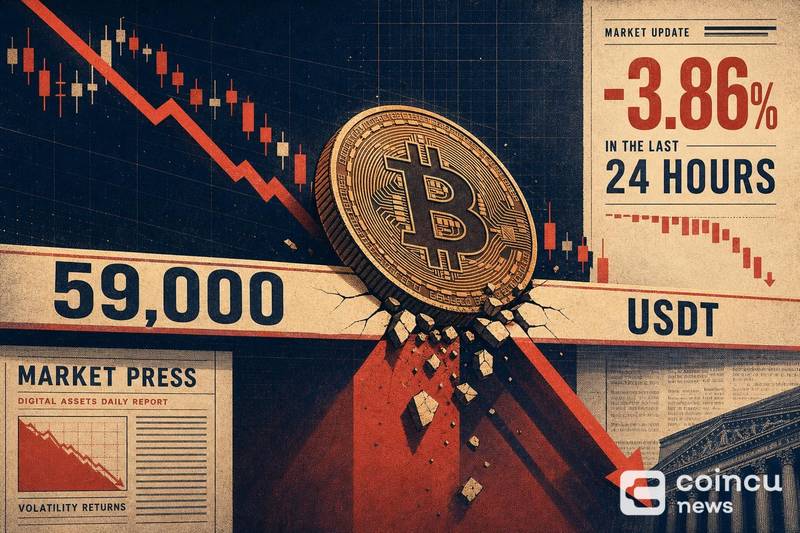
Bitcoin Falls Below 59,000 USDT as BTC Drops 3.86% in 24 Hours
Bitcoin fell below 59,000 USDT, recording a 3.86% decline over 24 hours as selling pressure intensified across the cryptocurrency market.
The drop pushed BTC through a closely watched round-number threshold, triggering a wave of liquidations that compounded the sell-off. According to CoinDesk reporting, crypto bulls faced $230 million in liquidations as Bitcoin plunged under the $59,000 level. For related coverage, see Bitcoin Falls Below 63,000 USDT, Down 3.72% in 24 Hours.
Liquidation Pressure Accelerated the Move Lower
The 3.86% intraday decline was sharp enough to cascade through leveraged long positions. The $230 million in liquidations reported across crypto markets suggests that traders had built up significant bullish exposure near the $60,000 range, leaving them vulnerable to a swift breakdown. For related coverage, see Bitcoin Falls Below 60,000 USDT After 4.06% 24H Drop.
Spot selling and forced liquidations fed on each other. As leveraged longs were closed, additional sell orders hit the market, pushing the price further below the 59,000 USDT mark. This pattern is consistent with similar episodes when Bitcoin fell below 60,000 USDT in prior sessions. For related coverage, see Ether Falls Below 1,700 USDT, Down 3.84% in 24 Hours.
Mt. Gox Repayment Timeline Added to Market Anxiety
One factor weighing on sentiment was the Mt. Gox rehabilitation trustee’s announcement regarding creditor repayments. The trustee published a formal notice outlining the timeline for distributing Bitcoin and Bitcoin Cash to creditors of the defunct exchange.
Markets have long treated the prospect of Mt. Gox distributions as a potential source of sell pressure. The concern is straightforward: creditors who have waited years to recover their holdings may choose to liquidate upon receipt, adding supply to an already fragile market.
Whether creditor selling materially contributed to this particular move remains unconfirmed. The announcement, however, coincided with a period of broader risk-off positioning in crypto, and traders cited it as one of several headwinds.
Why the 59,000 USDT Level Draws Attention
Round-number price levels serve as psychological anchors for both retail and institutional traders. A break below 59,000 USDT carries more weight than a move from, say, 59,400 to 58,800, even though the dollar amount is the same.
This is partly because automated trading strategies cluster stop-loss and take-profit orders around round numbers. When those levels break, the concentration of triggered orders can amplify the move. The dynamic was visible in Bitcoin’s earlier decline below 63,000 USDT, which followed a similar pattern of rapid selling once the threshold gave way.
For short-term traders, the 59,000 level now becomes a reference point for any recovery attempt. A failure to reclaim it on a retest would signal continued weakness, while a decisive move back above could indicate that the liquidation-driven selling has been absorbed.
Broader Market Context
Bitcoin’s decline did not occur in isolation. Other major assets also saw sharp drawdowns during the same period, with Ether falling below 1,700 USDT with a nearly identical 3.84% loss. The synchronized nature of the selling points to macro or cross-asset deleveraging rather than a Bitcoin-specific catalyst.
Exchange-level flow data also reflected the stress. Binance recorded a $594 million net USDT outflow over 24 hours in a separate recent episode, illustrating the scale of capital movement that accompanies these sell-offs.
What to Watch After the Breakdown
Traders monitoring the aftermath of the sub-59,000 move should focus on three indicators. First, whether spot volume confirms the breakdown or fades, which would suggest the move was primarily liquidation-driven rather than conviction selling.
Second, liquidation data over the next several four-hour candles will reveal whether the deleveraging is complete or if additional forced selling remains. Open interest across major exchanges is the key metric here.
Third, exchange reserve flows will show whether holders are moving Bitcoin onto exchanges to sell or withdrawing to cold storage. Net inflows to exchange wallets would suggest further selling pressure ahead, while outflows would indicate accumulation at lower prices.
The tactical outlook hinges on whether Bitcoin can stabilize and reclaim the $60,000 region in the sessions ahead, or whether the breakdown below 59,000 marks the start of a deeper correction.
FAQ: Bitcoin’s Drop Below 59,000 USDT
Does a 3.86% drop in 24 hours signal a larger crash?
Not necessarily. A single-day decline of this magnitude is within the normal range of Bitcoin volatility. It becomes more significant if follow-through selling continues over subsequent days, or if it triggers a break below further support levels. The $230 million in liquidations suggests leveraged positioning was a major amplifier.
What caused Bitcoin to fall below 59,000 USDT?
No single confirmed catalyst explains the move. Contributing factors likely include liquidation cascades from overleveraged long positions, broader crypto market weakness, and sentiment pressure from the Mt. Gox creditor repayment timeline. The synchronized decline across multiple assets points to market-wide deleveraging.
What should traders watch next?
Key indicators include spot trading volume to gauge conviction behind the move, liquidation data to assess whether forced selling is complete, and exchange reserve flows to track whether holders are depositing or withdrawing Bitcoin. Whether BTC reclaims or decisively loses the 59,000 level on a retest will set the short-term direction.
Disclaimer: This article is for informational purposes only and does not constitute financial or investment advice. Cryptocurrency and digital asset markets carry significant risk. Always do your own research before making decisions.
No tags available.


Other Posts








- China, US Conclude Trade Talks with Focus on Cooperation
- Crypto Weekly: NYSE Backs OKX, Kraken Gets Fed Access, BTC Sells
- Court Upholds Fed’s Rejection of Custodia Bank’s Request
- Former CFO Convicted for $35M Fraudulent Crypto Investment
- DeriW Launches Edge Hour Trading Competition Platform for Derivatives Traders
- Michael Saylor Denies Bitcoin Sell-Off Amid Large BTC Transfer
- Buy Dogecoin on eToro: Step-by-Step Guide for Beginners (2024)
- Kazakhstan Explores Crypto Reserves Backed by National Funds
- JPMorgan Increases Holdings in BlackRock’s Bitcoin ETF
- Nordea Bank Introduces Bitcoin ETP Trading for Nordic Customers
- XRP Spot ETF Launches on Nasdaq Amid Market Fluctuations
- Peter Schiff Challenges Michael Saylor on MSTR’s Business Model
- Thailand Orders Worldcoin to Delete 1.2 Million Biometric Records
- UK Proposes New DeFi Tax Framework to Ease User Burden
- WLFI Under Fire: Analyst Warns Hyperliquid Could Be Next
- Ancient Ethereum Whale Moves $1.19 Billion After Decade
- BlackRock Receives Large Crypto Transfers from Coinbase
- SEC Scrutiny on ALT5 Sigma’s Leadership Disclosure Timing
- Yala Injects $5.5 Million Amid Recovery Efforts
- Radiant Capital Faces $50M Loss in Major Security Breach
- China, US Conclude Trade Talks with Focus on Cooperation
- Crypto Weekly: NYSE Backs OKX, Kraken Gets Fed Access, BTC Sells
- Court Upholds Fed’s Rejection of Custodia Bank’s Request
- Former CFO Convicted for $35M Fraudulent Crypto Investment
- DeriW Launches Edge Hour Trading Competition Platform for Derivatives Traders
- Michael Saylor Denies Bitcoin Sell-Off Amid Large BTC Transfer
- Buy Dogecoin on eToro: Step-by-Step Guide for Beginners (2024)
- Kazakhstan Explores Crypto Reserves Backed by National Funds
- JPMorgan Increases Holdings in BlackRock’s Bitcoin ETF
- Nordea Bank Introduces Bitcoin ETP Trading for Nordic Customers
- XRP Spot ETF Launches on Nasdaq Amid Market Fluctuations
- Peter Schiff Challenges Michael Saylor on MSTR’s Business Model
- Thailand Orders Worldcoin to Delete 1.2 Million Biometric Records
- UK Proposes New DeFi Tax Framework to Ease User Burden
- WLFI Under Fire: Analyst Warns Hyperliquid Could Be Next
- Ancient Ethereum Whale Moves $1.19 Billion After Decade
- BlackRock Receives Large Crypto Transfers from Coinbase
- SEC Scrutiny on ALT5 Sigma’s Leadership Disclosure Timing
- Yala Injects $5.5 Million Amid Recovery Efforts
- Radiant Capital Faces $50M Loss in Major Security Breach
- China, US Conclude Trade Talks with Focus on Cooperation
- Crypto Weekly: NYSE Backs OKX, Kraken Gets Fed Access, BTC Sells
- Court Upholds Fed’s Rejection of Custodia Bank’s Request
- Former CFO Convicted for $35M Fraudulent Crypto Investment
- DeriW Launches Edge Hour Trading Competition Platform for Derivatives Traders
- Michael Saylor Denies Bitcoin Sell-Off Amid Large BTC Transfer
- Buy Dogecoin on eToro: Step-by-Step Guide for Beginners (2024)
- Kazakhstan Explores Crypto Reserves Backed by National Funds
- JPMorgan Increases Holdings in BlackRock’s Bitcoin ETF
- Nordea Bank Introduces Bitcoin ETP Trading for Nordic Customers
- XRP Spot ETF Launches on Nasdaq Amid Market Fluctuations
- Peter Schiff Challenges Michael Saylor on MSTR’s Business Model
- Thailand Orders Worldcoin to Delete 1.2 Million Biometric Records
- UK Proposes New DeFi Tax Framework to Ease User Burden
- WLFI Under Fire: Analyst Warns Hyperliquid Could Be Next
- Ancient Ethereum Whale Moves $1.19 Billion After Decade
- BlackRock Receives Large Crypto Transfers from Coinbase
- SEC Scrutiny on ALT5 Sigma’s Leadership Disclosure Timing
- Yala Injects $5.5 Million Amid Recovery Efforts
- Radiant Capital Faces $50M Loss in Major Security Breach




Pump.fun Let Staff Go Just Before Their Tokens Were Due to Pay Out