Bitcoin spot ETFs recorded roughly $227 million in net inflows in their latest session, extending a run of daily gains to a fifth consecutive day and pointing to steady, regulated demand for Bitcoin exposure.
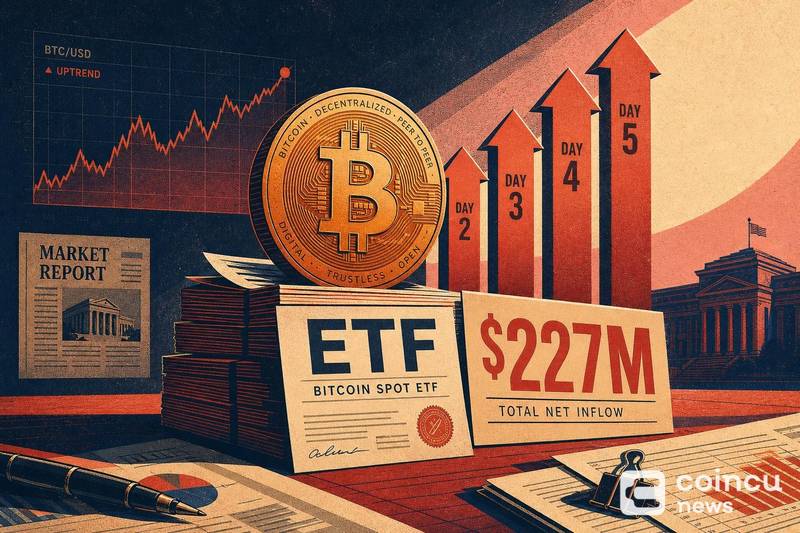
The figure refers to the combined net flow across U.S.-listed Bitcoin spot ETFs, meaning new money entering the funds exceeded the money leaving them on the day. A positive net inflow indicates that creations outweighed redemptions across the product group. For related coverage, see U.S. Bitcoin ETFs Add 1,321 BTC as Ethereum ETFs See 2,353 ETH Outflow.
The continuation of the streak to five straight sessions was reported by Cointelegraph, which framed the run as a notable stretch of sustained demand rather than a single-day move. Because the underlying research for this update is limited, the exact daily total should be treated as a reported figure pending fuller confirmation. For related coverage, see U.S. Spot SOL ETFs See $707,100 in Daily Net Outflows.
Why a Five-Day Streak Carries More Weight Than One Session
A single day of inflows can reflect one large allocation or short-term positioning. A multi-session streak is harder to explain away, because it implies allocation behavior that persists across several trading days. For related coverage, see Ethereum Spot ETFs Add $36.7M as BlackRock ETHA Leads.
Consecutive inflow days are commonly read as a signal of investor confidence, since they show demand holding up rather than reversing. Aggregated daily flow data for the product group is tracked on Farside’s Bitcoin ETF flow dashboard, which breaks the numbers down issuer by issuer.
Momentum in fund flows does not, by itself, dictate price. It is one input among many, and a streak in creations does not guarantee that Bitcoin’s spot price moves in lockstep.
How ETF Flows Fit Into the Bitcoin Market Picture
Spot Bitcoin ETFs let investors gain exposure to Bitcoin through a regulated, exchange-listed wrapper, without holding the asset directly. That structure is why inflow trends are widely used as a proxy for institutional and broader investor appetite.
Traders and analysts watch these flows because they offer a near-daily read on demand through a transparent channel. Issuer-level and market-wide ETF flow tracking is also maintained on CoinGlass for cross-checking the day-to-day picture.
Flows remain one indicator, not the whole story. They should be weighed alongside spot price action, volume, and on-chain activity rather than read in isolation.
The current streak follows a pattern of choppy sessions in recent ETF coverage, including days when Bitcoin funds added inflows while Ethereum products bled outflows, and sessions where BlackRock’s IBIT led the group’s net creations. Measuring flows in dollar terms is only one lens; some trackers also report the moves in Bitcoin terms rather than USD.
What Comes Next for the Streak
The immediate question is whether inflows persist into upcoming sessions or whether the run breaks. A sixth straight day would strengthen the demand read; a swing back to net outflows would cut it short.
The second thing to watch is whether ETF demand lines up with broader Bitcoin market strength, or diverges from it. For now, the trend is worth monitoring for durability rather than treating as a settled directional signal.
FAQ About Bitcoin Spot ETF Inflows
What is a Bitcoin spot ETF? It is an exchange-listed fund that holds Bitcoin and gives investors price exposure without directly buying or custodying the asset.
What does net inflow mean? Net inflow is the amount of new money entering the funds minus what leaves through redemptions over a given period. A positive number means creations outpaced redemptions.
Why is a five-day inflow streak important? Consecutive inflow days suggest demand is persisting rather than reflecting a one-off allocation, which many market watchers read as a confidence signal.
Do ETF inflows guarantee Bitcoin price gains? No. Inflows are one demand indicator and do not, on their own, determine spot price direction.
Disclaimer: This article is for informational purposes only and does not constitute financial or investment advice. Cryptocurrency and digital asset markets carry significant risk. Always do your own research before making decisions.
No tags available.


Other Posts








- China, US Conclude Trade Talks with Focus on Cooperation
- Crypto Weekly: NYSE Backs OKX, Kraken Gets Fed Access, BTC Sells
- Court Upholds Fed’s Rejection of Custodia Bank’s Request
- Former CFO Convicted for $35M Fraudulent Crypto Investment
- DeriW Launches Edge Hour Trading Competition Platform for Derivatives Traders
- Michael Saylor Denies Bitcoin Sell-Off Amid Large BTC Transfer
- Buy Dogecoin on eToro: Step-by-Step Guide for Beginners (2024)
- Kazakhstan Explores Crypto Reserves Backed by National Funds
- JPMorgan Increases Holdings in BlackRock’s Bitcoin ETF
- Nordea Bank Introduces Bitcoin ETP Trading for Nordic Customers
- XRP Spot ETF Launches on Nasdaq Amid Market Fluctuations
- Peter Schiff Challenges Michael Saylor on MSTR’s Business Model
- Thailand Orders Worldcoin to Delete 1.2 Million Biometric Records
- UK Proposes New DeFi Tax Framework to Ease User Burden
- WLFI Under Fire: Analyst Warns Hyperliquid Could Be Next
- Ancient Ethereum Whale Moves $1.19 Billion After Decade
- BlackRock Receives Large Crypto Transfers from Coinbase
- SEC Scrutiny on ALT5 Sigma’s Leadership Disclosure Timing
- Yala Injects $5.5 Million Amid Recovery Efforts
- Radiant Capital Faces $50M Loss in Major Security Breach
- China, US Conclude Trade Talks with Focus on Cooperation
- Crypto Weekly: NYSE Backs OKX, Kraken Gets Fed Access, BTC Sells
- Court Upholds Fed’s Rejection of Custodia Bank’s Request
- Former CFO Convicted for $35M Fraudulent Crypto Investment
- DeriW Launches Edge Hour Trading Competition Platform for Derivatives Traders
- Michael Saylor Denies Bitcoin Sell-Off Amid Large BTC Transfer
- Buy Dogecoin on eToro: Step-by-Step Guide for Beginners (2024)
- Kazakhstan Explores Crypto Reserves Backed by National Funds
- JPMorgan Increases Holdings in BlackRock’s Bitcoin ETF
- Nordea Bank Introduces Bitcoin ETP Trading for Nordic Customers
- XRP Spot ETF Launches on Nasdaq Amid Market Fluctuations
- Peter Schiff Challenges Michael Saylor on MSTR’s Business Model
- Thailand Orders Worldcoin to Delete 1.2 Million Biometric Records
- UK Proposes New DeFi Tax Framework to Ease User Burden
- WLFI Under Fire: Analyst Warns Hyperliquid Could Be Next
- Ancient Ethereum Whale Moves $1.19 Billion After Decade
- BlackRock Receives Large Crypto Transfers from Coinbase
- SEC Scrutiny on ALT5 Sigma’s Leadership Disclosure Timing
- Yala Injects $5.5 Million Amid Recovery Efforts
- Radiant Capital Faces $50M Loss in Major Security Breach
- China, US Conclude Trade Talks with Focus on Cooperation
- Crypto Weekly: NYSE Backs OKX, Kraken Gets Fed Access, BTC Sells
- Court Upholds Fed’s Rejection of Custodia Bank’s Request
- Former CFO Convicted for $35M Fraudulent Crypto Investment
- DeriW Launches Edge Hour Trading Competition Platform for Derivatives Traders
- Michael Saylor Denies Bitcoin Sell-Off Amid Large BTC Transfer
- Buy Dogecoin on eToro: Step-by-Step Guide for Beginners (2024)
- Kazakhstan Explores Crypto Reserves Backed by National Funds
- JPMorgan Increases Holdings in BlackRock’s Bitcoin ETF
- Nordea Bank Introduces Bitcoin ETP Trading for Nordic Customers
- XRP Spot ETF Launches on Nasdaq Amid Market Fluctuations
- Peter Schiff Challenges Michael Saylor on MSTR’s Business Model
- Thailand Orders Worldcoin to Delete 1.2 Million Biometric Records
- UK Proposes New DeFi Tax Framework to Ease User Burden
- WLFI Under Fire: Analyst Warns Hyperliquid Could Be Next
- Ancient Ethereum Whale Moves $1.19 Billion After Decade
- BlackRock Receives Large Crypto Transfers from Coinbase
- SEC Scrutiny on ALT5 Sigma’s Leadership Disclosure Timing
- Yala Injects $5.5 Million Amid Recovery Efforts
- Radiant Capital Faces $50M Loss in Major Security Breach

HashKey Middle East Launches BTC and ETH Perpetual Derivatives After Dubai VARA Approval


Binance Launches U-Margined Perpetual Contracts for SHAZ, SOFI, PANW and PENG
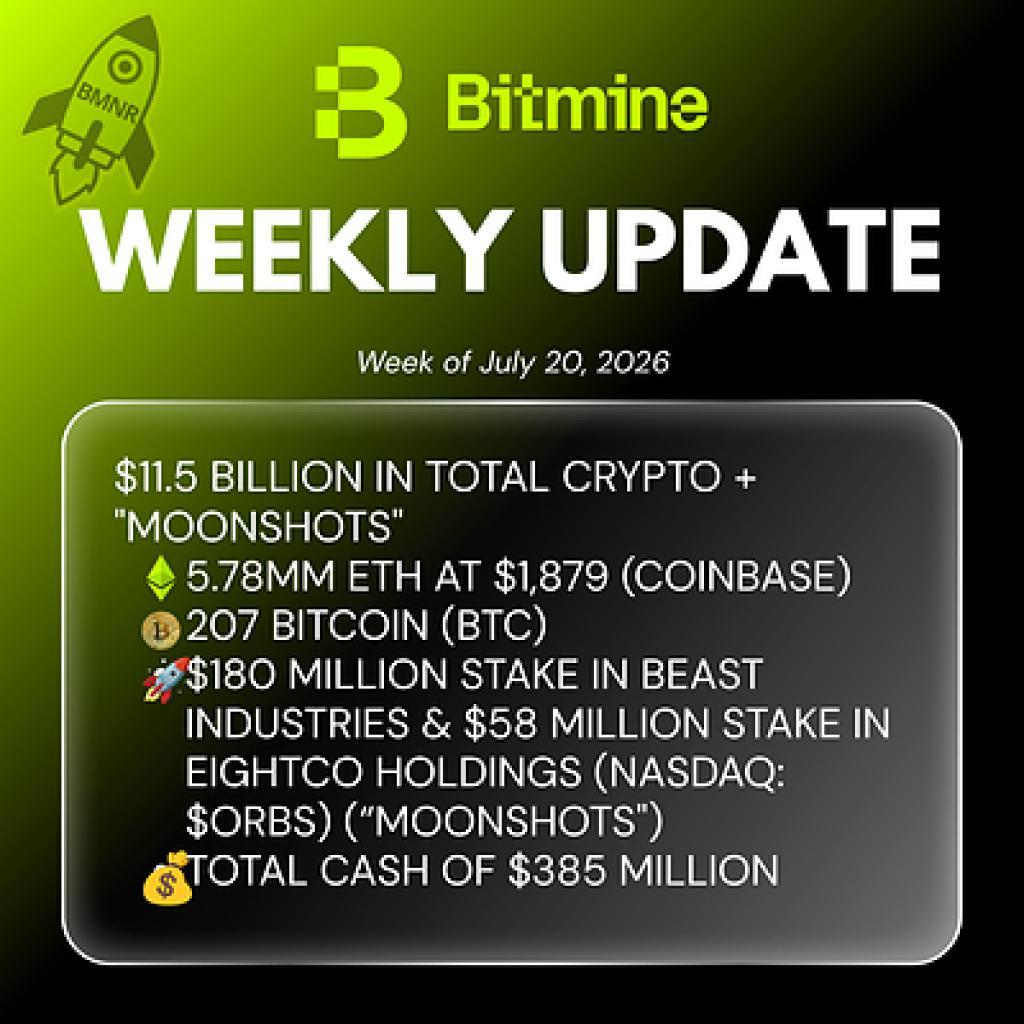
Bitmine Immersion Technologies (BMNR) Announces ETH Holdings Reach 5.78 Million Tokens, and Total Crypto and Total Cash Holdings of $11.5 Billion

GLOBAL MEDIA PROCUREMENT: THE 500-YEAR YIXING ZISHA TEAPOTS PARADIGM