Tokenized real-world-asset (RWA) deposits have climbed to $7.4 billion even as the broader decentralized finance market contracted 15%, according to research from CoinShares, pointing to a defensive rotation of capital toward yield-bearing and lower-volatility onchain products.
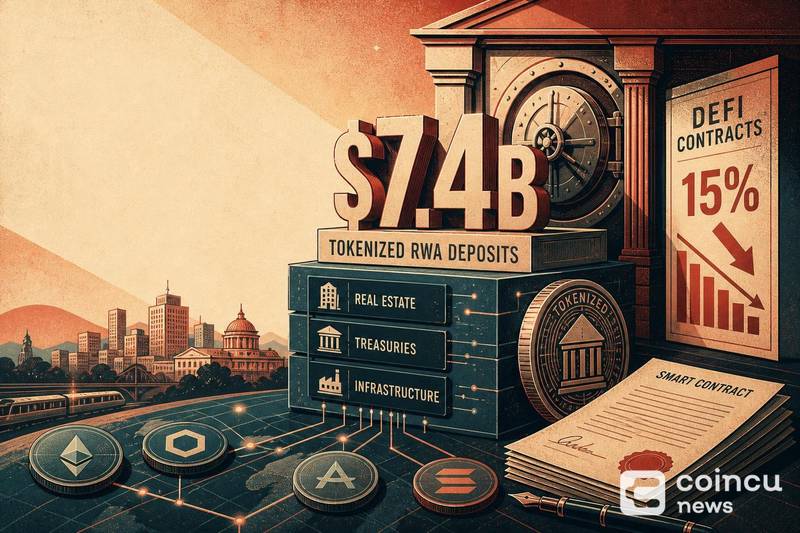
RWA Deposits Reach $7.4 Billion While DeFi Contracts 15%
Deposits into tokenized real-world assets rose to $7.4 billion, CoinShares reported, framing the milestone as evidence that tokenization is drawing capital even during a weaker stretch for onchain finance. For related coverage, see Bitcoin DeFi Ecosystem Map: BTCFi Projects to Watch in 2026.
The gain stands in contrast to the wider sector, where CoinShares measured a 15% contraction across broader DeFi over the same period. For related coverage, see Bybit, Mantle, and Aave Partner to Bring Institutional-Grade DeFi Liquidity Onchain at Global Scale.
The divergence is the core of the story: one segment is expanding while the market around it shrinks, a split that matters because it suggests capital is being reallocated rather than simply leaving crypto entirely. For related coverage, see Mantle Collaborates with Bybit and Backed to Bring U.S. Equities Onchain, Pioneering Next Trillion-Dollar Wave of Tokenized Assets.
Why Tokenized RWAs Are Holding Up Better
The reported figures imply that investors are favoring yield-bearing or lower-volatility onchain assets, a pattern consistent with defensive positioning during risk-off conditions. Tokenized RWAs, which represent offchain instruments such as debt or equities onchain, tend to carry steadier return profiles than speculative DeFi tokens.
That distinction helps explain the split. Growth in RWA deposits reflects demand for stability and predictable yield, whereas the 15% pullback in the broader market captures the more volatile, trading-driven corners of DeFi. This interpretation applies to the reported divergence and should not be read as a claim about the entire crypto market.
Traditional-finance participation is a recurring theme in this shift. Institutions have been moving established products onchain, from HSBC’s expansion of its tokenized deposit service to efforts like bringing U.S. equities onchain, both of which reinforce RWAs as a distinct sub-sector.
What the Divergence Signals for DeFi Liquidity
A 15% contraction points to pressure on broader DeFi activity or deposits, while RWA inflows suggest selective demand rather than sector-wide recovery. The two data points together describe capital concentrating in perceived safer onchain products.
Importantly, RWA growth does not mean all of DeFi is recovering. The figures describe fragmentation: liquidity is redistributing toward RWAs rather than lifting every category at once. Lending markets have been an entry point for this trend, with Aave surpassing $1 billion in RWAs as tokenization expands across the protocol layer.
How This Fits the Broader RWA Narrative
Tokenized RWAs are increasingly described as a bridge between traditional assets and onchain finance, and deposit growth strengthens the case for treating them as a meaningful DeFi sub-sector rather than a niche experiment. Institutional plumbing continues to build out around the theme, including efforts to bring institutional-grade DeFi liquidity onchain.
The CoinShares data ties that narrative back to concrete numbers: RWAs outperforming in a softer DeFi environment, at $7.4 billion in deposits against a 15% sector decline.
FAQ
What are tokenized RWAs? Tokenized real-world assets are offchain instruments, such as bonds, credit, or equities, represented as tokens on a blockchain so they can be held and settled within DeFi.
What does $7.4 billion in RWA deposits mean? It is the total CoinShares reported for capital deposited into tokenized RWA products, a figure the firm presents as a sign of growing adoption.
Why did broader DeFi contract 15%? CoinShares reported the 15% decline across the wider DeFi market without a single attributed cause; the article treats it as the benchmark against which RWA growth is measured.
Why are RWAs attracting attention during DeFi weakness? The reported divergence suggests investors are rotating toward lower-volatility, yield-bearing onchain assets when the broader market softens.
Additional source references: source document 1.
Disclaimer: This article is for informational purposes only and does not constitute financial or investment advice. Cryptocurrency and digital asset markets carry significant risk. Always do your own research before making decisions.
No tags available.


Other Posts








- China, US Conclude Trade Talks with Focus on Cooperation
- Crypto Weekly: NYSE Backs OKX, Kraken Gets Fed Access, BTC Sells
- Court Upholds Fed’s Rejection of Custodia Bank’s Request
- Former CFO Convicted for $35M Fraudulent Crypto Investment
- DeriW Launches Edge Hour Trading Competition Platform for Derivatives Traders
- Michael Saylor Denies Bitcoin Sell-Off Amid Large BTC Transfer
- Buy Dogecoin on eToro: Step-by-Step Guide for Beginners (2024)
- Kazakhstan Explores Crypto Reserves Backed by National Funds
- JPMorgan Increases Holdings in BlackRock’s Bitcoin ETF
- Nordea Bank Introduces Bitcoin ETP Trading for Nordic Customers
- XRP Spot ETF Launches on Nasdaq Amid Market Fluctuations
- Peter Schiff Challenges Michael Saylor on MSTR’s Business Model
- Thailand Orders Worldcoin to Delete 1.2 Million Biometric Records
- UK Proposes New DeFi Tax Framework to Ease User Burden
- WLFI Under Fire: Analyst Warns Hyperliquid Could Be Next
- Ancient Ethereum Whale Moves $1.19 Billion After Decade
- BlackRock Receives Large Crypto Transfers from Coinbase
- SEC Scrutiny on ALT5 Sigma’s Leadership Disclosure Timing
- Yala Injects $5.5 Million Amid Recovery Efforts
- Radiant Capital Faces $50M Loss in Major Security Breach
- China, US Conclude Trade Talks with Focus on Cooperation
- Crypto Weekly: NYSE Backs OKX, Kraken Gets Fed Access, BTC Sells
- Court Upholds Fed’s Rejection of Custodia Bank’s Request
- Former CFO Convicted for $35M Fraudulent Crypto Investment
- DeriW Launches Edge Hour Trading Competition Platform for Derivatives Traders
- Michael Saylor Denies Bitcoin Sell-Off Amid Large BTC Transfer
- Buy Dogecoin on eToro: Step-by-Step Guide for Beginners (2024)
- Kazakhstan Explores Crypto Reserves Backed by National Funds
- JPMorgan Increases Holdings in BlackRock’s Bitcoin ETF
- Nordea Bank Introduces Bitcoin ETP Trading for Nordic Customers
- XRP Spot ETF Launches on Nasdaq Amid Market Fluctuations
- Peter Schiff Challenges Michael Saylor on MSTR’s Business Model
- Thailand Orders Worldcoin to Delete 1.2 Million Biometric Records
- UK Proposes New DeFi Tax Framework to Ease User Burden
- WLFI Under Fire: Analyst Warns Hyperliquid Could Be Next
- Ancient Ethereum Whale Moves $1.19 Billion After Decade
- BlackRock Receives Large Crypto Transfers from Coinbase
- SEC Scrutiny on ALT5 Sigma’s Leadership Disclosure Timing
- Yala Injects $5.5 Million Amid Recovery Efforts
- Radiant Capital Faces $50M Loss in Major Security Breach
- China, US Conclude Trade Talks with Focus on Cooperation
- Crypto Weekly: NYSE Backs OKX, Kraken Gets Fed Access, BTC Sells
- Court Upholds Fed’s Rejection of Custodia Bank’s Request
- Former CFO Convicted for $35M Fraudulent Crypto Investment
- DeriW Launches Edge Hour Trading Competition Platform for Derivatives Traders
- Michael Saylor Denies Bitcoin Sell-Off Amid Large BTC Transfer
- Buy Dogecoin on eToro: Step-by-Step Guide for Beginners (2024)
- Kazakhstan Explores Crypto Reserves Backed by National Funds
- JPMorgan Increases Holdings in BlackRock’s Bitcoin ETF
- Nordea Bank Introduces Bitcoin ETP Trading for Nordic Customers
- XRP Spot ETF Launches on Nasdaq Amid Market Fluctuations
- Peter Schiff Challenges Michael Saylor on MSTR’s Business Model
- Thailand Orders Worldcoin to Delete 1.2 Million Biometric Records
- UK Proposes New DeFi Tax Framework to Ease User Burden
- WLFI Under Fire: Analyst Warns Hyperliquid Could Be Next
- Ancient Ethereum Whale Moves $1.19 Billion After Decade
- BlackRock Receives Large Crypto Transfers from Coinbase
- SEC Scrutiny on ALT5 Sigma’s Leadership Disclosure Timing
- Yala Injects $5.5 Million Amid Recovery Efforts
- Radiant Capital Faces $50M Loss in Major Security Breach



Bernstein Says Circle’s Q2 Eases Competition and Reserve Income Concerns

Zoomex Enhances Its Strategy Center With Advanced Strategy Trading Tools