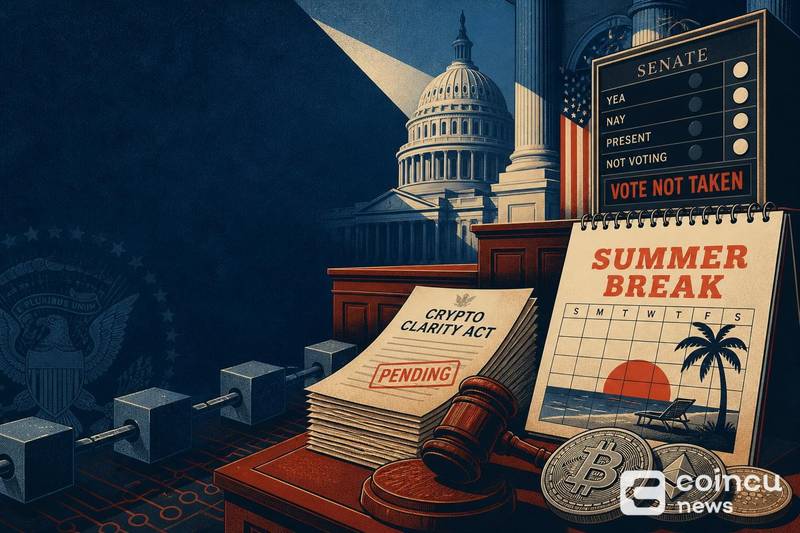
The U.S. Senate is not expected to vote on the crypto Clarity Act before lawmakers leave Washington for their summer break, pushing any decision on the market-structure bill into a later legislative window.
No Senate vote before the recess
The Senate will not take up the Clarity Act before its summer recess, as first reported by CoinDesk. That removes a near-term catalyst crypto policy watchers had been tracking. For related coverage, see U.S. Shutdown Nears Resolution Amid Senate Vote Approaches.
The Clarity Act is the market-structure measure that seeks to define how digital assets are regulated in the United States, including which tokens fall under which agency. The House version is tracked as H.R. 3633. For related coverage, see Texas Crypto Kiosk Scam Losses Hit $56.8M in 2025 Amid Crackdown.
Timing matters because the postponement does not end the bill; it defers it. Congress is expected to return to the question after the break, so the delay resets the calendar rather than closing the debate. For related coverage, see New Standard Chartered Crypto Division Launched in Luxembourg.
Why the vote slipped
The Senate’s floor time is governed by its published 2026 legislative calendar, and a missed pre-recess window often reflects scheduling pressure and procedural sequencing as much as any single policy dispute.
A delayed vote is not a failed bill. No floor action before recess means the measure carries over, distinct from a vote that fails or a bill that is formally withdrawn.
The known facts here are limited to timing. This article does not attribute motives to individual senators beyond what the schedule and reporting establish.
What the delay means for crypto firms
The Clarity Act is designed to set the ground rules that exchanges and token issuers would use to plan listings, compliance, and U.S. market strategy. Without a Senate vote, that regulatory certainty stays out of reach for now.
Prolonged uncertainty tends to keep firms in a holding pattern, waiting on clearer federal rules before committing to U.S.-specific decisions. The delay extends that waiting period rather than resolving it.
The postponement lands amid other active policy threads, including efforts by Senator Lummis to shape the CLARITY Act around crypto crime concerns and an earlier Senate draft adding ethics provisions for senior officials. Those workstreams underline that the bill remains under negotiation rather than settled.
What to watch when lawmakers return
Once the Senate reconvenes, the postponed vote reopens questions about scheduling, potential amendments, and whether the measure has the support to advance. The next available floor window becomes the key marker.
Readers tracking the bill should watch for a rescheduled vote date, new amendment text, and any signals on whip counts. Broader floor conflicts, such as prior episodes when a government shutdown fight consumed Senate vote time, can also crowd out crypto legislation.
FAQ
Is the Clarity Act dead if there is no summer vote? No. A missed pre-recess vote defers the bill; it does not kill it. The measure is expected to return when Congress reconvenes.
When could the Senate vote after the break? No date has been confirmed. Any timing depends on the Senate’s floor schedule and competing priorities once lawmakers return.
Why does this matter for U.S. crypto regulation? The Clarity Act aims to define how digital assets are regulated, so a delay extends the period in which firms lack clear federal market-structure rules.
Disclaimer: This article is for informational purposes only and does not constitute financial or investment advice. Cryptocurrency and digital asset markets carry significant risk. Always do your own research before making decisions.
No tags available.


Other Posts








- China, US Conclude Trade Talks with Focus on Cooperation
- Crypto Weekly: NYSE Backs OKX, Kraken Gets Fed Access, BTC Sells
- Court Upholds Fed’s Rejection of Custodia Bank’s Request
- Former CFO Convicted for $35M Fraudulent Crypto Investment
- DeriW Launches Edge Hour Trading Competition Platform for Derivatives Traders
- Michael Saylor Denies Bitcoin Sell-Off Amid Large BTC Transfer
- Buy Dogecoin on eToro: Step-by-Step Guide for Beginners (2024)
- Kazakhstan Explores Crypto Reserves Backed by National Funds
- JPMorgan Increases Holdings in BlackRock’s Bitcoin ETF
- Nordea Bank Introduces Bitcoin ETP Trading for Nordic Customers
- XRP Spot ETF Launches on Nasdaq Amid Market Fluctuations
- Peter Schiff Challenges Michael Saylor on MSTR’s Business Model
- Thailand Orders Worldcoin to Delete 1.2 Million Biometric Records
- UK Proposes New DeFi Tax Framework to Ease User Burden
- WLFI Under Fire: Analyst Warns Hyperliquid Could Be Next
- Ancient Ethereum Whale Moves $1.19 Billion After Decade
- BlackRock Receives Large Crypto Transfers from Coinbase
- SEC Scrutiny on ALT5 Sigma’s Leadership Disclosure Timing
- Yala Injects $5.5 Million Amid Recovery Efforts
- Radiant Capital Faces $50M Loss in Major Security Breach
- China, US Conclude Trade Talks with Focus on Cooperation
- Crypto Weekly: NYSE Backs OKX, Kraken Gets Fed Access, BTC Sells
- Court Upholds Fed’s Rejection of Custodia Bank’s Request
- Former CFO Convicted for $35M Fraudulent Crypto Investment
- DeriW Launches Edge Hour Trading Competition Platform for Derivatives Traders
- Michael Saylor Denies Bitcoin Sell-Off Amid Large BTC Transfer
- Buy Dogecoin on eToro: Step-by-Step Guide for Beginners (2024)
- Kazakhstan Explores Crypto Reserves Backed by National Funds
- JPMorgan Increases Holdings in BlackRock’s Bitcoin ETF
- Nordea Bank Introduces Bitcoin ETP Trading for Nordic Customers
- XRP Spot ETF Launches on Nasdaq Amid Market Fluctuations
- Peter Schiff Challenges Michael Saylor on MSTR’s Business Model
- Thailand Orders Worldcoin to Delete 1.2 Million Biometric Records
- UK Proposes New DeFi Tax Framework to Ease User Burden
- WLFI Under Fire: Analyst Warns Hyperliquid Could Be Next
- Ancient Ethereum Whale Moves $1.19 Billion After Decade
- BlackRock Receives Large Crypto Transfers from Coinbase
- SEC Scrutiny on ALT5 Sigma’s Leadership Disclosure Timing
- Yala Injects $5.5 Million Amid Recovery Efforts
- Radiant Capital Faces $50M Loss in Major Security Breach
- China, US Conclude Trade Talks with Focus on Cooperation
- Crypto Weekly: NYSE Backs OKX, Kraken Gets Fed Access, BTC Sells
- Court Upholds Fed’s Rejection of Custodia Bank’s Request
- Former CFO Convicted for $35M Fraudulent Crypto Investment
- DeriW Launches Edge Hour Trading Competition Platform for Derivatives Traders
- Michael Saylor Denies Bitcoin Sell-Off Amid Large BTC Transfer
- Buy Dogecoin on eToro: Step-by-Step Guide for Beginners (2024)
- Kazakhstan Explores Crypto Reserves Backed by National Funds
- JPMorgan Increases Holdings in BlackRock’s Bitcoin ETF
- Nordea Bank Introduces Bitcoin ETP Trading for Nordic Customers
- XRP Spot ETF Launches on Nasdaq Amid Market Fluctuations
- Peter Schiff Challenges Michael Saylor on MSTR’s Business Model
- Thailand Orders Worldcoin to Delete 1.2 Million Biometric Records
- UK Proposes New DeFi Tax Framework to Ease User Burden
- WLFI Under Fire: Analyst Warns Hyperliquid Could Be Next
- Ancient Ethereum Whale Moves $1.19 Billion After Decade
- BlackRock Receives Large Crypto Transfers from Coinbase
- SEC Scrutiny on ALT5 Sigma’s Leadership Disclosure Timing
- Yala Injects $5.5 Million Amid Recovery Efforts
- Radiant Capital Faces $50M Loss in Major Security Breach


Wintermute Registers as SEC Broker-Dealer for Stocks, Options and Crypto ETFs


Zoomex Enhances Its Strategy Center With Advanced Strategy Trading Tools