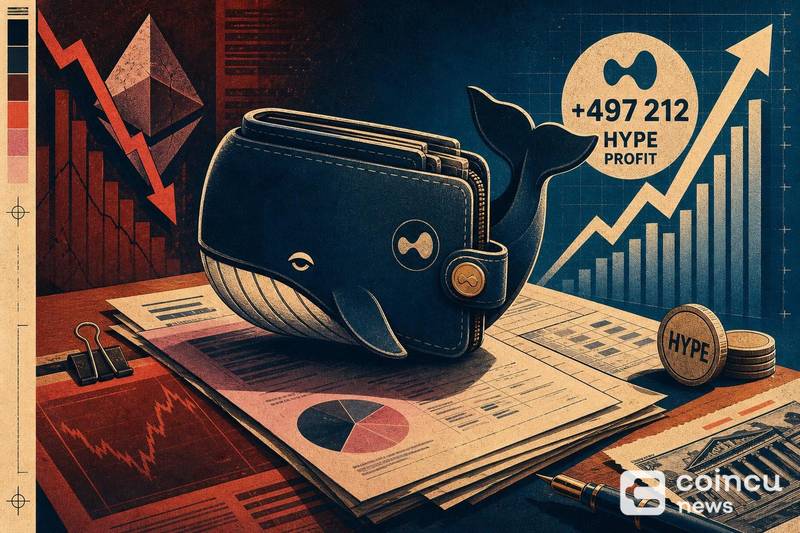
A whale wallet currently holds 497,212 HYPE in unrealized profit after previously exiting an Ethereum position at a loss. The sequence, flagged by on-chain tracking account OnchainLens, highlights a sharp capital rotation from ETH into Hyperliquid’s native token.
Whale Wallet’s HYPE Position Becomes the Central Story
On-chain analyst account OnchainLens flagged the wallet as sitting on a sizable unrealized HYPE gain. The figure, 497,212 HYPE, represents the difference between the wallet’s entry cost and the current market value of its holdings. For related coverage, see Polymarket Launches Audit After Profit Video Allegations.
The profit remains unrealized, meaning the whale has not yet sold the position. Until the tokens are moved to an exchange or swapped, the gain exists only on paper and remains subject to price fluctuations in either direction. For related coverage, see 5 Crypto Exchanges to Compare in 2026.
The wallet qualifies as a whale account based on the sheer size of its HYPE exposure. Positions of this magnitude are rare enough that they draw attention from on-chain monitoring services and traders who track large-holder behavior for directional signals.
The ETH Loss That Preceded the HYPE Rotation
Before accumulating the HYPE position, the same wallet exited an Ethereum holding at a realized loss. The wallet’s Ethereum transaction history is visible on its Etherscan address page, which shows activity prior to the rotation into HYPE.
The timeline matters: the whale locked in a losing ETH trade first, then redirected capital into HYPE, which has since moved in its favor. This sequence turns the story from a simple profit update into a rotation narrative.
The contrast between a realized loss on ETH and an unrealized gain on HYPE underscores how divergent returns can be across altcoin positions, even within the same portfolio over a short timeframe. The wallet operator chose to cut losses on Ethereum rather than hold, then redeployed into a different token entirely.
This kind of ETH-to-altcoin pivot is not unique to this wallet. Other large players have been making aggressive directional bets on Ethereum recently, including a whale who opened an 8,615 ETH 25x leveraged long position worth $14.86 million, showing that big capital continues to move around ETH with conviction in both directions.
What the Position Suggests About Whale Conviction in HYPE
A position large enough to generate nearly 500,000 HYPE in unrealized profit implies a substantial initial allocation. Taking that size of a bet on HYPE immediately after absorbing an ETH loss suggests the wallet operator had strong directional conviction in the Hyperliquid ecosystem.
Whale wallets are closely watched because their moves often precede or reflect positioning that smaller traders try to interpret. In this case, the willingness to rotate out of the largest altcoin by market cap and into a newer, higher-volatility token is a data point about where at least one large player sees opportunity.
The wallet’s HYPE activity can be further reviewed through Hypurrscan’s token tracker, which provides additional visibility into Hyperliquid token movements.
That said, a single wallet’s behavior does not confirm broader market direction. Whale tracking is a signal, not a strategy. The wallet could sell at any time, and the unrealized profit could shrink or disappear entirely if HYPE’s price reverses.
Why This Wallet Move Matters for Altcoin Traders
The story combines two elements that altcoin traders monitor closely: a failed trade in a major asset followed by a currently profitable bet on a smaller one. This pattern, cutting a loser and rotating into a winner, is a classic momentum rotation play.
For traders comparing opportunities across crypto assets, the distinction between unrealized and realized profit is critical. Unrealized gains can vanish in minutes during volatile sessions. The whale’s HYPE position is profitable now, but only a completed exit would confirm actual returns. Those evaluating crypto exchanges to use in 2026 should understand that monitoring whale flows across platforms is one input among many for assessing altcoin sentiment.
Following whale wallets can provide useful context about where large capital is flowing. However, copying trades without understanding the full portfolio, risk tolerance, and timeline of the original trader is a fundamentally different proposition. The wallet’s ETH loss is a reminder that even large, well-capitalized players get trades wrong.
Transparency tools across blockchains continue to evolve. With platforms like My Wallet expanding to 11 blockchains, traders now have more ways to monitor multi-chain activity, though interpreting wallet behavior still requires careful context.
FAQ About the Whale Wallet’s HYPE Profit
What does unrealized profit mean?
Unrealized profit is the difference between the current market value of a holding and its purchase cost. It becomes realized profit only when the holder sells. Until then, the gain or loss exists only on paper and changes with price movement.
Why does the earlier ETH loss matter?
The ETH loss establishes context. It shows the wallet operator made a directional bet on Ethereum that did not work out, then pivoted to HYPE. The rotation from a losing position into a currently winning one is more informative than either trade viewed in isolation.
Why are traders watching HYPE whale wallets?
Large wallet movements in newer tokens like HYPE can indicate early conviction from well-capitalized players. Traders use this as one signal among many when assessing sentiment and potential price direction, though it should never be treated as investment advice or a guaranteed indicator.
Disclaimer: This article is for informational purposes only and does not constitute financial or investment advice. Cryptocurrency and digital asset markets carry significant risk. Always do your own research before making decisions.
No tags available.


Other Posts





- China, US Conclude Trade Talks with Focus on Cooperation
- Crypto Weekly: NYSE Backs OKX, Kraken Gets Fed Access, BTC Sells
- Court Upholds Fed’s Rejection of Custodia Bank’s Request
- Former CFO Convicted for $35M Fraudulent Crypto Investment
- DeriW Launches Edge Hour Trading Competition Platform for Derivatives Traders
- Michael Saylor Denies Bitcoin Sell-Off Amid Large BTC Transfer
- Buy Dogecoin on eToro: Step-by-Step Guide for Beginners (2024)
- Kazakhstan Explores Crypto Reserves Backed by National Funds
- JPMorgan Increases Holdings in BlackRock’s Bitcoin ETF
- Nordea Bank Introduces Bitcoin ETP Trading for Nordic Customers
- XRP Spot ETF Launches on Nasdaq Amid Market Fluctuations
- Peter Schiff Challenges Michael Saylor on MSTR’s Business Model
- Thailand Orders Worldcoin to Delete 1.2 Million Biometric Records
- UK Proposes New DeFi Tax Framework to Ease User Burden
- WLFI Under Fire: Analyst Warns Hyperliquid Could Be Next
- Ancient Ethereum Whale Moves $1.19 Billion After Decade
- BlackRock Receives Large Crypto Transfers from Coinbase
- SEC Scrutiny on ALT5 Sigma’s Leadership Disclosure Timing
- Yala Injects $5.5 Million Amid Recovery Efforts
- Radiant Capital Faces $50M Loss in Major Security Breach
- China, US Conclude Trade Talks with Focus on Cooperation
- Crypto Weekly: NYSE Backs OKX, Kraken Gets Fed Access, BTC Sells
- Court Upholds Fed’s Rejection of Custodia Bank’s Request
- Former CFO Convicted for $35M Fraudulent Crypto Investment
- DeriW Launches Edge Hour Trading Competition Platform for Derivatives Traders
- Michael Saylor Denies Bitcoin Sell-Off Amid Large BTC Transfer
- Buy Dogecoin on eToro: Step-by-Step Guide for Beginners (2024)
- Kazakhstan Explores Crypto Reserves Backed by National Funds
- JPMorgan Increases Holdings in BlackRock’s Bitcoin ETF
- Nordea Bank Introduces Bitcoin ETP Trading for Nordic Customers
- XRP Spot ETF Launches on Nasdaq Amid Market Fluctuations
- Peter Schiff Challenges Michael Saylor on MSTR’s Business Model
- Thailand Orders Worldcoin to Delete 1.2 Million Biometric Records
- UK Proposes New DeFi Tax Framework to Ease User Burden
- WLFI Under Fire: Analyst Warns Hyperliquid Could Be Next
- Ancient Ethereum Whale Moves $1.19 Billion After Decade
- BlackRock Receives Large Crypto Transfers from Coinbase
- SEC Scrutiny on ALT5 Sigma’s Leadership Disclosure Timing
- Yala Injects $5.5 Million Amid Recovery Efforts
- Radiant Capital Faces $50M Loss in Major Security Breach
- China, US Conclude Trade Talks with Focus on Cooperation
- Crypto Weekly: NYSE Backs OKX, Kraken Gets Fed Access, BTC Sells
- Court Upholds Fed’s Rejection of Custodia Bank’s Request
- Former CFO Convicted for $35M Fraudulent Crypto Investment
- DeriW Launches Edge Hour Trading Competition Platform for Derivatives Traders
- Michael Saylor Denies Bitcoin Sell-Off Amid Large BTC Transfer
- Buy Dogecoin on eToro: Step-by-Step Guide for Beginners (2024)
- Kazakhstan Explores Crypto Reserves Backed by National Funds
- JPMorgan Increases Holdings in BlackRock’s Bitcoin ETF
- Nordea Bank Introduces Bitcoin ETP Trading for Nordic Customers
- XRP Spot ETF Launches on Nasdaq Amid Market Fluctuations
- Peter Schiff Challenges Michael Saylor on MSTR’s Business Model
- Thailand Orders Worldcoin to Delete 1.2 Million Biometric Records
- UK Proposes New DeFi Tax Framework to Ease User Burden
- WLFI Under Fire: Analyst Warns Hyperliquid Could Be Next
- Ancient Ethereum Whale Moves $1.19 Billion After Decade
- BlackRock Receives Large Crypto Transfers from Coinbase
- SEC Scrutiny on ALT5 Sigma’s Leadership Disclosure Timing
- Yala Injects $5.5 Million Amid Recovery Efforts
- Radiant Capital Faces $50M Loss in Major Security Breach

Bitcoin Slips Toward $64,000 Ahead of Wednesday Inflation Test

Bitcoin Holds Steady as ETF Inflows Offset Selling Ahead of U.S. Inflation Data

ForumPay Expands Payment Infrastructure with New Card and Bank Transfer Acceptance Solution

Newest Assets, Improved User Promotions & Much Greater Crypto Experience_ Xxkk Trade Exchange Reinforces Its Trade Environment