BlackRock Deposits 1,564 BTC to Coinbase: What the Transfer Could Signal
BlackRock has deposited 1,564 BTC to Coinbase, a transfer large enough to draw immediate attention from traders and on-chain analysts tracking institutional Bitcoin flows.
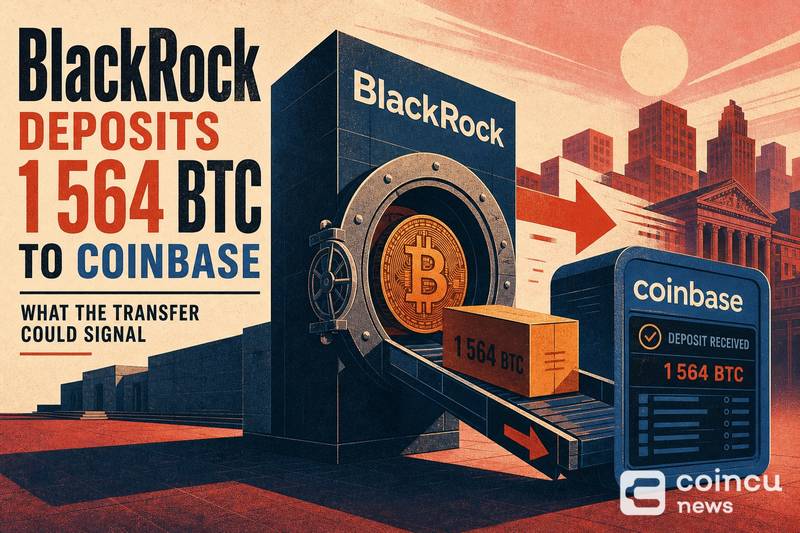
The transfer was flagged through wallet-tracking services that monitor addresses linked to major institutional holders. BlackRock-linked wallets have been observed moving significant BTC amounts in recent weeks, with Coinbase serving as the primary exchange destination for these flows.
BlackRock operates the iShares Bitcoin Trust ETF (IBIT), one of the largest spot Bitcoin ETFs in the United States. Coinbase acts as the custodian for IBIT, which means transfers between BlackRock-associated wallets and Coinbase do not necessarily indicate selling activity.
Why a Transfer to Coinbase Does Not Automatically Mean a Sale
Large BTC deposits to exchanges are commonly interpreted as potential sell-side pressure. When a major holder moves coins onto an exchange, traders often assume the intent is liquidation.
In the case of BlackRock and Coinbase, the relationship is more nuanced. Coinbase Prime serves as the custodian for IBIT, meaning routine custody operations, portfolio rebalancing, and ETF redemption processing all involve transfers between these two entities.
The 1,564 BTC movement could reflect any of several operational functions: processing shareholder redemptions, rebalancing custody wallets across cold and hot storage, or adjusting holdings in response to fund flows. Without confirmed on-chain transaction details showing a subsequent sale on Coinbase’s order books, the transfer alone does not prove directional intent.
How Exchange Deposits Shape Short-Term Bitcoin Sentiment
Regardless of the underlying reason, large exchange deposits from institutional wallets tend to influence trader psychology. Market participants monitoring on-chain flows often adjust positioning when they see significant BTC moving to exchange addresses.
BlackRock’s visibility amplifies this effect. As the world’s largest asset manager, any wallet activity linked to the firm carries outsized weight in sentiment discussions, similar to how movements by other major holders on platforms like Binance and other major exchanges attract scrutiny.
The perception of sell-side pressure from a transfer like this can sometimes exceed the actual market impact. A 1,564 BTC deposit represents a meaningful sum, but relative to daily Bitcoin trading volume, it is unlikely to move the market on its own.
Reading On-Chain Signals in Context
Analysts evaluating institutional wallet movements typically look beyond a single transfer. The destination address, timing relative to ETF flow data, and whether the BTC subsequently moves to a trading wallet or remains in custody all factor into interpretation.
A single deposit to Coinbase from a BlackRock-linked wallet, without additional context such as corresponding ETF outflow filings or visible order book activity, provides limited directional information. On-chain observers tracking Bitcoin and other major crypto assets have noted that institutional transfers are frequently misread when taken in isolation.
Confirmation bias poses a particular risk with headline-driven on-chain analysis. Traders who are already bearish may interpret the deposit as selling, while those who are bullish may dismiss it as routine custody management. Both readings are plausible given the available data.
The transfer also highlights the growing role of regulated custody infrastructure in institutional crypto operations. As more traditional finance firms hold Bitcoin through ETF structures, wallet movements between custodians and fund operators will become increasingly routine, potentially reducing their value as trading signals over time, much as crypto exchange activity broadly continues to evolve.
FAQ
Did BlackRock sell the 1,564 BTC?
There is no confirmed evidence that the transfer represents a sale. Coinbase serves as the custodian for BlackRock’s iShares Bitcoin Trust ETF, so transfers between these entities can reflect routine custody operations rather than liquidation.
Why was Coinbase used for the transfer?
Coinbase Prime is the designated custodian for BlackRock’s spot Bitcoin ETF. Transfers to Coinbase from BlackRock-linked wallets are expected as part of normal ETF operations, including rebalancing and redemption processing.
Is this transfer bearish for Bitcoin?
Not necessarily. While large exchange deposits are often watched for sell-side signals, the custodial relationship between BlackRock and Coinbase means this transfer has multiple plausible explanations. Without additional data showing an actual sale, the transfer alone is not a reliable bearish indicator.
Additional source references: source document 1.
Disclaimer: This article is for informational purposes only and does not constitute financial or investment advice. Cryptocurrency and digital asset markets carry significant risk. Always do your own research before making decisions.
No tags available.


Other Posts








- China, US Conclude Trade Talks with Focus on Cooperation
- Crypto Weekly: NYSE Backs OKX, Kraken Gets Fed Access, BTC Sells
- Court Upholds Fed’s Rejection of Custodia Bank’s Request
- Former CFO Convicted for $35M Fraudulent Crypto Investment
- DeriW Launches Edge Hour Trading Competition Platform for Derivatives Traders
- Michael Saylor Denies Bitcoin Sell-Off Amid Large BTC Transfer
- Buy Dogecoin on eToro: Step-by-Step Guide for Beginners (2024)
- Kazakhstan Explores Crypto Reserves Backed by National Funds
- JPMorgan Increases Holdings in BlackRock’s Bitcoin ETF
- Nordea Bank Introduces Bitcoin ETP Trading for Nordic Customers
- XRP Spot ETF Launches on Nasdaq Amid Market Fluctuations
- Peter Schiff Challenges Michael Saylor on MSTR’s Business Model
- Thailand Orders Worldcoin to Delete 1.2 Million Biometric Records
- UK Proposes New DeFi Tax Framework to Ease User Burden
- WLFI Under Fire: Analyst Warns Hyperliquid Could Be Next
- Ancient Ethereum Whale Moves $1.19 Billion After Decade
- BlackRock Receives Large Crypto Transfers from Coinbase
- SEC Scrutiny on ALT5 Sigma’s Leadership Disclosure Timing
- Yala Injects $5.5 Million Amid Recovery Efforts
- Radiant Capital Faces $50M Loss in Major Security Breach
- China, US Conclude Trade Talks with Focus on Cooperation
- Crypto Weekly: NYSE Backs OKX, Kraken Gets Fed Access, BTC Sells
- Court Upholds Fed’s Rejection of Custodia Bank’s Request
- Former CFO Convicted for $35M Fraudulent Crypto Investment
- DeriW Launches Edge Hour Trading Competition Platform for Derivatives Traders
- Michael Saylor Denies Bitcoin Sell-Off Amid Large BTC Transfer
- Buy Dogecoin on eToro: Step-by-Step Guide for Beginners (2024)
- Kazakhstan Explores Crypto Reserves Backed by National Funds
- JPMorgan Increases Holdings in BlackRock’s Bitcoin ETF
- Nordea Bank Introduces Bitcoin ETP Trading for Nordic Customers
- XRP Spot ETF Launches on Nasdaq Amid Market Fluctuations
- Peter Schiff Challenges Michael Saylor on MSTR’s Business Model
- Thailand Orders Worldcoin to Delete 1.2 Million Biometric Records
- UK Proposes New DeFi Tax Framework to Ease User Burden
- WLFI Under Fire: Analyst Warns Hyperliquid Could Be Next
- Ancient Ethereum Whale Moves $1.19 Billion After Decade
- BlackRock Receives Large Crypto Transfers from Coinbase
- SEC Scrutiny on ALT5 Sigma’s Leadership Disclosure Timing
- Yala Injects $5.5 Million Amid Recovery Efforts
- Radiant Capital Faces $50M Loss in Major Security Breach
- China, US Conclude Trade Talks with Focus on Cooperation
- Crypto Weekly: NYSE Backs OKX, Kraken Gets Fed Access, BTC Sells
- Court Upholds Fed’s Rejection of Custodia Bank’s Request
- Former CFO Convicted for $35M Fraudulent Crypto Investment
- DeriW Launches Edge Hour Trading Competition Platform for Derivatives Traders
- Michael Saylor Denies Bitcoin Sell-Off Amid Large BTC Transfer
- Buy Dogecoin on eToro: Step-by-Step Guide for Beginners (2024)
- Kazakhstan Explores Crypto Reserves Backed by National Funds
- JPMorgan Increases Holdings in BlackRock’s Bitcoin ETF
- Nordea Bank Introduces Bitcoin ETP Trading for Nordic Customers
- XRP Spot ETF Launches on Nasdaq Amid Market Fluctuations
- Peter Schiff Challenges Michael Saylor on MSTR’s Business Model
- Thailand Orders Worldcoin to Delete 1.2 Million Biometric Records
- UK Proposes New DeFi Tax Framework to Ease User Burden
- WLFI Under Fire: Analyst Warns Hyperliquid Could Be Next
- Ancient Ethereum Whale Moves $1.19 Billion After Decade
- BlackRock Receives Large Crypto Transfers from Coinbase
- SEC Scrutiny on ALT5 Sigma’s Leadership Disclosure Timing
- Yala Injects $5.5 Million Amid Recovery Efforts
- Radiant Capital Faces $50M Loss in Major Security Breach

Senator Lummis Pushes CLARITY Act to Target Crypto Crime Tied to Lazarus


Japan May Ease Crypto’s 2x Leverage Limit to Restore Liquidity
RISEx Launches ‘Ignite’ Season 1 Points Program, Following $3B in Volume During the Early Access Phase

Zoomex X Space Recap With Fernando Llorente and the World Cup Final Panel