Trust Wallet Announces Support for bStocks Tokenized U.S. Stocks
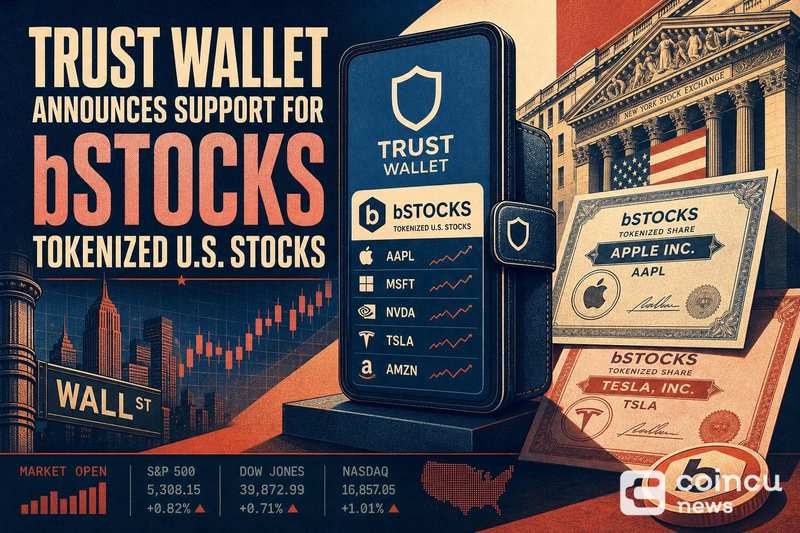
Trust Wallet has announced support for bStocks, a tokenized U.S. stocks product built on BNB Smart Chain, allowing eligible users to access blockchain-based equity exposure directly inside the wallet app. The integration covers five tokenized equities at launch, though the feature is explicitly unavailable in the United States, United Kingdom, and European Union.
What Trust Wallet Actually Announced
Trust Wallet’s announcement detailed that eligible users can now buy and trade bStocks tokenized shares through the app’s Markets section. The wallet listed five tokenized equities available at launch: Apple, Tesla, Nvidia, MicroStrategy, and Circle.
The bStocks product runs on BNB Smart Chain with 24/7 trading availability and zero fees, according to the announcement. Assets remain in users’ self-custodied wallets, a distinction from centralized brokerage models where the platform holds shares on behalf of users.
Each bStock token is backed 1:1 by reserve assets held by Binance under its proof-of-collateral framework, according to BNB Chain’s official blog post. The tokens are also designed for use across DeFi protocols, meaning holders could potentially deploy tokenized stock positions as collateral or in liquidity pools.
However, Binance’s public proof-of-collateral page showed zero bStocks currently issued at the time of research. This means the Trust Wallet announcement represents support availability rather than evidence of live trading scale.
What Tokenized U.S. Stocks Actually Are
Tokenized stocks are blockchain-based tokens designed to track the price of traditional equities. Unlike buying shares through a brokerage, holding a tokenized stock means holding a crypto token that represents exposure to the underlying asset’s price, not direct ownership of the equity itself.
The distinction matters. Tokenized stock holders typically do not have voting rights, may not receive dividends in the same way, and depend on the issuer’s reserve backing and regulatory standing. Terms vary by issuer and platform, so users should review the specific product documentation before treating these tokens as equivalent to traditional stock ownership.
Binance’s bStocks offering is structured under an ADGM-approved prospectus in Abu Dhabi Global Market. U.S. persons are explicitly excluded from eligibility, and Trust Wallet’s announcement confirmed that users in the United States, United Kingdom, and European Union cannot access the feature.
How the Integration Could Affect Wallet Users
For Trust Wallet’s user base outside restricted jurisdictions, the integration adds a new asset class to a familiar interface. Rather than navigating to a separate exchange or DeFi protocol to access tokenized equities, eligible users can find bStocks within the wallet’s existing Markets tab.
This convenience layer is the core value proposition. Self-custody wallets have traditionally focused on native crypto assets and DeFi tokens. Adding tokenized real-world assets like U.S. equities signals a broader shift in what wallet interfaces are expected to support.
Users should verify their eligibility based on jurisdiction before attempting to access bStocks. Regional availability, platform rules, and issuer terms all constrain who can actually use the feature. The zero-fee trading claim applies to the BNB Smart Chain layer, but network gas costs still apply to transactions.
Trust Wallet Token, the closest liquid market proxy for Trust Wallet sentiment, traded around $0.3925 with a market cap near $163 million at the time of the announcement.
Tokenized Equities in a Growing RWA Market
Trust Wallet’s move arrives as the tokenized stocks segment continues to expand. Data from RWA.xyz showed a total tokenized-stocks market value of $1.08 billion with monthly transfer volume reaching $2.30 billion at the time of research.
The broader push to bring real-world assets onchain has intensified across crypto platforms. Tokenized equities sit alongside tokenized treasuries, real estate, and private credit as categories where blockchain infrastructure is being applied to traditional financial instruments. The trend has drawn attention from both crypto-native firms and traditional financial institutions exploring blockchain settlement.
Wallet-level integration matters for adoption because it removes friction. Users who already manage crypto portfolios in Trust Wallet can now encounter tokenized equities without switching platforms, similar to how Metaplanet’s acquisition of a licensed securities firm signaled traditional finance entities moving closer to crypto infrastructure.
Competition among platforms to bridge traditional finance and blockchain is accelerating. Binance’s bStocks competes with other tokenized stock models, and the distribution through Trust Wallet, one of the most widely used self-custody wallets, gives the product a potentially large addressable user base outside restricted regions.
The regulatory landscape around tokenized securities remains fragmented. Different jurisdictions apply different frameworks to these products, which is why bStocks carries explicit geographic restrictions. Efforts to create clearer regulatory pathways for digital assets, including proposals like EIP-8182 for Ethereum-native privacy transfers, reflect the broader challenge of building compliant onchain financial products.
Enforcement activity around crypto financial products also continues to intensify globally, as demonstrated by recent international joint operations targeting crypto-linked financial crime. Products like bStocks that operate under specific regulatory approvals, such as the ADGM prospectus framework, are designed to navigate this environment.
Key Questions About Trust Wallet’s bStocks Support
Does holding a bStock token mean owning actual U.S. stock shares?
No. bStocks are tokenized representations backed 1:1 by reserve assets held by Binance, not direct equity ownership. Holders do not necessarily receive the same rights as traditional shareholders, including voting rights or direct dividend payments. The specific terms are governed by the issuer’s prospectus.
How do users access bStocks inside Trust Wallet?
Eligible users can navigate to the Markets section within the Trust Wallet app and select bStocks. The feature requires an eligible jurisdiction and compliance with applicable platform terms.
Which regions are excluded from accessing bStocks?
Trust Wallet explicitly stated that bStocks are unavailable in the United States, United Kingdom, and European Union. Binance’s landing page further specifies that U.S. persons are not eligible and that the public offer is made only within Abu Dhabi Global Market under an ADGM-approved prospectus.
What are the main risks users should consider?
Key risks include counterparty risk tied to Binance’s reserve backing, regulatory risk as jurisdictions continue to develop frameworks for tokenized securities, and smart contract risk inherent in any BNB Smart Chain-based product. The fact that zero bStocks were issued at the time of research also raises questions about early-stage liquidity and market depth.
The broader crypto market mood at the time of the announcement was subdued, with the Fear & Greed Index sitting at 12, indicating extreme fear. Whether tokenized equity products gain traction in this environment will depend on user demand for onchain stock exposure and the pace at which actual issuance begins.
Disclaimer: This article is for informational purposes only and does not constitute financial or investment advice. Cryptocurrency and digital asset markets carry significant risk. Always do your own research before making decisions.
No tags available.


Other Posts







- China, US Conclude Trade Talks with Focus on Cooperation
- Crypto Weekly: NYSE Backs OKX, Kraken Gets Fed Access, BTC Sells
- Court Upholds Fed’s Rejection of Custodia Bank’s Request
- Former CFO Convicted for $35M Fraudulent Crypto Investment
- DeriW Launches Edge Hour Trading Competition Platform for Derivatives Traders
- Michael Saylor Denies Bitcoin Sell-Off Amid Large BTC Transfer
- Buy Dogecoin on eToro: Step-by-Step Guide for Beginners (2024)
- Kazakhstan Explores Crypto Reserves Backed by National Funds
- JPMorgan Increases Holdings in BlackRock’s Bitcoin ETF
- Nordea Bank Introduces Bitcoin ETP Trading for Nordic Customers
- XRP Spot ETF Launches on Nasdaq Amid Market Fluctuations
- Peter Schiff Challenges Michael Saylor on MSTR’s Business Model
- Thailand Orders Worldcoin to Delete 1.2 Million Biometric Records
- UK Proposes New DeFi Tax Framework to Ease User Burden
- WLFI Under Fire: Analyst Warns Hyperliquid Could Be Next
- Ancient Ethereum Whale Moves $1.19 Billion After Decade
- BlackRock Receives Large Crypto Transfers from Coinbase
- SEC Scrutiny on ALT5 Sigma’s Leadership Disclosure Timing
- Yala Injects $5.5 Million Amid Recovery Efforts
- Radiant Capital Faces $50M Loss in Major Security Breach
- China, US Conclude Trade Talks with Focus on Cooperation
- Crypto Weekly: NYSE Backs OKX, Kraken Gets Fed Access, BTC Sells
- Court Upholds Fed’s Rejection of Custodia Bank’s Request
- Former CFO Convicted for $35M Fraudulent Crypto Investment
- DeriW Launches Edge Hour Trading Competition Platform for Derivatives Traders
- Michael Saylor Denies Bitcoin Sell-Off Amid Large BTC Transfer
- Buy Dogecoin on eToro: Step-by-Step Guide for Beginners (2024)
- Kazakhstan Explores Crypto Reserves Backed by National Funds
- JPMorgan Increases Holdings in BlackRock’s Bitcoin ETF
- Nordea Bank Introduces Bitcoin ETP Trading for Nordic Customers
- XRP Spot ETF Launches on Nasdaq Amid Market Fluctuations
- Peter Schiff Challenges Michael Saylor on MSTR’s Business Model
- Thailand Orders Worldcoin to Delete 1.2 Million Biometric Records
- UK Proposes New DeFi Tax Framework to Ease User Burden
- WLFI Under Fire: Analyst Warns Hyperliquid Could Be Next
- Ancient Ethereum Whale Moves $1.19 Billion After Decade
- BlackRock Receives Large Crypto Transfers from Coinbase
- SEC Scrutiny on ALT5 Sigma’s Leadership Disclosure Timing
- Yala Injects $5.5 Million Amid Recovery Efforts
- Radiant Capital Faces $50M Loss in Major Security Breach
- China, US Conclude Trade Talks with Focus on Cooperation
- Crypto Weekly: NYSE Backs OKX, Kraken Gets Fed Access, BTC Sells
- Court Upholds Fed’s Rejection of Custodia Bank’s Request
- Former CFO Convicted for $35M Fraudulent Crypto Investment
- DeriW Launches Edge Hour Trading Competition Platform for Derivatives Traders
- Michael Saylor Denies Bitcoin Sell-Off Amid Large BTC Transfer
- Buy Dogecoin on eToro: Step-by-Step Guide for Beginners (2024)
- Kazakhstan Explores Crypto Reserves Backed by National Funds
- JPMorgan Increases Holdings in BlackRock’s Bitcoin ETF
- Nordea Bank Introduces Bitcoin ETP Trading for Nordic Customers
- XRP Spot ETF Launches on Nasdaq Amid Market Fluctuations
- Peter Schiff Challenges Michael Saylor on MSTR’s Business Model
- Thailand Orders Worldcoin to Delete 1.2 Million Biometric Records
- UK Proposes New DeFi Tax Framework to Ease User Burden
- WLFI Under Fire: Analyst Warns Hyperliquid Could Be Next
- Ancient Ethereum Whale Moves $1.19 Billion After Decade
- BlackRock Receives Large Crypto Transfers from Coinbase
- SEC Scrutiny on ALT5 Sigma’s Leadership Disclosure Timing
- Yala Injects $5.5 Million Amid Recovery Efforts
- Radiant Capital Faces $50M Loss in Major Security Breach


Japan May Ease Crypto’s 2x Leverage Limit to Restore Liquidity

OKX to Launch AEON/USDT Spot Trading Pair: Listing Details and Market Focus
RISEx Launches ‘Ignite’ Season 1 Points Program, Following $3B in Volume During the Early Access Phase
Zoomex X Space Recap With Fernando Llorente and the World Cup Final Panel