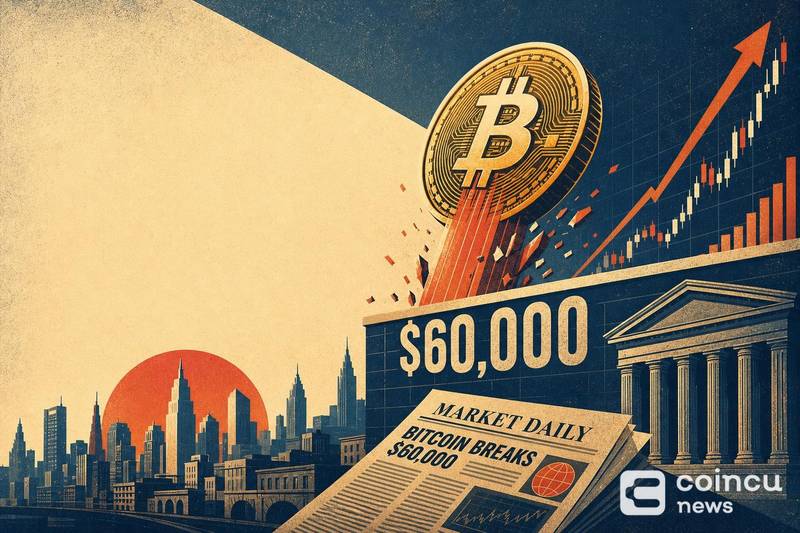
Bitcoin surged above $60,000 on February 28, 2024, reclaiming the level for the first time since November 2021 as spot ETF inflows and halving anticipation fueled a broad rally that pushed the price past $63,000 within hours.
The breakout marked a turning point for bitcoin after more than two years of trading below the psychologically important $60,000 threshold. For traders and long-term holders alike, the move signaled renewed momentum in a market that had spent much of 2022 and 2023 recovering from the post-cycle drawdown. For related coverage, see BlockDAG’s $0.10 Buyback Continues to Draw Thousands in June While Cosmos Rises 15% & Bittensor Awaits ETF Outcomes.
Bitcoin currently trades at $59,368, sitting just below the $60,000 level that defined the February 2024 breakout. The asset carries a market capitalization of approximately $1.19 trillion. For related coverage, see Bitcoin Nears $70,000 as Buying Activity Builds and Short Liquidations Loom.
Bitcoin Breaks Above $60,000: What Happened
CoinDesk reported that bitcoin topped $63,000 on February 28, 2024, after first crossing $60,000 earlier the same day. The move represented bitcoin’s first time above that level since the November 2021 cycle high. For related coverage, see Here’s What Has Been Fueling Bitcoin’s All-Time High Weekly Close.
The $60,000 level holds outsized psychological weight in crypto markets. It served as a key resistance zone during bitcoin’s 2021 run to its then all-time high near $69,000, and its reclamation after a prolonged absence reinforced the narrative that the post-FTX bear market was decisively over. For related coverage, see Bitcoin Price Retains $22,000 After Whales Scramble To Buy The Dip.
Axios independently confirmed the rally, noting that bitcoin gained over 6% on the day and reached its highest level in more than two years. The speed of the move, clearing $60,000 and then $63,000 in a single session, caught many short-term traders off guard.
What May Be Driving Bitcoin’s Latest Rally
The clearest catalyst was demand from newly launched U.S. spot bitcoin ETFs. CoinDesk reported that the new funds added more than 12,000 BTC on Tuesday alone, following approximately 10,000 BTC on Monday. That pace of accumulation far outstripped daily mining supply.
The ETFs themselves trace back to the SEC’s January 10, 2024 decision to approve the listing and trading of spot bitcoin exchange-traded product shares. That regulatory green light opened a direct channel for institutional and retail capital to flow into bitcoin through traditional brokerage accounts, a development the market had anticipated for over a decade.
The approaching April 2024 halving added a second layer of bullish sentiment. Halvings reduce the rate at which new bitcoin enters circulation, and historical precedent from the 2012, 2016, and 2020 cycles has conditioned the market to expect price appreciation in the months surrounding these events. Similar dynamics have played out in previous rallies to all-time high weekly closes.
Broader risk appetite also appeared to support the move. Equity markets were near all-time highs in late February 2024, and macro conditions, including expectations for eventual Federal Reserve rate cuts, created a favorable backdrop for speculative assets.
How the Market Reacted to the $60,000 Breakout
The breakout above $60,000 triggered a wave of follow-through buying that extended well beyond the initial session. AP News reported that bitcoin briefly surpassed $68,800 on March 5, 2024, just days after clearing the $60,000 level, and was still up more than 175% year over year even after pulling back to just under $62,000.
Trading volumes surged as the breakout confirmed. The combination of spot ETF demand and momentum-driven buying compressed what might have been a gradual grind into a rapid vertical move. Bitcoin’s current 24-hour volume of $44.3 billion reflects the kind of liquidity that major price levels continue to attract.
The rally also lifted sentiment across the broader crypto market. When bitcoin breaks a major resistance level, altcoins historically follow with amplified moves as capital rotates from bitcoin into higher-beta assets. The pattern played out again here, with the total crypto market capitalization expanding rapidly through early March 2024. More recently, bitcoin’s push above $65,000 showed the same dynamic at a higher price band.
Key Levels and Scenarios to Watch Next
The $60,000 level has transformed from resistance into a critical support zone. Whether bitcoin can hold above it on retests will shape near-term sentiment. A sustained break below $60,000 would suggest the February 2024 move was a liquidity-driven spike rather than the start of a new trend.
On the upside, the November 2021 all-time high near $69,000 remains the next major target. The speed with which bitcoin moved from $60,000 toward $68,800 in early March 2024 suggests that thin order books above $60,000 could allow rapid price discovery once that zone clears convincingly. Momentum toward the $70,000 area has already been tested multiple times since.
The bearish scenario centers on ETF flow reversal. If spot bitcoin ETFs shift from net inflows to sustained outflows, the same mechanism that propelled the rally could work in reverse. Daily redemptions exceeding daily mining supply would create persistent selling pressure.
Bitcoin’s circulating supply stands at approximately 20.05 million out of a maximum 21 million, meaning supply-side scarcity only tightens from here. That structural backdrop differentiates bitcoin from assets where supply can expand to meet demand.
The crypto Fear & Greed Index currently reads 12, deep in “Extreme Fear” territory. That contrasts sharply with the optimism that surrounded the February 2024 breakout. For contrarian traders, extreme fear readings at a price level where the market previously showed strong buying interest can signal opportunity, though such readings can also persist during extended drawdowns.
FAQ About Bitcoin Rising Above $60,000
Why is $60,000 important for Bitcoin?
Round numbers carry psychological weight in all financial markets, but $60,000 holds particular significance because it served as a key resistance zone during bitcoin’s 2021 run to its all-time high. Reclaiming it after more than two years confirmed to many traders that the bear market cycle had ended. When bitcoin held support at $22,000 during the 2022 lows, the $60,000 level became a widely watched milestone for recovery confirmation.
Does moving above $60,000 mean Bitcoin is bullish again?
Crossing a single price level does not guarantee a sustained trend. However, the February 2024 breakout was backed by measurable catalysts: spot ETF inflows exceeding 12,000 BTC in a single day and the approaching halving event. These structural drivers, rather than purely speculative momentum, gave the move more weight than a simple technical breakout.
What should traders watch after Bitcoin crosses a major resistance level?
Volume confirmation matters most. A breakout on high volume suggests genuine demand, while a move on thin volume is more likely to reverse. Traders also monitor whether the broken resistance level holds as new support on the first retest. In bitcoin’s case, the speed of follow-through from $60,000 to nearly $69,000 within a week suggested strong underlying demand rather than a false breakout.
Disclaimer: This article is for informational purposes only and does not constitute financial or investment advice. Cryptocurrency and digital asset markets carry significant risk. Always do your own research before making decisions.
No tags available.


Other Posts








- China, US Conclude Trade Talks with Focus on Cooperation
- Crypto Weekly: NYSE Backs OKX, Kraken Gets Fed Access, BTC Sells
- DeriW Launches Edge Hour Trading Competition Platform for Derivatives Traders
- Court Upholds Fed’s Rejection of Custodia Bank’s Request
- Former CFO Convicted for $35M Fraudulent Crypto Investment
- Michael Saylor Denies Bitcoin Sell-Off Amid Large BTC Transfer
- Buy Dogecoin on eToro: Step-by-Step Guide for Beginners (2024)
- Kazakhstan Explores Crypto Reserves Backed by National Funds
- JPMorgan Increases Holdings in BlackRock’s Bitcoin ETF
- Nordea Bank Introduces Bitcoin ETP Trading for Nordic Customers
- XRP Spot ETF Launches on Nasdaq Amid Market Fluctuations
- Crypto Leaders Address Macro Volatility Amid Market Shifts
- Peter Schiff Challenges Michael Saylor on MSTR’s Business Model
- Thailand Orders Worldcoin to Delete 1.2 Million Biometric Records
- UK Proposes New DeFi Tax Framework to Ease User Burden
- WLFI Under Fire: Analyst Warns Hyperliquid Could Be Next
- Ancient Ethereum Whale Moves $1.19 Billion After Decade
- BlackRock Receives Large Crypto Transfers from Coinbase
- SEC Scrutiny on ALT5 Sigma’s Leadership Disclosure Timing
- MoonPay Gains Trust License for Crypto Operations in New York
- China, US Conclude Trade Talks with Focus on Cooperation
- Crypto Weekly: NYSE Backs OKX, Kraken Gets Fed Access, BTC Sells
- DeriW Launches Edge Hour Trading Competition Platform for Derivatives Traders
- Court Upholds Fed’s Rejection of Custodia Bank’s Request
- Former CFO Convicted for $35M Fraudulent Crypto Investment
- Michael Saylor Denies Bitcoin Sell-Off Amid Large BTC Transfer
- Buy Dogecoin on eToro: Step-by-Step Guide for Beginners (2024)
- Kazakhstan Explores Crypto Reserves Backed by National Funds
- JPMorgan Increases Holdings in BlackRock’s Bitcoin ETF
- Nordea Bank Introduces Bitcoin ETP Trading for Nordic Customers
- XRP Spot ETF Launches on Nasdaq Amid Market Fluctuations
- Crypto Leaders Address Macro Volatility Amid Market Shifts
- Peter Schiff Challenges Michael Saylor on MSTR’s Business Model
- Thailand Orders Worldcoin to Delete 1.2 Million Biometric Records
- UK Proposes New DeFi Tax Framework to Ease User Burden
- WLFI Under Fire: Analyst Warns Hyperliquid Could Be Next
- Ancient Ethereum Whale Moves $1.19 Billion After Decade
- BlackRock Receives Large Crypto Transfers from Coinbase
- SEC Scrutiny on ALT5 Sigma’s Leadership Disclosure Timing
- MoonPay Gains Trust License for Crypto Operations in New York
- China, US Conclude Trade Talks with Focus on Cooperation
- Crypto Weekly: NYSE Backs OKX, Kraken Gets Fed Access, BTC Sells
- DeriW Launches Edge Hour Trading Competition Platform for Derivatives Traders
- Court Upholds Fed’s Rejection of Custodia Bank’s Request
- Former CFO Convicted for $35M Fraudulent Crypto Investment
- Michael Saylor Denies Bitcoin Sell-Off Amid Large BTC Transfer
- Buy Dogecoin on eToro: Step-by-Step Guide for Beginners (2024)
- Kazakhstan Explores Crypto Reserves Backed by National Funds
- JPMorgan Increases Holdings in BlackRock’s Bitcoin ETF
- Nordea Bank Introduces Bitcoin ETP Trading for Nordic Customers
- XRP Spot ETF Launches on Nasdaq Amid Market Fluctuations
- Crypto Leaders Address Macro Volatility Amid Market Shifts
- Peter Schiff Challenges Michael Saylor on MSTR’s Business Model
- Thailand Orders Worldcoin to Delete 1.2 Million Biometric Records
- UK Proposes New DeFi Tax Framework to Ease User Burden
- WLFI Under Fire: Analyst Warns Hyperliquid Could Be Next
- Ancient Ethereum Whale Moves $1.19 Billion After Decade
- BlackRock Receives Large Crypto Transfers from Coinbase
- SEC Scrutiny on ALT5 Sigma’s Leadership Disclosure Timing
- MoonPay Gains Trust License for Crypto Operations in New York


Coinbase to List Cap (CAP): What the Listing Announcement Means


Solstice and Tensorx to Buy $1 Billion in AI Infrastructure to Support EU Sovereign AI Demand