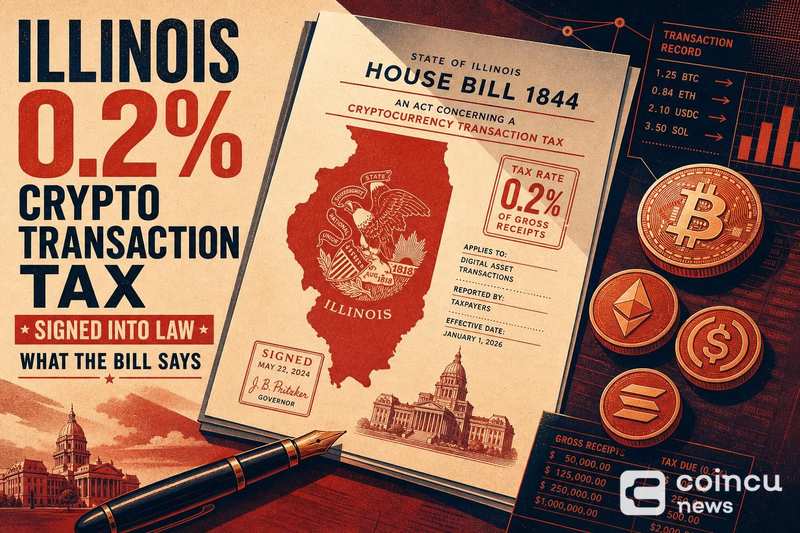
Illinois 0.2% Crypto Transaction Tax Signed Into Law: What the Bill Says
Illinois has signed a 0.2% tax on certain digital asset transactions into law, making it one of the first U.S. states to impose a dedicated levy on cryptocurrency activity. The measure, originating as Senate Bill 3019, was enrolled and enacted as Public Act 104-0464.
This article is based on the Illinois legislative record and the enrolled and public act documents available through the Illinois General Assembly. The bill completed its full legislative journey, passing both chambers and receiving the governor’s signature, as recorded on the SB3019 bill status page.
What the Law Text Says About the 0.2% Digital Asset Tax
The tax provision is contained in Public Act 104-0464, which emerged from Senate Bill 3019 in the 104th Illinois General Assembly. The statute references a 0.2% rate applied to digital asset transactions, defining the taxable event and the parties responsible for collection or remittance.
The enrolled bill text uses specific statutory definitions for digital assets and covered transactions. These definitions determine which activities trigger the tax obligation and which intermediaries bear responsibility for remittance.
A House amendment modified the original Senate version before final passage, adjusting provisions in the measure. Readers tracking the legislative history should review both the enrolled text and the amendment to understand the final enacted language.
Who Could Be Affected if the Measure Is Applied Broadly
The law’s definitions section determines which entities fall under the tax obligation. Depending on how broadly the statutory language is read, exchanges, brokers, and other intermediaries facilitating digital asset transactions in Illinois could face compliance requirements.
A BDO analysis described the measure as “potentially wide-reaching,” suggesting the tax could extend beyond simple retail trades to encompass a broader set of digital asset activities. The exact scope depends on how definitions like “digital asset,” “exchange,” and “transaction” are interpreted in practice.
Illinois-based users transacting through centralized platforms may see the tax applied at the point of sale or exchange. Whether decentralized protocols, self-custodial wallets, or peer-to-peer transfers fall within the statute’s reach is less clear from the text alone. The measure arrives at a time when major digital assets like Bitcoin have been testing key price levels, raising the stakes for how transaction-based taxes interact with active trading activity.
For crypto firms already navigating a patchwork of state-level regulations, the Illinois measure adds another compliance layer. Companies operating across multiple states, including those building high-throughput networks to support thousands of transactions per second, will need to evaluate whether their Illinois-connected activity triggers the 0.2% obligation.
What Remains Unclear: Scope, Timing, and Enforcement
The Public Act PDF contains effective-date language, but critical implementation details, including reporting formats, collection mechanics, and audit procedures, are not fully spelled out in the statute itself.
Administrative guidance from the Illinois Department of Revenue will likely be needed to clarify how the tax applies in practice. Until that rulemaking occurs, affected parties face uncertainty about compliance timelines and operational requirements.
The statute’s treatment of edge cases, such as staking rewards, airdrops, NFT sales, and cross-chain swaps, is not explicitly addressed. Whether these activities constitute taxable transactions under the law will depend on future interpretation. The broader crypto market continues to watch how state-level policy developments interact with digital asset price trajectories and ecosystem growth.
Enforcement mechanics also remain an open question. The law does not detail how the state plans to identify non-compliant actors or verify transaction volumes for entities outside traditional exchange infrastructure.
FAQ
What is the Illinois crypto transaction tax?
It is a 0.2% tax on certain digital asset transactions enacted through Public Act 104-0464, originating as Senate Bill 3019 in the Illinois General Assembly.
Is the rate 0.2% according to the law text?
Yes. The enrolled bill text specifies a 0.2% rate on covered digital asset transactions.
Who may need to comply under the measure?
The statute references exchanges, brokers, and intermediaries facilitating digital asset transactions. The full range of affected entities depends on how the law’s definitions are applied by regulators.
When does the law take effect?
The Public Act contains effective-date provisions, but specific compliance deadlines may require additional administrative guidance from the Illinois Department of Revenue.
Why is the scope of the law still debated?
The statutory definitions are broad enough to potentially cover a wide range of digital asset activities beyond simple buy-sell trades. Final scope will depend on rulemaking and regulatory interpretation that has not yet been published.
Disclaimer: This article is for informational purposes only and does not constitute financial or investment advice. Cryptocurrency and digital asset markets carry significant risk. Always do your own research before making decisions.
No tags available.


Other Posts








- China, US Conclude Trade Talks with Focus on Cooperation
- Crypto Weekly: NYSE Backs OKX, Kraken Gets Fed Access, BTC Sells
- Court Upholds Fed’s Rejection of Custodia Bank’s Request
- Former CFO Convicted for $35M Fraudulent Crypto Investment
- DeriW Launches Edge Hour Trading Competition Platform for Derivatives Traders
- Michael Saylor Denies Bitcoin Sell-Off Amid Large BTC Transfer
- Buy Dogecoin on eToro: Step-by-Step Guide for Beginners (2024)
- Kazakhstan Explores Crypto Reserves Backed by National Funds
- JPMorgan Increases Holdings in BlackRock’s Bitcoin ETF
- Nordea Bank Introduces Bitcoin ETP Trading for Nordic Customers
- XRP Spot ETF Launches on Nasdaq Amid Market Fluctuations
- Peter Schiff Challenges Michael Saylor on MSTR’s Business Model
- Thailand Orders Worldcoin to Delete 1.2 Million Biometric Records
- UK Proposes New DeFi Tax Framework to Ease User Burden
- WLFI Under Fire: Analyst Warns Hyperliquid Could Be Next
- Ancient Ethereum Whale Moves $1.19 Billion After Decade
- BlackRock Receives Large Crypto Transfers from Coinbase
- SEC Scrutiny on ALT5 Sigma’s Leadership Disclosure Timing
- Yala Injects $5.5 Million Amid Recovery Efforts
- Radiant Capital Faces $50M Loss in Major Security Breach
- China, US Conclude Trade Talks with Focus on Cooperation
- Crypto Weekly: NYSE Backs OKX, Kraken Gets Fed Access, BTC Sells
- Court Upholds Fed’s Rejection of Custodia Bank’s Request
- Former CFO Convicted for $35M Fraudulent Crypto Investment
- DeriW Launches Edge Hour Trading Competition Platform for Derivatives Traders
- Michael Saylor Denies Bitcoin Sell-Off Amid Large BTC Transfer
- Buy Dogecoin on eToro: Step-by-Step Guide for Beginners (2024)
- Kazakhstan Explores Crypto Reserves Backed by National Funds
- JPMorgan Increases Holdings in BlackRock’s Bitcoin ETF
- Nordea Bank Introduces Bitcoin ETP Trading for Nordic Customers
- XRP Spot ETF Launches on Nasdaq Amid Market Fluctuations
- Peter Schiff Challenges Michael Saylor on MSTR’s Business Model
- Thailand Orders Worldcoin to Delete 1.2 Million Biometric Records
- UK Proposes New DeFi Tax Framework to Ease User Burden
- WLFI Under Fire: Analyst Warns Hyperliquid Could Be Next
- Ancient Ethereum Whale Moves $1.19 Billion After Decade
- BlackRock Receives Large Crypto Transfers from Coinbase
- SEC Scrutiny on ALT5 Sigma’s Leadership Disclosure Timing
- Yala Injects $5.5 Million Amid Recovery Efforts
- Radiant Capital Faces $50M Loss in Major Security Breach
- China, US Conclude Trade Talks with Focus on Cooperation
- Crypto Weekly: NYSE Backs OKX, Kraken Gets Fed Access, BTC Sells
- Court Upholds Fed’s Rejection of Custodia Bank’s Request
- Former CFO Convicted for $35M Fraudulent Crypto Investment
- DeriW Launches Edge Hour Trading Competition Platform for Derivatives Traders
- Michael Saylor Denies Bitcoin Sell-Off Amid Large BTC Transfer
- Buy Dogecoin on eToro: Step-by-Step Guide for Beginners (2024)
- Kazakhstan Explores Crypto Reserves Backed by National Funds
- JPMorgan Increases Holdings in BlackRock’s Bitcoin ETF
- Nordea Bank Introduces Bitcoin ETP Trading for Nordic Customers
- XRP Spot ETF Launches on Nasdaq Amid Market Fluctuations
- Peter Schiff Challenges Michael Saylor on MSTR’s Business Model
- Thailand Orders Worldcoin to Delete 1.2 Million Biometric Records
- UK Proposes New DeFi Tax Framework to Ease User Burden
- WLFI Under Fire: Analyst Warns Hyperliquid Could Be Next
- Ancient Ethereum Whale Moves $1.19 Billion After Decade
- BlackRock Receives Large Crypto Transfers from Coinbase
- SEC Scrutiny on ALT5 Sigma’s Leadership Disclosure Timing
- Yala Injects $5.5 Million Amid Recovery Efforts
- Radiant Capital Faces $50M Loss in Major Security Breach

Bitcoin BIP-110 Signal Window Opens in Under Two Weeks as Support Hits 2.64%


BlackRock ETF Wallet Moves $271M in BTC and ETH to Coinbase Prime

Bitmine Immersion Technologies (BMNR) Announces ETH Holdings Reach 5.79 Million Tokens, and Total Crypto and Total Cash Holdings of $11.8 Billion