Bitcoin Price Drop Below $60,593 Could Trigger $1.07B in Long Liquidations
Liquidation data shows that approximately $1.07 billion in long positions could be forcibly closed if Bitcoin drops below the $60,593 price level, highlighting a significant concentration of leveraged bullish bets clustered near that threshold.
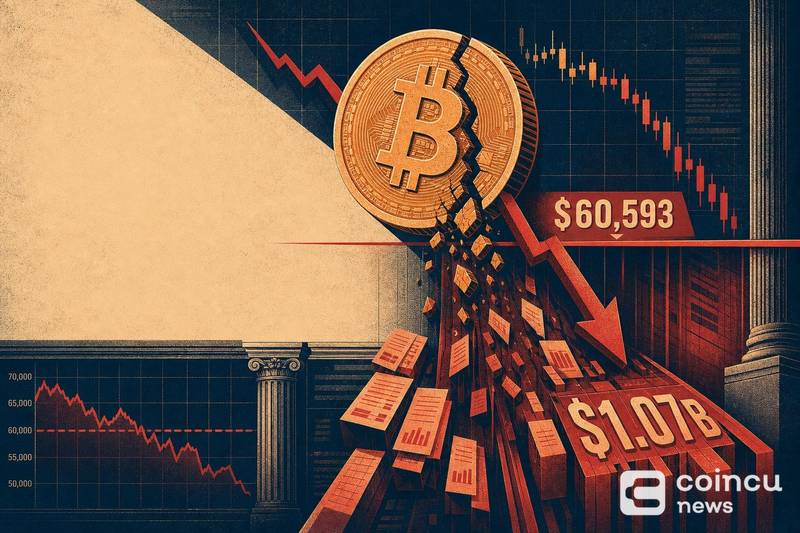
The figure, derived from Coinglass liquidation map data, represents the cumulative value of long positions across major exchanges that would hit their liquidation prices if BTC were to trade below $60,593. These are not spot holders but leveraged futures traders whose collateral would become insufficient at that price.
What a $1.07 billion liquidation cluster means for leveraged traders
A long liquidation occurs when a trader holding a leveraged long position, essentially a bet that Bitcoin’s price will rise, sees the price fall far enough that their margin can no longer cover the position. The exchange then forcibly closes the trade, selling the underlying asset to recover the loan.
When $1.07 billion worth of such positions are concentrated near a single price zone, it signals that a large number of traders have placed similar bullish bets with similar risk parameters. This crowding creates a feedback risk: if the price reaches the trigger level, the forced selling from liquidated positions adds further downward pressure.
That additional sell pressure can push the price even lower, potentially triggering more liquidations below the initial cluster. This mechanism, sometimes called a liquidation cascade, is well-documented in crypto derivatives markets and has historically amplified short-term volatility during sharp BTC declines.
Why $60,593 matters as a support threshold
The $60,593 level is not arbitrary. It reflects where the highest density of undercollateralized long positions currently sits, according to Coinglass BTC liquidation data. When leverage clusters around a specific price, that price effectively becomes a line where market behavior can shift rapidly.
A break below this level would not only liquidate the concentrated positions but could also erode broader market confidence, as traders watching the same data may preemptively reduce exposure. The interaction between funding rates and leverage positioning adds another layer of complexity; recent observations around BTC funding rates sitting at 0.0024% across the market suggest the derivatives market has been running with moderate but persistent bullish bias.
It is important to distinguish between what the data shows and what it guarantees. A $1.07 billion liquidation pocket does not mean Bitcoin will fall to $60,593. It means that if it does, the market impact would be amplified by forced selling of that magnitude.
How a liquidation cascade could play out
If Bitcoin were to approach and breach the $60,593 level, two broad scenarios emerge. In the first, liquidations trigger a rapid price drop that overshoots to the downside before buyers step in at lower levels, creating a sharp V-shaped recovery. This pattern has occurred in previous BTC liquidation events where cascading forced sales briefly pushed prices well below equilibrium.
In the second scenario, the liquidation-driven selling feeds into a broader bearish shift, with the forced sales confirming negative sentiment and leading to sustained downside. Which scenario plays out depends on factors including spot market depth, broader risk appetite, and whether new buying interest materializes at lower levels.
Large-scale liquidation events can also ripple into altcoin markets. When leveraged BTC positions are forcibly unwound, the resulting volatility and risk-off sentiment frequently spread to assets like Ethereum, which has seen its own notable whale selling activity recently, and to broader institutional flow patterns in crypto ETF markets.
Risk metrics traders should monitor
For leveraged Bitcoin traders, the $1.07 billion liquidation cluster is a data point, not a directive. Its value lies in what it reveals about current market positioning: a significant amount of capital is exposed to downside risk near a well-defined price level.
Key metrics to watch alongside liquidation maps include open interest concentration, which shows how much total leveraged exposure exists; order book depth near the $60,593 level, which indicates how much buying support sits between the current price and the trigger zone; and funding rates, which reveal whether the market is paying a premium for long or short positioning.
Traders managing leveraged positions near this zone should assess their own liquidation prices relative to the cluster. Positions with liquidation levels close to a large concentration of other liquidations face elevated risk, because the cascade effect means the price can move through these levels faster than it would in a normal sell-off.
FAQ about Bitcoin long liquidations below $60,593
What is a long liquidation in Bitcoin trading?
A long liquidation occurs when a trader who has borrowed funds to bet on Bitcoin’s price going up sees the price fall enough that their collateral is no longer sufficient. The exchange automatically closes their position by selling, which can add further downward pressure on the price.
Why is the $60,593 level specifically significant?
This price level currently has the highest concentration of leveraged long positions that would become undercollateralized if reached. The $1.07 billion figure represents the aggregate value of these exposed positions across major derivatives exchanges.
Does $1.07 billion in potential liquidations guarantee a crash?
No. The data shows what would happen if Bitcoin reaches that price, not that it will. The liquidation cluster is a risk indicator, not a prediction. Bitcoin could trade sideways, move higher, or decline to a different level entirely. The data simply quantifies the downside exposure currently built into the market at one specific price point.
Disclaimer: This article is for informational purposes only and does not constitute financial or investment advice. Cryptocurrency and digital asset markets carry significant risk. Always do your own research before making decisions.
No tags available.


Other Posts








- China, US Conclude Trade Talks with Focus on Cooperation
- Crypto Weekly: NYSE Backs OKX, Kraken Gets Fed Access, BTC Sells
- DeriW Launches Edge Hour Trading Competition Platform for Derivatives Traders
- Court Upholds Fed’s Rejection of Custodia Bank’s Request
- Former CFO Convicted for $35M Fraudulent Crypto Investment
- Michael Saylor Denies Bitcoin Sell-Off Amid Large BTC Transfer
- Kazakhstan Explores Crypto Reserves Backed by National Funds
- JPMorgan Increases Holdings in BlackRock’s Bitcoin ETF
- Nordea Bank Introduces Bitcoin ETP Trading for Nordic Customers
- XRP Spot ETF Launches on Nasdaq Amid Market Fluctuations
- Buy Dogecoin on eToro: Step-by-Step Guide for Beginners (2024)
- Crypto Leaders Address Macro Volatility Amid Market Shifts
- Peter Schiff Challenges Michael Saylor on MSTR’s Business Model
- Thailand Orders Worldcoin to Delete 1.2 Million Biometric Records
- UK Proposes New DeFi Tax Framework to Ease User Burden
- WLFI Under Fire: Analyst Warns Hyperliquid Could Be Next
- Ancient Ethereum Whale Moves $1.19 Billion After Decade
- BlackRock Receives Large Crypto Transfers from Coinbase
- SEC Scrutiny on ALT5 Sigma’s Leadership Disclosure Timing
- MoonPay Gains Trust License for Crypto Operations in New York
- China, US Conclude Trade Talks with Focus on Cooperation
- Crypto Weekly: NYSE Backs OKX, Kraken Gets Fed Access, BTC Sells
- DeriW Launches Edge Hour Trading Competition Platform for Derivatives Traders
- Court Upholds Fed’s Rejection of Custodia Bank’s Request
- Former CFO Convicted for $35M Fraudulent Crypto Investment
- Michael Saylor Denies Bitcoin Sell-Off Amid Large BTC Transfer
- Kazakhstan Explores Crypto Reserves Backed by National Funds
- JPMorgan Increases Holdings in BlackRock’s Bitcoin ETF
- Nordea Bank Introduces Bitcoin ETP Trading for Nordic Customers
- XRP Spot ETF Launches on Nasdaq Amid Market Fluctuations
- Buy Dogecoin on eToro: Step-by-Step Guide for Beginners (2024)
- Crypto Leaders Address Macro Volatility Amid Market Shifts
- Peter Schiff Challenges Michael Saylor on MSTR’s Business Model
- Thailand Orders Worldcoin to Delete 1.2 Million Biometric Records
- UK Proposes New DeFi Tax Framework to Ease User Burden
- WLFI Under Fire: Analyst Warns Hyperliquid Could Be Next
- Ancient Ethereum Whale Moves $1.19 Billion After Decade
- BlackRock Receives Large Crypto Transfers from Coinbase
- SEC Scrutiny on ALT5 Sigma’s Leadership Disclosure Timing
- MoonPay Gains Trust License for Crypto Operations in New York
- China, US Conclude Trade Talks with Focus on Cooperation
- Crypto Weekly: NYSE Backs OKX, Kraken Gets Fed Access, BTC Sells
- DeriW Launches Edge Hour Trading Competition Platform for Derivatives Traders
- Court Upholds Fed’s Rejection of Custodia Bank’s Request
- Former CFO Convicted for $35M Fraudulent Crypto Investment
- Michael Saylor Denies Bitcoin Sell-Off Amid Large BTC Transfer
- Kazakhstan Explores Crypto Reserves Backed by National Funds
- JPMorgan Increases Holdings in BlackRock’s Bitcoin ETF
- Nordea Bank Introduces Bitcoin ETP Trading for Nordic Customers
- XRP Spot ETF Launches on Nasdaq Amid Market Fluctuations
- Buy Dogecoin on eToro: Step-by-Step Guide for Beginners (2024)
- Crypto Leaders Address Macro Volatility Amid Market Shifts
- Peter Schiff Challenges Michael Saylor on MSTR’s Business Model
- Thailand Orders Worldcoin to Delete 1.2 Million Biometric Records
- UK Proposes New DeFi Tax Framework to Ease User Burden
- WLFI Under Fire: Analyst Warns Hyperliquid Could Be Next
- Ancient Ethereum Whale Moves $1.19 Billion After Decade
- BlackRock Receives Large Crypto Transfers from Coinbase
- SEC Scrutiny on ALT5 Sigma’s Leadership Disclosure Timing
- MoonPay Gains Trust License for Crypto Operations in New York

Bitcoin Price Drop Below $60,593 Could Trigger $1.07B in Long Liquidations


Address Sells 3,000 ETH Worth $4.98 Million: Ethereum Market Impact

AFX Accelerates Global Expansion with Industry Veteran Ken C Leading Growth