CertiK Says Hinkal Protocol Was Attacked, $800K USDC Stolen
Blockchain security firm CertiK has flagged an attack on Hinkal Protocol, reporting that approximately $800,000 in USDC was stolen from the privacy-focused DeFi platform.
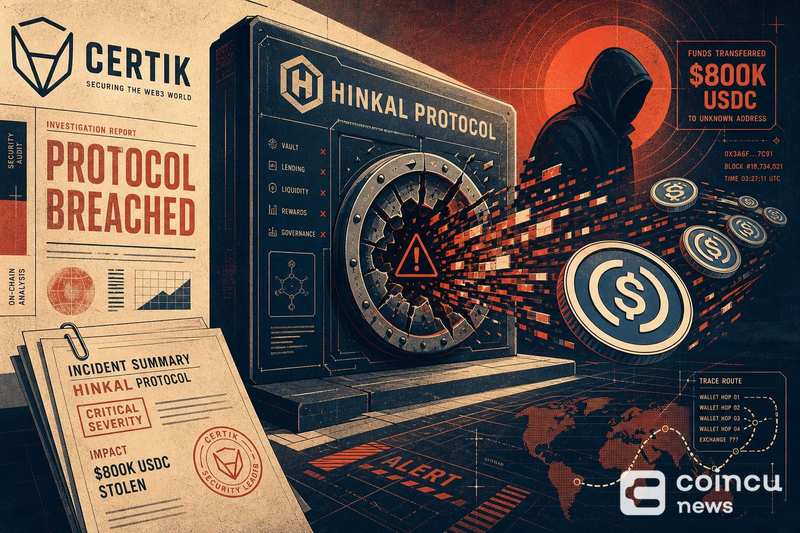
CertiK’s alert system identified the incident, noting the estimated loss of roughly $800,000 denominated in USDC. The report was published through CertiK’s monitoring channels, which track smart contract exploits and protocol vulnerabilities across the DeFi ecosystem. For related coverage, see SBI-Owned Crypto Company To Shut Down Bitcoin Mining Pool Service.
Hinkal Protocol, which provides privacy infrastructure for on-chain transactions, is listed on CertiK’s Skynet security platform. The protocol’s security profile and audit history are publicly accessible through that dashboard. For related coverage, see Irish Authorities Recover Another 500 BTC From Clifton Collins' Lost Bitcoin.
Why an $800,000 USDC theft draws immediate scrutiny
The stolen asset being USDC, a fully collateralized stablecoin, is notable. Unlike volatile tokens that can lose value quickly after theft, USDC maintains a consistent dollar peg, meaning the attacker extracted a predictable $800,000 in liquid value. For related coverage, see BTC Contract Open Interest Rises 5.85% in 24 Hours: What It Signals.
Stablecoin thefts present a different recovery calculus than volatile token exploits. Circle, the issuer of USDC, has the technical ability to freeze specific addresses holding its tokens, a tool that has been deployed in previous incidents involving USDC holders affected by protocol hacks. Whether any such action has been taken in this case remains unconfirmed.
The $800,000 figure, while significant, represents a mid-tier exploit by DeFi standards. Larger protocol breaches have resulted in losses orders of magnitude higher, but incidents of this size still highlight persistent smart contract risk across the sector.
Key questions that remain unanswered
Several critical details about the Hinkal Protocol attack have not been publicly confirmed at the time of reporting. These include the specific attack vector, whether a smart contract vulnerability, compromised key, or other exploit method was used.
It is also unclear which contracts or wallets were directly affected, how many users may have experienced losses, and whether any funds have been recovered or frozen. The Hinkal Protocol team has not issued a detailed public post-mortem based on available information.
Users who interacted with Hinkal Protocol should monitor official channels for updates on the incident’s scope and any recommended actions such as revoking contract approvals.
DeFi protocol attacks remain a persistent risk
The reported Hinkal Protocol exploit is the latest in a recurring pattern of DeFi security incidents. Privacy-focused protocols, which handle complex cryptographic operations, carry inherent smart contract complexity that can expand the attack surface.
Security audits, including those conducted by firms like CertiK, which also serves as a validator on other networks, provide a layer of assurance but do not eliminate risk entirely. Audited protocols have been exploited before, and the presence of an audit does not guarantee immunity from novel attack vectors.
For DeFi users, the incident reinforces the importance of monitoring protocol security dashboards, limiting exposure to any single platform, and maintaining awareness of smart contract approval hygiene.
FAQ about the Hinkal Protocol attack
What happened to Hinkal Protocol?
CertiK reported that Hinkal Protocol was attacked and approximately $800,000 in USDC was stolen.
Who reported the attack?
CertiK, a blockchain security firm that monitors smart contract exploits, flagged the incident through its alert system.
How much was stolen?
The estimated loss is about $800,000 in USDC.
Has the attack vector been identified?
No confirmed details about the exploit method have been made public at the time of this report.
Have any funds been recovered?
There is no confirmed information about fund recovery or freezing at this time.
Additional source references: source document 1.
Disclaimer: This article is for informational purposes only and does not constitute financial or investment advice. Cryptocurrency and digital asset markets carry significant risk. Always do your own research before making decisions.
No tags available.


Other Posts








- China, US Conclude Trade Talks with Focus on Cooperation
- Crypto Weekly: NYSE Backs OKX, Kraken Gets Fed Access, BTC Sells
- DeriW Launches Edge Hour Trading Competition Platform for Derivatives Traders
- Court Upholds Fed’s Rejection of Custodia Bank’s Request
- Former CFO Convicted for $35M Fraudulent Crypto Investment
- Michael Saylor Denies Bitcoin Sell-Off Amid Large BTC Transfer
- Buy Dogecoin on eToro: Step-by-Step Guide for Beginners (2024)
- Kazakhstan Explores Crypto Reserves Backed by National Funds
- JPMorgan Increases Holdings in BlackRock’s Bitcoin ETF
- Nordea Bank Introduces Bitcoin ETP Trading for Nordic Customers
- XRP Spot ETF Launches on Nasdaq Amid Market Fluctuations
- Peter Schiff Challenges Michael Saylor on MSTR’s Business Model
- Thailand Orders Worldcoin to Delete 1.2 Million Biometric Records
- UK Proposes New DeFi Tax Framework to Ease User Burden
- WLFI Under Fire: Analyst Warns Hyperliquid Could Be Next
- Ancient Ethereum Whale Moves $1.19 Billion After Decade
- BlackRock Receives Large Crypto Transfers from Coinbase
- SEC Scrutiny on ALT5 Sigma’s Leadership Disclosure Timing
- Yala Injects $5.5 Million Amid Recovery Efforts
- Radiant Capital Faces $50M Loss in Major Security Breach
- China, US Conclude Trade Talks with Focus on Cooperation
- Crypto Weekly: NYSE Backs OKX, Kraken Gets Fed Access, BTC Sells
- DeriW Launches Edge Hour Trading Competition Platform for Derivatives Traders
- Court Upholds Fed’s Rejection of Custodia Bank’s Request
- Former CFO Convicted for $35M Fraudulent Crypto Investment
- Michael Saylor Denies Bitcoin Sell-Off Amid Large BTC Transfer
- Buy Dogecoin on eToro: Step-by-Step Guide for Beginners (2024)
- Kazakhstan Explores Crypto Reserves Backed by National Funds
- JPMorgan Increases Holdings in BlackRock’s Bitcoin ETF
- Nordea Bank Introduces Bitcoin ETP Trading for Nordic Customers
- XRP Spot ETF Launches on Nasdaq Amid Market Fluctuations
- Peter Schiff Challenges Michael Saylor on MSTR’s Business Model
- Thailand Orders Worldcoin to Delete 1.2 Million Biometric Records
- UK Proposes New DeFi Tax Framework to Ease User Burden
- WLFI Under Fire: Analyst Warns Hyperliquid Could Be Next
- Ancient Ethereum Whale Moves $1.19 Billion After Decade
- BlackRock Receives Large Crypto Transfers from Coinbase
- SEC Scrutiny on ALT5 Sigma’s Leadership Disclosure Timing
- Yala Injects $5.5 Million Amid Recovery Efforts
- Radiant Capital Faces $50M Loss in Major Security Breach
- China, US Conclude Trade Talks with Focus on Cooperation
- Crypto Weekly: NYSE Backs OKX, Kraken Gets Fed Access, BTC Sells
- DeriW Launches Edge Hour Trading Competition Platform for Derivatives Traders
- Court Upholds Fed’s Rejection of Custodia Bank’s Request
- Former CFO Convicted for $35M Fraudulent Crypto Investment
- Michael Saylor Denies Bitcoin Sell-Off Amid Large BTC Transfer
- Buy Dogecoin on eToro: Step-by-Step Guide for Beginners (2024)
- Kazakhstan Explores Crypto Reserves Backed by National Funds
- JPMorgan Increases Holdings in BlackRock’s Bitcoin ETF
- Nordea Bank Introduces Bitcoin ETP Trading for Nordic Customers
- XRP Spot ETF Launches on Nasdaq Amid Market Fluctuations
- Peter Schiff Challenges Michael Saylor on MSTR’s Business Model
- Thailand Orders Worldcoin to Delete 1.2 Million Biometric Records
- UK Proposes New DeFi Tax Framework to Ease User Burden
- WLFI Under Fire: Analyst Warns Hyperliquid Could Be Next
- Ancient Ethereum Whale Moves $1.19 Billion After Decade
- BlackRock Receives Large Crypto Transfers from Coinbase
- SEC Scrutiny on ALT5 Sigma’s Leadership Disclosure Timing
- Yala Injects $5.5 Million Amid Recovery Efforts
- Radiant Capital Faces $50M Loss in Major Security Breach

Treasury Secretary Says President’s $1.4B Crypto Income Is No Issue

SBI-Owned Crypto Company To Shut Down Bitcoin Mining Pool Service

Irish Authorities Recover Another 500 BTC From Clifton Collins’ Lost Bitcoin