Circle has issued an additional 250 million USDC on the Solana network, adding fresh stablecoin supply to one of the most active Layer 1 blockchains in the crypto ecosystem.
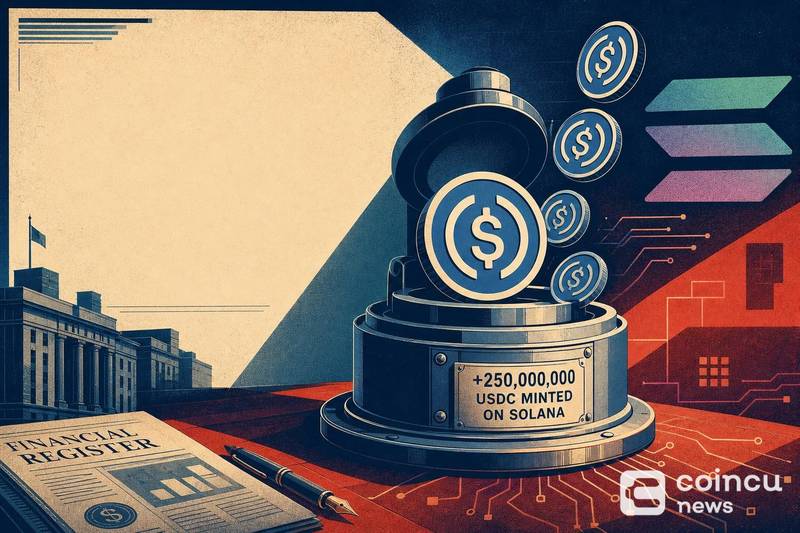
The issuance represents new USDC tokens minted by Circle, the sole authorized issuer of the stablecoin. This is not a first-time deployment; USDC has been live on Solana for years, and Circle has conducted multiple prior minting events on the network. The 250 million figure marks another significant batch added to the existing Solana-based USDC supply. For related coverage, see Circle Mints 250 Million USDC on Solana Network.
Circle controls the minting process for USDC across all supported chains. Each issuance is backed by reserves held in cash and short-duration U.S. Treasuries, according to the company’s published attestation framework. The Solana mint specifically adds tokens to Circle’s treasury address on that chain before any further distribution occurs. For related coverage, see USDC Treasury Mints 250 Million USDC on Solana.
Why a New USDC Mint on Solana Matters
Stablecoin supply on a given blockchain serves as a rough proxy for available liquidity. When Circle mints new USDC on Solana, it increases the theoretical capacity for trading, lending, and payments denominated in the dollar-pegged token across the network’s exchanges and DeFi protocols. For related coverage, see CertiK Says Hinkal Protocol Was Attacked, $800K USDC Stolen.
Solana hosts a range of decentralized exchanges, lending platforms, and payment applications that rely on USDC as a base trading pair and collateral asset. A supply increase of 250 million tokens can support higher transaction volumes and deeper order books on venues like Jupiter, Raydium, and Marinade Finance. For related coverage, see Reflec Recovery Plan Targets USDC+ Holders Hit by Drift Hack.
The mint also signals sustained institutional interest in Solana as a stablecoin settlement layer. Circle has progressively expanded USDC availability across multiple chains, and repeated large issuances on Solana suggest that demand from market makers, payment processors, or institutional participants continues to grow on the network. A previous 250 million USDC mint on Solana followed a similar pattern.
For context, Solana’s broader stablecoin ecosystem has expanded considerably. USDC remains the dominant dollar-pegged token on the chain, and each new mint reinforces that position relative to competitors like USDT.
Minting Is Not the Same as Circulation
A critical distinction exists between issuance and active circulation. When Circle mints 250 million USDC, the tokens initially sit in a Circle-controlled treasury wallet on Solana. They are not yet deployed into the open market.
Distribution happens in a separate step. Tokens move from the treasury to exchanges, payment partners, institutional clients, or DeFi protocols only when there is demand. The mint itself is a supply-side preparation, not confirmation that 250 million new dollars worth of stablecoin activity has entered the Solana ecosystem.
This distinction matters because observers sometimes interpret large mints as immediate bullish signals for a network’s DeFi activity or token price. In practice, minted tokens can remain in treasury for days or weeks before distribution, and some portion may never enter active circulation if demand conditions change.
No transaction hash or specific wallet data has been confirmed for this particular issuance at the time of reporting. Readers can monitor Solana-based USDC movements through Solscan to track when and where the newly minted tokens are deployed.
What to Watch After the Mint
The most immediate signal to track is whether the newly minted USDC moves out of Circle’s treasury wallet on Solana. Large outflows from the treasury to exchange hot wallets or DeFi protocol addresses would indicate active deployment of the new supply.
Exchange deposit activity is particularly telling. If significant portions of the 250 million USDC flow to centralized exchanges operating on Solana, it may reflect increased trading demand or market-making activity on the network.
DeFi protocol inflows represent another key metric. USDC entering lending protocols or liquidity pools on Solana would expand the network’s total value locked and improve borrowing and trading conditions. The overall stablecoin supply across chains provides broader context for how Solana’s share is evolving.
Circle’s expanding multi-chain strategy also merits attention. The company has been bringing native USDC and its Cross-Chain Transfer Protocol to additional networks, and each Solana mint should be viewed within this broader expansion framework.
Payment integrations on Solana are a longer-term signal. USDC’s utility extends beyond trading, and growth in payment-related transfers would indicate that the new supply is serving real economic activity rather than purely speculative flows.
FAQ About Circle’s 250 Million USDC Issuance on Solana
What exactly was issued?
Circle minted 250 million USDC tokens on the Solana blockchain. USDC is a dollar-pegged stablecoin, meaning each token is designed to maintain a value of one U.S. dollar, backed by reserves.
Are the newly minted tokens already circulating?
Not necessarily. Minted tokens first enter Circle’s treasury wallet. They only enter active circulation when distributed to exchanges, institutions, or DeFi protocols. The mint is a supply preparation step, not immediate deployment.
Why does this matter for Solana users?
Additional USDC supply increases the liquidity available for trading, lending, and payments on Solana. It can lead to tighter spreads on decentralized exchanges, more borrowing capacity in lending protocols, and greater overall utility for Solana-based applications that use USDC.
How can I verify the issuance on-chain?
USDC mint events on Solana can be tracked through Solscan by monitoring the USDC mint authority address. Treasury movements from Circle’s wallet to other addresses will show when and where the tokens are being distributed.
Is this a one-time event?
No. Circle regularly mints USDC across multiple blockchains based on market demand. Solana has seen repeated large-scale USDC minting events, and this issuance follows an established pattern of supply expansion on the network.
Additional source references: source document 1.
Disclaimer: This article is for informational purposes only and does not constitute financial or investment advice. Cryptocurrency and digital asset markets carry significant risk. Always do your own research before making decisions.
No tags available.


Other Posts








- China, US Conclude Trade Talks with Focus on Cooperation
- Crypto Weekly: NYSE Backs OKX, Kraken Gets Fed Access, BTC Sells
- DeriW Launches Edge Hour Trading Competition Platform for Derivatives Traders
- Court Upholds Fed’s Rejection of Custodia Bank’s Request
- Former CFO Convicted for $35M Fraudulent Crypto Investment
- Michael Saylor Denies Bitcoin Sell-Off Amid Large BTC Transfer
- Buy Dogecoin on eToro: Step-by-Step Guide for Beginners (2024)
- Kazakhstan Explores Crypto Reserves Backed by National Funds
- JPMorgan Increases Holdings in BlackRock’s Bitcoin ETF
- Nordea Bank Introduces Bitcoin ETP Trading for Nordic Customers
- XRP Spot ETF Launches on Nasdaq Amid Market Fluctuations
- Peter Schiff Challenges Michael Saylor on MSTR’s Business Model
- Thailand Orders Worldcoin to Delete 1.2 Million Biometric Records
- UK Proposes New DeFi Tax Framework to Ease User Burden
- WLFI Under Fire: Analyst Warns Hyperliquid Could Be Next
- Ancient Ethereum Whale Moves $1.19 Billion After Decade
- BlackRock Receives Large Crypto Transfers from Coinbase
- SEC Scrutiny on ALT5 Sigma’s Leadership Disclosure Timing
- Yala Injects $5.5 Million Amid Recovery Efforts
- Radiant Capital Faces $50M Loss in Major Security Breach
- China, US Conclude Trade Talks with Focus on Cooperation
- Crypto Weekly: NYSE Backs OKX, Kraken Gets Fed Access, BTC Sells
- DeriW Launches Edge Hour Trading Competition Platform for Derivatives Traders
- Court Upholds Fed’s Rejection of Custodia Bank’s Request
- Former CFO Convicted for $35M Fraudulent Crypto Investment
- Michael Saylor Denies Bitcoin Sell-Off Amid Large BTC Transfer
- Buy Dogecoin on eToro: Step-by-Step Guide for Beginners (2024)
- Kazakhstan Explores Crypto Reserves Backed by National Funds
- JPMorgan Increases Holdings in BlackRock’s Bitcoin ETF
- Nordea Bank Introduces Bitcoin ETP Trading for Nordic Customers
- XRP Spot ETF Launches on Nasdaq Amid Market Fluctuations
- Peter Schiff Challenges Michael Saylor on MSTR’s Business Model
- Thailand Orders Worldcoin to Delete 1.2 Million Biometric Records
- UK Proposes New DeFi Tax Framework to Ease User Burden
- WLFI Under Fire: Analyst Warns Hyperliquid Could Be Next
- Ancient Ethereum Whale Moves $1.19 Billion After Decade
- BlackRock Receives Large Crypto Transfers from Coinbase
- SEC Scrutiny on ALT5 Sigma’s Leadership Disclosure Timing
- Yala Injects $5.5 Million Amid Recovery Efforts
- Radiant Capital Faces $50M Loss in Major Security Breach
- China, US Conclude Trade Talks with Focus on Cooperation
- Crypto Weekly: NYSE Backs OKX, Kraken Gets Fed Access, BTC Sells
- DeriW Launches Edge Hour Trading Competition Platform for Derivatives Traders
- Court Upholds Fed’s Rejection of Custodia Bank’s Request
- Former CFO Convicted for $35M Fraudulent Crypto Investment
- Michael Saylor Denies Bitcoin Sell-Off Amid Large BTC Transfer
- Buy Dogecoin on eToro: Step-by-Step Guide for Beginners (2024)
- Kazakhstan Explores Crypto Reserves Backed by National Funds
- JPMorgan Increases Holdings in BlackRock’s Bitcoin ETF
- Nordea Bank Introduces Bitcoin ETP Trading for Nordic Customers
- XRP Spot ETF Launches on Nasdaq Amid Market Fluctuations
- Peter Schiff Challenges Michael Saylor on MSTR’s Business Model
- Thailand Orders Worldcoin to Delete 1.2 Million Biometric Records
- UK Proposes New DeFi Tax Framework to Ease User Burden
- WLFI Under Fire: Analyst Warns Hyperliquid Could Be Next
- Ancient Ethereum Whale Moves $1.19 Billion After Decade
- BlackRock Receives Large Crypto Transfers from Coinbase
- SEC Scrutiny on ALT5 Sigma’s Leadership Disclosure Timing
- Yala Injects $5.5 Million Amid Recovery Efforts
- Radiant Capital Faces $50M Loss in Major Security Breach

OKX Upgrades Flash Earn With Staking and Trading-Based Earning Modes

New Wallet Deposits $1.995M USDC to HyperLiquid, Opens $9.74M Gold Long

CME Group June Crypto Contract ADV Jumps 76% YoY, Notional Tops $10B