Berachain has launched PoL Next on mainnet, marking the network’s transition from its original BGT-based incentive model to a new system built around sWBERA. The upgrade represents a structural shift in how the Proof of Liquidity chain distributes rewards to validators, liquidity providers, and decentralized applications.
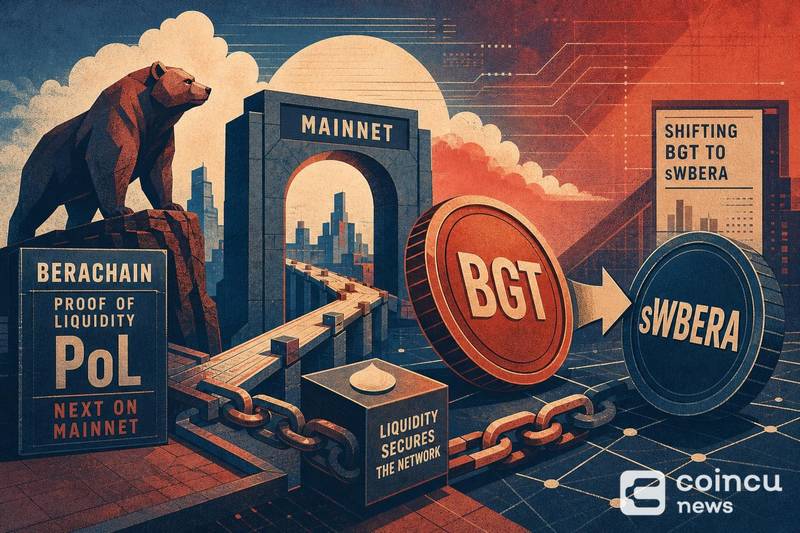
What PoL Next changes on Berachain mainnet
PoL Next is a mainnet upgrade to Berachain’s core Proof of Liquidity mechanism, not a testnet experiment. The rollout moves the network’s incentive architecture from the BGT (Bera Governance Token) model to a redesigned system centered on sWBERA, according to Berachain’s official changelog. For related coverage, see Base to Activate B20 Token Standard on Mainnet July 9.
Proof of Liquidity is Berachain’s consensus innovation that ties network security to DeFi liquidity rather than treating them as separate concerns. Under the original design, BGT served as the non-transferable governance and reward token that validators earned and directed toward liquidity pools. For related coverage, see TermiX Mainnet Launch and BNB Chain Agent.family Release.
The PoL Next upgrade replaces that flow with sWBERA, a staked wrapped BERA token that restructures how incentives reach participants. This is a protocol-level change to the reward pipeline, not a simple rebranding. The shift was discussed extensively in Berachain’s governance forum before implementation.
How the BGT model is transitioning to sWBERA
What BGT represented
Under the original PoL system, BGT was a soulbound token earned by depositing assets into whitelisted liquidity pools. Validators would then direct BGT emissions toward specific pools, creating a flywheel where liquidity provision and network security reinforced each other.
BGT could not be transferred or sold directly. Holders could burn it to receive BERA, the network’s native gas token, but this was a one-way conversion. The model aimed to prevent mercenary capital from extracting rewards without contributing lasting liquidity.
What sWBERA changes
The sWBERA incentive system restructures this flow by introducing a staked wrapped version of BERA as the core reward mechanism. Rather than routing incentives through a non-transferable governance token, the new model uses sWBERA to align staking and liquidity incentives more directly.
For users, the practical difference is in how they interact with the reward system. The BGT burn-to-BERA mechanic is replaced by a staking wrapper that may simplify participation while preserving the link between liquidity provision and validator incentives. Berachain has previously navigated significant protocol-level changes through emergency measures, but PoL Next represents a planned evolution rather than a reactive fix.
Why the sWBERA shift matters for validators, liquidity, and dApps
Validator implications
Validators under the BGT model competed for delegation by directing emissions to popular liquidity pools. The sWBERA transition changes the mechanics of this competition. Validators will need to adapt their strategies for attracting delegation and directing incentives under the new token structure.
The change also affects how validator economics interact with the broader token supply. With sWBERA replacing BGT as the incentive vehicle, the relationship between staking yield and liquidity provision rewards is being recalibrated.
Liquidity and DeFi participation
For liquidity providers, the transition means a different reward token and potentially different strategies for maximizing returns. Protocols built on Berachain that integrated BGT mechanics into their products, such as liquid staking derivatives or yield optimizers, will need to update their integrations.
The timing of this transition comes as major exchanges like Bybit have been expanding stablecoin support to Berachain, suggesting growing infrastructure investment in the ecosystem.
What builders and dApps should monitor
Developers building on Berachain should watch for updated SDK documentation and contract interfaces reflecting the sWBERA system. Any dApp that previously interacted with BGT emissions, delegation, or burning will require contract updates.
Smart contract integrations that reference BGT-specific functions will need migration. Teams should monitor the official documentation for migration guides and deprecation timelines for BGT-related endpoints.
What this launch signals for Berachain’s DeFi roadmap
The PoL Next launch represents a maturation milestone for Berachain. Moving from the initial BGT design to sWBERA suggests the team identified friction points in the original model that limited adoption or complicated the user experience.
Mainnet incentive redesigns of this scale are uncommon. Most chains adjust parameters rather than replacing core reward tokens. The willingness to execute a structural change signals confidence in the network’s governance process and validator coordination.
Short-term metrics to watch
Readers tracking the impact of PoL Next should monitor several indicators in the weeks following launch: total value locked across Berachain DeFi protocols, validator participation rates under the new system, and sWBERA staking adoption relative to previous BGT engagement levels.
It is important to distinguish confirmed facts from expected outcomes. The launch itself is confirmed. Whether sWBERA drives higher liquidity retention or validator participation compared to BGT remains to be demonstrated by on-chain data in the coming weeks. Earlier this year, Berachain’s token unlock schedule drew significant market attention, and the PoL Next transition adds another variable to the network’s evolving tokenomics.
FAQ about Berachain PoL Next and the sWBERA transition
What is Berachain PoL Next?
PoL Next is a mainnet upgrade to Berachain’s Proof of Liquidity consensus mechanism. It replaces the original BGT-based incentive model with a new system built around sWBERA, changing how the network distributes rewards to participants.
What happens to the BGT model after the sWBERA transition?
The BGT model is being phased out as the primary incentive mechanism. The transition moves reward distribution from the non-transferable BGT token to sWBERA. Specific deprecation timelines for BGT-related functions should be tracked through Berachain’s official documentation.
Why did Berachain move to an sWBERA incentive system?
The transition aims to streamline the relationship between staking, liquidity provision, and validator incentives. The original BGT model, while innovative, introduced complexity through its non-transferable nature and one-way burn mechanism that the sWBERA design seeks to simplify.
Who is most affected by the mainnet change?
Validators, liquidity providers, and dApp developers with BGT integrations face the most direct impact. Validators must adapt their emission-directing strategies, liquidity providers encounter a new reward token, and developers need to update smart contract interactions that referenced BGT-specific functions.
Disclaimer: This article is for informational purposes only and does not constitute financial or investment advice. Cryptocurrency and digital asset markets carry significant risk. Always do your own research before making decisions.
No tags available.


Other Posts








- China, US Conclude Trade Talks with Focus on Cooperation
- Crypto Weekly: NYSE Backs OKX, Kraken Gets Fed Access, BTC Sells
- Court Upholds Fed’s Rejection of Custodia Bank’s Request
- DeriW Launches Edge Hour Trading Competition Platform for Derivatives Traders
- Former CFO Convicted for $35M Fraudulent Crypto Investment
- Michael Saylor Denies Bitcoin Sell-Off Amid Large BTC Transfer
- Buy Dogecoin on eToro: Step-by-Step Guide for Beginners (2024)
- Kazakhstan Explores Crypto Reserves Backed by National Funds
- JPMorgan Increases Holdings in BlackRock’s Bitcoin ETF
- Nordea Bank Introduces Bitcoin ETP Trading for Nordic Customers
- XRP Spot ETF Launches on Nasdaq Amid Market Fluctuations
- Peter Schiff Challenges Michael Saylor on MSTR’s Business Model
- Thailand Orders Worldcoin to Delete 1.2 Million Biometric Records
- UK Proposes New DeFi Tax Framework to Ease User Burden
- WLFI Under Fire: Analyst Warns Hyperliquid Could Be Next
- Ancient Ethereum Whale Moves $1.19 Billion After Decade
- BlackRock Receives Large Crypto Transfers from Coinbase
- SEC Scrutiny on ALT5 Sigma’s Leadership Disclosure Timing
- Yala Injects $5.5 Million Amid Recovery Efforts
- Radiant Capital Faces $50M Loss in Major Security Breach
- China, US Conclude Trade Talks with Focus on Cooperation
- Crypto Weekly: NYSE Backs OKX, Kraken Gets Fed Access, BTC Sells
- Court Upholds Fed’s Rejection of Custodia Bank’s Request
- DeriW Launches Edge Hour Trading Competition Platform for Derivatives Traders
- Former CFO Convicted for $35M Fraudulent Crypto Investment
- Michael Saylor Denies Bitcoin Sell-Off Amid Large BTC Transfer
- Buy Dogecoin on eToro: Step-by-Step Guide for Beginners (2024)
- Kazakhstan Explores Crypto Reserves Backed by National Funds
- JPMorgan Increases Holdings in BlackRock’s Bitcoin ETF
- Nordea Bank Introduces Bitcoin ETP Trading for Nordic Customers
- XRP Spot ETF Launches on Nasdaq Amid Market Fluctuations
- Peter Schiff Challenges Michael Saylor on MSTR’s Business Model
- Thailand Orders Worldcoin to Delete 1.2 Million Biometric Records
- UK Proposes New DeFi Tax Framework to Ease User Burden
- WLFI Under Fire: Analyst Warns Hyperliquid Could Be Next
- Ancient Ethereum Whale Moves $1.19 Billion After Decade
- BlackRock Receives Large Crypto Transfers from Coinbase
- SEC Scrutiny on ALT5 Sigma’s Leadership Disclosure Timing
- Yala Injects $5.5 Million Amid Recovery Efforts
- Radiant Capital Faces $50M Loss in Major Security Breach
- China, US Conclude Trade Talks with Focus on Cooperation
- Crypto Weekly: NYSE Backs OKX, Kraken Gets Fed Access, BTC Sells
- Court Upholds Fed’s Rejection of Custodia Bank’s Request
- DeriW Launches Edge Hour Trading Competition Platform for Derivatives Traders
- Former CFO Convicted for $35M Fraudulent Crypto Investment
- Michael Saylor Denies Bitcoin Sell-Off Amid Large BTC Transfer
- Buy Dogecoin on eToro: Step-by-Step Guide for Beginners (2024)
- Kazakhstan Explores Crypto Reserves Backed by National Funds
- JPMorgan Increases Holdings in BlackRock’s Bitcoin ETF
- Nordea Bank Introduces Bitcoin ETP Trading for Nordic Customers
- XRP Spot ETF Launches on Nasdaq Amid Market Fluctuations
- Peter Schiff Challenges Michael Saylor on MSTR’s Business Model
- Thailand Orders Worldcoin to Delete 1.2 Million Biometric Records
- UK Proposes New DeFi Tax Framework to Ease User Burden
- WLFI Under Fire: Analyst Warns Hyperliquid Could Be Next
- Ancient Ethereum Whale Moves $1.19 Billion After Decade
- BlackRock Receives Large Crypto Transfers from Coinbase
- SEC Scrutiny on ALT5 Sigma’s Leadership Disclosure Timing
- Yala Injects $5.5 Million Amid Recovery Efforts
- Radiant Capital Faces $50M Loss in Major Security Breach



Bitcoin Suisse Advances Middle East Expansion, Receives Financial Services Permission in Abu Dhabi

Bitmine Immersion Technologies (BMNR) Announces Total Crypto and Cash Holdings Top $11.1 Billion Now