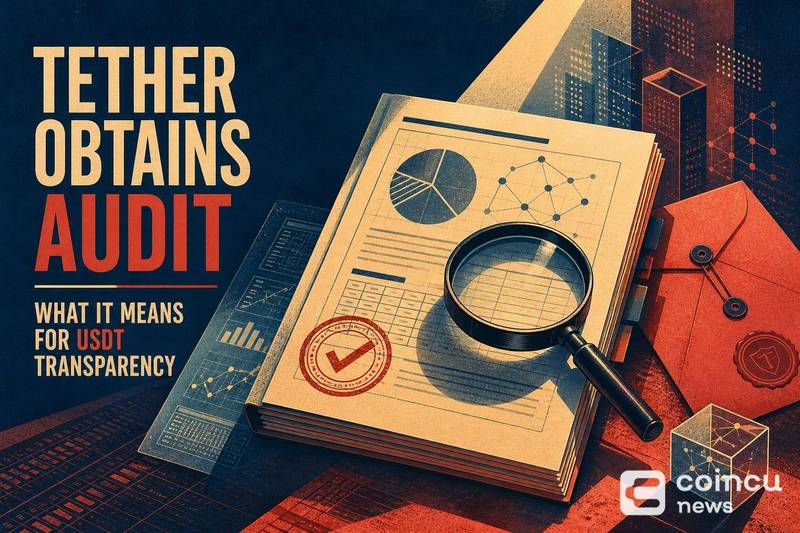
Tether obtains audit for the first time in its history, saying on August 13, 2026 that KPMG U.S. completed a full independent audit of Tether International’s 2025 financial statements and issued an unqualified opinion, the most positive form of audit result available.
What Happened in Tether’s Audit Announcement
Tether said the review covered Tether International’s financial statements for the year ended December 31, 2025, and was conducted by KPMG U.S., one of the Big Four accounting firms, according to the company’s announcement.
This is a full financial statement audit, not a reserve attestation of the kind Tether has published quarterly for years. KPMG U.S. issued an unqualified opinion, which Tether described as the highest possible result an auditor can give.
The audited statements showed reserves exceeding liabilities by $6.814 billion at year-end 2025, the company said. Tether also stated that KPMG physically counted and inspected every individual gold bar the company holds as part of the process.
The completion follows a formal engagement. On March 24, 2026, Tether said it had signed a Big Four firm to carry out its first full independent financial statement audit, a step the company had promised for years but never delivered until now.
CoinDesk, which reported the news, said a KPMG U.S. spokesperson confirmed the firm issued an unqualified opinion on Tether International’s 2025 financials. Coincu previously covered the completion in its report on KPMG issuing a clean opinion in Tether’s first full audit.
Tether framed the milestone as “the largest inaugural financial audit in history,” though that is a self-described superlative and no independent comparison has been verified. The engagement-to-completion timeline is detailed in Coincu’s coverage of the Big Four audit of the finances behind the $180 billion USDT stablecoin.
Why a Tether Audit Matters for USDT Holders
USDT is the settlement layer for a large share of crypto trading, functioning as the default quote asset on major exchanges and a primary vehicle for moving value between venues. Its credibility rests on the assumption that each token is backed by real reserves.
Tether’s scale makes the update market-relevant. USDT’s market capitalization stood at roughly $183.03 billion at press time, with the token trading at about $0.9992 and 24-hour volume near $31.1 billion.
Independent verification of reserves reduces counterparty risk for the traders, market makers, and institutions that hold USDT balances. A clean opinion from a Big Four firm carries more weight than a point-in-time attestation because it applies audit-level scrutiny to a full set of financial statements.
USDT’s reach also extends into new markets. Russia recently approved Bitcoin, Ethereum and USDT trading while excluding XRP, and Tether has been expanding tokenization into Saudi Arabia real estate, deepening the stablecoin’s institutional footprint.
Audit vs Attestation: What Readers Should Watch Closely
An attestation is a limited engagement in which an accountant confirms specific figures, typically reserves at a single point in time. A full audit examines a complete set of financial statements, including assets, liabilities, and the judgments behind them, and results in a formal opinion.
The unqualified opinion Tether reported is the strongest outcome in that framework, indicating the auditor found the statements fairly presented without material reservations. That is a meaningful step beyond the quarterly attestations stablecoin issuers commonly publish.
Readers should still note the scope. The opinion covers Tether International’s financials for the year ended December 31, 2025, a specific reporting period rather than live, real-time backing. No standalone public KPMG audit report URL was located, so verification rests on Tether’s announcement and CoinDesk’s confirmation that KPMG U.S. issued the opinion.
Reserve figures also move over time. Tether’s July 31, 2026 Q2 attestation reported total assets of $187.75 billion against liabilities of $183.64 billion, leaving excess reserves of about $4.11 billion as of June 30, 2026, a smaller buffer than the audited year-end 2025 figure.
How the News Could Shape Stablecoin Oversight and Competition
Regulators and counterparties care about audited reserve claims because they raise the assurance level on money-like instruments. Tether explicitly framed its March 2026 Big Four engagement as a transparency and regulatory-readiness move, positioning the audit ahead of tightening stablecoin disclosure expectations.
The completed audit strengthens Tether’s positioning against rivals that have leaned on transparency narratives, since a full audit with an unqualified opinion is a harder standard to match than periodic attestations. Coincu detailed the underlying statements in its report on KPMG signing off on Tether’s 2025 financial statements.
The regulatory impact ultimately depends on the audit’s actual scope. A single year-end opinion does not settle every open question about ongoing backing, but it does move Tether beyond the attestation-only model that had drawn years of scrutiny.
Tether CEO Paolo Ardoino used X to frame the clean opinion as an answer to long-running criticism that the company would never complete a full audit.
Wen Tether audit? nOw.
Today Tether announces its first full financial audit for Tether International, conducted by KPMG U.S. which resulted in an unqualified clean opinion, marking the highest result possible.
An unqualified opinion is the best possible audit opinion an… pic.twitter.com/quav6uUIhy— Paolo Ardoino 🤖 (@paoloardoino) August 13, 2026
Source: @paoloardoino on X
The announcement landed while broader market sentiment stayed cautious. The Fear & Greed Index sat at 29, in “Fear” territory.
FAQ About Tether’s Audit
What does Tether obtaining an audit mean?
It means an independent firm, KPMG U.S., examined Tether International’s full 2025 financial statements and issued a formal opinion, rather than a limited snapshot of reserves.
Is an audit the same as a reserves attestation?
No. An attestation confirms specific figures at a point in time, while an audit reviews complete financial statements and yields an opinion. The unqualified opinion Tether reported is the strongest audit result available.
Does the news prove every USDT token is fully backed right now?
The audit covers the year ended December 31, 2025, showing reserves exceeded liabilities by billions at that date. It is not a live, real-time guarantee, and later attestations show the excess reserve buffer changes over time.
Why does this matter for the stablecoin market?
USDT is the dominant trading and settlement stablecoin, with a market cap around $183 billion. A Big Four audit raises the transparency bar across the sector and could influence how regulators and rivals approach reserve disclosure.
Disclaimer: This article is for informational purposes only and does not constitute financial or investment advice. Cryptocurrency and digital asset markets carry significant risk. Always do your own research before making decisions.
No tags available.


Other Posts








- China, US Conclude Trade Talks with Focus on Cooperation
- Court Upholds Fed’s Rejection of Custodia Bank’s Request
- Crypto Weekly: NYSE Backs OKX, Kraken Gets Fed Access, BTC Sells
- Former CFO Convicted for $35M Fraudulent Crypto Investment
- DeriW Launches Edge Hour Trading Competition Platform for Derivatives Traders
- Michael Saylor Denies Bitcoin Sell-Off Amid Large BTC Transfer
- Buy Dogecoin on eToro: Step-by-Step Guide for Beginners (2024)
- Kazakhstan Explores Crypto Reserves Backed by National Funds
- JPMorgan Increases Holdings in BlackRock’s Bitcoin ETF
- Nordea Bank Introduces Bitcoin ETP Trading for Nordic Customers
- XRP Spot ETF Launches on Nasdaq Amid Market Fluctuations
- Peter Schiff Challenges Michael Saylor on MSTR’s Business Model
- Thailand Orders Worldcoin to Delete 1.2 Million Biometric Records
- UK Proposes New DeFi Tax Framework to Ease User Burden
- WLFI Under Fire: Analyst Warns Hyperliquid Could Be Next
- Ancient Ethereum Whale Moves $1.19 Billion After Decade
- BlackRock Receives Large Crypto Transfers from Coinbase
- SEC Scrutiny on ALT5 Sigma’s Leadership Disclosure Timing
- Yala Injects $5.5 Million Amid Recovery Efforts
- Radiant Capital Faces $50M Loss in Major Security Breach
- China, US Conclude Trade Talks with Focus on Cooperation
- Court Upholds Fed’s Rejection of Custodia Bank’s Request
- Crypto Weekly: NYSE Backs OKX, Kraken Gets Fed Access, BTC Sells
- Former CFO Convicted for $35M Fraudulent Crypto Investment
- DeriW Launches Edge Hour Trading Competition Platform for Derivatives Traders
- Michael Saylor Denies Bitcoin Sell-Off Amid Large BTC Transfer
- Buy Dogecoin on eToro: Step-by-Step Guide for Beginners (2024)
- Kazakhstan Explores Crypto Reserves Backed by National Funds
- JPMorgan Increases Holdings in BlackRock’s Bitcoin ETF
- Nordea Bank Introduces Bitcoin ETP Trading for Nordic Customers
- XRP Spot ETF Launches on Nasdaq Amid Market Fluctuations
- Peter Schiff Challenges Michael Saylor on MSTR’s Business Model
- Thailand Orders Worldcoin to Delete 1.2 Million Biometric Records
- UK Proposes New DeFi Tax Framework to Ease User Burden
- WLFI Under Fire: Analyst Warns Hyperliquid Could Be Next
- Ancient Ethereum Whale Moves $1.19 Billion After Decade
- BlackRock Receives Large Crypto Transfers from Coinbase
- SEC Scrutiny on ALT5 Sigma’s Leadership Disclosure Timing
- Yala Injects $5.5 Million Amid Recovery Efforts
- Radiant Capital Faces $50M Loss in Major Security Breach
- China, US Conclude Trade Talks with Focus on Cooperation
- Court Upholds Fed’s Rejection of Custodia Bank’s Request
- Crypto Weekly: NYSE Backs OKX, Kraken Gets Fed Access, BTC Sells
- Former CFO Convicted for $35M Fraudulent Crypto Investment
- DeriW Launches Edge Hour Trading Competition Platform for Derivatives Traders
- Michael Saylor Denies Bitcoin Sell-Off Amid Large BTC Transfer
- Buy Dogecoin on eToro: Step-by-Step Guide for Beginners (2024)
- Kazakhstan Explores Crypto Reserves Backed by National Funds
- JPMorgan Increases Holdings in BlackRock’s Bitcoin ETF
- Nordea Bank Introduces Bitcoin ETP Trading for Nordic Customers
- XRP Spot ETF Launches on Nasdaq Amid Market Fluctuations
- Peter Schiff Challenges Michael Saylor on MSTR’s Business Model
- Thailand Orders Worldcoin to Delete 1.2 Million Biometric Records
- UK Proposes New DeFi Tax Framework to Ease User Burden
- WLFI Under Fire: Analyst Warns Hyperliquid Could Be Next
- Ancient Ethereum Whale Moves $1.19 Billion After Decade
- BlackRock Receives Large Crypto Transfers from Coinbase
- SEC Scrutiny on ALT5 Sigma’s Leadership Disclosure Timing
- Yala Injects $5.5 Million Amid Recovery Efforts
- Radiant Capital Faces $50M Loss in Major Security Breach


Norway Wealth Fund’s Indirect Bitcoin Exposure Reaches Record High as Strategy Makes Up 86%

Bitmine Immersion Technologies Announces Record and Payment Dates for Cash Dividends on 9.50% Series A Perpetual Preferred Stock
Crypto Player Takes Home $1.749M After a Million PSG Bet on 1win