ETH Could Trigger $643M in Long Liquidations Below $1,511, Data Shows
CoinGlass data shows that if ETH falls below $1,511, cumulative long liquidation intensity across mainstream centralized exchanges could reach $643 million, a threshold that sits less than $80 below the token’s current spot price amid extreme fear in broader crypto markets.
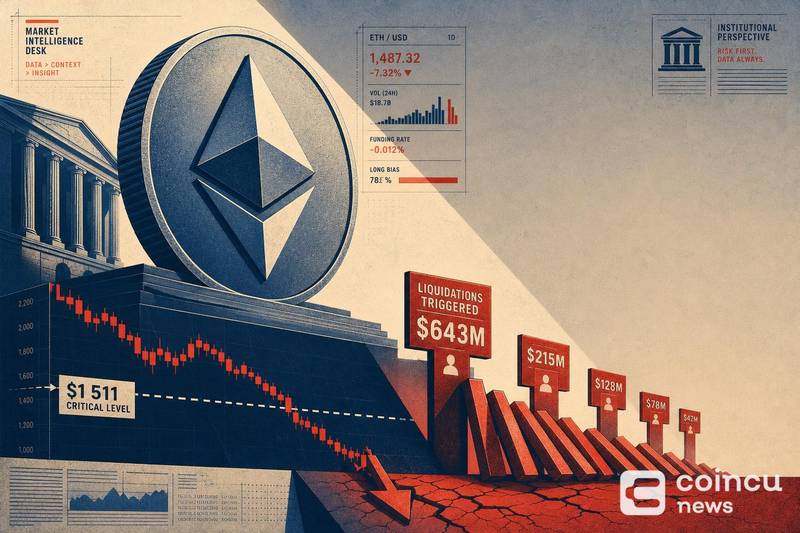
The figures were reported by CertiK Pulse, which cited CoinGlass as the underlying data source. The same item noted that if ETH breaks above $1,656, cumulative short liquidation intensity could reach $562 million, framing the token inside a defined liquidation band on both sides. For related coverage, see Base Outage Analysis: Sequencer Bug Caused Brief Block Production Downtime.
Why the $1,511 ETH Level Matters Right Now
Cumulative long liquidation intensity measures the estimated dollar value of leveraged long positions that would be forcibly closed as price moves through a given level. Unlike a single liquidation price, it aggregates clustered exposure across perpetual swaps, delivery contracts, and margin trading pairs on multiple exchanges.
The $1,511 threshold is notable because ETH was trading at $1,590.08 at the time of the market snapshot, putting the token roughly 5% above the trigger. A similar dynamic played out earlier this year when Ethereum faced $114 million in potential liquidations at $1,472, though the current downside cluster is more than five times larger.
Traders monitor these downside trigger zones because they mark price levels where forced selling can accelerate a move already underway. When a dense band of long liquidations sits close to spot price, relatively modest selling pressure can push the market into the cluster and unlock additional forced selling.
How $643 Million in Long Liquidations Could Build Across Mainstream CEXs
The $643 million figure represents cumulative intensity, not a single block of positions sitting at exactly $1,511. CoinGlass aggregates perpetual swaps, delivery contracts, and margin trading pairs across major exchanges, and the cumulative number stacks all long exposure that would be liquidated as price moves from current levels down through that threshold.
This distinction matters. If ETH drops to $1,540 and bounces, only a fraction of the $643 million cluster would trigger. The full figure assumes a clean move through $1,511 without a recovery, which is an extreme but not unprecedented scenario given recent volatility. In early June, CoinDesk documented an ETH-led liquidation event in which bullish crypto bets lost $1.6 billion in a single session as ETH, SOL, and DOGE dropped 9%.
The exposure is spread across mainstream centralized exchanges rather than concentrated on one platform. That distribution means no single exchange is likely to absorb the full shock alone, but it also means liquidation cascades can propagate across venues as arbitrage bots and market makers reprice simultaneously.
What a Break Below $1,511 Could Mean for ETH Market Structure
The Crypto Fear and Greed Index sits at 15, classified as Extreme Fear. That reading suggests the market is already positioned defensively, which can cut both ways: thin liquidity in a fearful market means even moderate sell orders can move price sharply, but extreme pessimism also compresses the pool of remaining sellers.
ETH only recently reclaimed the $1,600 level after a broad sell-off. The token remained down more than 3% on the day during that recovery, underscoring how fragile the rebound was. With market cap at $191.8 billion and 24-hour volume near $6.3 billion, ETH has enough liquidity to absorb routine flow but may struggle with $643 million in forced selling if the trigger is breached.
Derivatives-driven pressure behaves differently from spot weakness. In a spot-led decline, sellers are making a voluntary decision and can pause. In a liquidation cascade, the selling is mechanical: once margin requirements are breached, exchange engines close positions automatically regardless of order book depth. That forced nature is what makes concentrated liquidation bands dangerous, as a similar mechanism contributed to Bitcoin’s drop below 59,000 USDT during a recent broad market selloff.
What Traders Should Watch on CEX Order Flow and Liquidation Data
The first signal is price action near $1,511 itself. If ETH approaches the level with declining volume, it may indicate that sellers are exhausting rather than building momentum. Conversely, increasing volume on a move toward $1,511 raises the probability that the liquidation cluster triggers.
Open interest trends are a second indicator. Rising open interest alongside falling price suggests new short positions are being added, which can accelerate a downside move. Falling open interest with falling price suggests existing longs are closing voluntarily before liquidation, which reduces the remaining cluster size.
Leverage ratios across CEXs provide additional context. CoinGlass tracks estimated leverage across major venues in real time, and spikes in aggregate leverage typically precede liquidation events. Traders referencing BTC short liquidation intensity dynamics on CEXs will recognize the same framework applied to ETH’s long side here.
Funding rates on ETH perpetual contracts are also worth monitoring. Deeply negative funding means shorts are paying longs to hold positions, which often occurs near local bottoms as speculative bearish bets become crowded. Neutral or positive funding near the $1,511 zone would suggest the market has not yet priced in the downside scenario.
FAQ: ETH Liquidation Intensity and the $1,511 Risk Zone
What does long liquidation intensity mean?
Long liquidation intensity measures the estimated dollar value of leveraged long positions that would be forcibly closed by exchange engines as price drops through a specific level. It aggregates exposure across multiple contract types and venues, giving a picture of clustered directional risk.
Why is $1,511 important for ETH?
CoinGlass data, as reported by CertiK Pulse, identified $1,511 as the level where cumulative long liquidation intensity across mainstream CEXs reaches $643 million. With ETH recently trading near $1,590, the threshold is close enough to spot price that a moderate sell-off could reach it.
Does $643 million mean guaranteed losses?
No. The figure represents the maximum cumulative liquidation intensity if price moves cleanly through $1,511 without bouncing. In practice, partial fills, stop-losses triggered above the level, and voluntary position closures reduce the amount that actually liquidates at the threshold. The number is a risk map, not a prediction.
What is the upside liquidation level?
The same data set showed that if ETH breaks above $1,656, cumulative short liquidation intensity could reach $562 million, creating a defined band of derivatives risk on both sides of the current price.
Disclaimer: This article is for informational purposes only and does not constitute financial or investment advice. Cryptocurrency and digital asset markets carry significant risk. Always do your own research before making decisions.
No tags available.


Other Posts








- China, US Conclude Trade Talks with Focus on Cooperation
- Crypto Weekly: NYSE Backs OKX, Kraken Gets Fed Access, BTC Sells
- Court Upholds Fed’s Rejection of Custodia Bank’s Request
- Former CFO Convicted for $35M Fraudulent Crypto Investment
- DeriW Launches Edge Hour Trading Competition Platform for Derivatives Traders
- Michael Saylor Denies Bitcoin Sell-Off Amid Large BTC Transfer
- Buy Dogecoin on eToro: Step-by-Step Guide for Beginners (2024)
- Kazakhstan Explores Crypto Reserves Backed by National Funds
- JPMorgan Increases Holdings in BlackRock’s Bitcoin ETF
- Nordea Bank Introduces Bitcoin ETP Trading for Nordic Customers
- XRP Spot ETF Launches on Nasdaq Amid Market Fluctuations
- Peter Schiff Challenges Michael Saylor on MSTR’s Business Model
- Thailand Orders Worldcoin to Delete 1.2 Million Biometric Records
- UK Proposes New DeFi Tax Framework to Ease User Burden
- WLFI Under Fire: Analyst Warns Hyperliquid Could Be Next
- Ancient Ethereum Whale Moves $1.19 Billion After Decade
- BlackRock Receives Large Crypto Transfers from Coinbase
- SEC Scrutiny on ALT5 Sigma’s Leadership Disclosure Timing
- Yala Injects $5.5 Million Amid Recovery Efforts
- Radiant Capital Faces $50M Loss in Major Security Breach
- China, US Conclude Trade Talks with Focus on Cooperation
- Crypto Weekly: NYSE Backs OKX, Kraken Gets Fed Access, BTC Sells
- Court Upholds Fed’s Rejection of Custodia Bank’s Request
- Former CFO Convicted for $35M Fraudulent Crypto Investment
- DeriW Launches Edge Hour Trading Competition Platform for Derivatives Traders
- Michael Saylor Denies Bitcoin Sell-Off Amid Large BTC Transfer
- Buy Dogecoin on eToro: Step-by-Step Guide for Beginners (2024)
- Kazakhstan Explores Crypto Reserves Backed by National Funds
- JPMorgan Increases Holdings in BlackRock’s Bitcoin ETF
- Nordea Bank Introduces Bitcoin ETP Trading for Nordic Customers
- XRP Spot ETF Launches on Nasdaq Amid Market Fluctuations
- Peter Schiff Challenges Michael Saylor on MSTR’s Business Model
- Thailand Orders Worldcoin to Delete 1.2 Million Biometric Records
- UK Proposes New DeFi Tax Framework to Ease User Burden
- WLFI Under Fire: Analyst Warns Hyperliquid Could Be Next
- Ancient Ethereum Whale Moves $1.19 Billion After Decade
- BlackRock Receives Large Crypto Transfers from Coinbase
- SEC Scrutiny on ALT5 Sigma’s Leadership Disclosure Timing
- Yala Injects $5.5 Million Amid Recovery Efforts
- Radiant Capital Faces $50M Loss in Major Security Breach
- China, US Conclude Trade Talks with Focus on Cooperation
- Crypto Weekly: NYSE Backs OKX, Kraken Gets Fed Access, BTC Sells
- Court Upholds Fed’s Rejection of Custodia Bank’s Request
- Former CFO Convicted for $35M Fraudulent Crypto Investment
- DeriW Launches Edge Hour Trading Competition Platform for Derivatives Traders
- Michael Saylor Denies Bitcoin Sell-Off Amid Large BTC Transfer
- Buy Dogecoin on eToro: Step-by-Step Guide for Beginners (2024)
- Kazakhstan Explores Crypto Reserves Backed by National Funds
- JPMorgan Increases Holdings in BlackRock’s Bitcoin ETF
- Nordea Bank Introduces Bitcoin ETP Trading for Nordic Customers
- XRP Spot ETF Launches on Nasdaq Amid Market Fluctuations
- Peter Schiff Challenges Michael Saylor on MSTR’s Business Model
- Thailand Orders Worldcoin to Delete 1.2 Million Biometric Records
- UK Proposes New DeFi Tax Framework to Ease User Burden
- WLFI Under Fire: Analyst Warns Hyperliquid Could Be Next
- Ancient Ethereum Whale Moves $1.19 Billion After Decade
- BlackRock Receives Large Crypto Transfers from Coinbase
- SEC Scrutiny on ALT5 Sigma’s Leadership Disclosure Timing
- Yala Injects $5.5 Million Amid Recovery Efforts
- Radiant Capital Faces $50M Loss in Major Security Breach



Pump.fun Let Staff Go Just Before Their Tokens Were Due to Pay Out