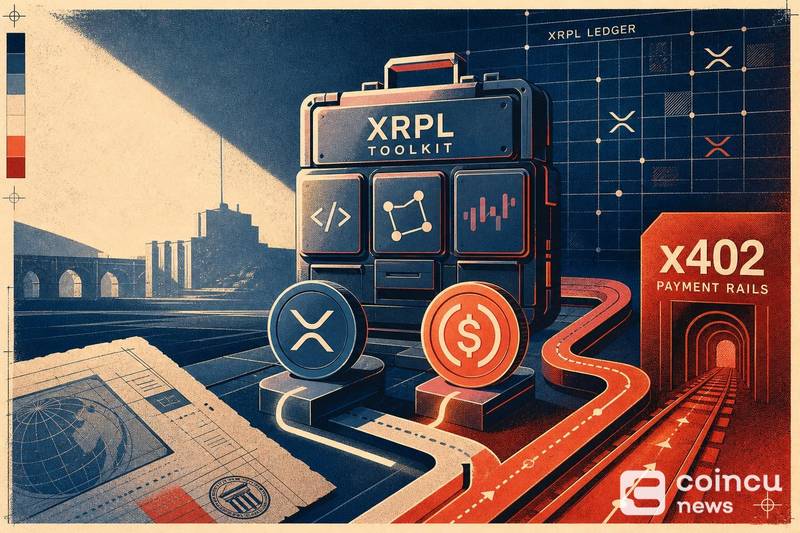
Ripple has launched an XRPL Toolkit aimed at developers building on the XRP Ledger, while XRP and the RLUSD stablecoin have been added as supported assets within the x402 payment system.
What Ripple Announced With the XRPL Toolkit
Ripple introduced what it calls the XRPL AI Starter Kit, a developer-facing toolkit designed to lower the barrier for building applications on the XRP Ledger. The toolkit ties into Ripple’s broader push to expand XRPL’s utility beyond simple token transfers.
What the Toolkit Is Designed to Do
The XRPL Toolkit provides starter infrastructure for developers looking to integrate XRPL capabilities into their projects. It is positioned as part of Ripple’s ecosystem expansion, targeting builders who want to work with agentic transactions and AI-driven use cases on the ledger.
The XRP Ledger’s documentation outlines support for agentic transactions, suggesting the toolkit aligns with a broader effort to make XRPL compatible with autonomous software agents that can initiate and settle payments programmatically.
How XRP and RLUSD Fit Into the x402 Payment System
Separately, both XRP and Ripple’s RLUSD stablecoin have been added to the x402 payment system. The x402 protocol is a payment framework that enables machine-to-machine and API-level payments using cryptocurrency, a sector gaining traction as crypto payment infrastructure matures across the broader market.
According to the x402 documentation on network and token support, the protocol now lists XRPL-based assets among its supported payment options. This means developers building x402-compatible services can accept XRP and RLUSD as payment methods.
The Difference Between the Assets and the Payment System
XRP is the native token of the XRP Ledger, used for transaction fees and as a bridge currency. RLUSD is Ripple’s USD-pegged stablecoin, designed for payments requiring price stability. The x402 system itself is a protocol layer, not a token; it defines how payments are requested and settled between machines.
The addition of both a volatile asset (XRP) and a stablecoin (RLUSD) gives x402 users flexibility depending on whether they prioritize liquidity or price certainty. The XRPL facilitator documentation for x402 details how the integration handles settlement on the XRP Ledger.
Why the Toolkit and Payment Integration Matter Together
The two announcements, a developer toolkit and a payment-system integration, address different sides of the same ecosystem. The toolkit targets builders creating new applications, while the x402 addition targets transactional utility for existing infrastructure.
Developer Enablement Meets Payments Enablement
A toolkit without payment rails limits what developers can build. Payment rails without developer tools limit who can build on them. By releasing both simultaneously, Ripple creates a more complete proposition for developers evaluating XRPL against competing chains.
Whether this translates into measurable developer adoption remains to be confirmed through usage data, which has not been disclosed. Major crypto assets have seen significant price volatility driven by market-wide factors rather than individual project announcements in recent months.
What This Announcement Still Leaves Unanswered
The announcement raises several questions that neither the toolkit release nor the x402 integration documentation fully address. No adoption metrics, transaction volume projections, or launch partner names have been published alongside these releases.
Key Confirmations Readers Should Watch For
The rollout scope remains unclear. It is not confirmed how many x402-compatible services currently operate, or how many plan to support XRP and RLUSD specifically.
Implementation specifics, such as fee structures for x402 payments on XRPL, settlement finality guarantees, and supported transaction types, are partially documented but not fully detailed for production use cases.
No price impact on XRP has been confirmed as a result of these announcements. Large on-chain movements, such as the recent case where a single address sold 3,000 ETH worth $4.98 million, can move crypto markets far more than infrastructure announcements.
FAQ About Ripple’s XRPL Toolkit, XRP, RLUSD, and x402
What is the XRPL Toolkit announced by Ripple?
The XRPL Toolkit, referred to as the XRPL AI Starter Kit, is a developer-focused package from Ripple that provides tools and templates for building applications on the XRP Ledger. It is aimed at reducing setup time for new XRPL projects.
How are XRP and RLUSD connected to the x402 payment system?
Both XRP and RLUSD have been added as supported assets within the x402 protocol, meaning services built on x402 can now accept these tokens as payment. XRP serves as the native ledger token, while RLUSD provides a USD-stable payment option.
Does this announcement confirm any market impact or adoption figures?
No. The available documentation does not include adoption metrics, user counts, or transaction volume data. No confirmed market impact on XRP’s price has been attributed to these releases based on the information currently available.
What is the x402 payment system?
The x402 protocol is a payment framework designed for machine-to-machine transactions and API-level payments. It allows software services to request and receive cryptocurrency payments programmatically, without requiring manual user intervention for each transaction.
Disclaimer: This article is for informational purposes only and does not constitute financial or investment advice. Cryptocurrency and digital asset markets carry significant risk. Always do your own research before making decisions.
No tags available.


Other Posts








- China, US Conclude Trade Talks with Focus on Cooperation
- Crypto Weekly: NYSE Backs OKX, Kraken Gets Fed Access, BTC Sells
- Court Upholds Fed’s Rejection of Custodia Bank’s Request
- Former CFO Convicted for $35M Fraudulent Crypto Investment
- DeriW Launches Edge Hour Trading Competition Platform for Derivatives Traders
- Michael Saylor Denies Bitcoin Sell-Off Amid Large BTC Transfer
- Buy Dogecoin on eToro: Step-by-Step Guide for Beginners (2024)
- Kazakhstan Explores Crypto Reserves Backed by National Funds
- JPMorgan Increases Holdings in BlackRock’s Bitcoin ETF
- Nordea Bank Introduces Bitcoin ETP Trading for Nordic Customers
- XRP Spot ETF Launches on Nasdaq Amid Market Fluctuations
- Peter Schiff Challenges Michael Saylor on MSTR’s Business Model
- Thailand Orders Worldcoin to Delete 1.2 Million Biometric Records
- UK Proposes New DeFi Tax Framework to Ease User Burden
- WLFI Under Fire: Analyst Warns Hyperliquid Could Be Next
- Ancient Ethereum Whale Moves $1.19 Billion After Decade
- BlackRock Receives Large Crypto Transfers from Coinbase
- SEC Scrutiny on ALT5 Sigma’s Leadership Disclosure Timing
- Yala Injects $5.5 Million Amid Recovery Efforts
- Radiant Capital Faces $50M Loss in Major Security Breach
- China, US Conclude Trade Talks with Focus on Cooperation
- Crypto Weekly: NYSE Backs OKX, Kraken Gets Fed Access, BTC Sells
- Court Upholds Fed’s Rejection of Custodia Bank’s Request
- Former CFO Convicted for $35M Fraudulent Crypto Investment
- DeriW Launches Edge Hour Trading Competition Platform for Derivatives Traders
- Michael Saylor Denies Bitcoin Sell-Off Amid Large BTC Transfer
- Buy Dogecoin on eToro: Step-by-Step Guide for Beginners (2024)
- Kazakhstan Explores Crypto Reserves Backed by National Funds
- JPMorgan Increases Holdings in BlackRock’s Bitcoin ETF
- Nordea Bank Introduces Bitcoin ETP Trading for Nordic Customers
- XRP Spot ETF Launches on Nasdaq Amid Market Fluctuations
- Peter Schiff Challenges Michael Saylor on MSTR’s Business Model
- Thailand Orders Worldcoin to Delete 1.2 Million Biometric Records
- UK Proposes New DeFi Tax Framework to Ease User Burden
- WLFI Under Fire: Analyst Warns Hyperliquid Could Be Next
- Ancient Ethereum Whale Moves $1.19 Billion After Decade
- BlackRock Receives Large Crypto Transfers from Coinbase
- SEC Scrutiny on ALT5 Sigma’s Leadership Disclosure Timing
- Yala Injects $5.5 Million Amid Recovery Efforts
- Radiant Capital Faces $50M Loss in Major Security Breach
- China, US Conclude Trade Talks with Focus on Cooperation
- Crypto Weekly: NYSE Backs OKX, Kraken Gets Fed Access, BTC Sells
- Court Upholds Fed’s Rejection of Custodia Bank’s Request
- Former CFO Convicted for $35M Fraudulent Crypto Investment
- DeriW Launches Edge Hour Trading Competition Platform for Derivatives Traders
- Michael Saylor Denies Bitcoin Sell-Off Amid Large BTC Transfer
- Buy Dogecoin on eToro: Step-by-Step Guide for Beginners (2024)
- Kazakhstan Explores Crypto Reserves Backed by National Funds
- JPMorgan Increases Holdings in BlackRock’s Bitcoin ETF
- Nordea Bank Introduces Bitcoin ETP Trading for Nordic Customers
- XRP Spot ETF Launches on Nasdaq Amid Market Fluctuations
- Peter Schiff Challenges Michael Saylor on MSTR’s Business Model
- Thailand Orders Worldcoin to Delete 1.2 Million Biometric Records
- UK Proposes New DeFi Tax Framework to Ease User Burden
- WLFI Under Fire: Analyst Warns Hyperliquid Could Be Next
- Ancient Ethereum Whale Moves $1.19 Billion After Decade
- BlackRock Receives Large Crypto Transfers from Coinbase
- SEC Scrutiny on ALT5 Sigma’s Leadership Disclosure Timing
- Yala Injects $5.5 Million Amid Recovery Efforts
- Radiant Capital Faces $50M Loss in Major Security Breach

Zhibao Plans $220M Bitcoin-Funded Share Sale as Buyer Could Win Board Majority

BitMEX to Shut Down on September 23, 2026: What Users Need to Know

CoinRabbit and GoMining Report: Managing Bitcoin Matters More Than Mining Volume