Tom Lee: Rising ETH/BTC Ratio Signals Stronger Ethereum Fundamentals
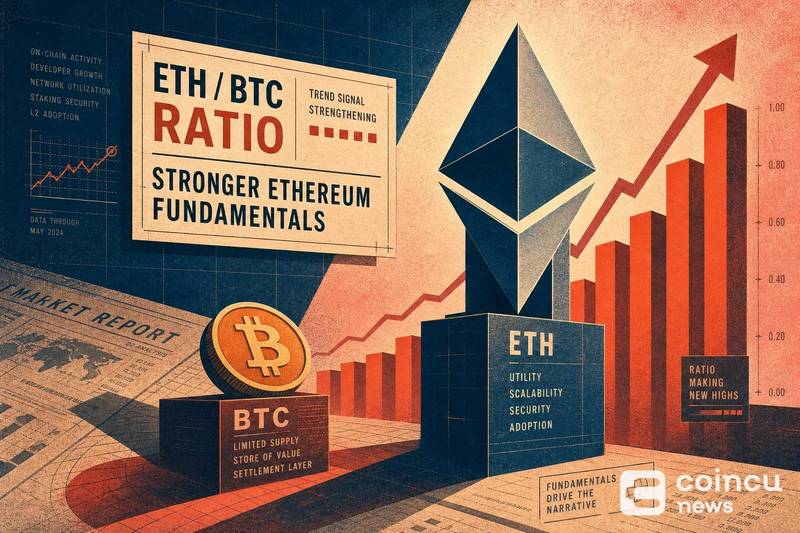
Fundstrat’s Tom Lee has pointed to a rising ETH/BTC ratio as a signal that market participants are pricing in improved Ethereum fundamentals, framing the relative strength of Ether against Bitcoin as a forward-looking indicator rather than a simple price move.
What the ETH/BTC Ratio Measures and Why It Matters Here
The ETH/BTC ratio tracks how many Bitcoin one Ether is worth. When the ratio rises, Ethereum is outperforming Bitcoin in relative terms, regardless of whether both assets are moving up or down in dollar value. For related coverage, see Ethereum sees stake build as BitMine holds 3.04M staked ETH.
Traders watch this ratio as a gauge of capital rotation between the two largest cryptocurrencies. A sustained move higher in ETH/BTC typically suggests that market participants see more upside potential or stronger near-term catalysts on the Ethereum side. For related coverage, see BTC Contract Open Interest Rises 5.85% in 24 Hours: What It Signals.
The ratio is distinct from absolute price action. Ethereum can lose value in dollar terms while still gaining ground against Bitcoin if Bitcoin falls faster. That nuance is central to interpreting Lee’s comments, which focus on relative positioning rather than outright price targets. For related coverage, see CertiK Hack3D Report: Web3 Losses Top $1.3B in H1 2026.
Tom Lee’s Thesis: Ratio Strength as a Fundamentals Signal
Tom Lee, co-founder and head of research at Fundstrat Global Advisors, noted that the rising ETH/BTC ratio reflects expectations for improved Ethereum fundamentals. The framing is deliberate: Lee is describing what the market is signaling, not declaring that fundamentals have already improved.
This distinction matters. A rising ratio can indicate that capital is rotating into Ethereum ahead of anticipated catalysts, whether those involve network upgrades, shifts in on-chain activity, or broader institutional positioning. Lee’s read treats the ratio as a consensus indicator, suggesting that enough participants expect positive developments to move the needle on relative valuation.
Fundstrat has historically used relative-strength frameworks to interpret crypto markets, treating cross-pair dynamics as sentiment proxies. Lee’s interpretation fits that pattern, positioning the ETH/BTC ratio as a leading rather than lagging signal.
What “Improved Fundamentals” Could Encompass
The phrase “improved Ethereum fundamentals” is broad, but in practice it maps to a handful of measurable categories. Network usage, including transaction throughput and active addresses, is one. Fee revenue and its relationship to Ethereum’s net supply dynamics is another.
Developer activity and smart contract deployment rates also fall under the fundamentals umbrella. So does capital locked in DeFi protocols built on Ethereum, as well as staking participation levels that reflect long-term holder conviction.
Institutional flows represent a separate dimension. Increased corporate or fund-level exposure to Ethereum, whether through treasury strategies that include ETH or through regulated investment vehicles, could be one of the catalysts the market is pricing in.
None of these categories are confirmed by Lee’s statement alone. They represent the analytical buckets that a rising ETH/BTC ratio could reflect, and the market’s bet is that at least some of them are trending positively.
Why the Signal Does Not Equal Confirmation
A rising ETH/BTC ratio is a price-derived signal. It reflects where money is flowing, not necessarily where on-chain metrics are heading. Price can lead fundamentals, but it can also lead traders into false narratives.
Short-term rotation is one alternative explanation. Traders cycling capital from Bitcoin into Ethereum after a prolonged period of Bitcoin-dominant positioning can push the ratio higher without any underlying change in Ethereum’s network health.
Narrative-driven moves are another factor. If enough market commentary frames Ethereum as undervalued relative to Bitcoin, the resulting positioning can temporarily lift the ratio regardless of fundamental trajectory. The signal becomes self-reinforcing until the narrative shifts.
Lee’s framing as “expectations for improved fundamentals” rather than confirmed improvement acknowledges this gap. The ratio tells you what the market believes. Whether those beliefs prove correct depends on whether Ethereum’s on-chain metrics and adoption trajectory actually follow through.
FAQ
What is the ETH/BTC ratio?
The ETH/BTC ratio measures the price of one Ether denominated in Bitcoin. It shows whether Ethereum is gaining or losing ground relative to Bitcoin, independent of dollar-denominated price moves.
Why would a rising ETH/BTC ratio matter for Ethereum?
A rising ratio suggests that capital is rotating toward Ethereum relative to Bitcoin. Market participants often interpret this as a sign that expectations for Ethereum’s growth, usage, or upcoming catalysts are improving compared to Bitcoin’s near-term outlook.
Does the ratio prove Ethereum fundamentals are improving?
No. The ratio is a price-based signal that reflects market expectations, not confirmed changes in network activity, revenue, or adoption. Fundamental improvement requires verification through on-chain data, and a rising ratio can also result from short-term rotation or narrative momentum.
Additional source references: source document 1.
Disclaimer: This article is for informational purposes only and does not constitute financial or investment advice. Cryptocurrency and digital asset markets carry significant risk. Always do your own research before making decisions.
No tags available.


Other Posts








- China, US Conclude Trade Talks with Focus on Cooperation
- Court Upholds Fed’s Rejection of Custodia Bank’s Request
- Crypto Weekly: NYSE Backs OKX, Kraken Gets Fed Access, BTC Sells
- Former CFO Convicted for $35M Fraudulent Crypto Investment
- DeriW Launches Edge Hour Trading Competition Platform for Derivatives Traders
- Michael Saylor Denies Bitcoin Sell-Off Amid Large BTC Transfer
- Buy Dogecoin on eToro: Step-by-Step Guide for Beginners (2024)
- Kazakhstan Explores Crypto Reserves Backed by National Funds
- JPMorgan Increases Holdings in BlackRock’s Bitcoin ETF
- Nordea Bank Introduces Bitcoin ETP Trading for Nordic Customers
- XRP Spot ETF Launches on Nasdaq Amid Market Fluctuations
- Peter Schiff Challenges Michael Saylor on MSTR’s Business Model
- Thailand Orders Worldcoin to Delete 1.2 Million Biometric Records
- UK Proposes New DeFi Tax Framework to Ease User Burden
- WLFI Under Fire: Analyst Warns Hyperliquid Could Be Next
- Ancient Ethereum Whale Moves $1.19 Billion After Decade
- BlackRock Receives Large Crypto Transfers from Coinbase
- SEC Scrutiny on ALT5 Sigma’s Leadership Disclosure Timing
- Yala Injects $5.5 Million Amid Recovery Efforts
- Radiant Capital Faces $50M Loss in Major Security Breach
- China, US Conclude Trade Talks with Focus on Cooperation
- Court Upholds Fed’s Rejection of Custodia Bank’s Request
- Crypto Weekly: NYSE Backs OKX, Kraken Gets Fed Access, BTC Sells
- Former CFO Convicted for $35M Fraudulent Crypto Investment
- DeriW Launches Edge Hour Trading Competition Platform for Derivatives Traders
- Michael Saylor Denies Bitcoin Sell-Off Amid Large BTC Transfer
- Buy Dogecoin on eToro: Step-by-Step Guide for Beginners (2024)
- Kazakhstan Explores Crypto Reserves Backed by National Funds
- JPMorgan Increases Holdings in BlackRock’s Bitcoin ETF
- Nordea Bank Introduces Bitcoin ETP Trading for Nordic Customers
- XRP Spot ETF Launches on Nasdaq Amid Market Fluctuations
- Peter Schiff Challenges Michael Saylor on MSTR’s Business Model
- Thailand Orders Worldcoin to Delete 1.2 Million Biometric Records
- UK Proposes New DeFi Tax Framework to Ease User Burden
- WLFI Under Fire: Analyst Warns Hyperliquid Could Be Next
- Ancient Ethereum Whale Moves $1.19 Billion After Decade
- BlackRock Receives Large Crypto Transfers from Coinbase
- SEC Scrutiny on ALT5 Sigma’s Leadership Disclosure Timing
- Yala Injects $5.5 Million Amid Recovery Efforts
- Radiant Capital Faces $50M Loss in Major Security Breach
- China, US Conclude Trade Talks with Focus on Cooperation
- Court Upholds Fed’s Rejection of Custodia Bank’s Request
- Crypto Weekly: NYSE Backs OKX, Kraken Gets Fed Access, BTC Sells
- Former CFO Convicted for $35M Fraudulent Crypto Investment
- DeriW Launches Edge Hour Trading Competition Platform for Derivatives Traders
- Michael Saylor Denies Bitcoin Sell-Off Amid Large BTC Transfer
- Buy Dogecoin on eToro: Step-by-Step Guide for Beginners (2024)
- Kazakhstan Explores Crypto Reserves Backed by National Funds
- JPMorgan Increases Holdings in BlackRock’s Bitcoin ETF
- Nordea Bank Introduces Bitcoin ETP Trading for Nordic Customers
- XRP Spot ETF Launches on Nasdaq Amid Market Fluctuations
- Peter Schiff Challenges Michael Saylor on MSTR’s Business Model
- Thailand Orders Worldcoin to Delete 1.2 Million Biometric Records
- UK Proposes New DeFi Tax Framework to Ease User Burden
- WLFI Under Fire: Analyst Warns Hyperliquid Could Be Next
- Ancient Ethereum Whale Moves $1.19 Billion After Decade
- BlackRock Receives Large Crypto Transfers from Coinbase
- SEC Scrutiny on ALT5 Sigma’s Leadership Disclosure Timing
- Yala Injects $5.5 Million Amid Recovery Efforts
- Radiant Capital Faces $50M Loss in Major Security Breach


Sources: Trump Expected to Attend White House Meeting With Crypto CEOs

Bitcoin Mining Rigs Shut Down in Capital of Major Mining Power
Bitmine Immersion Technologies Announces Record and Payment Dates for Cash Dividends on 9.50% Series A Perpetual Preferred Stock

Crypto Player Takes Home $1.749M After a Million PSG Bet on 1win