What Is Humanity Protocol? 5 Powerful Facts Behind the H Coin, App, and Airdrop
Most readers arrive at Humanity Protocol through one of five questions. What is Humanity Protocol? Who founded it? Is there an official app? How did the airdrop work? And what does the H coin actually do?
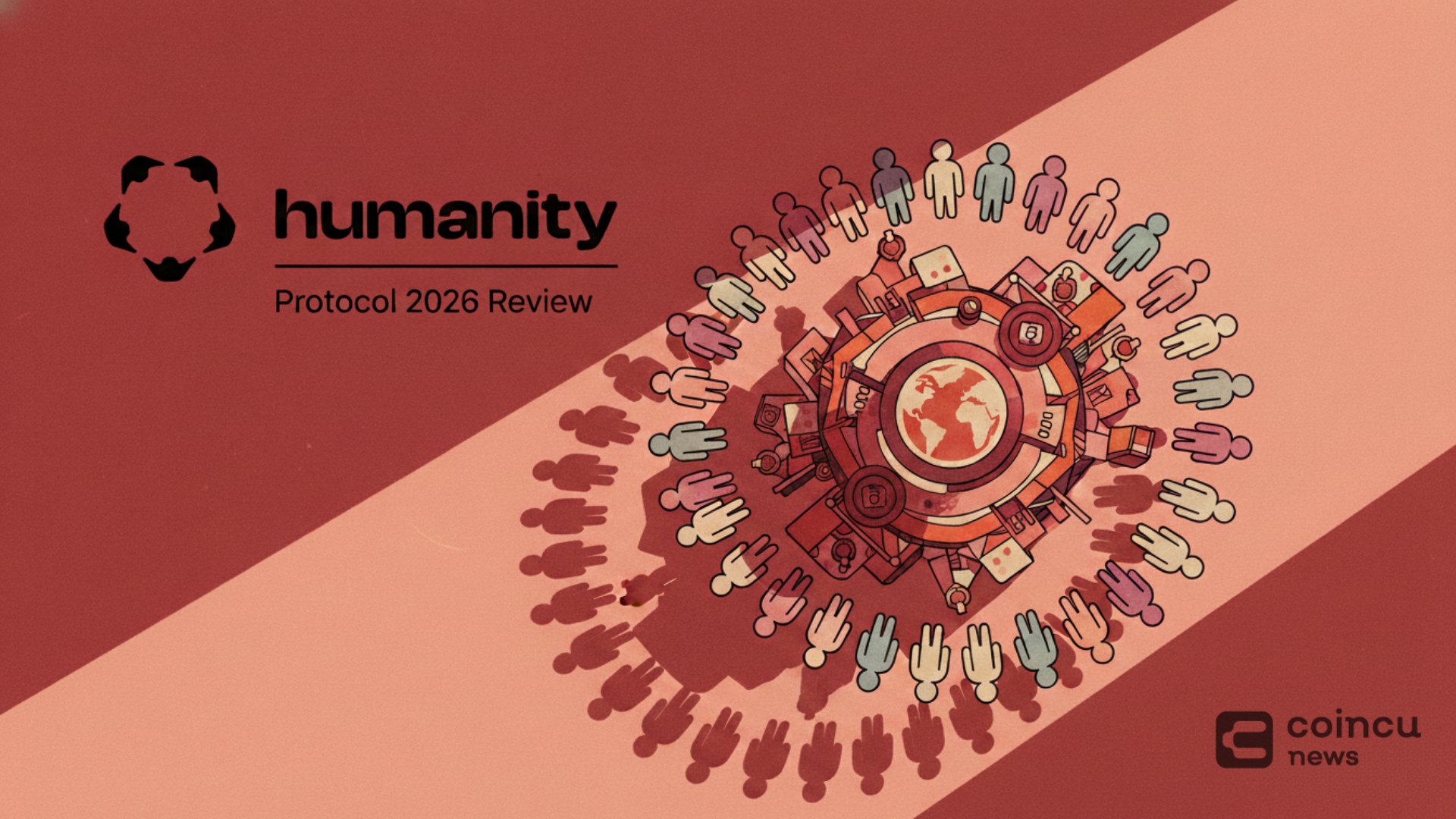
Those questions all point to the same deeper issue. Humanity is not just trying to launch another token with an identity narrative attached to it. The project is trying to build a trust layer where users can verify who they are once, then reuse privacy-preserving credentials across finance, events, education, communities, and other high-friction parts of the internet.
Humanity Protocol is best understood as a digital identity and trust infrastructure project, not simply as an airdrop, an app, or a coin. The protocol matters because it is moving from a narrower Proof of Humanity model toward a broader Proof of Trust model, while still keeping a visible founder-and-foundation structure, a live token economy, and an expanding list of real-world use cases.
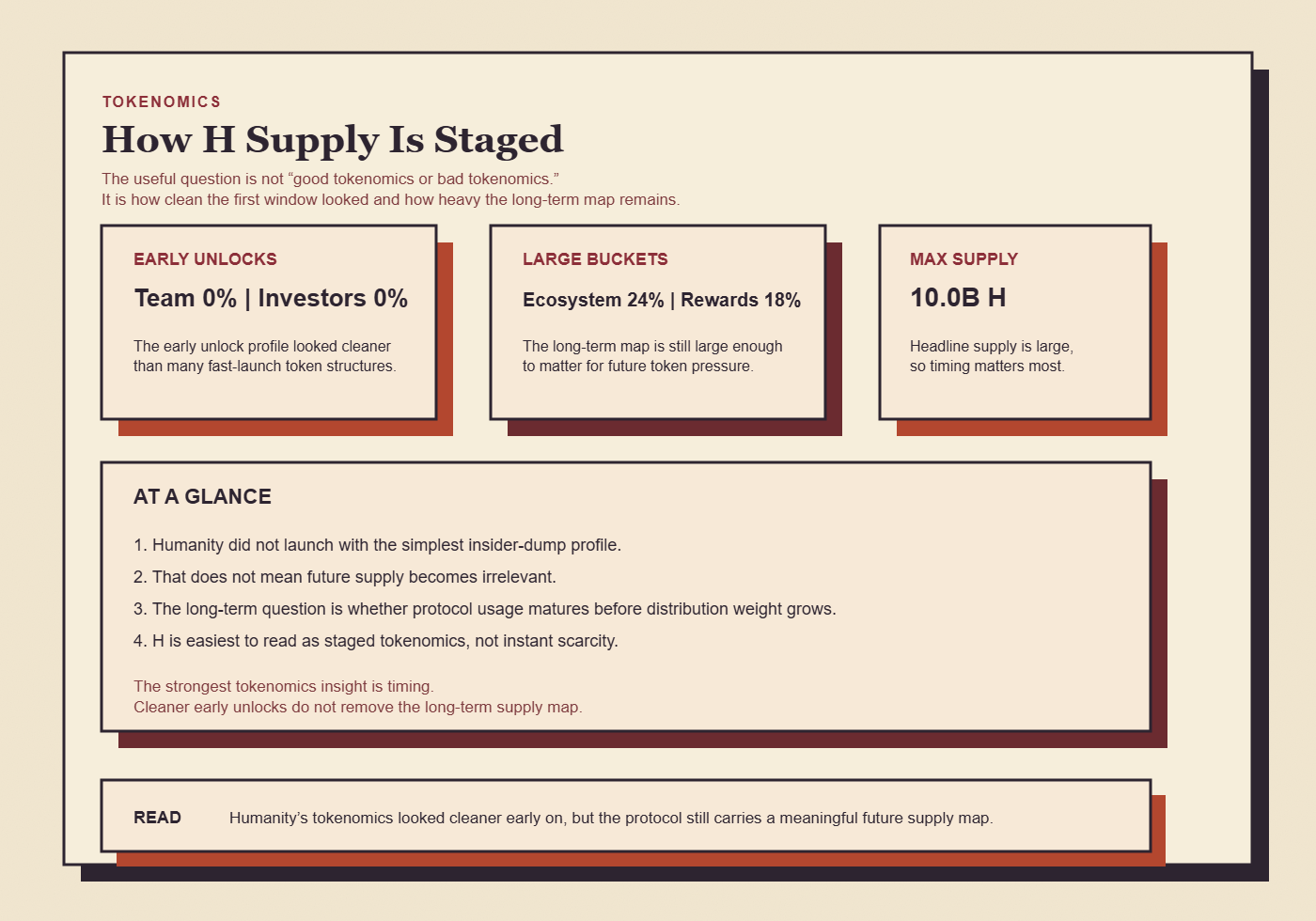
The token side is more nuanced than the branding first suggests. Official materials show a cleaner initial unlock profile than many readers may expect, with both team and investor buckets listed as 0% unlocked at TGE. At the same time, the long-term supply map is still large, which means the project has to prove that product relevance and credential usage can mature into durable token relevance over time.
This guide is built to answer the actual search intent around Humanity Protocol: what the protocol is, who runs it, how the app and fairdrop fit into the ecosystem, how tokenomics work, and what risks still matter in 2026.
Table of Contents
Key Takeaways
- Humanity Protocol is a digital identity and trust infrastructure project built around privacy-preserving human verification and reusable credentials.
- The biggest conceptual shift is the move from Proof of Humanity toward Proof of Trust, which expands the project from uniqueness checks into portable trust claims.
- The public leadership structure is still visible. Official materials list founder Terence Kwok, interim foundation CEO Yeewai Chong, and foundation directors Mario Nawfal and Yat Siu.
- Humanity has an official app layer and onboarding flow, including app.humanity.org plus iOS and Android app references on official channels.
What Is Humanity Protocol?
The simplest answer is that Humanity Protocol is trying to make identity programmable without making users surrender unnecessary privacy every time they prove something about themselves.
The protocol’s official materials describe Humanity as a privacy-preserving identity layer built around human verification, reusable credentials, self-sovereign control, and zero-knowledge infrastructure. That puts it in the same broad category as other crypto identity systems, which is also why Coincu’s earlier coverage of World ID integrations across Web3 platforms is useful context for comparison.
The more important point is how Humanity now describes its direction. Earlier framing centered on Proof of Humanity, which is mostly about proving that a user is real and unique. The newer framing centers on Proof of Trust, which broadens the model into reusable claims such as age, residency, employment, education, ownership, or compliance status, all without forcing users to reveal the underlying raw data each time.
That shift matters because it changes the ambition of the project. A proof-of-humanity system helps with bot resistance and Sybil defense. A proof-of-trust system is trying to become a broader trust rail for both Web3 and Web2-adjacent applications.
Humanity Protocol Founder and Team
One reason Humanity is easier to analyze than some community-run crypto networks is that the public leadership map is still visible.
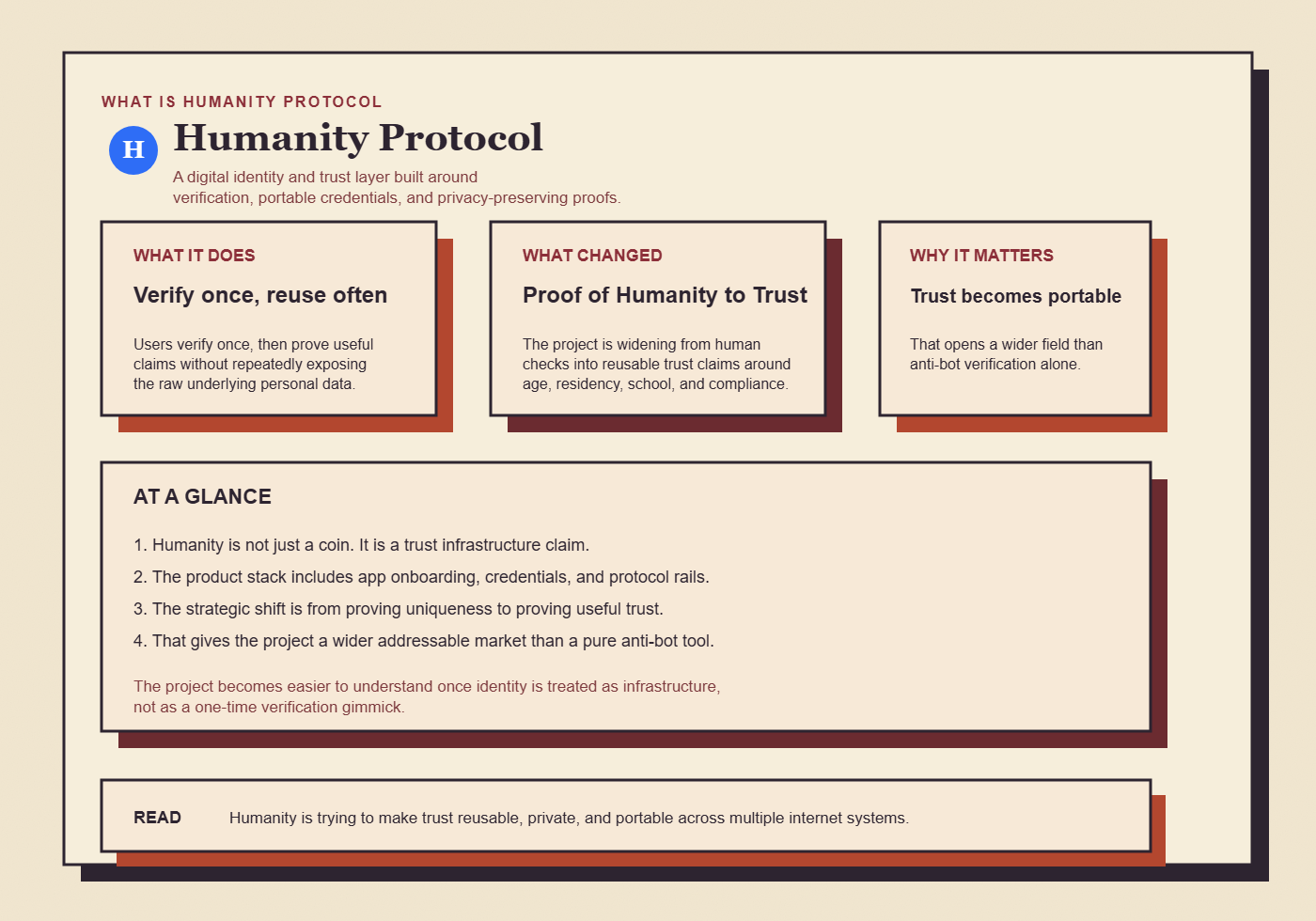
According to the official team page, Terence Kwok is listed as Founder. Yeewai Chong is listed as Interim Foundation CEO. Mario Nawfal and Yat Siu are listed as Foundation Directors. That matters because Humanity is still operating through a recognisable founder-and-foundation structure, even while official mission materials say the long-term goal is a community-governed protocol.
The official team page also surfaces public X profiles for the main leadership figures, which makes the operator layer easier to verify directly:
| Role | Person | Public social |
|---|---|---|
| Founder | Terence Kwok | X |
| Interim Foundation CEO | Yeewai Chong | X |
| Foundation Director | Mario Nawfal | X |
| Foundation Director | Yat Siu | X |
The funding side reinforces that reading. Humanity’s official funding announcement says the project secured a strategic round co-led by Jump Crypto and Pantera Capital at a $1.1 billion fully diluted valuation. That does not prove future success, but it does show that the identity and trust thesis already attracted serious capital and institutional attention.
The practical conclusion is straightforward. Humanity is not a faceless protocol with no visible operator layer, and it is not yet a fully diffuse community-governed system either. In 2026, it still looks like a protocol project with a public founder, a formal foundation layer, and a decentralization destination that remains in progress rather than fully achieved.
Humanity Protocol App: Is There An Official App?
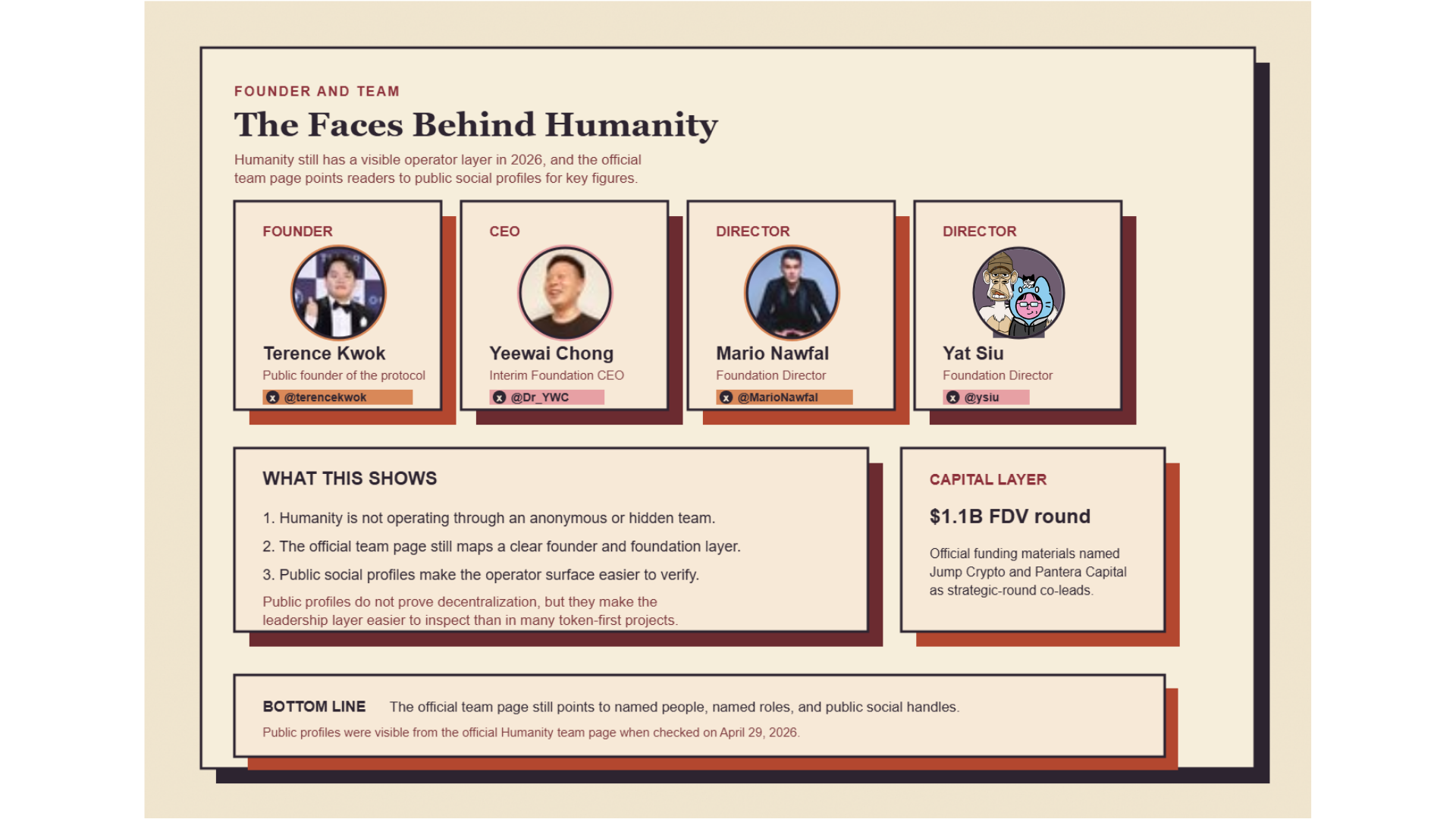
Yes, official Humanity materials do point to a real app layer, but the cleaner answer is that Humanity operates through both a web-based onboarding route and mobile app references rather than through a single simple consumer app story.
The official app hub is app.humanity.org. Humanity’s official materials also reference iOS and Android availability, along with a developer-facing and documentation layer for the mainnet. That means the “Humanity Protocol app” search intent is valid, but readers should think of the app as part of a broader identity onboarding and credential ecosystem rather than as a standalone retail product. That broader app-and-connection layer is easier to understand when read next to Coincu’s explainer on WalletConnect as Web3’s connectivity backbone, because identity onboarding only becomes useful when users can actually move between apps, credentials, and wallets cleanly.
The main reason the app matters is functional, not cosmetic. Humanity needs a user-facing way to onboard identity, manage credentials, interact with claims, and connect verification into use-case flows. Without that layer, the trust protocol would stay too abstract for normal users.
Humanity Protocol Airdrop And Fairdrop Eligibility
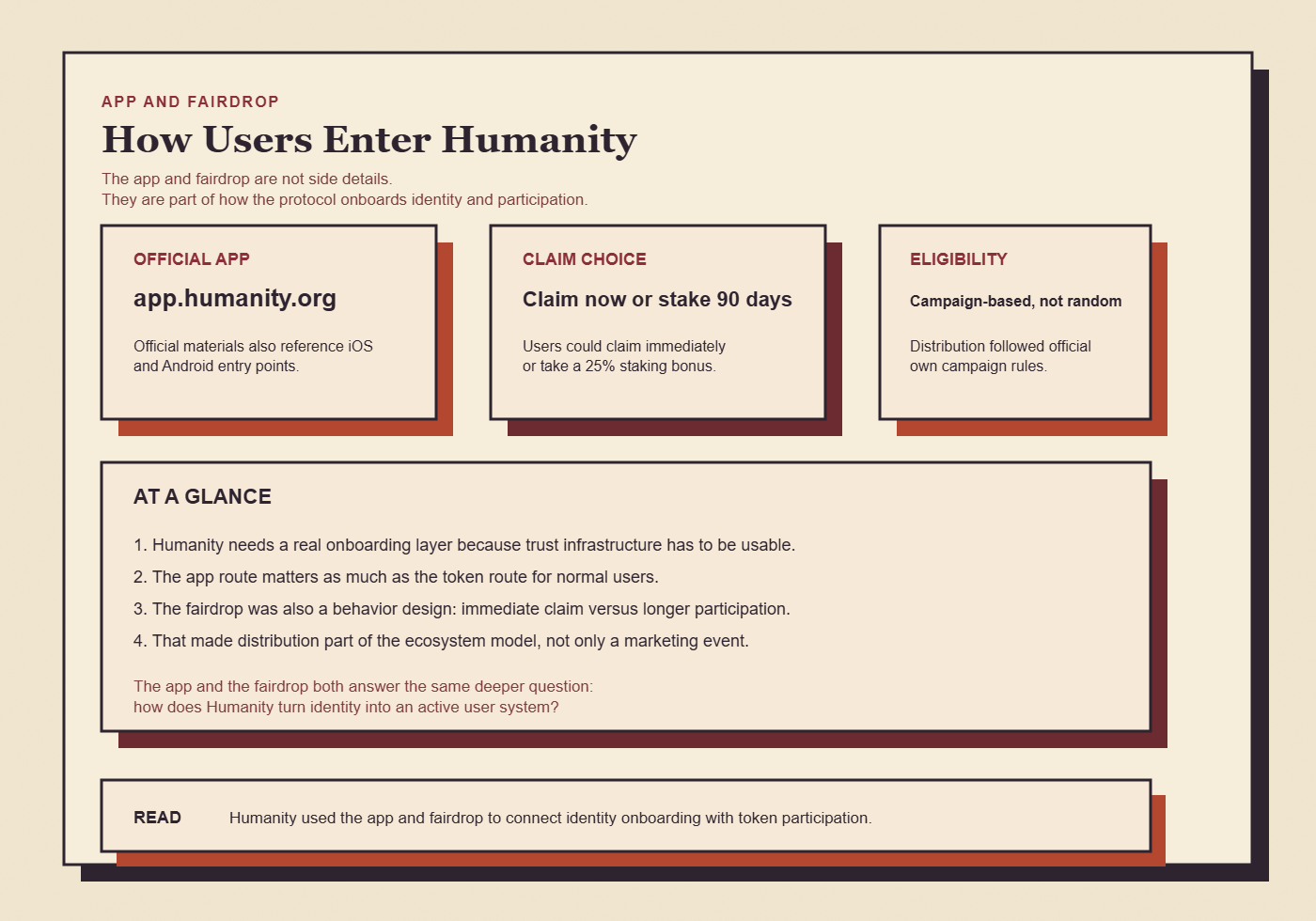
The official Humanity language focuses on a fairdrop rather than on a generic airdrop. That wording matters because the distribution was framed as part of ecosystem participation, not just pure free-token marketing.
According to the official claim materials, eligible users could either claim immediately and pay gas or stake for 90 days to receive a 25% bonus. That structure turned the fairdrop into a behavior fork. It was not only about who received H. It was also about whether recipients chose immediate liquidity or longer-duration participation.
For readers who want a broader framework for why staking changes market behavior, Coincu’s earlier Proof-of-Stake explainer is useful context even though Humanity’s fairdrop staking is not identical to validator staking.
For “Humanity Protocol airdrop eligibility,” the most accurate answer is that eligibility depended on Humanity’s own campaign rules and user history across the official distribution process. Official materials and community coverage tied the campaign to factors such as Human ID activity, referral systems, early ecosystem participation, and campaign-specific checkpoints. The protocol also used app-based verification and claim flows rather than treating the distribution as a simple wallet snapshot event.
Humanity Protocol Coin And Tokenomics
The H coin is the token layer tied to Humanity’s broader trust infrastructure. The official tokenomics page shows the following allocation structure:
| Allocation bucket | Share | Cliff | Vesting | Unlocked at TGE |
|---|---|---|---|---|
| Early Contributors (Team) | 19.00% | 12 months | 24 months | 0% |
| Investors | 10.00% | 12 months | 18 months | 0% |
| Community Incentives | 12.00% | 0 months | 0 months | 100% |
| Human Institute Strategic Reserves | 5.00% | 12 months | 18 months | 5% |
| Foundation Operations Treasury | 12.00% | 0 months | 48 months | 50% |
| Ecosystem Fund | 24.00% | 0 months | 48 months | 0% |
| Identity Verification Rewards | 18.00% | 6 months | 42 months | 0% |
That structure leads to a more balanced conclusion than either bulls or bears usually prefer.
On the positive side, team and investor buckets both showing 0% unlocked at TGE make the initial launch profile cleaner than many readers first assume. On the caution side, the long-term map still contains large future buckets across the ecosystem fund, foundation operations, and identity verification rewards. That is why Coincu’s explainers on tokenomics and token unlock risk are highly relevant in Humanity’s case.
The important discipline is to separate three different ideas:
| Token question | Better way to read it |
|---|---|
| Is H scarce right now? | Cleaner at TGE than many tokens, but not permanently scarce |
| Is H massively overdistributed from day one? | Not in the simple immediate-unlock sense |
| Is future supply still a real long-term factor? | Yes, because the ecosystem, treasury, and rewards map is still large |
What Makes Humanity Protocol Different?
Many identity projects can sound similar at headline level, so the useful question is where Humanity is trying to differentiate.
The first difference is the move from simple human verification into broader credential portability. Humanity is not only trying to prove that a user is real. It is trying to help that user carry reusable trust claims into different systems.
The second difference is the privacy framing. Official materials repeatedly lean on zero-knowledge architecture and selective disclosure rather than on a model where users constantly hand raw documents to every new service.
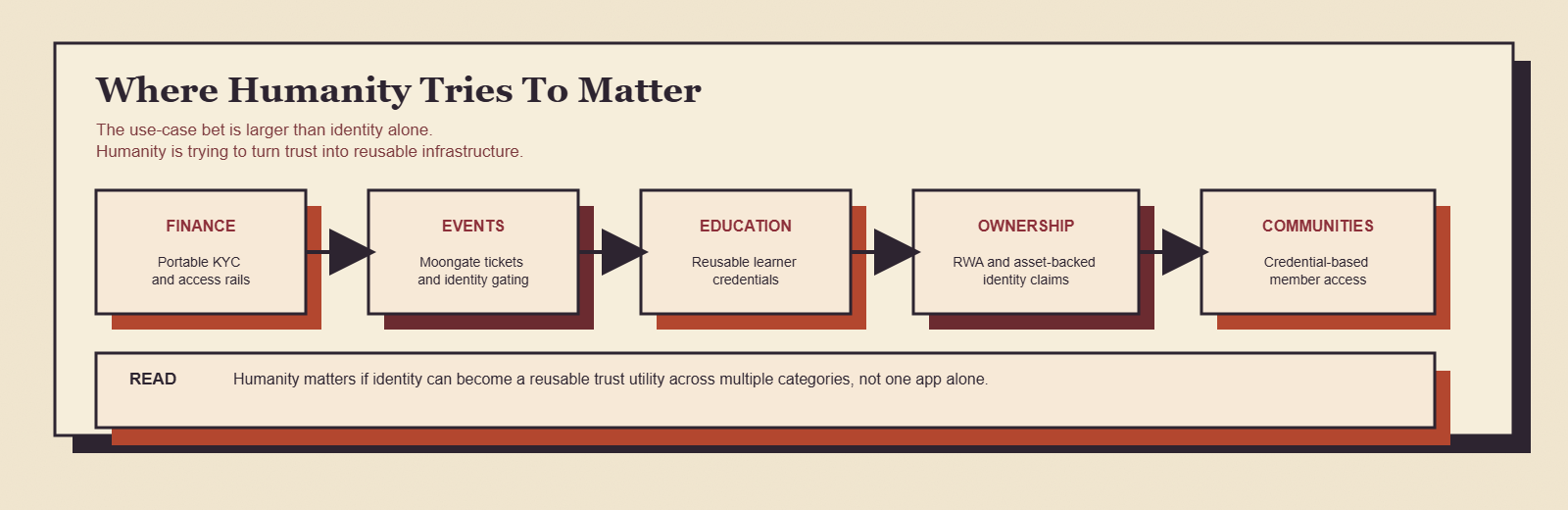
The third difference is the real-world use-case push. Humanity’s official use-case pages point toward finance, RWA-linked ownership, education credentials, loyalty systems, online communities, and access control. That makes the protocol easier to compare with infrastructure than with a one-purpose application. The finance angle becomes easier to read next to Coincu’s coverage of Mastercard’s broader crypto payment support expansion, because Humanity is clearly trying to place identity and trust rails inside that wider financial-access direction.
Then there is Moongate. The official Moongate page says the system has supported more than 300,000 on-chain tickets across events such as TOKEN2049, Binance Blockchain Week, and ETHDenver, while integrating Humanity’s palm-based verification and credential model. That does not prove that the token economy is solved. It does show that the protocol is trying to anchor itself in actual identity-and-access workflows rather than staying theoretical.
Main Risks In A Humanity Protocol Review
The biggest risk is execution. Ambition is not the same thing as deployment, and a protocol that wants to become trust infrastructure across multiple verticals is taking on a very difficult operating challenge.
The second risk is token-demand mismatch. Humanity can prove product relevance faster than it proves token relevance. That gap matters because a strong identity product does not automatically create durable value capture for H.
The third risk is supply overhang. The initial unlock structure looked cleaner than many fast-launch tokens, but the future distribution map is still large enough to matter over time. In Humanity’s case, that pressure would come less from a simple day-one dump story and more from how larger future buckets eventually move toward the market.
The fourth risk is trust sensitivity itself. Identity protocols face a higher burden than many crypto products because privacy, biometrics, governance, and compliance all sit in the same conversation. If users become uncomfortable with any one of those pillars, the protocol can feel fragile quickly.
The fifth risk is governance maturity. Humanity still has a visible founder-and-foundation structure, while also talking about long-term community governance. That transition path matters, and it has not been fully proven yet.
| Structural risk | Why it matters |
|---|---|
| Execution risk | Cross-vertical trust infrastructure is hard to operationalize |
| Token-demand mismatch | Product usage does not automatically become token value capture |
| Supply overhang | Cleaner early distribution does not remove long-term release risk |
| Privacy and biometrics sensitivity | Trust can weaken fast if users dislike the operating model |
| Governance maturity risk | The path from visible leadership to durable community governance still needs to be demonstrated |
Current Humanity Protocol Snapshot
Last updated: April 29, 2026
The sections above are designed to stay useful over time. The figures below are the point-in-time snapshot checked for this guide.
| Metric | Value |
|---|---|
| Circulating supply | 2.7268B H |
| Max supply | 10.0B H |
| Team unlock at TGE | 0% |
| Investor unlock at TGE | 0% |
| Community incentives allocation | 12.00% |
| Humanity Explorer verified users | 476,121 |
| Humanity Explorer total users | 8,948,025 |
| Humanity Explorer credentials issued | 9,300,478 |
| Humanity Explorer issuers | 20 |
These numbers describe a protocol that is already broad enough to matter, but still early enough that its long-term operating and token model remain open questions.
Readers who want a quick refresher on terms such as circulating supply, market cap, or fully diluted valuation can also use Coincu’s crypto glossary as a simple reference layer alongside this snapshot.
FAQ
What is Humanity Protocol in simple terms?
Humanity Protocol is a privacy-preserving identity and trust infrastructure project. In simple terms, it is trying to let users prove important facts about themselves, such as uniqueness or other credentials, without exposing more personal data than necessary.
Who founded Humanity Protocol?
According to Humanity’s official team page, Terence Kwok is listed as Founder. The same page lists Yeewai Chong as Interim Foundation CEO, with Mario Nawfal and Yat Siu listed as Foundation Directors.
Is there an official Humanity Protocol app?
Yes. Official Humanity materials point users to app.humanity.org and also reference mobile app availability through official channels. The safer path is to use Humanity’s own website and linked app routes rather than third-party APK pages or unofficial installers.
How did Humanity Protocol airdrop eligibility work?
Humanity described the distribution as a fairdrop rather than a generic airdrop. Eligibility depended on Humanity’s own campaign rules and user activity across its official process, including identity-related participation, referral or campaign mechanics, and app-based verification steps tied to the distribution flow.
What does the H coin do?
H is the token layer tied to Humanity’s broader trust infrastructure. The token matters not only as a tradable asset, but also as part of the protocol’s incentive, distribution, and ecosystem design around verification, participation, and longer-term network growth.
What makes Humanity Protocol different from other identity projects?
The biggest difference is that Humanity is trying to move beyond simple proof-of-human verification into a broader Proof of Trust model. That means the project is not only about proving a user is real, but also about making privacy-preserving credentials portable across finance, events, education, ownership, and other trust-heavy digital environments.
Methodology
This guide is based on public materials checked on April 29, 2026, including the CoinMarketCap Humanity Protocol page, the official H token page, the Humanity protocol page, the Proof of Trust page, the Humanity mission page, the official team page, the official app hub, the Humanity app page, the mainnet documentation page, the mainnet launch post, the fairdrop claim post, the staking post, the Fireblocks announcement, the Mastercard announcement, the D’CENT announcement, the The New Humanity: What’s Changing? post, the Humanity use-cases page, the Moongate page, and the Humanity Explorer overview.
This article is written as a search-intent explainer first. Current token and protocol figures are isolated in the snapshot section so the core guide can stay useful even when numbers change.
Disclaimer
This article is for research and informational purposes only and should not be treated as financial advice. Identity protocols can carry strong narratives, but narrative breadth does not remove execution risk, governance risk, or token-structure risk.
Sources
CoinMarketCap, Humanity Protocol page: https://coinmarketcap.com/currencies/humanity-protocol/
Humanity, H token page: https://www.humanity.org/h-token
Humanity, protocol page: https://www.humanity.org/protocol
Humanity, Proof of Trust page: https://www.humanity.org/proof-of-trust
Humanity, mission page: https://www.humanity.org/mission
Humanity, team page: https://www.humanity.org/team
Humanity, app page: https://www.humanity.org/app
Humanity app hub: https://app.humanity.org/
Humanity docs, mainnet: https://docs.humanity.org/mainnet
Humanity, Humanity Protocol Mainnet Live, Bridging Web2 and Web3: https://www.humanity.org/blog/humanity-protocol-mainnet-live-bridging-web2-and-web3
Humanity, $H is Here: Here’s How You Can Claim and Stake your Fairdrop: https://www.humanity.org/blog/h-is-here-here-s-how-you-can-claim-and-stake-your-fairdrop
Humanity, A New Chapter for $H: Why Staking Today Builds the Humanity of Tomorrow: https://www.humanity.org/blog/staking-h
Humanity, Humanity Mainnet Integrates with Fireblocks, Expanding Institutional Treasury Access: https://www.humanity.org/blog/humanity-mainnet-integrates-with-fireblocks-expanding-institutional-treasury-access
Humanity, Humanity Protocol Taps Mastercard Open Finance Technology to Enable Secure Access to Financial Services through Human ID: https://www.humanity.org/blog/mastercard-partners-with-humanity-protocol-to-enable-privacy-preserving-access-to-financial-services
Humanity, $H Now Supported on D’CENT Wallet: Security Meets Humanity: https://www.humanity.org/blog/h-now-supported-on-d-cent-wallet-security-meets-humanity
Humanity, The New Humanity: What’s Changing?: https://www.humanity.org/blog/the-new-humanity-what-s-changing
Humanity, use-cases page: https://www.humanity.org/use-cases
Humanity, Moongate page: https://www.humanity.org/moongate-by-humanity-protocol
Humanity Protocol funding announcement with Jump Crypto and Pantera Capital: https://www.humanity.org/blog/humanity-protocol-secures-strategic-funding-from-jump-crypto-and-pantera-capital-at-1-1b-fully-diluted-valuation
Humanity Explorer overview: https://explorer.humanity.org/mainnet/overview
No tags available.


- China, US Conclude Trade Talks with Focus on Cooperation
- Crypto Weekly: NYSE Backs OKX, Kraken Gets Fed Access, BTC Sells
- Court Upholds Fed’s Rejection of Custodia Bank’s Request
- Former CFO Convicted for $35M Fraudulent Crypto Investment
- DeriW Launches Edge Hour Trading Competition Platform for Derivatives Traders
- Michael Saylor Denies Bitcoin Sell-Off Amid Large BTC Transfer
- Buy Dogecoin on eToro: Step-by-Step Guide for Beginners (2024)
- Kazakhstan Explores Crypto Reserves Backed by National Funds
- JPMorgan Increases Holdings in BlackRock’s Bitcoin ETF
- Nordea Bank Introduces Bitcoin ETP Trading for Nordic Customers
- XRP Spot ETF Launches on Nasdaq Amid Market Fluctuations
- Peter Schiff Challenges Michael Saylor on MSTR’s Business Model
- Thailand Orders Worldcoin to Delete 1.2 Million Biometric Records
- UK Proposes New DeFi Tax Framework to Ease User Burden
- WLFI Under Fire: Analyst Warns Hyperliquid Could Be Next
- Ancient Ethereum Whale Moves $1.19 Billion After Decade
- BlackRock Receives Large Crypto Transfers from Coinbase
- SEC Scrutiny on ALT5 Sigma’s Leadership Disclosure Timing
- Yala Injects $5.5 Million Amid Recovery Efforts
- Radiant Capital Faces $50M Loss in Major Security Breach
- China, US Conclude Trade Talks with Focus on Cooperation
- Crypto Weekly: NYSE Backs OKX, Kraken Gets Fed Access, BTC Sells
- Court Upholds Fed’s Rejection of Custodia Bank’s Request
- Former CFO Convicted for $35M Fraudulent Crypto Investment
- DeriW Launches Edge Hour Trading Competition Platform for Derivatives Traders
- Michael Saylor Denies Bitcoin Sell-Off Amid Large BTC Transfer
- Buy Dogecoin on eToro: Step-by-Step Guide for Beginners (2024)
- Kazakhstan Explores Crypto Reserves Backed by National Funds
- JPMorgan Increases Holdings in BlackRock’s Bitcoin ETF
- Nordea Bank Introduces Bitcoin ETP Trading for Nordic Customers
- XRP Spot ETF Launches on Nasdaq Amid Market Fluctuations
- Peter Schiff Challenges Michael Saylor on MSTR’s Business Model
- Thailand Orders Worldcoin to Delete 1.2 Million Biometric Records
- UK Proposes New DeFi Tax Framework to Ease User Burden
- WLFI Under Fire: Analyst Warns Hyperliquid Could Be Next
- Ancient Ethereum Whale Moves $1.19 Billion After Decade
- BlackRock Receives Large Crypto Transfers from Coinbase
- SEC Scrutiny on ALT5 Sigma’s Leadership Disclosure Timing
- Yala Injects $5.5 Million Amid Recovery Efforts
- Radiant Capital Faces $50M Loss in Major Security Breach
- China, US Conclude Trade Talks with Focus on Cooperation
- Crypto Weekly: NYSE Backs OKX, Kraken Gets Fed Access, BTC Sells
- Court Upholds Fed’s Rejection of Custodia Bank’s Request
- Former CFO Convicted for $35M Fraudulent Crypto Investment
- DeriW Launches Edge Hour Trading Competition Platform for Derivatives Traders
- Michael Saylor Denies Bitcoin Sell-Off Amid Large BTC Transfer
- Buy Dogecoin on eToro: Step-by-Step Guide for Beginners (2024)
- Kazakhstan Explores Crypto Reserves Backed by National Funds
- JPMorgan Increases Holdings in BlackRock’s Bitcoin ETF
- Nordea Bank Introduces Bitcoin ETP Trading for Nordic Customers
- XRP Spot ETF Launches on Nasdaq Amid Market Fluctuations
- Peter Schiff Challenges Michael Saylor on MSTR’s Business Model
- Thailand Orders Worldcoin to Delete 1.2 Million Biometric Records
- UK Proposes New DeFi Tax Framework to Ease User Burden
- WLFI Under Fire: Analyst Warns Hyperliquid Could Be Next
- Ancient Ethereum Whale Moves $1.19 Billion After Decade
- BlackRock Receives Large Crypto Transfers from Coinbase
- SEC Scrutiny on ALT5 Sigma’s Leadership Disclosure Timing
- Yala Injects $5.5 Million Amid Recovery Efforts
- Radiant Capital Faces $50M Loss in Major Security Breach

Uniswap Launches Earn Feature for USDC, USDT, and ETH Deposits


Circle Obtains New York State Limited Purpose Trust License: What It Means

Performa Marks One Year Live with Major Upgrade for Digital-Native SMBs
Zoomex to Attend Coinfest Asia 2026 as Gold Sponsor and Host Summer Bay Party in Bali