The Korea Exchange activated its SIDECAR mechanism, triggering an automatic suspension of programmed buying orders tied to the Korea GEM Index. The measure, designed as a volatility circuit breaker, temporarily halted algorithmic order execution on the small-cap focused index during a period of sharp price movement.
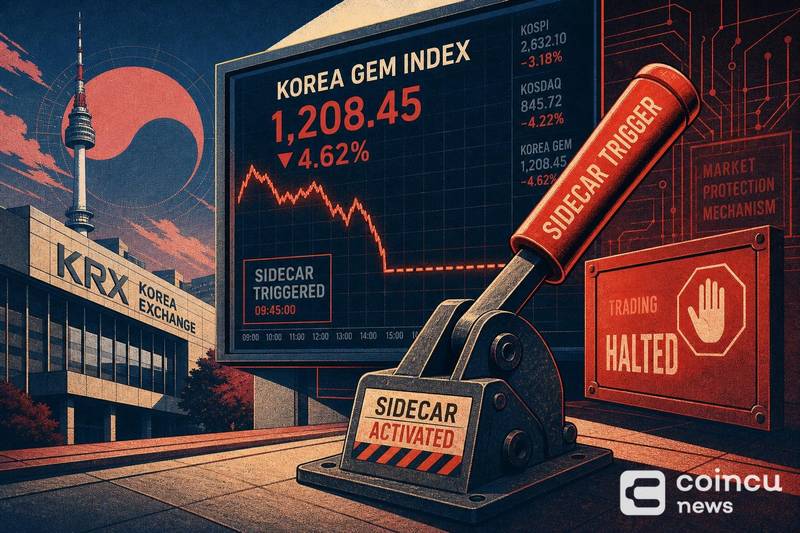
What the SIDECAR activation means for Korea GEM Index trading
A SIDECAR is an automated volatility safeguard used by the Korea Exchange (KRX) to temporarily suspend program trading when futures prices move beyond a set threshold within a short period. Unlike a full trading halt, the SIDECAR only targets programmed or algorithmic orders, leaving manual trading activity unaffected.
The activation specifically applied to the Korea GEM Index, which tracks small and mid-cap growth enterprises listed on the Korean market. When triggered, the mechanism suspends all program buy orders for a defined cooling period, typically five minutes, before normal trading resumes.
This type of intervention is procedural rather than discretionary. The exchange’s automated systems detect when index-linked futures experience rapid price swings and deploy the SIDECAR without manual intervention from exchange officials.
Why exchanges deploy automated circuit breakers
Volatility safeguards like the SIDECAR exist to prevent feedback loops where algorithmic trading amplifies rapid price movements. Program trading strategies that automatically execute large baskets of buy or sell orders can accelerate momentum in already stressed market conditions.
By temporarily removing programmed orders from the order book, the mechanism aims to restore price discovery driven by discretionary market participants. This is particularly relevant for small-cap indices like the Korea GEM, where liquidity is thinner and individual stocks are more susceptible to large order flow imbalances.
The Korea Exchange operates several tiers of market safeguards. The SIDECAR sits below a full circuit breaker halt and is designed to address program-trading-specific risks without disrupting the broader market structure. Global cryptocurrency markets track similar volatility patterns, and tools like the Crypto Fear and Greed Index serve an analogous function by measuring sentiment extremes across digital asset markets.
How the suspension affects traders and market sentiment
For algorithmic and quantitative traders running index arbitrage or basket strategies tied to the Korea GEM Index, a SIDECAR activation forces an immediate pause in execution. Pending program buy orders are held until the suspension lifts, which can create short-term dislocations between futures and the underlying index components.
Intraday liquidity can thin during the suspension window as a significant share of order flow on small-cap indices comes from programmatic strategies. Manual traders may see wider bid-ask spreads during and immediately after the SIDECAR period.
Market participants generally interpret SIDECAR activations as signals of elevated short-term volatility rather than fundamental distress. The mechanism has been triggered periodically during past episodes of regional market stress, and sentiment indicators have shown periods of deep fear across asset classes during similar episodes.
What broader market watchers should note
Exchange-level interventions on equity indices are closely monitored by cross-market participants, including those in digital assets. Regional equity volatility can influence risk appetite across correlated markets, and traders in crypto often watch traditional market stress indicators for positioning signals. Tracking global crypto market capitalization trends alongside equity circuit breaker events can help identify cross-asset risk contagion.
South Korea’s financial markets carry particular significance for crypto-adjacent watchers given the country’s outsized retail participation in digital asset trading. Periods of equity market stress in Korea have historically coincided with shifts in local crypto trading volumes, as retail capital flows respond to changing risk sentiment. Institutional players, including those building Web3 education partnerships in the region, also monitor these equity signals closely.
The SIDECAR suspension was a temporary, procedural measure, and trading in the Korea GEM Index resumed under normal conditions after the cooling period expired. The activation does not indicate any change in exchange policy or listing requirements for GEM-listed companies.
FAQ: Korea Exchange SIDECAR mechanism and Korea GEM Index
What is a SIDECAR mechanism?
A SIDECAR is an automated circuit breaker deployed by the Korea Exchange that temporarily suspends program trading when index-linked futures prices move beyond a predefined threshold. It targets only algorithmic orders, not manual trades.
Did the Korea Exchange halt all trading?
No. The SIDECAR only suspended programmed buying orders on the Korea GEM Index. Manual trading and other indices continued to operate normally during the suspension. Large-scale promotional events like crypto reward tournaments tied to global sports also continued unaffected by the equity-side intervention.
How long does a SIDECAR suspension last?
A SIDECAR-related suspension on the Korea Exchange typically lasts five minutes. After the cooling period, program trading resumes automatically unless market conditions trigger a more severe circuit breaker.
Disclaimer: This article is for informational purposes only and does not constitute financial or investment advice. Cryptocurrency and digital asset markets carry significant risk. Always do your own research before making decisions.
No tags available.


Other Posts








- China, US Conclude Trade Talks with Focus on Cooperation
- Crypto Weekly: NYSE Backs OKX, Kraken Gets Fed Access, BTC Sells
- Court Upholds Fed’s Rejection of Custodia Bank’s Request
- Former CFO Convicted for $35M Fraudulent Crypto Investment
- DeriW Launches Edge Hour Trading Competition Platform for Derivatives Traders
- Michael Saylor Denies Bitcoin Sell-Off Amid Large BTC Transfer
- Buy Dogecoin on eToro: Step-by-Step Guide for Beginners (2024)
- Kazakhstan Explores Crypto Reserves Backed by National Funds
- JPMorgan Increases Holdings in BlackRock’s Bitcoin ETF
- Nordea Bank Introduces Bitcoin ETP Trading for Nordic Customers
- XRP Spot ETF Launches on Nasdaq Amid Market Fluctuations
- Peter Schiff Challenges Michael Saylor on MSTR’s Business Model
- Thailand Orders Worldcoin to Delete 1.2 Million Biometric Records
- UK Proposes New DeFi Tax Framework to Ease User Burden
- WLFI Under Fire: Analyst Warns Hyperliquid Could Be Next
- Ancient Ethereum Whale Moves $1.19 Billion After Decade
- BlackRock Receives Large Crypto Transfers from Coinbase
- SEC Scrutiny on ALT5 Sigma’s Leadership Disclosure Timing
- Yala Injects $5.5 Million Amid Recovery Efforts
- Radiant Capital Faces $50M Loss in Major Security Breach
- China, US Conclude Trade Talks with Focus on Cooperation
- Crypto Weekly: NYSE Backs OKX, Kraken Gets Fed Access, BTC Sells
- Court Upholds Fed’s Rejection of Custodia Bank’s Request
- Former CFO Convicted for $35M Fraudulent Crypto Investment
- DeriW Launches Edge Hour Trading Competition Platform for Derivatives Traders
- Michael Saylor Denies Bitcoin Sell-Off Amid Large BTC Transfer
- Buy Dogecoin on eToro: Step-by-Step Guide for Beginners (2024)
- Kazakhstan Explores Crypto Reserves Backed by National Funds
- JPMorgan Increases Holdings in BlackRock’s Bitcoin ETF
- Nordea Bank Introduces Bitcoin ETP Trading for Nordic Customers
- XRP Spot ETF Launches on Nasdaq Amid Market Fluctuations
- Peter Schiff Challenges Michael Saylor on MSTR’s Business Model
- Thailand Orders Worldcoin to Delete 1.2 Million Biometric Records
- UK Proposes New DeFi Tax Framework to Ease User Burden
- WLFI Under Fire: Analyst Warns Hyperliquid Could Be Next
- Ancient Ethereum Whale Moves $1.19 Billion After Decade
- BlackRock Receives Large Crypto Transfers from Coinbase
- SEC Scrutiny on ALT5 Sigma’s Leadership Disclosure Timing
- Yala Injects $5.5 Million Amid Recovery Efforts
- Radiant Capital Faces $50M Loss in Major Security Breach
- China, US Conclude Trade Talks with Focus on Cooperation
- Crypto Weekly: NYSE Backs OKX, Kraken Gets Fed Access, BTC Sells
- Court Upholds Fed’s Rejection of Custodia Bank’s Request
- Former CFO Convicted for $35M Fraudulent Crypto Investment
- DeriW Launches Edge Hour Trading Competition Platform for Derivatives Traders
- Michael Saylor Denies Bitcoin Sell-Off Amid Large BTC Transfer
- Buy Dogecoin on eToro: Step-by-Step Guide for Beginners (2024)
- Kazakhstan Explores Crypto Reserves Backed by National Funds
- JPMorgan Increases Holdings in BlackRock’s Bitcoin ETF
- Nordea Bank Introduces Bitcoin ETP Trading for Nordic Customers
- XRP Spot ETF Launches on Nasdaq Amid Market Fluctuations
- Peter Schiff Challenges Michael Saylor on MSTR’s Business Model
- Thailand Orders Worldcoin to Delete 1.2 Million Biometric Records
- UK Proposes New DeFi Tax Framework to Ease User Burden
- WLFI Under Fire: Analyst Warns Hyperliquid Could Be Next
- Ancient Ethereum Whale Moves $1.19 Billion After Decade
- BlackRock Receives Large Crypto Transfers from Coinbase
- SEC Scrutiny on ALT5 Sigma’s Leadership Disclosure Timing
- Yala Injects $5.5 Million Amid Recovery Efforts
- Radiant Capital Faces $50M Loss in Major Security Breach

POSCO International and LG CNS Launch Blockchain Pilot for Accounts Receivable

Russian Central Bank Governor Backs Crypto Purchase Caps for Retail Investors

BNY Mellon Targets 2027 for 24/7 Tokenized Treasury Settlement
RISEx Launches ‘Ignite’ Season 1 Points Program, Following $3B in Volume During the Early Access Phase

Zoomex X Space Recap With Fernando Llorente and the World Cup Final Panel