Vitalik Buterin Launches AI De-Anonymization Experiment, Reveals Anonymous Ethereum Writing
Ethereum co-founder Vitalik Buterin has disclosed his involvement in launching an AI-powered de-anonymization experiment, while simultaneously revealing that he once authored key Ethereum documents under pseudonymous identities. The dual disclosure, made through a blog post on privacy, underscores growing tensions between artificial intelligence capabilities and the pseudonymous culture that underpins much of the blockchain world.
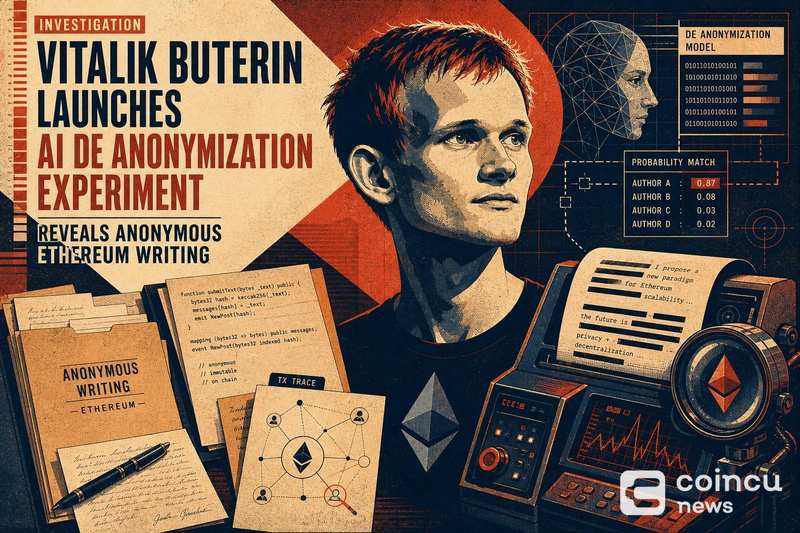
Vitalik Helped Launch an AI De-Anonymization Experiment
Buterin outlined his participation in the experiment in an April 2025 blog post titled “Privacy,” published on his personal website. The post frames the experiment as part of a broader argument about why privacy protections in blockchain systems need to be strengthened, not relaxed.
The story centers on Buterin’s own framing of the project. He presented the experiment not as a product launch or commercial venture, but as a demonstration of how current AI models can strip away online pseudonymity. The research brief for this article carries a partial verification status, meaning some details of the experiment’s scope and results remain unconfirmed.
Buterin’s disclosure arrives at a time when Ethereum ecosystem participants are navigating multiple transparency-related developments, from institutional players reporting significant ETH holdings to evolving standards around on-chain identity.
What the De-Anonymization Research Tests
The experiment appears to be connected to research on large-scale online deanonymization using large language models, hosted by the MATS research program. The research explores how LLMs can match writing patterns across pseudonymous accounts to identify the same author.
At a high level, the approach uses stylometric analysis powered by modern AI models. Rather than relying on metadata leaks or operational security failures, the technique analyzes writing style, vocabulary choices, and sentence structure to link anonymous posts to known identities.
Specific accuracy rates, dataset sizes, and detailed results from the experiment have not been independently verified for this article. What is clear from the available evidence is that the research focuses on text-based deanonymization rather than blockchain address clustering or transaction graph analysis.
The distinction matters. While blockchain analytics firms have long tracked wallet addresses and transaction flows, this experiment targets a different layer of pseudonymity: the written word. For communities like Ethereum, where pseudonymous contributors have shaped governance proposals, protocol documentation, and ecosystem projects, that capability carries particular weight.
Why the Anonymous Ethereum Writing Claim Stands Out
Alongside the experiment disclosure, Buterin made a personal admission that adds concrete stakes to the privacy argument. He stated that he once wrote key Ethereum documents anonymously, without attaching his widely recognized name.
This is a first-person disclosure from the most prominent figure in the Ethereum ecosystem. Buterin did not frame the admission as controversial or secretive. Instead, he used it to illustrate why pseudonymous contribution matters for open-source blockchain communities.
The implication is direct: if an AI system like the one described in the experiment could have identified Buterin as the author of those documents at the time, the pseudonymous contribution would have failed. The anonymous authorship would have been rendered meaningless.
Buterin’s admission also raises questions about Ethereum governance and authorship more broadly. If the ecosystem’s most recognizable figure felt the need to write anonymously at certain points, other contributors operating under pseudonyms may face even greater exposure risks as AI capabilities advance. This is especially relevant as projects across the crypto industry grapple with disclosure norms around contributor identity and eligibility.
How the Disclosure Fits Buterin’s Broader Privacy Argument
The experiment and the anonymous-writing anecdote are not separate stories. Buterin presented them as two sides of the same argument in his related post on X: that privacy is an essential feature, not a bug, and that AI is actively eroding it.
His thesis connects to a long-running tension in blockchain communities. Public blockchains are transparent by design, with every transaction visible on-chain. But the people building, governing, and using these systems have historically relied on pseudonymity to participate without exposing their full identities.
Buterin’s argument is that AI-powered deanonymization threatens this balance. If LLMs can reliably match writing styles across platforms, then pseudonymous forum posts, governance proposals, and even anonymous blog entries become linkable to real identities. The practical privacy that pseudonymity once offered diminishes as model capabilities improve.
The privacy argument also extends beyond individual contributors. Projects that rely on anonymous or pseudonymous teams, a common structure in DeFi and across cross-chain infrastructure development, face a new category of risk if AI stylometry becomes widely accessible.
FAQ: What Readers Still Need Clarified
What exactly is the AI de-anonymization experiment?
Based on available evidence, it is a research project exploring how large language models can identify anonymous authors by analyzing their writing patterns across different online platforms. The research is connected to the MATS program and focuses on text-based stylometric analysis rather than blockchain address tracking.
Did Buterin confirm which specific Ethereum documents he wrote anonymously?
The available sources do not specify which documents Buterin authored under pseudonyms. He referenced the practice as part of his privacy argument, but detailed identification of the specific documents remains unconfirmed in the evidence reviewed for this article.
Why is privacy the central theme rather than AI capability?
Buterin framed both disclosures, the experiment and the anonymous writing admission, as supporting a privacy-first thesis. His argument is that the ability of AI to strip pseudonymity makes stronger privacy protections urgent, particularly for blockchain communities that depend on pseudonymous participation.
Does this experiment have immediate implications for Ethereum users?
No immediate ecosystem changes, protocol updates, or policy outcomes have been announced in connection with the experiment. The disclosure is best understood as part of Buterin’s ongoing advocacy for privacy-preserving technologies within Ethereum and the broader crypto ecosystem.
Disclaimer: This article is for informational purposes only and does not constitute financial or investment advice. Cryptocurrency and digital asset markets carry significant risk. Always do your own research before making decisions.
No tags available.


Other Posts








- China, US Conclude Trade Talks with Focus on Cooperation
- Crypto Weekly: NYSE Backs OKX, Kraken Gets Fed Access, BTC Sells
- DeriW Launches Edge Hour Trading Competition Platform for Derivatives Traders
- Court Upholds Fed’s Rejection of Custodia Bank’s Request
- Former CFO Convicted for $35M Fraudulent Crypto Investment
- Michael Saylor Denies Bitcoin Sell-Off Amid Large BTC Transfer
- Buy Dogecoin on eToro: Step-by-Step Guide for Beginners (2024)
- Kazakhstan Explores Crypto Reserves Backed by National Funds
- JPMorgan Increases Holdings in BlackRock’s Bitcoin ETF
- Nordea Bank Introduces Bitcoin ETP Trading for Nordic Customers
- XRP Spot ETF Launches on Nasdaq Amid Market Fluctuations
- Crypto Leaders Address Macro Volatility Amid Market Shifts
- Peter Schiff Challenges Michael Saylor on MSTR’s Business Model
- Thailand Orders Worldcoin to Delete 1.2 Million Biometric Records
- UK Proposes New DeFi Tax Framework to Ease User Burden
- WLFI Under Fire: Analyst Warns Hyperliquid Could Be Next
- Ancient Ethereum Whale Moves $1.19 Billion After Decade
- BlackRock Receives Large Crypto Transfers from Coinbase
- SEC Scrutiny on ALT5 Sigma’s Leadership Disclosure Timing
- MoonPay Gains Trust License for Crypto Operations in New York
- China, US Conclude Trade Talks with Focus on Cooperation
- Crypto Weekly: NYSE Backs OKX, Kraken Gets Fed Access, BTC Sells
- DeriW Launches Edge Hour Trading Competition Platform for Derivatives Traders
- Court Upholds Fed’s Rejection of Custodia Bank’s Request
- Former CFO Convicted for $35M Fraudulent Crypto Investment
- Michael Saylor Denies Bitcoin Sell-Off Amid Large BTC Transfer
- Buy Dogecoin on eToro: Step-by-Step Guide for Beginners (2024)
- Kazakhstan Explores Crypto Reserves Backed by National Funds
- JPMorgan Increases Holdings in BlackRock’s Bitcoin ETF
- Nordea Bank Introduces Bitcoin ETP Trading for Nordic Customers
- XRP Spot ETF Launches on Nasdaq Amid Market Fluctuations
- Crypto Leaders Address Macro Volatility Amid Market Shifts
- Peter Schiff Challenges Michael Saylor on MSTR’s Business Model
- Thailand Orders Worldcoin to Delete 1.2 Million Biometric Records
- UK Proposes New DeFi Tax Framework to Ease User Burden
- WLFI Under Fire: Analyst Warns Hyperliquid Could Be Next
- Ancient Ethereum Whale Moves $1.19 Billion After Decade
- BlackRock Receives Large Crypto Transfers from Coinbase
- SEC Scrutiny on ALT5 Sigma’s Leadership Disclosure Timing
- MoonPay Gains Trust License for Crypto Operations in New York
- China, US Conclude Trade Talks with Focus on Cooperation
- Crypto Weekly: NYSE Backs OKX, Kraken Gets Fed Access, BTC Sells
- DeriW Launches Edge Hour Trading Competition Platform for Derivatives Traders
- Court Upholds Fed’s Rejection of Custodia Bank’s Request
- Former CFO Convicted for $35M Fraudulent Crypto Investment
- Michael Saylor Denies Bitcoin Sell-Off Amid Large BTC Transfer
- Buy Dogecoin on eToro: Step-by-Step Guide for Beginners (2024)
- Kazakhstan Explores Crypto Reserves Backed by National Funds
- JPMorgan Increases Holdings in BlackRock’s Bitcoin ETF
- Nordea Bank Introduces Bitcoin ETP Trading for Nordic Customers
- XRP Spot ETF Launches on Nasdaq Amid Market Fluctuations
- Crypto Leaders Address Macro Volatility Amid Market Shifts
- Peter Schiff Challenges Michael Saylor on MSTR’s Business Model
- Thailand Orders Worldcoin to Delete 1.2 Million Biometric Records
- UK Proposes New DeFi Tax Framework to Ease User Burden
- WLFI Under Fire: Analyst Warns Hyperliquid Could Be Next
- Ancient Ethereum Whale Moves $1.19 Billion After Decade
- BlackRock Receives Large Crypto Transfers from Coinbase
- SEC Scrutiny on ALT5 Sigma’s Leadership Disclosure Timing
- MoonPay Gains Trust License for Crypto Operations in New York

Vitalik Buterin Launches AI De-Anonymization Experiment, Reveals Anonymous Ethereum Writing

Circle Announces Native USDC, EURC, and CCTP Coming Soon to Cronos

Polymarket Updates Documentation, Keeps Airdrop Eligibility Undisclosed

PremiumBlock Launches Non-Custodial Risk Hub for User-Created Prediction Markets, Perps and Web3 Poker